

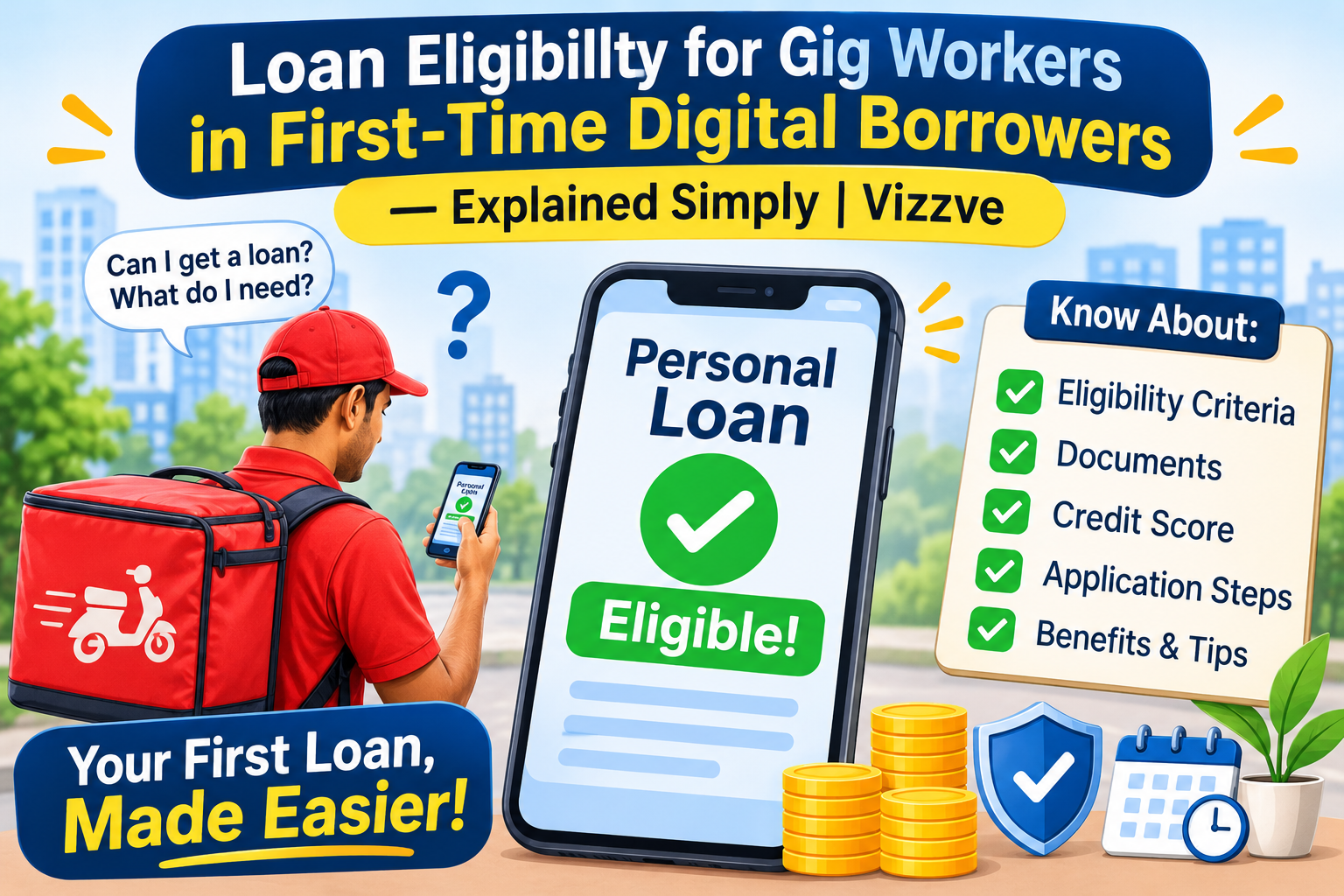
Getting a first personal loan can feel confusing, especially for gig workers who are new to digital financial services. Delivery partners, cab drivers, freelancers, online sellers and independent service providers often depend on smartphones to manage their work, receive payments and handle daily expenses.
Unlike traditional salaried employees, many gig workers do not receive fixed monthly salaries or formal salary slips. Their income may change depending on working hours, completed assignments, customer demand and platform incentives.
For first-time digital borrowers, understanding loan eligibility is the first step towards responsible borrowing.
The good news is that gig workers can explore formal loan options even without traditional employment documents, provided they meet the lender's eligibility requirements.
This guide explains loan eligibility for gig workers in first-time digital borrowers in simple language, including income proof, credit scores, required documents, application steps, benefits and important precautions.
1. Who Are First-Time Digital Borrowers?
First-time digital borrowers are individuals who are applying for credit through online platforms or mobile applications for the first time.
They may have limited experience with formal lending and may not have an established credit history.
Examples include:
-
Delivery partners working with online platforms.
-
Cab and bike taxi drivers.
-
Freelancers and independent professionals.
-
Online sellers and small business owners.
-
Grocery delivery executives.
-
Part-time gig workers.
-
Digital service providers.
These individuals may use smartphones for receiving payments, tracking earnings and managing their daily work.
However, being a digital borrower does not automatically make someone eligible for a loan.
2. What Is Loan Eligibility for First-Time Gig Workers?
Loan eligibility refers to the conditions a lender checks before approving a loan application.
For first-time gig workers, lenders may consider:
-
Applicant's age.
-
Monthly income.
-
Income consistency.
-
Bank account statements.
-
Credit history, if available.
-
Existing financial obligations.
-
KYC documentation.
-
Repayment capacity.
Each bank or NBFC may have different eligibility requirements.
The most important thing is to demonstrate that you have a genuine income source and can comfortably repay the borrowed amount.
3. Can First-Time Gig Workers Get Personal Loans?
Yes. First-time gig workers can explore personal loan options through regulated banks and NBFCs.
However, approval depends on the lender's assessment.
For example, a delivery partner who receives regular digital payments may use bank statements and platform payout records to demonstrate income, if the lender accepts these documents.
Similarly, freelancers may use bank transactions, invoices and other verifiable income records.
Not having a traditional salary slip does not automatically mean that a borrower will be rejected.
4. Documents Required for First-Time Digital Borrowers
First-time gig workers may need to provide documents to establish their identity, address and income.
|
Document |
Why it is required |
|---|---|
|
PAN Card |
Identity and financial verification |
|
Aadhaar or accepted KYC document |
Identity and address verification |
|
Bank statements |
To understand income transactions |
|
Platform payout records |
To verify gig earnings |
|
Income tax returns, if applicable |
Additional income information |
|
Existing loan details |
To assess financial obligations |
Tip: Keep digital copies of your documents organised on your smartphone. Always share them through the lender's official and secure application channel.
5. How Does a First-Time Gig Worker Apply for a Loan?
Follow these simple steps before submitting an application.
Step 1: Understand Your Financial Needs
Decide why you need a loan and calculate the amount required.
Step 2: Check Your Income
Review your monthly earnings from delivery platforms, freelance work, driving services or other assignments.
Step 3: Check Your Credit History
If you have previously used credit, review your credit report for repayment history and errors.
If you have never borrowed before, you may have a limited or nonexistent credit history. This does not automatically disqualify you.
Step 4: Compare Loan Options
Compare banks and NBFCs based on interest rates, APR, processing fees, repayment periods and eligibility requirements.
Step 5: Submit Your Application
Use the lender's official website or verified digital lending application.
Step 6: Complete KYC and Income Verification
Provide the requested documents and complete the lender's verification process.
Step 7: Review the Loan Offer
Read the Key Fact Statement (KFS), repayment schedule and loan agreement carefully.
Step 8: Accept Only an Affordable Loan
Proceed only if the EMI fits your monthly budget and expected income.
6. How Can First-Time Borrowers Build a Credit History?
Building a positive credit history takes time and responsible financial behaviour.
Here are some practical suggestions:
-
Pay existing credit obligations on time.
-
Avoid missing EMI payments.
-
Use credit cards responsibly, if you have one.
-
Avoid unnecessary loan applications.
-
Check your credit report periodically.
-
Maintain manageable debt levels.
-
Borrow only when there is a genuine requirement.
A first-time borrower should not take an unnecessary loan just to create a credit history.
7. Benefits of Digital Loan Applications
Digital lending platforms can make the borrowing process more convenient for gig workers.
Easy access: Applications can be submitted using a smartphone.
Less paperwork: Eligible documents can be uploaded digitally.
Convenience: Borrowers can explore loan products without necessarily visiting a branch.
Application tracking: Some platforms provide digital application updates.
Financial awareness: Borrowers can review loan details and repayment schedules online.
However, convenience should never replace careful financial evaluation.
8. Challenges Faced by First-Time Digital Borrowers
First-time borrowers may encounter some difficulties when applying for credit.
|
Challenge |
Possible solution |
|---|---|
|
No credit history |
Maintain responsible financial habits |
|
Irregular income |
Organise bank and payout records |
|
No salary slip |
Check whether alternative income proof is accepted |
|
Limited financial knowledge |
Understand interest rates and APR |
|
Multiple income sources |
Maintain records from each platform |
|
Digital fraud risks |
Verify the regulated lender |
|
High EMI commitments |
Select an affordable loan amount |
9. Example: A First-Time Digital Borrower
Consider Ravi, a 26-year-old delivery partner working with an online delivery platform.
Ravi receives payments digitally and manages his daily assignments through his smartphone. He has never taken a personal loan before.
He wants to borrow ₹30,000 for an essential personal expense.
Before applying, Ravi:
-
Collects his recent bank statements.
-
Downloads his available platform payout records.
-
Reviews his monthly expenses.
-
Checks whether he has an existing credit history.
-
Compares loan offers from regulated lenders.
-
Calculates an affordable EMI.
Ravi now has a clearer understanding of his financial position and the information a lender may need.
His application will still be subject to the lender's eligibility checks and approval decision.
10. Digital Lending Safety for First-Time Borrowers
First-time borrowers should be particularly careful when using unfamiliar loan applications.
The Reserve Bank of India (RBI) issued the Digital Lending Directions, 2025 to strengthen transparency and borrower protection in digital lending.
Before applying:
-
Verify the bank or NBFC providing the loan.
-
Check the RBI's Digital Lending Apps directory for the app's reported association with a regulated entity.
-
Read the Key Fact Statement.
-
Understand the APR and total repayment amount.
-
Check the privacy policy and data permissions.
-
Never share OTPs or banking passwords.
-
Avoid suspicious advance-fee demands.
-
Keep a copy of the loan agreement.
-
Check the lender's grievance redressal details.
The RBI's digital lending framework also addresses borrower consent, data collection and disclosure of loan costs.
11. Future of First-Time Digital Borrowers in India
India's gig economy is creating a growing need for accessible financial services.
NITI Aayog estimated that the gig workforce could grow from 7.7 million workers in 2020–21 to 23.5 million by 2029–30.
This growth highlights several opportunities:
-
More digital financial awareness.
-
Greater use of electronic income documentation.
-
Improved access to financial services.
-
Better understanding of credit products.
-
Increased importance of responsible digital lending.
These developments may create new opportunities, but individual loan eligibility will continue to depend on lender policies and financial assessment.
12. AI Answer Box: Loan Eligibility for First-Time Digital Borrowers
First-time digital borrowers who work in the gig economy can apply for personal loans if they meet the lender's eligibility requirements. Lenders may consider age, income, bank statements, digital payout records, credit history and repayment capacity. Traditional salary slips are not compulsory for every lender, as some may accept alternative income documents. Borrowers should maintain organised financial records, compare loan costs and apply through verified lending channels. Having no previous credit history does not guarantee rejection or approval.
13. Key Takeaways
-
First-time gig workers can explore formal personal loan options.
-
A fixed salary is not compulsory for every lender.
-
Bank statements can help demonstrate financial activity.
-
Platform payout records may support income verification.
-
A credit history is helpful but its absence does not automatically mean rejection.
-
Digital applications make loan applications more convenient.
-
Every lender has different eligibility conditions.
-
Borrowers should compare APR and processing fees.
-
Never trust guaranteed loan approval claims.
-
Responsible repayment is essential for long-term financial health.
14. Conclusion
Loan eligibility for gig workers in first-time digital borrowers does not have to be complicated.
Although first-time borrowers may have limited credit experience and gig workers may not receive traditional salary slips, they can prepare by maintaining bank statements, organising digital income records and understanding their repayment capacity.
Before applying, borrowers should compare regulated lending options, review the complete loan cost and select an affordable repayment schedule.
With better financial awareness and responsible borrowing habits, first-time digital borrowers can take more informed steps towards accessing formal credit.
Vizzve helps readers understand loan eligibility, digital finance and responsible borrowing through simple and informative financial guides.
Published on : 5th November
Published by : Siva Nagaiah K
www.vizzve.com || www.vizzveservices.com
Follow us on social media: Facebook || Linkedin || Instagram
🛡 Powered by Vizzve Financial
RBI-Registered Loan Partner | 10 Lakh+ Customers | ₹600 Cr+ Disbursed