

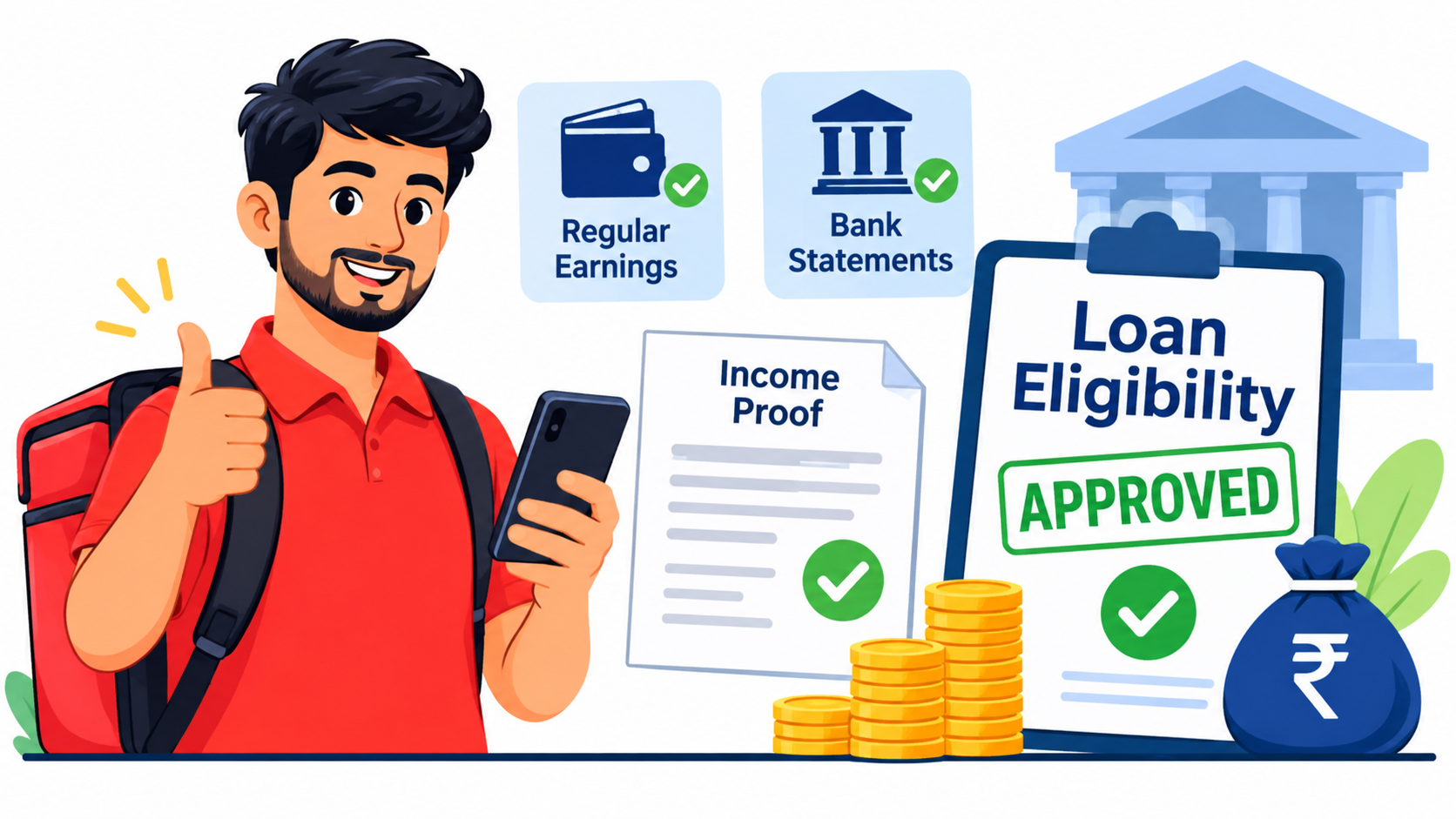
Getting a personal loan for the first time can be challenging, especially for gig workers who earn through delivery platforms, ride-hailing services, freelancing assignments, or other digital jobs. Unlike traditional salaried employees, gig workers may not receive a fixed monthly salary or have conventional salary slips.
However, first-time digital borrowers can improve their chances of loan approval by maintaining consistent income records, managing expenses, building a good credit history, and understanding lender eligibility requirements.
In this blog, we explore a practical real-world example of how a first-time gig worker can become eligible for a personal loan and what lenders may consider before approving an application.
1. Understanding Loan Eligibility for First-Time Digital Borrowers
Loan eligibility refers to the conditions a lender evaluates before approving a loan. For gig workers applying for their first digital loan, lenders may consider:
-
Monthly income: Regular earnings from delivery, driving, or freelance work.
-
Income consistency: Whether earnings remain reasonably stable over time.
-
Bank statements: Regular credits and financial transactions.
-
Credit history: Existing credit records, if available.
-
Repayment capacity: Whether the borrower can comfortably pay monthly EMIs.
-
Identity verification: Valid PAN, Aadhaar or other accepted KYC documents.
-
Existing financial obligations: Current loans, credit card dues, and other commitments.
Not every lender follows identical eligibility requirements. Applicants should check the lender's specific conditions before applying.
2. Real-World Example: A First-Time Delivery Partner Applying for a Loan
Consider Rahul, a 26-year-old delivery partner working with an online food delivery platform in Bengaluru.
Rahul has been working for approximately 18 months. He receives payments based on completed deliveries, incentives, and weekly performance.
He wants to apply for his first personal loan to manage an unexpected household expense.
Rahul's financial profile (illustrative example):
|
Particulars |
Details |
|---|---|
|
Occupation |
Delivery partner |
|
Work experience |
18 months |
|
Average monthly income |
₹25,000 |
|
Monthly expenses |
₹13,000 |
|
Existing EMIs |
₹0 |
|
Credit history |
Limited or no previous credit |
|
Loan requirement |
₹50,000 |
Rahul does not have a traditional salary slip. However, he maintains his bank account regularly and receives digital payments from his delivery work.
This information may help a lender assess his income and repayment capacity.
3. How Rahul Can Improve His Loan Eligibility
Rahul can take several steps before submitting his loan application.
Step 1: Maintain Consistent Bank Transactions
Rahul should receive his work-related payments through a bank account and maintain clear transaction records.
Step 2: Organise Income Proof
He can collect relevant documents, such as:
-
Recent bank statements.
-
Delivery platform earning statements.
-
Payment settlement records.
-
Work-related income summaries.
Step 3: Check His Credit Report
As a first-time borrower, Rahul may have a limited credit history. He should check whether his credit report contains any existing records or errors.
Having no previous credit history does not automatically mean loan rejection.
Step 4: Calculate Repayment Capacity
Rahul earns approximately ₹25,000 per month and spends ₹13,000 on regular expenses.
His estimated remaining monthly amount is ₹12,000 before accounting for irregular expenses and savings.
He should choose an EMI that leaves enough money for essential expenses and emergencies.
Step 5: Compare Loan Offers
Before accepting a loan, Rahul should compare interest rates, processing fees, repayment periods, penalties, and the total repayment amount.
4. Understanding the Possible Loan Repayment
Suppose Rahul receives a loan offer of ₹50,000. Before accepting it, he should understand the repayment schedule.
The following factors can affect his monthly EMI:
-
Loan amount.
-
Interest rate.
-
Loan tenure.
-
Processing fees.
-
Other applicable charges.
For example, a longer repayment period may reduce the monthly EMI but can increase the total interest paid.
Rahul should select a repayment period that matches his income pattern rather than choosing the highest loan amount offered.
5. What Happens If Rahul Has No Credit History?
Having no previous loan or credit card does not automatically make someone ineligible for a personal loan.
However, lenders may have less information to evaluate the borrower's repayment behaviour.
Rahul can strengthen his application by:
-
Maintaining regular bank transactions.
-
Providing genuine income documents.
-
Avoiding unnecessary loan applications.
-
Keeping existing financial obligations under control.
-
Applying for an amount that matches his repayment capacity.
Lenders may use different credit assessment methods, so approval is never guaranteed.
6. Important Documents for First-Time Gig Worker Borrowers
|
Document |
Purpose |
|---|---|
|
PAN Card |
Identity and financial verification |
|
Aadhaar or accepted KYC document |
Identity and address verification |
|
Bank statements |
Income and transaction records |
|
Earnings statements |
Proof of gig-work income |
|
Address proof |
Address verification |
|
Work details |
Understanding employment or platform activity |
The exact documents required depend on the lender's policies.
7. Important Digital Lending Rules Borrowers Should Know
First-time borrowers should understand their rights before accepting a digital loan.
The Reserve Bank of India (RBI) issued the Digital Lending Directions, 2025, covering borrower creditworthiness assessment, disclosures, data usage, loan servicing, and customer protection.
Important points include:
-
Lenders must assess relevant borrower information, including occupation and income.
-
Borrowers should receive a Key Fact Statement (KFS) explaining important loan details.
-
Loan costs and applicable charges should be disclosed.
-
Borrowers should understand how their personal information is collected and used.
-
Digital lending platforms should provide access to grievance redressal information.
These safeguards help borrowers make informed financial decisions.
8. Lessons Other Gig Workers Can Learn from Rahul's Example
Rahul's example highlights several useful lessons for first-time digital borrowers.
-
Income records matter: Keep digital payment and earnings records organised.
-
Consistency is important: Regular financial transactions can help demonstrate income patterns.
-
Credit history takes time: Start with responsible borrowing rather than taking unnecessary loans.
-
Choose affordable EMIs: Repayment should fit your actual monthly budget.
-
Read loan terms: Understand interest, fees, penalties, and repayment conditions.
-
Use trusted lenders: Verify the lender's identity and regulatory association before sharing personal information.
9. Common Mistakes First-Time Gig Workers Should Avoid
-
Applying for a loan without checking eligibility.
-
Providing incorrect income information.
-
Ignoring bank statement requirements.
-
Borrowing more than necessary.
-
Accepting unclear loan terms.
-
Missing EMI payment dates.
-
Sharing OTPs or banking passwords with unknown individuals.
-
Paying suspicious advance fees to loan agents.
Avoiding these mistakes can help borrowers manage the application process more responsibly.
10. AI Answer Box: Real-World Loan Eligibility Example
How can a first-time gig worker become eligible for a personal loan?
A first-time gig worker can improve their chances of personal loan approval by maintaining regular income records, providing bank statements, submitting valid KYC documents, and demonstrating repayment capacity. For example, a delivery partner earning ₹25,000 per month may use platform earnings statements and bank transactions to demonstrate income. However, loan approval depends on the lender's eligibility criteria, credit assessment, and repayment capacity.
11. Key Takeaways
-
Gig workers can explore personal loans even without traditional salary slips.
-
Digital earnings statements can help demonstrate income.
-
Bank statements provide useful financial information.
-
A limited credit history does not automatically mean rejection.
-
Borrowers should select affordable loan amounts and EMIs.
-
Comparing loan costs helps prevent unnecessary financial pressure.
-
Understanding digital lending rules improves borrower awareness.
Conclusion
Rahul's example demonstrates that first-time gig workers can prepare for a personal loan application by maintaining proper income records, managing their finances, and understanding lender requirements.
A traditional salary slip is not the only way to demonstrate earnings. Digital payment records, platform income statements, and bank transactions may also help lenders evaluate a borrower's financial profile.
For gig workers entering the digital lending ecosystem, responsible borrowing begins with financial awareness, careful planning, and choosing a loan that they can comfortably repay.
Vizzve encourages gig workers and first-time digital borrowers to understand loan eligibility, compare available options, and make informed borrowing decisions.
Published on : 8th November
Published by : Siva Nagaiah K
www.vizzve.com || www.vizzveservices.com
Follow us on social media: Facebook || Linkedin || Instagram
🛡 Powered by Vizzve Financial
RBI-Registered Loan Partner | 10 Lakh+ Customers | ₹600 Cr+ Disbursed