

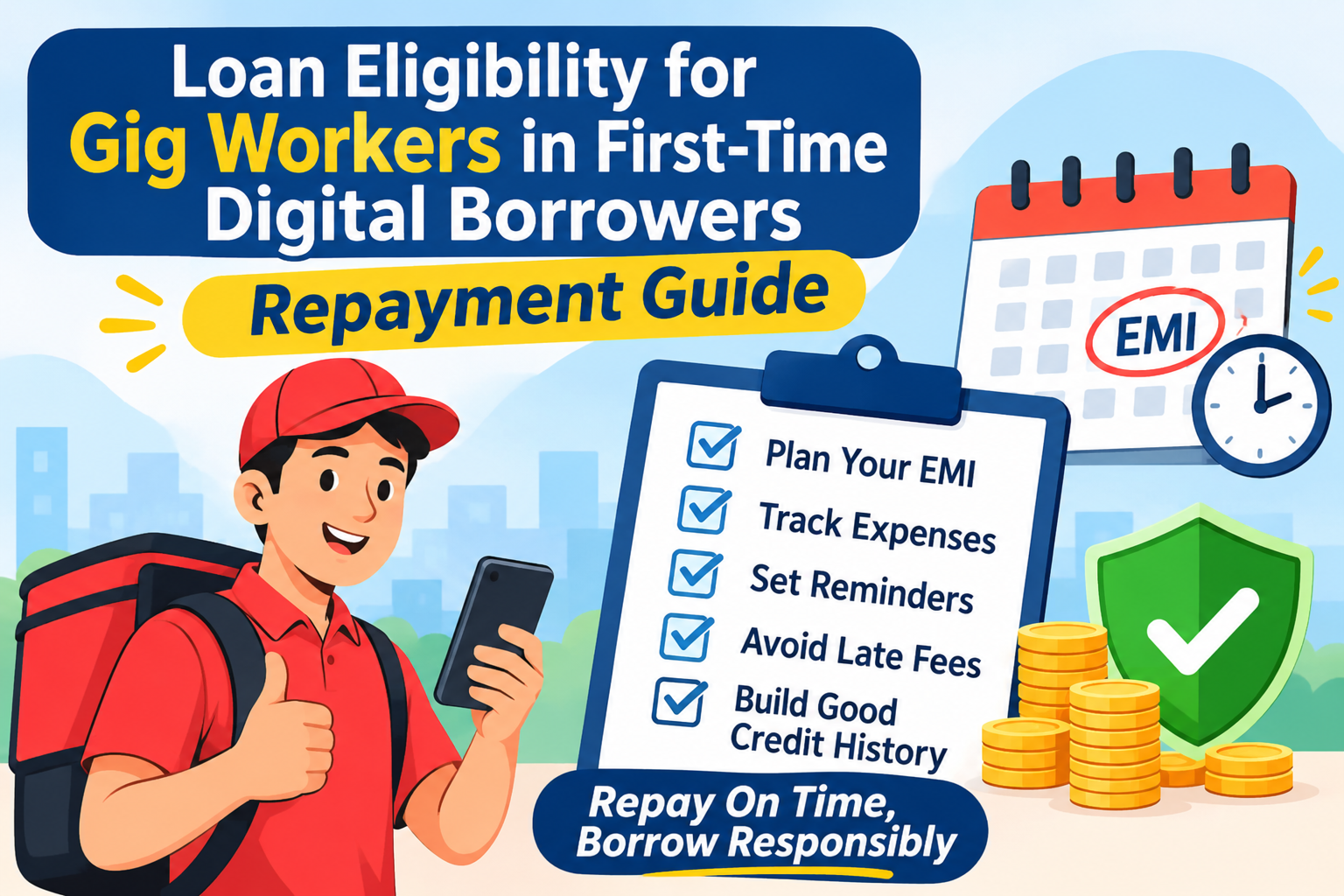
For gig workers and first-time digital borrowers, taking a loan can help manage financial emergencies, personal expenses, and unexpected income gaps. However, repaying a loan on time is just as important as getting loan approval.
Unlike salaried employees, gig workers often receive income from multiple platforms, and their earnings may change from week to week. Therefore, having a proper repayment plan can help borrowers avoid missed payments, additional charges, and unnecessary financial stress.
This guide explains how first-time digital borrowers can manage loan repayments, plan their budgets, maintain a healthy credit history, and borrow responsibly.
1. What Is Loan Repayment?
Loan repayment is the process of returning borrowed money to the lender within the agreed period.
A typical loan repayment includes:
-
Principal Amount: The original amount borrowed.
-
Interest: The cost charged for borrowing money.
-
EMI: Equated Monthly Instalment paid towards the loan.
-
Repayment Tenure: The total time allowed to repay the loan.
-
Late Payment Charges: Additional charges that may apply when payments are delayed, as specified in the loan agreement.
Understanding these terms helps first-time borrowers make better financial decisions.
2. Why Repayment Planning Is Important for Gig Workers
Gig workers may earn through food delivery, ride-sharing, freelance projects, online services, and other platform-based activities.
Since their monthly income may not always be fixed, repayment planning becomes especially important.
Key benefits of repayment planning:
-
Helps avoid missed EMI payments.
-
Reduces the risk of additional charges.
-
Supports a healthy credit repayment history.
-
Makes monthly budgeting easier.
-
Helps prevent unnecessary borrowing.
-
Improves long-term financial discipline.
3. How First-Time Digital Borrowers Can Plan Loan Repayments
Follow these practical steps before and after taking a loan.
Step 1: Calculate Your Average Monthly Income
Check your earnings from all gig platforms and freelance activities.
Consider your average income over the previous three to six months rather than depending on your highest-earning month.
Step 2: Understand Your Monthly Expenses
Prepare a list of essential expenses, including:
-
House rent and electricity bills.
-
Food and groceries.
-
Fuel and vehicle maintenance.
-
Mobile and internet bills.
-
Medical and emergency expenses.
-
Existing loan repayments.
Step 3: Choose an Affordable EMI
Select an EMI that you can comfortably afford even during months when your income is lower.
Do not choose a loan only because the lender offers a higher loan amount.
Step 4: Check the Interest Rate and Loan Charges
Before accepting a loan, review:
-
Interest rate.
-
Annual Percentage Rate (APR).
-
Processing fees.
-
Applicable late payment charges.
-
Repayment schedule.
-
Prepayment and foreclosure conditions.
Step 5: Set a Repayment Reminder
Use mobile reminders, calendar alerts, or banking notifications to remember upcoming EMI dates.
Step 6: Keep Sufficient Money in Your Bank Account
Maintain enough balance before the scheduled repayment date, especially if your EMI is collected through an automatic payment facility.
4. Best Repayment Strategies for Gig Workers
A. Follow a Weekly Budget
Divide your monthly income into weekly budgets. This helps gig workers manage irregular earnings without spending their entire income immediately.
B. Maintain an EMI Reserve
Keep a separate amount for upcoming loan repayments. Avoid using this money for shopping or unnecessary expenses.
C. Save During High-Income Periods
When you earn more during busy seasons or weekends, reserve a portion of the additional income for future repayments and emergencies.
D. Avoid Taking Multiple Loans
Taking several loans to manage existing EMIs can create a debt cycle. Evaluate your repayment capacity before applying for another loan.
E. Pay on or Before the Due Date
Timely repayments help maintain a positive repayment history and reduce the possibility of late payment charges.
5. Example of a Monthly Repayment Plan
Consider a gig worker who earns an average of ₹25,000 per month.
Illustrative monthly budget, not a recommended borrowing limit.
|
Expense category |
Monthly amount |
|---|---|
|
Monthly income |
₹25,000 |
|
Household expenses |
₹9,000 |
|
Food and travel |
₹4,000 |
|
Vehicle expenses |
₹2,000 |
|
EMI repayment |
₹3,000 |
|
Emergency savings |
₹2,000 |
|
Other expenses |
₹5,000 |
|
Total expenses |
₹25,000 |
This example shows why borrowers should calculate their essential expenses before selecting an EMI. Actual affordability depends on income stability, existing debts, and personal responsibilities.
6. What Happens If You Miss an EMI Payment?
Missing an EMI payment can create financial difficulties.
Some possible consequences include:
-
Late payment charges as per the loan agreement.
-
Additional financial pressure in the following month.
-
Negative reporting of repayment delays to credit bureaus, where applicable.
-
Difficulty managing future borrowing requirements.
-
Increased outstanding dues.
What should you do if you cannot pay an EMI?
-
Contact your lender as early as possible.
-
Explain your financial situation honestly.
-
Ask whether any repayment assistance or restructuring option is available.
-
Understand the charges and consequences before accepting a revised repayment arrangement.
-
Keep records of all communications and payments.
Avoid ignoring calls or messages from your lender.
7. How Can First-Time Borrowers Maintain a Good Credit History?
Your repayment behaviour can influence your credit profile.
Follow these practices:
-
Pay all EMIs on time.
-
Avoid frequent loan applications.
-
Do not borrow more than you can repay.
-
Check your credit report periodically.
-
Maintain a record of loan repayments.
-
Avoid defaulting on existing credit obligations.
-
Clear outstanding dues according to the loan agreement.
Remember that timely repayment supports a healthy credit history, but it does not guarantee future loan approval.
8. Important RBI Guidelines for Digital Loan Repayment
First-time digital borrowers should understand their rights before accepting a loan.
According to the Reserve Bank of India's Digital Lending Directions, 2025:
-
Lenders must provide borrowers with a Key Facts Statement (KFS).
-
The Annual Percentage Rate (APR) must be disclosed.
-
Loan terms and applicable charges should be communicated transparently.
-
Digital loan repayments should generally flow directly between the borrower's bank account and the regulated lender's bank account.
-
Borrowers must receive information about the grievance redressal mechanism.
-
A cooling-off period must be provided under applicable digital lending requirements.
Always read the loan agreement and KFS before accepting a digital loan.
For more details, visit the RBI Digital Lending Directions, 2025.
9. Common Loan Repayment Mistakes to Avoid
|
Common mistake |
Better practice |
|---|---|
|
Choosing a high EMI |
Select an affordable EMI |
|
Ignoring due dates |
Set payment reminders |
|
Spending EMI savings |
Maintain a separate EMI reserve |
|
Taking multiple loans |
Review existing debt first |
|
Ignoring loan charges |
Read the KFS carefully |
|
Depending on one good earning month |
Calculate average income |
|
Ignoring repayment notifications |
Contact the lender promptly |
10. Practical Repayment Checklist for Gig Workers
Use this checklist before and during your loan repayment journey.
11. How Vizzve Can Support Digital Borrowers
Vizzve focuses on helping borrowers understand digital financial services and loan-related information.
For gig workers and first-time digital borrowers, understanding loan eligibility, repayment schedules, interest rates, and responsible borrowing practices is important before applying.
Borrowers should always:
-
Review the loan terms carefully.
-
Understand their repayment responsibilities.
-
Verify the lender's credentials.
-
Compare available loan options.
-
Borrow according to their repayment capacity.
A responsible borrowing decision starts with understanding both loan eligibility and repayment obligations.
12. Key Takeaways
-
Loan repayment planning is essential for gig workers with irregular incomes.
-
First-time digital borrowers should understand EMI, APR, and repayment tenure.
-
Maintaining an EMI reserve can help prevent missed payments.
-
Borrowers should avoid taking multiple loans unnecessarily.
-
Timely repayments can support a healthy credit history.
-
Reading the KFS and loan agreement helps prevent unexpected costs.
-
Responsible borrowing improves financial discipline.
13. Frequently Asked Questions (FAQs)
1. How can gig workers repay loans on time?
Gig workers can repay loans on time by preparing a monthly budget, keeping money aside for EMIs, and setting payment reminders.
2. Can first-time digital borrowers get loans without a fixed salary?
Yes. Some lenders consider alternative income evidence, bank statements, and gig earnings instead of relying only on a fixed monthly salary.
3. What is the best repayment method for gig workers?
A planned EMI schedule with a separate repayment reserve is a practical approach for workers with irregular income.
4. What happens if I miss my loan EMI?
You may face late payment charges and negative credit reporting, depending on the loan terms and applicable reporting rules.
5. How much of my income should I spend on loan repayment?
There is no universal percentage. Your EMI should fit comfortably within your income after essential expenses and existing financial commitments.
6. Can gig workers repay loans before the due date?
Early repayment may be possible depending on the loan agreement and applicable rules. Check the lender's prepayment conditions.
7. Does timely EMI payment improve my credit score?
Timely repayment can contribute positively to your credit history and credit score, although other credit-related factors also matter.
8. How can first-time borrowers avoid repayment problems?
Understand the loan terms, select an affordable EMI, maintain savings, and avoid unnecessary borrowing.
9. What is an EMI reserve?
An EMI reserve is money kept separately to cover upcoming loan instalments.
10. Can delivery partners apply for digital loans?
Eligibility depends on the lender's requirements, income assessment, credit profile, and other applicable conditions.
11. Why should gig workers check their loan repayment schedule?
It helps them understand payment dates, instalment amounts, interest costs, and the total repayment period.
12. What is APR in digital lending?
APR represents the annualised cost of borrowing, including interest and applicable charges covered under the APR calculation.
13. What should I do if my gig income decreases?
Contact your lender immediately and discuss available repayment assistance options instead of ignoring upcoming payments.
14. Can multiple loan applications affect my credit profile?
Multiple credit applications within a short period may result in hard enquiries and can affect your credit profile.
15. Is digital loan repayment safe?
It can be safe when borrowers use verified lender channels, follow the official repayment instructions, and avoid transferring money to unauthorised individuals.
14. Conclusion
Loan repayment is an important part of financial management for gig workers and first-time digital borrowers. Since gig income can fluctuate, borrowers should carefully plan their expenses, maintain an emergency fund, and choose repayment schedules that match their earning capacity.
Understanding EMI, interest rates, APR, and repayment conditions can help borrowers make informed financial decisions. Most importantly, responsible borrowing and timely repayments can support long-term financial stability.
With the right repayment strategy, gig workers can manage their loans more confidently and build better financial habits.
Published on : 11th November
Published by : Siva Nagaiah K
www.vizzve.com || www.vizzveservices.com
Follow us on social media: Facebook || Linkedin || Instagram
🛡 Powered by Vizzve Financial
RBI-Registered Loan Partner | 10 Lakh+ Customers | ₹600 Cr+ Disbursed