

Introduction
India's employment landscape is changing rapidly. Many people are earning through digital platforms, freelance projects, independent assignments and flexible work arrangements rather than traditional full-time employment.
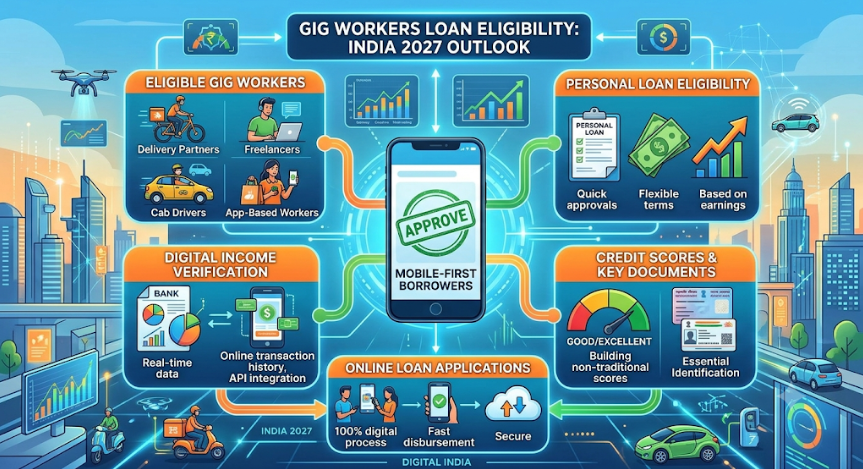
Delivery partners, cab drivers, freelance designers, digital marketers, online tutors and independent service providers are important participants in this changing workforce.
However, getting a personal loan can sometimes be challenging for these workers. Their income may be regular over time, but they may not receive a fixed monthly salary or conventional salary slips.
For example, a delivery partner may receive payments every week, while a freelancer may earn different amounts from multiple clients. A cab driver may have higher earnings during busy periods and lower earnings during quieter months.
This raises an important question:
Will gig workers find it easier to qualify for personal loans in India in 2027?
The outlook may be encouraging. Digital income records, electronic payments, improved credit information and alternative documentation can give lenders more ways to understand a borrower's financial position.
However, these developments do not guarantee approval. Banks and NBFCs will continue to evaluate income, existing EMIs, credit history, repayment capacity and their own lending policies.
This guide explains the 2027 outlook, loan eligibility conditions, required documents, mobile-based applications and practical ways gig workers can prepare for a personal loan.
3. AI Answer Box: What Is the 2027 Outlook for Gig Worker Loan Eligibility?
Gig workers in India may have more opportunities to demonstrate their income digitally in 2027. Some lenders may consider bank statements, platform earning reports, invoices, payment records and other accepted financial documents instead of relying only on traditional salary slips.
Loan eligibility will still depend on verified income, credit history, existing EMIs, repayment capacity and lender-specific requirements.
Quick answer: Gig workers may qualify for personal loans without conventional salary slips if a lender accepts their alternative income documents and they satisfy its eligibility conditions. There is no guaranteed loan approval or universal eligibility rule for all gig workers.
4. Who Are Mobile-First Gig Workers?
Mobile-first gig workers are individuals who use smartphones and digital platforms to find work, complete assignments, receive payments and manage their earnings.
They may work independently, through online platforms or with multiple clients.
Common examples of mobile-first gig workers
-
Food delivery partners
-
Grocery and parcel delivery executives
-
Cab and bike taxi drivers
-
Freelance graphic designers
-
Digital marketing professionals
-
Online tutors
-
Independent consultants
-
Home-service professionals
-
Freelance writers
-
Part-time service providers
-
Independent sales professionals
Why are mobile-first borrowers different?
Traditional salaried employees generally receive monthly salary credits and may have salary slips or employment letters.
Gig workers may receive multiple small payments, weekly settlements or project-based earnings.
For this reason, lenders may need to examine several months of financial information to understand the borrower's average income and its consistency.
5. Why Is Gig Worker Loan Eligibility Important in 2027?
As flexible employment develops, lenders need to understand different income structures.
A person should not automatically be considered financially unstable simply because they do not receive a conventional salary. At the same time, lenders must verify whether the person's earnings are sufficient to support regular repayments.
Five important reasons
1. Changing employment patterns
More people are working through independent assignments, platform-based services and freelance arrangements.
2. Growth of digital payments
Electronic payment records may help workers demonstrate where their income comes from.
3. Demand for convenient loan applications
Mobile-first borrowers often prefer online applications that reduce unnecessary paperwork and branch visits.
4. Better financial information
More frequent credit information updates can help lenders access more current information about borrowers.
5. Financial inclusion
Suitable assessment methods may help lenders evaluate applicants who do not fit traditional salary-based categories.
6. What Could Change for Gig Worker Loan Eligibility in 2027?
The following are potential developments to watch. They are not guaranteed changes across every bank, NBFC or lending application.
| Expected development | Possible benefit | Important limitation |
|---|---|---|
| Digital income verification | Easier submission of earning records | Lender must accept the documents |
| Better financial data analysis | More detailed income assessment | Information must be accurate |
| Automated underwriting | Potentially faster processing | Some cases still need manual review |
| More frequent credit updates | More current credit records | No automatic loan approval |
| Mobile-first applications | Convenient application process | KYC and verification remain necessary |
| Alternative income documentation | Broader assessment possibilities | Acceptance varies by lender |
6.1 Digital income verification
Lenders may increasingly use electronic records to understand how gig workers earn money.
Depending on their policies, they may accept:
-
Platform earning statements
-
Bank statements
-
Client invoices
-
Payment settlement reports
-
Business transaction records
-
Income tax returns
These documents must be genuine, relevant and verifiable.
6.2 More flexible income assessment
A traditional salary-based assessment may focus on fixed monthly earnings.
For gig workers, lenders may need to examine average income over several months and account for fluctuations.
For example, a delivery partner may earn more during festive seasons and less during quieter periods. Looking only at the highest earning month may give an unrealistic picture of repayment capacity.
6.3 Improved mobile-based applications
Online applications may make it easier to enter personal information, complete KYC, submit documents and receive updates.
However, a fully digital application does not mean automatic approval or guaranteed instant disbursal.
7. What Are the Eligibility Criteria for Gig Workers in India?
There is no single eligibility formula for all gig worker personal loans.
Each bank or NBFC sets its own conditions based on the loan product, applicant profile and applicable regulations.
7.1 Age requirement
Lenders specify minimum and maximum age limits for personal loan applicants.
The permitted age range varies depending on the financial institution and loan product.
7.2 Verified monthly income
Applicants should be able to demonstrate a genuine and reasonably consistent source of earnings.
Lenders may examine:
-
Average monthly income
-
Frequency of payments
-
Source of income
-
Recent income fluctuations
-
Bank account activity
-
Existing financial commitments
7.3 Credit score and repayment history
Credit history helps lenders understand how an applicant has managed previous borrowing.
They may consider:
-
Previous loan repayment records
-
Credit card payment history
-
Outstanding loan balances
-
Credit utilisation
-
Recent credit enquiries
-
Reported defaults or overdue accounts
A good credit score may support an application, but it does not guarantee approval.
7.4 Existing EMIs
Existing loan repayments reduce the income available for a new EMI.
A borrower with several active loans may qualify for a lower loan amount or may not meet the lender's repayment-capacity requirements.
7.5 Work continuity
Lenders may examine how long the applicant has been working and whether earnings are reasonably consistent.
The required work history differs between lenders.
7.6 Bank account activity
Bank statements can help establish the movement and source of income.
Lenders may review incoming payments, regular expenses, existing loan deductions and account activity.
8. Documents Required for Gig Worker Loans in 2027
Gig workers may not have conventional salary slips. Depending on the lender, alternative documents may be accepted to demonstrate income.
| Document | Purpose |
|---|---|
| PAN card | Identity and financial verification |
| Accepted identity proof | Identity verification |
| Address proof | Address verification |
| Bank statements | Income and transaction assessment |
| Platform earnings statement | Evidence of platform-based income |
| Payment settlement records | Evidence of received earnings |
| Freelance invoices | Evidence of client work |
| Contracts or work orders | Evidence of professional assignments |
| Income tax returns | Supporting income documentation |
| Existing loan details | Assessment of current debt obligations |
Can gig workers apply without salary slips?
Yes. Some lenders may accept alternative income documents instead of salary slips.
For example:
-
A delivery partner may submit platform earning statements and bank records.
-
A freelancer may provide invoices and client payment records.
-
A cab driver may provide ride earnings reports and bank statements.
-
An independent service provider may submit customer receipts and business records.
However, the acceptance of these documents depends on the lending institution.
Applicants should confirm the required documents directly with the bank or NBFC before applying.
9. Loan Eligibility for Different Types of Gig Workers
Different occupations have different income patterns. A suitable loan assessment may need to consider these differences.
9.1 Delivery partners
Delivery partners may receive payments based on completed orders, incentives and platform settlements.
Possible income records:
-
Monthly or weekly earning statements
-
Platform payment reports
-
Bank statements showing settlements
-
Other accepted financial records
9.2 Cab and bike taxi drivers
Drivers may earn through completed rides, incentives and other transport-related services.
Possible income records:
-
Ride earnings summaries
-
Platform settlement reports
-
Bank statements
-
Accepted business documents, where required
9.3 Freelancers
Freelancers may receive income from multiple clients and projects.
Possible income records:
-
Client invoices
-
Bank statements
-
Contracts
-
Payment receipts
-
Income tax returns
9.4 Independent service providers
Technicians, tutors, beauty professionals and repair specialists may receive direct customer payments or platform-based earnings.
Possible income records:
-
Digital payment statements
-
Customer invoices
-
Bank transaction records
-
Business income documents
10. How Do Lenders Calculate Gig Worker Loan Eligibility?
Lenders generally assess the applicant's verified income, financial obligations and ability to repay.
A simplified assessment may involve:
-
Average verified monthly income.
-
Existing loan EMIs.
-
Essential expenses and other financial commitments.
-
Credit history.
-
Proposed loan tenure.
-
Interest rate and expected EMI.
-
Lender-specific eligibility conditions.
Example: Understanding repayment capacity
Suppose a gig worker has the following monthly financial details:
| Financial details | Amount |
|---|---|
| Average monthly income | ₹40,000 |
| Existing loan EMIs | ₹6,000 |
| Essential monthly expenses | ₹20,000 |
| Remaining amount before a new EMI | ₹14,000 |
The remaining ₹14,000 should not automatically be treated as available EMI capacity.
The borrower should also consider income fluctuations, emergencies, vehicle maintenance and unexpected expenses.
Important: This is an illustrative household-budget calculation, not an official lender eligibility formula or loan approval estimate.
11. The Role of AI and Digital Lending in Gig Worker Loans
Artificial intelligence and digital lending technology may influence how lenders assess applications in 2027.
These technologies can help analyse information and identify patterns, but they should operate within appropriate regulatory and risk-management controls.
| Technology | Possible application |
|---|---|
| Income pattern analysis | Reviewing income consistency |
| Automated document checks | Identifying incomplete or inconsistent records |
| Credit risk models | Supporting repayment-risk assessment |
| Fraud detection | Flagging suspicious application activity |
| Digital underwriting | Supporting faster application processing |
| Financial data analysis | Reviewing permitted financial information |
Will AI automatically approve gig worker loans?
No. AI may support the assessment process, but the lending institution remains responsible for its credit decision.
An application may still be rejected if income cannot be verified, existing debt is too high or the applicant does not meet the lender's requirements.
12. RBI Digital Lending Rules: What Mobile-First Borrowers Should Know
The Reserve Bank of India issued the Reserve Bank of India (Digital Lending) Directions, 2025 on May 8, 2025.
These directions apply to digital lending activities of specified RBI-regulated entities, including banks and NBFCs.
Important areas include:
-
Borrower creditworthiness assessment
-
Loan disclosures
-
Key Facts Statement requirements
-
Loan disbursal and repayment arrangements
-
Cooling-off requirements
-
Grievance redressal
-
Collection and use of borrower data
-
Data storage and privacy requirements
Why do these rules matter to gig workers?
Gig workers applying through digital platforms should understand that a mobile application is not necessarily the actual lender.
Before accepting an offer:
-
Identify the bank or NBFC providing the loan.
-
Check the lender's official website.
-
Read the Key Facts Statement.
-
Review the interest rate and APR.
-
Understand applicable fees and charges.
-
Check the grievance redressal process.
-
Review the privacy policy and data permissions.
A genuine digital lending process should provide clear loan information and appropriate borrower protections.
13. How Can Credit Information Reporting Affect Gig Workers in 2027?
Credit information is an important part of personal loan assessment.
RBI's credit information reporting framework has moved towards more frequent reporting. Under the framework effective from July 1, 2026, applicable credit institutions submit information based on reference dates of the 9th, 16th, 23rd and last day of each month.
What does this mean for borrowers?
-
Credit records may reflect account changes more frequently.
-
Lenders may access more current credit information.
-
Recent repayments and outstanding obligations may become visible sooner, subject to reporting and processing timelines.
-
Borrowers should continue checking their credit reports for errors.
More frequent reporting does not automatically increase a credit score or guarantee loan approval.
14. Social Security Developments and the Gig Economy
The Code on Social Security, 2020 includes provisions relating to gig workers and platform workers.
The Code came into force on November 21, 2025. The Social Security (Central) Rules, 2026, notified in May 2026, provide further implementation details relating to worker registration and social security arrangements.
How could this affect gig workers?
The broader social security framework may support formal recognition and access to applicable welfare measures.
Potential areas include:
-
Social security registration
-
Accident-related protection
-
Health and other welfare schemes
-
Improved worker-related records
-
Greater formal recognition of platform-based work
Does social security registration guarantee a personal loan?
No.
Social security benefits and personal loan eligibility are separate matters.
Registration may help establish a worker's identity within an applicable welfare framework, but it does not automatically establish income eligibility, improve a credit score or guarantee loan approval.
15. Mobile-First Loan Application Process for Gig Workers
A mobile phone can help gig workers submit applications and manage documents without visiting a branch for every step.
Step-by-step application guide
Step 1: Identify the actual lender
Choose a bank or NBFC and verify the digital platform through its official website.
Step 2: Check eligibility conditions
Review age, income, credit history and accepted documentation requirements.
Step 3: Organise income documents
Prepare recent bank statements, platform earning reports, invoices and other accepted records.
Step 4: Complete the application
Enter accurate personal, occupation and income details.
Step 5: Complete KYC
Follow the lender's official identity verification process.
Step 6: Submit income evidence
Upload only the requested documents through the lender's official and secure channel.
Step 7: Review the loan offer
Check the loan amount, interest rate, APR, EMI, tenure and charges.
Step 8: Read the agreement
Review the Key Facts Statement and loan agreement before accepting.
Step 9: Save your records
Keep copies of the sanction letter, loan agreement, repayment schedule and payment receipts.
16. How Can Gig Workers Improve Their Loan Eligibility in 2027?
Borrowers can take practical steps to make their financial position easier for lenders to assess.
1. Maintain clear bank records
Where practical, receive work-related payments into a consistent bank account.
2. Download platform earning statements
Save monthly or weekly reports from the platforms through which you work.
3. Maintain accurate income details
Do not overstate monthly earnings. Use realistic figures based on documented income.
4. Pay existing EMIs on time
Consistent repayment behaviour can support a healthy credit profile.
5. Reduce unnecessary borrowing
Avoid taking multiple loans simply to meet short-term expenses.
6. Check your credit report
Review reported accounts, outstanding balances and repayment records. Dispute inaccurate information through the appropriate channels.
7. Prepare for income fluctuations
Calculate affordability using an average or lower-income month rather than assuming every month will be equally profitable.
8. Compare loan costs
Review APR, processing charges, applicable taxes, EMI and total repayment before accepting an offer.
17. Common Mistakes Mobile-First Borrowers Should Avoid
| Mistake | Why it is risky | Better approach |
|---|---|---|
| Reporting inflated income | Can lead to verification problems | Provide realistic documented earnings |
| Uploading unclear screenshots | May delay verification | Submit clear official records |
| Ignoring existing EMIs | Can lead to poor affordability decisions | Disclose existing debt |
| Applying through unknown apps | May expose personal information | Verify the actual lender |
| Sharing OTPs or PINs | Can lead to financial fraud | Never disclose confidential credentials |
| Accepting the highest available amount | Can increase repayment stress | Borrow only what is necessary |
| Ignoring APR | Can hide the overall cost | Compare total borrowing costs |
18. Pros and Cons of Digital Personal Loans for Gig Workers
| Potential advantages | Potential disadvantages |
|---|---|
| Convenient online applications | Approval is not guaranteed |
| Less dependence on physical paperwork in some cases | Document requirements vary |
| May support alternative income verification | Not all lenders accept alternative documents |
| Faster processing for some applications | Verification can still take time |
| Easier access to loan information | Fake loan applications remain a concern |
| Can support planned financial needs | Interest and fees increase borrowing costs |
Digital lending can improve convenience, but borrowers should not sacrifice safety or affordability for speed.
19. Real-World Examples: How Gig Workers May Be Assessed in 2027
The following are illustrative situations, not actual customer cases or lender approval decisions.
Example 1: Food delivery partner
A delivery partner receives weekly payments from a platform and maintains bank statements and monthly earning reports.
A lender that accepts these documents may review average earnings, income consistency and existing financial obligations.
Example 2: Freelance digital marketer
A freelance digital marketer works with several clients and receives payments on different dates.
Invoices, client contracts and bank records may help demonstrate the source of income if the lender accepts these documents.
Example 3: App-based cab driver
A cab driver receives ride payments and incentives. The lender may review platform earnings summaries and bank transactions to understand the worker's income pattern.
In every case, approval depends on the lender's verification, eligibility criteria and credit policy.
20. Expert Perspective: What Should Responsible Gig Worker Lending Focus On?
A responsible lending process should recognise that a gig worker's income structure may differ from that of a salaried employee.
The absence of a salary slip should not automatically be treated as proof of an inability to repay. At the same time, digital income records should not be accepted without appropriate verification.
Three factors are especially important:
Verified income: The lender should understand the source, frequency and consistency of earnings.
Realistic repayment capacity: The proposed EMI should remain affordable after existing debt and essential expenses.
Transparent loan terms: Borrowers should understand the total cost, repayment schedule, applicable charges and complaint process.
Technology can support these goals, but it cannot replace sound credit assessment or responsible lending practices.
21. Vizzve Financial: Explore Personal Loan Options
Gig workers and mobile-first borrowers should understand their eligibility, maintain clear income records and compare loan terms before applying for a personal loan.
Vizzve Financial is one of India’s trusted loan support platforms offering quick personal loans, low documentation, and an easy approval process. Apply at www.vizzve.com.
Published on : 15th November
Published by : Reddy kumar
www.vizzve.com || www.vizzveservices.com
Follow us on social media: Facebook || Linkedin || Instagram
🛡 Powered by Vizzve Financial
RBI-Registered Loan Partner | 10 Lakh+ Customers | ₹600 Cr+ Disbursed