

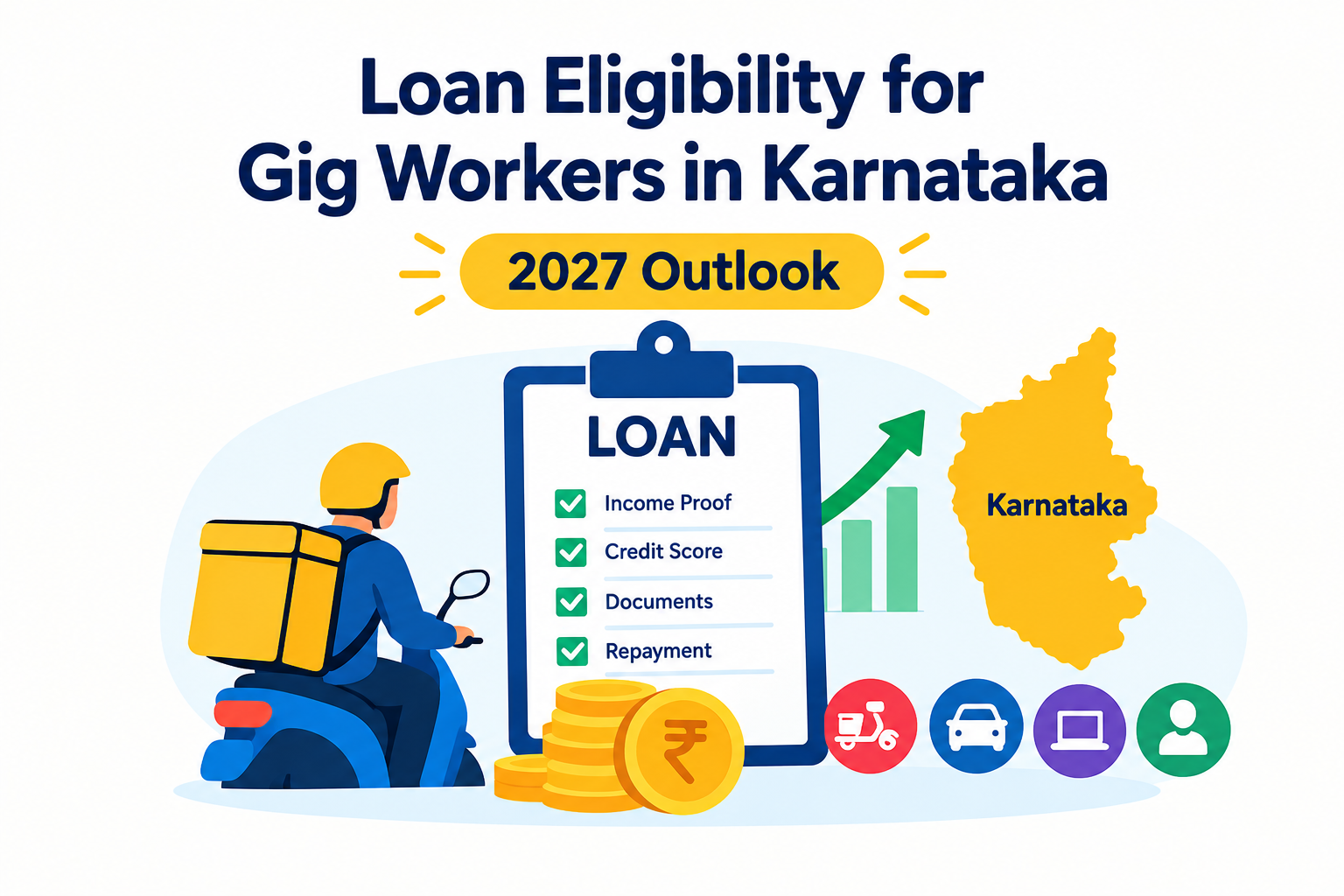
Gig work has become an important source of income for delivery partners, drivers, freelancers, online service providers, independent professionals and other platform workers.
For many gig workers, income does not arrive in the same way as a conventional salaried employee's monthly salary. Earnings can vary according to working hours, demand, incentives, platform activity, seasonality and the number of platforms used.
This creates an important question:
Will gig workers in Karnataka find it easier to qualify for loans in 2027?
The answer will depend on how lenders assess variable income, how borrowers maintain their financial records and how lending technology develops.
There is no universal 2027 eligibility rule that guarantees approval for gig workers. Each lender can apply its own underwriting policies, subject to applicable regulations.
However, several trends suggest that better financial documentation, digital transaction records and responsible credit behaviour could become increasingly important.
What Does Loan Eligibility Mean for a Gig Worker?
Loan eligibility refers to the factors a lender considers before deciding whether an applicant qualifies for credit.
For a gig worker, these factors may include:
- Age and basic applicant information
- Income and income stability
- Bank-account transactions
- Credit history and repayment behaviour
- Existing EMIs and debts
- Work or platform history
- Residence and employment details
- Required identity and address documents
- Lender-specific minimum income requirements
- Loan amount requested
- Repayment capacity
The exact requirements can differ considerably between lenders.
A gig worker should therefore avoid assuming that one lender's criteria apply to every lender.
2027 Outlook: What Could Change?
The 2027 lending environment could become more digitally driven, but that does not mean every gig worker will automatically receive easier access to loans.
The important development may be the increasing availability of financial information that can help lenders understand non-traditional income patterns.
NITI Aayog's research projects gig employment to expand significantly through 2029–30. Its projections estimated 23.5 million gig workers by 2029–30.
As gig work becomes more established, lenders may increasingly encounter applicants whose income comes from platforms, contracts, assignments or multiple sources rather than one traditional employer.
Potential 2027 trends include:
- Greater use of digital income records
- More attention to bank-account cash flow
- Greater importance of repayment history
- Technology-assisted underwriting
- More digital loan applications
- Greater emphasis on responsible borrowing
- Better comparison of loan costs
- Increased focus on borrower protection
These are outlook trends rather than guaranteed future rules.
Key Factors That May Affect Gig Worker Loan Eligibility in 2027
1. Income Consistency
A gig worker's monthly income can fluctuate.
For example:
| Month | Example Income |
|---|---|
| January | ₹30,000 |
| February | ₹34,000 |
| March | ₹29,000 |
| April | ₹32,000 |
| May | ₹35,000 |
| June | ₹31,000 |
A lender may look beyond one month's earnings and evaluate the broader financial pattern.
Consistent bank credits and clearly documented income can make financial assessment easier.
2. Bank Account Activity
Regular digital transactions may provide useful evidence of cash flow.
Gig workers can consider:
- Receiving platform payments into a bank account
- Keeping transaction records
- Avoiding unnecessary account closures
- Maintaining adequate account discipline
- Separating business-related transactions where practical
Bank statements may help demonstrate actual financial activity, although the lender decides which documents and transaction patterns it accepts.
3. Credit Score and Credit History
Credit history can be an important part of loan assessment.
A good credit profile generally reflects responsible borrowing and repayment behaviour.
Gig workers can work toward maintaining a healthy credit profile by:
- Paying EMIs on time
- Paying credit-card bills on time
- Avoiding unnecessary loan applications
- Keeping outstanding debt manageable
- Checking credit reports for errors
- Avoiding repeated defaults
Important point
A high credit score does not guarantee loan approval.
Lenders may also consider income, obligations, loan amount, documents and other internal criteria.
4. Existing EMIs
Existing loans can influence repayment capacity.
Suppose a gig worker earns ₹40,000 per month but already has several monthly obligations.
The lender may consider whether another EMI would place excessive pressure on the borrower's finances.
Before applying in 2027, borrowers should calculate:
Monthly income − existing obligations − essential expenses = available repayment capacity
This is only a budgeting approach and does not represent a lender's specific eligibility formula.
5. Income Documentation
Income proof could remain one of the most important areas for gig workers.
Depending on the lender, documentation may include:
- Bank statements
- Platform earning statements
- Payment records
- Income-tax documents where applicable
- Business records for eligible self-employed workers
- Identity documents
- Address documents
- Other documents requested by the lender
The exact requirements vary.
2027 Comparison: Salaried Workers vs Gig Workers
| Factor | Salaried Worker | Gig Worker |
|---|---|---|
| Income pattern | Usually fixed | May fluctuate |
| Salary slip | Often available | May not be available |
| Bank credits | Usually regular | Can vary |
| Employer relationship | Traditional employer | Platform/client based |
| Income proof | Salary documents | Multiple possible records |
| Credit history | Important | Important |
| Existing EMI | Considered | Considered |
| Repayment capacity | Evaluated | Evaluated |
| Approval | Lender dependent | Lender dependent |
The difference is mainly in how income is demonstrated, not simply whether the applicant is a gig worker.
Will Gig Workers Get Easier Loans in 2027?
There is a reasonable possibility that digital financial records and improved underwriting technology could make non-traditional income easier to assess.
However, it would be incorrect to claim that all gig workers will automatically receive easier loans in 2027.
Several factors will continue to matter:
- Lender policies
- Borrower's income
- Credit history
- Existing liabilities
- Documentation
- Loan amount
- Repayment capacity
- Regulatory requirements
The most useful approach is to prepare financially rather than depend on a future prediction.
Digital Lending and Gig Workers
Digital lending is already an important part of India's financial ecosystem.
RBI's digital-lending framework includes requirements concerning borrower protection, data collection, disclosures and the roles of regulated entities and lending service providers.
RBI has also highlighted the need for borrowers to receive important loan information, including the Annual Percentage Rate and other relevant charges through the Key Facts Statement framework.
For gig workers, this means convenience should not replace careful evaluation.
Before accepting a digital loan, borrowers should check:
- Lender identity
- Interest rate
- APR
- Processing fee
- Penal charges
- Repayment schedule
- Total repayment amount
- Privacy terms
- Grievance-redress information
A Major 2027 Opportunity: Better Financial Records
One of the biggest advantages a gig worker can create before 2027 is a stronger financial record.
Instead of thinking only about:
“How much can I borrow?”
consider:
“How clearly can I demonstrate my ability to repay?”
This shift can improve financial decision-making.
Maintain:
- Regular bank records
- Platform payment statements
- Tax records where applicable
- EMI payment records
- Credit-card payment records
- Loan closure documents
- Income-related documentation
Good records can make financial management easier even when income changes from month to month.
How Gig Workers Can Prepare for 2027
Step 1: Track Monthly Income
Record earnings from every major income source.
Step 2: Maintain Bank Records
Keep important income flows documented through appropriate financial accounts.
Step 3: Monitor Credit
Review your credit report periodically and identify incorrect information.
Step 4: Reduce Unnecessary Debt
Avoid taking loans simply because an application appears available.
Step 5: Build an Emergency Fund
A financial buffer can reduce dependence on expensive short-term borrowing.
Step 6: Compare Loan Costs
Do not compare lenders only by advertised interest rates.
Look at the total cost of borrowing.
Step 7: Read the Key Facts Statement
For applicable digital lending arrangements, borrowers should review the information provided before accepting the loan.
2027 Loan Eligibility Checklist for Gig Workers
Before applying, use this checklist:
| Checklist Item | Ready? |
|---|---|
| Identity documents | ☐ |
| Address documents | ☐ |
| Bank statements | ☐ |
| Income records | ☐ |
| Platform earning records | ☐ |
| Credit report checked | ☐ |
| Existing EMI calculated | ☐ |
| Monthly budget prepared | ☐ |
| Loan amount required calculated | ☐ |
| Total loan cost compared | ☐ |
| Repayment plan prepared | ☐ |
Common Mistakes Gig Workers Should Avoid
Mistake 1: Applying for Too Much
Being eligible for a large amount does not mean you should borrow it.
Mistake 2: Ignoring Existing Debt
Multiple EMIs can reduce monthly financial flexibility.
Mistake 3: Relying Only on Cash Income
Undocumented income can be harder to demonstrate during formal credit assessment.
Mistake 4: Applying Everywhere
Repeated loan applications may not be a sensible strategy.
Mistake 5: Ignoring the Total Cost
A low-looking interest rate does not tell the entire borrowing-cost story.
Mistake 6: Sharing Sensitive Information Carelessly
Borrowers should verify the lender and understand why personal information is being requested.
How Loan Eligibility Could Evolve by 2027
A possible evolution could look like this:
| Today | Possible 2027 Direction |
|---|---|
| Traditional income documents | Broader digital income evidence |
| Salary-focused assessment | Greater consideration of variable income |
| Manual verification | More technology-assisted verification |
| Single income source | Multiple income-source analysis |
| Limited financial records | More digital financial footprints |
| Generic assessment | Potentially more data-driven assessment |
These are possible industry directions, not guaranteed regulatory or lender changes.
Expert Perspective
For gig workers, the most important preparation for future borrowing is not simply finding a lender. It is creating a reliable financial profile.
A worker who consistently records income, manages existing debt, pays EMIs on time and maintains accurate financial documentation may be better prepared for future credit applications.
At the same time, borrowers should remember that lenders have different underwriting policies. No article can guarantee eligibility or approval.
Real-World Example
Consider a delivery partner in Bengaluru earning between ₹28,000 and ₹38,000 per month.
Instead of applying immediately for a large personal loan, the worker spends the months before 2027 on:
- Maintaining regular bank records
- Tracking platform earnings
- Paying existing EMIs on time
- Reducing unnecessary debt
- Reviewing their credit profile
- Building emergency savings
By the time they need credit, their financial records may provide a clearer picture of their repayment capacity.
The example is illustrative. Actual eligibility depends on the lender's policies and the borrower's circumstances.
Benefits and Challenges for Gig Workers in 2027
Potential Benefits
- Growing recognition of gig work
- Increasing digital payment adoption
- More financial records
- Technology-assisted credit assessment
- Potentially wider access to digital financial services
Potential Challenges
- Variable monthly income
- Limited traditional salary documentation
- High existing debt
- Unpredictable work volume
- Difficulty proving certain cash earnings
- Risk of unsuitable or expensive digital credit
How to Choose a Loan Carefully in 2027
Before accepting a loan, compare:
- Interest rate
- Annual Percentage Rate where applicable
- Processing fees
- Penal charges
- Prepayment or foreclosure terms
- Loan tenure
- Monthly EMI
- Total repayment amount
- Lender or regulated-entity details
- Grievance-redress mechanism
RBI's digital-lending framework emphasizes transparency, borrower protection and regulated-entity responsibility.
Safety Checklist for Digital Loans
Be cautious if an app or agent:
- Promises guaranteed approval
- Demands unusual upfront payments
- Hides the lender's identity
- Does not clearly explain loan costs
- Pressures you to borrow immediately
- Requests unnecessary personal information
- Uses threatening recovery messages
- Provides unclear repayment information
RBI announced the creation of a public repository of digital lending apps associated with regulated entities to help consumers verify such associations.
Vizzve Financial and Gig Worker Loans
Gig workers looking for financial products can compare available loan options and understand their eligibility before applying.
Vizzve Financial can be included as a financial-services resource for borrowers researching loan options, documentation and application processes.
Before applying for any loan, borrowers should review the lender's terms, eligibility requirements, applicable fees and repayment obligations.
Important: Loan approval is subject to lender eligibility criteria and applicable terms. No loan provider or platform should be presented as guaranteeing approval solely because an applicant is a gig worker.
Key Takeaways
- Gig work is expected to remain an important part of India's employment landscape.
- NITI Aayog projected India's gig workforce could reach about 23.5 million by 2029–30.
- There is no universal rule guaranteeing gig workers loan approval in 2027.
- Income consistency and documentation can be important.
- Bank statements may help demonstrate financial activity.
- Credit history and repayment behaviour remain important.
- Existing EMIs can affect repayment capacity.
- Digital lending can provide convenience but requires careful checking.
- Borrowers should compare total loan costs rather than focusing only on advertised rates.
- Financial preparation today can help gig workers become better prepared for future borrowing.
Frequently Asked Questions
1. Can gig workers in Karnataka get loans in 2027?
Gig workers may be eligible for loans in 2027, subject to the lender's eligibility criteria, income assessment, credit history, documentation and repayment capacity.
2. Is a salary slip required for gig workers?
Not necessarily. Depending on the lender, alternative income records such as bank statements or platform earnings may be considered.
3. Does a gig worker need a high credit score?
Credit requirements differ by lender. A stronger credit history can generally support a healthier borrowing profile, but a particular score does not guarantee approval.
4. Can delivery partners apply for personal loans?
Delivery partners may apply for suitable credit products if they meet the lender's eligibility requirements.
5. Will gig workers automatically get easier loans in 2027?
No. The 2027 outlook suggests possible improvements in digital assessment, but approval will remain dependent on individual lender policies.
6. How can a gig worker improve loan eligibility?
Maintaining regular income records, paying existing EMIs on time, managing debt and keeping financial documents organized can help prepare for a future application.
7. Can freelancers qualify for loans?
Freelancers may qualify for loans depending on income, documentation, credit history and the lender's criteria.
8. Does irregular income mean automatic rejection?
No. Variable income does not automatically mean rejection. However, the lender may assess income stability and repayment capacity differently.
9. What documents may gig workers need?
Possible documents include identity proof, address proof, bank statements, income records and platform earnings. Requirements vary by lender.
10. Are digital loans safe?
Digital loans should be taken only after verifying the lender, understanding the costs and reviewing the applicable loan documents and disclosures.
11. Should gig workers borrow the maximum amount they qualify for?
Not necessarily. Borrowers should consider their actual requirement, monthly budget and repayment capacity.
12. Does existing debt affect loan eligibility?
Existing loans and monthly obligations can affect how a lender evaluates repayment capacity.
13. Can bank statements help gig workers prove income?
Bank statements can provide evidence of financial activity and income flows, although lenders decide which documents they accept.
14. Will technology change gig worker lending by 2027?
Technology may enable more digital and data-driven assessment, but specific changes in lender practices cannot be guaranteed.
15. Is loan approval guaranteed for gig workers?
No. Loan approval is never guaranteed simply because someone works in the gig economy. It depends on the lender's assessment and applicable conditions.
Internal Linking Suggestions
Use relevant internal links such as:
- Loan Eligibility for Gig Workers in Karnataka
- Loan Eligibility Checklist for Gig Workers
- Personal Loan Eligibility in India
- Loan Repayment Guide for Gig Workers
- Common Loan Application Mistakes
- Credit Score and Personal Loan Eligibility
- How to Check Personal Loan Eligibility
- Digital Lending Guide
- Loan Documents Required in India
External Linking Suggestions
For authoritative references, consider linking to:
- RBI digital lending guidelines
- RBI borrower-protection information
- RBI digital lending app repository information
- NITI Aayog's report on India's gig and platform economy
- Official financial-regulatory resources
EEAT Optimization
Expert Commentary
Loan eligibility should be viewed as a combination of income, creditworthiness, documentation and repayment capacity, rather than a single eligibility number.
For gig workers, maintaining organized income records is particularly useful because earnings may not follow a conventional salary structure.
Trust-Building Statement
Loan terms and eligibility requirements can change between lenders and over time. Borrowers should verify current terms directly with the relevant lender before submitting an application.
Real-World Experience Point
Gig workers often have multiple income sources and fluctuating monthly earnings. Tracking these earnings consistently can make personal financial planning easier and may provide useful documentation when applying for financial products.
Final Conclusion
The 2027 outlook for loan eligibility for gig workers in Karnataka is closely connected to the growth of the gig economy, digital financial records and technology-assisted lending.
India's gig workforce is projected by NITI Aayog to grow substantially by 2029–30, indicating that non-traditional employment could remain an important part of the country's economic landscape.
For gig workers, the best preparation is practical: maintain financial records, monitor credit, manage existing debt, document income and understand the total cost of borrowing.
The future may bring more digital ways to assess variable income, but responsible borrowing will remain essential.
Published on : 04th October
Published by : Siva Nagaiah K
www.vizzve.com || www.vizzveservices.com
Follow us on social media: Facebook || Linkedin || Instagram
🛡 Powered by Vizzve Financial
RBI-Registered Loan Partner | 10 Lakh+ Customers | ₹600 Cr+ Disbursed