

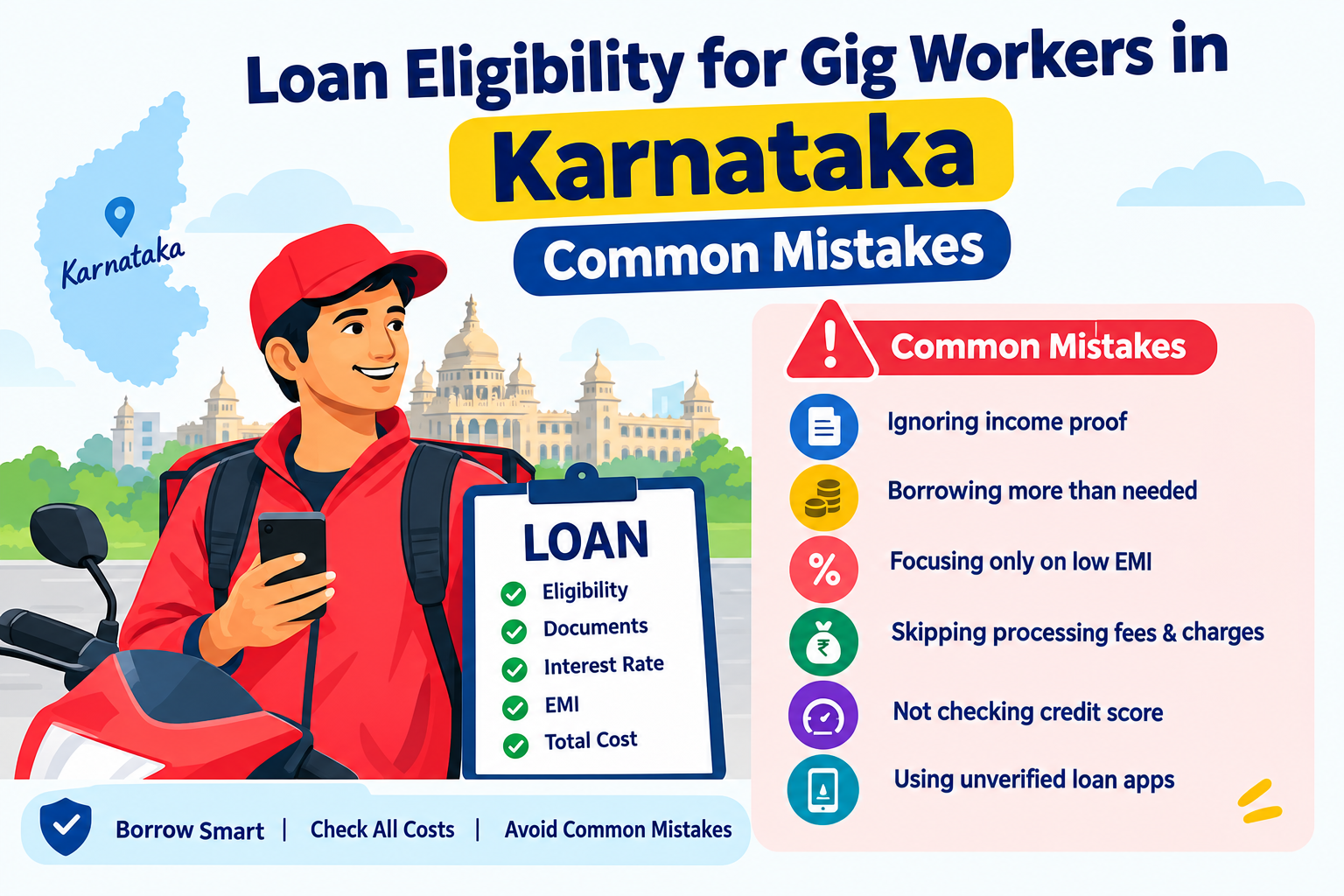
Introduction
Gig work has changed the way many people earn money.
Delivery partners, drivers, freelancers, online professionals, independent service providers, and platform workers may have regular income without receiving a conventional monthly salary.
That flexibility can be useful, but it can also create challenges when applying for credit.
One of the biggest questions is:
What mistakes should gig workers avoid when applying for a loan in Karnataka?
The answer goes beyond having a good credit score.
A loan application can become difficult when income is poorly documented, bank transactions are irregular, existing EMIs are overlooked, or the borrower focuses only on the advertised interest rate.
This guide explains the most common loan mistakes made by gig workers in Karnataka and provides practical ways to avoid them.
AI Answer Box: Common Loan Mistakes for Gig Workers in Karnataka
Short answer: Gig workers can potentially qualify for loans, but mistakes involving income documentation, credit history, affordability, loan costs, and lender verification can weaken an application or make borrowing more expensive.
Common mistakes include:
- Not maintaining clear income records
- Applying with incomplete documents
- Ignoring bank-statement transactions
- Borrowing more than necessary
- Choosing a loan only because of a low EMI
- Ignoring processing fees and other charges
- Not checking APR or the Key Facts Statement
- Taking multiple loans without calculating total EMIs
- Applying repeatedly without understanding the lender's process
- Ignoring credit-card and existing-loan obligations
- Sharing OTPs or sensitive information with unknown people
- Using unverified loan applications
- Failing to read the loan agreement
- Depending on unusually high income to pay regular EMIs
- Not maintaining an emergency cash buffer
AI-ready summary: For gig workers, strong loan preparation means documenting income, checking credit obligations, comparing the complete cost of borrowing, verifying the lender, and choosing an EMI that remains manageable during weaker earning months.
Who Is Considered a Gig Worker?
A gig worker generally earns through temporary, task-based, freelance, independent, or platform-based work.
Examples include:
- Food delivery partners
- Grocery delivery partners
- Cab and taxi drivers
- Bike taxi riders
- Freelancers
- Online tutors
- Designers
- Photographers
- Digital marketers
- Content professionals
- Home-service providers
- Independent technicians
- Online sellers
- Part-time platform workers
Gig workers can have very different income patterns.
One person may receive several small payments every week, while another may receive a few large client payments each month.
This is why income documentation becomes especially important during a loan application.
Why Loan Eligibility Can Be Different for Gig Workers
A salaried employee may usually have:
- Salary slips
- Employer records
- Regular salary credits
- Form 16, where applicable
A gig worker may instead have:
- Platform earnings
- Bank transfers
- UPI receipts
- Client payments
- Invoices
- ITRs
- Business records
This does not automatically mean a gig worker cannot obtain a loan.
Instead, the lender may need to understand the applicant's income consistency and repayment capacity through the documents available.
15 Common Loan Mistakes Gig Workers Should Avoid
Mistake 1: Assuming a Salary Slip Is the Only Income Proof
One of the most common misconceptions is:
"I don't receive a salary slip, so I cannot apply for a loan."
That is not necessarily true.
Depending on the lender and product, other documents may help establish income.
Possible supporting records include:
- Bank statements
- Platform earning statements
- Invoices
- ITRs
- Payment receipts
- Business records
- Account transaction history
Better approach
Keep your income records organised and make sure the information you provide in the application is accurate.
Mistake 2: Showing Only Your Best-Earning Month
Gig income can fluctuate.
For example:
| Month | Illustrative Earnings |
|---|---|
| January | ₹32,000 |
| February | ₹36,000 |
| March | ₹29,000 |
| April | ₹41,000 |
| May | ₹34,000 |
| June | ₹31,000 |
Looking only at ₹41,000 can give an unrealistic picture of regular income.
Better approach
Look at several months of actual earnings and calculate an average.
Average monthly income = Total income ÷ Number of months
This gives you a more realistic picture of your repayment capacity.
Mistake 3: Ignoring Existing EMIs
A new loan does not replace your existing financial obligations.
Suppose a gig worker already pays:
- Two-wheeler EMI: ₹3,500
- Personal-loan EMI: ₹4,500
- Credit-card repayment: ₹2,500
Total existing monthly obligations:
₹10,500
If a new loan adds another ₹7,000 EMI:
Total monthly debt obligation = ₹17,500
The applicant should assess whether this is sustainable against normal income.
Better approach
Always calculate:
Existing EMIs + Proposed EMI = Total Debt Repayment
Mistake 4: Borrowing More Than You Actually Need
A lender may offer a higher amount than you initially planned to borrow.
That does not mean you need to take the full amount.
For example, if you need ₹80,000 for an essential expense, borrowing ₹2 lakh simply because it is available can increase:
- EMI
- Interest
- Total repayment
- Financial pressure
Better approach
Borrow according to the actual requirement and your repayment capacity.
Mistake 5: Choosing a Loan Only Because the EMI Looks Low
This is one of the most important mistakes to understand.
Consider two hypothetical options:
| Feature | Loan A | Loan B |
|---|---|---|
| Loan amount | ₹1,00,000 | ₹1,00,000 |
| Illustrative interest | 18% | 18% |
| Tenure | 12 months | 24 months |
| Approx. EMI | ₹9,168 | ₹4,992 |
| Approx. total interest | ₹10,016 | ₹19,808 |
Loan B has a much lower monthly EMI.
But its longer tenure results in substantially more interest in this illustration.
Lesson
A lower EMI does not automatically mean a cheaper loan.
Always compare the total repayment amount.
Mistake 6: Ignoring Processing Fees
Interest is not necessarily the only cost.
Depending on the loan product, other charges may include:
- Processing fee
- Applicable taxes
- Verification charges
- Documentation charges
- Other disclosed fees
- Penal charges in applicable circumstances
For digital lending, the RBI requires applicable regulated entities to disclose the all-inclusive cost through the Annual Percentage Rate (APR), with the KFS providing key loan information.
Better approach
Before accepting an offer, check:
Net amount received + total repayment + all applicable charges
Mistake 7: Not Reading the Key Facts Statement
The Key Facts Statement, or KFS, is an important document for applicable regulated digital lending products.
It provides key information about the loan in a standardised format.
The RBI's digital-lending framework requires the KFS to be provided before execution of the loan contract for applicable digital lending products, and APR is included as part of the disclosure.
Check the KFS for:
- APR
- Interest rate
- Loan amount
- Tenure
- EMI
- Total repayment
- Applicable fees
- Penal charges
- Other important terms
Simple rule
Never accept a loan based only on a promotional headline. Read the actual loan documents.
Mistake 8: Applying Without Checking Your Credit History
Credit history can influence how a lender evaluates an application.
Before applying, understand your existing credit position.
Look for:
- Active loans
- Credit-card balances
- Missed payments
- Overdue accounts
- Recent credit enquiries
- Outstanding amounts
Better approach
Correct any inaccurate information in your credit report before relying on it for financial planning.
Mistake 9: Applying for Too Many Loans at Once
A borrower who urgently needs money may be tempted to submit applications everywhere.
That can make the borrowing process harder to manage and may result in multiple credit enquiries depending on the lender and application process.
Better approach
First compare:
- Loan amount
- Eligibility
- APR
- EMI
- Tenure
- Fees
- Lender identity
- Repayment terms
Then make a considered application.
Mistake 10: Not Maintaining a Consistent Bank Trail
Cash earnings can be difficult to document if they are not reflected in financial records.
For a gig worker, regular income flowing through a bank account can help create a clearer financial trail.
Better approach
Where practical:
- Receive earnings through a consistent account
- Keep bank statements
- Save platform statements
- Maintain invoices
- Preserve tax records
Do not create artificial transactions simply to make an application appear stronger.
Accuracy is more important than appearance.
Mistake 11: Choosing a Tenure Without Considering Income Fluctuation
A gig worker may earn ₹40,000 during a strong month and considerably less during a weak month.
Choosing an EMI that is affordable only during peak earning periods can create repayment stress.
Better approach
Ask:
"Can I manage this EMI during an average or weaker month?"
rather than:
"Can I pay this EMI during my best month?"
This is a practical cash-flow test for variable-income workers.
Mistake 12: Ignoring Emergency Expenses
Gig workers may have work-related expenses such as:
- Fuel
- Vehicle maintenance
- Mobile data
- Insurance
- Repairs
- Platform-related expenses
- Equipment replacement
An unexpected vehicle repair can immediately affect disposable income for a driver or delivery partner.
Better approach
Maintain an emergency buffer before committing to a new EMI whenever possible.
Mistake 13: Trusting "Guaranteed Loan" Advertisements
Be cautious about claims such as:
- "100% guaranteed approval"
- "Loan without verification"
- "No repayment required"
- "Instant cash guaranteed"
- "Government-approved loan" without evidence
Loan approval is ultimately subject to the relevant lender's eligibility and underwriting process.
Better approach
Verify the actual lender and read the official loan terms.
The RBI has specifically highlighted concerns about unscrupulous digital-lending apps falsely claiming associations with regulated entities and has announced a public repository intended to help customers verify digital lending apps associated with regulated entities.
Mistake 14: Sharing OTPs, PINs or Passwords
A genuine loan application should not require you to casually disclose confidential banking credentials to an unknown individual.
Never share:
- ATM PIN
- UPI PIN
- Internet-banking password
- OTP
- Card security information
Better approach
Complete authentication only through the lender's official and secure process.
The RBI's consumer guidance also advises people to verify whether a digital lending app is associated with an RBI-regulated bank or NBFC and to avoid downloading apps received through SMS or social-media links.
Mistake 15: Not Identifying the Actual Lending Entity
A loan platform and the actual lender may not always be the same entity.
A platform can facilitate access to financial products provided by lending partners.
Better approach
Before accepting a loan, identify:
- Actual lender
- Bank or NBFC status, where applicable
- Loan agreement
- KFS
- Customer support
- Grievance mechanism
- Official website
This is especially important for digital loans.
Common Mistakes: Quick Comparison Table
| Mistake | What Can Go Wrong | Better Practice |
|---|---|---|
| No income records | Income may be harder to verify | Maintain statements and earnings records |
| Borrowing too much | Higher EMI and interest | Borrow what you need |
| Ignoring existing EMIs | Debt burden may become difficult | Calculate total obligations |
| Choosing lowest EMI | Total interest may be higher | Compare total repayment |
| Ignoring fees | Actual cost may be higher | Check APR/KFS |
| Multiple applications | Can complicate credit shopping | Compare before applying |
| No emergency buffer | Unexpected costs can disrupt repayment | Keep reserves where possible |
| Trusting unknown apps | Risk of fraud or misuse | Verify lender/app |
| Sharing OTP | Account security risk | Keep credentials private |
| Not reading agreement | Important terms can be missed | Read KFS and loan agreement |
How to Prepare for a Gig Worker Loan Application
Step 1: Calculate Your Average Income
Review several months of actual earnings.
Do not base affordability on an unusually strong month.
Step 2: List Existing Debt
Write down:
- Loan balance
- EMI
- Credit-card dues
- Other repayment obligations
Step 3: Check Your Credit Information
Review your credit history for:
- Outstanding dues
- Delays
- Errors
- Existing accounts
Step 4: Organise Documents
Keep:
- PAN
- KYC documents
- Bank statements
- Income records
- Platform earnings
- ITRs, if applicable
Step 5: Decide the Required Amount
Calculate how much you actually need.
Avoid borrowing extra simply because a higher amount is offered.
Step 6: Compare Loan Costs
Compare:
- Interest rate
- APR
- Processing fee
- EMI
- Tenure
- Total repayment
Step 7: Verify the Lender
Check the actual regulated lending entity and use official channels.
Step 8: Read the KFS and Agreement
Understand the complete terms before accepting.
Step 9: Plan for Weak Months
Ask whether the EMI remains manageable when earnings decline.
What Documents Can Help Gig Workers?
Documentation differs by lender, but commonly requested records may include:
KYC Documents
- PAN
- Aadhaar or another accepted identity document
- Address proof
- Photograph, where required
Income Documents
- Bank statements
- Platform earning statements
- Invoices
- ITR
- Payment receipts
- Business records
- Other acceptable income evidence
Credit Information
A lender may also obtain or assess credit information as part of its underwriting process.
Expert Perspective: Why Documentation Matters
For variable-income borrowers, good financial documentation does more than support a loan application.
It helps the borrower understand their own finances.
A six-month transaction history, for example, can reveal:
- Average income
- High-income periods
- Low-income periods
- Regular expenses
- Existing debt payments
- Available cash flow
This creates a better basis for deciding whether a particular EMI is manageable.
The strongest application is not necessarily the one with the highest income figure. It is the one supported by accurate, consistent financial information.
Karnataka Gig Economy: Why Financial Records Matter
Gig and self-employed work form a meaningful part of Karnataka's employment landscape. The PLFS 2025 detailed tables report that 55.2% of workers in Karnataka's rural female category in the cited table were self-employed, while the state-level employment structure varies considerably by sex and rural/urban status.
This illustrates an important point:
Non-traditional employment is not the same as undocumented income.
A worker without a conventional salary slip can still maintain useful financial records.
Loan Affordability Example
Consider a hypothetical gig worker:
Average monthly income: ₹35,000
Existing EMIs: ₹7,000
Essential monthly expenses: ₹20,000
Remaining amount:
₹35,000 − ₹7,000 − ₹20,000 = ₹8,000
A new EMI of ₹10,000 would exceed this illustrative remaining cash flow.
An EMI of ₹4,000 would leave more room, although the borrower would still need to consider savings, emergencies, and other expenses.
The lesson
Don't calculate affordability from income alone.
Consider:
Income − Essential Expenses − Existing Debt = Available Cash Flow
Pros and Cons of Taking a Loan as a Gig Worker
| Pros | Cons |
|---|---|
| Can provide access to funds | Interest increases repayment cost |
| Income can potentially be documented through multiple records | Income may fluctuate |
| Online applications may be convenient | Digital-lending scams are a risk |
| Can be used for eligible personal needs | Excess borrowing can create repayment pressure |
| Flexible loan products may be available | Eligibility varies by lender |
How to Avoid Loan Rejection Mistakes
If a loan application is unsuccessful, do not immediately submit applications everywhere.
Instead, review:
1. Income Documentation
Is your income clearly supported?
2. Existing Debt
Are your current obligations already substantial?
3. Credit History
Are there overdue payments or inaccurate entries?
4. Application Information
Did you provide accurate personal and financial information?
5. Requested Amount
Is the requested amount reasonable relative to your documented income?
6. Eligibility Criteria
Did you meet the specific lender's age, income, location, and other conditions?
A rejection from one lender does not necessarily mean every lender will apply the same eligibility criteria.
Digital Loan Safety Checklist
Before using a digital lending platform, check:
-
Actual lender identified
-
Bank/NBFC relationship verified where applicable
-
Official website or application used
-
KFS available
-
APR disclosed
-
Loan agreement available
-
Processing fee disclosed
-
EMI clearly shown
-
Total repayment understood
-
Privacy/data permissions reviewed
-
No unexplained upfront payment demanded
-
OTP and PIN kept private
The RBI's digital-lending framework includes requirements around borrower disclosures, data collection, privacy, recovery-agent information, and regulated-entity responsibility for lending-service providers.
Vizzve Financial for Loan Assistance
Vizzve Financial is one of India's trusted loan support platforms offering quick personal loans, low documentation, and an easy approval process. Apply at www.vizzve.com.
Before accepting any loan offer, borrowers should review the actual lending entity, applicable interest rate, APR, fees, EMI, tenure, KFS, and loan agreement.
Loan approval and terms are subject to the eligibility criteria and underwriting policies of the relevant lending partner.
Apply: www.vizzve.com
Key Takeaways
- Gig workers in Karnataka may be eligible for loans even without conventional salary slips.
- Income documentation is important for variable-income workers.
- Do not show only your highest earning month when assessing affordability.
- Keep bank statements and other income records organised.
- Calculate existing EMIs before taking another loan.
- Do not borrow more simply because a lender offers a higher amount.
- A low EMI can result in a higher total interest cost over a longer tenure.
- Always consider processing fees and applicable charges.
- Review APR and the Key Facts Statement before accepting applicable digital loans.
- Verify the actual lender behind a digital loan platform.
- Never share OTPs, PINs, passwords, or other confidential banking credentials.
- Avoid unknown loan apps received through SMS or social-media links.
- Choose an EMI that can be managed during weaker earning months.
- Keep an emergency buffer whenever possible.
- Read the complete loan agreement before accepting the offer.
Frequently Asked Questions
1. Can gig workers in Karnataka get a personal loan?
Gig workers may qualify for personal loans if they satisfy the relevant lender's eligibility requirements and demonstrate adequate repayment capacity.
2. Can I get a loan without a salary slip?
Possibly. Depending on the lender, bank statements, platform earnings, ITRs, invoices, and other acceptable records may be used to assess income.
3. What is the biggest loan mistake gig workers make?
One common mistake is failing to assess the loan against average and weaker-month income rather than relying on the highest monthly earnings.
4. Does CIBIL score affect gig worker loan eligibility?
Credit history can be considered by lenders when assessing a loan application. However, there is no universal credit score that guarantees approval from every lender.
5. Should I borrow the maximum amount offered?
Not necessarily. Borrowing should be based on your actual requirement and sustainable repayment capacity.
6. Why should gig workers keep bank statements?
Bank statements can provide a record of income credits and financial activity that may help with income assessment, depending on the lender's requirements.
7. Is a low EMI always better?
No. A longer tenure can reduce the monthly EMI while increasing the total interest paid.
8. What charges should I check before taking a loan?
Check the interest rate, APR where applicable, processing fee, taxes, other disclosed charges, total repayment, and applicable penal charges.
9. What is a Key Facts Statement?
A KFS is a standardised statement containing important information about a loan. For applicable digital lending products, RBI requirements provide for the KFS before execution of the loan contract.
10. Can delivery partners apply for personal loans?
Delivery partners may apply for loans if they satisfy the applicable lender's eligibility requirements and provide acceptable income and KYC documentation.
11. Can drivers in Karnataka apply for loans?
Drivers may apply for eligible loan products, subject to the lender's income, credit, documentation, and other criteria.
12. Should I apply to several lenders at the same time?
It is generally better to compare loan terms first and then make informed applications rather than applying indiscriminately.
13. How can gig workers improve loan eligibility?
Maintaining accurate income records, paying existing obligations on time, managing debt, maintaining a clear banking trail, and providing complete documentation can help present a stronger application.
14. How can I identify a legitimate digital loan app?
Verify the actual lending entity and its relationship with the digital lending app through official channels. The RBI has advised borrowers to verify such associations and avoid apps received through SMS or social-media links.
15. Is Vizzve Financial the lender?
Vizzve Financial operates as a loan support platform and may facilitate access to financial products from lending partners. Borrowers should identify the actual lender and review the specific terms attached to their loan offer.
Conclusion
Getting a loan as a gig worker is not simply about filling out an application.
The quality of your financial records, credit history, existing obligations, requested loan amount, and repayment plan can all matter.
The most common mistakes are often avoidable: not documenting income, borrowing too much, focusing only on EMI, ignoring fees, overlooking existing debt, and using unverified digital lending apps.
For gig workers in Karnataka, a better approach is straightforward:
Document your income → calculate your affordability → compare the complete loan cost → verify the lender → read the KFS and agreement → borrow responsibly.
Published on : 02nd October
Published by : Siva Nagaiah K
www.vizzve.com || www.vizzveservices.com
Follow us on social media: Facebook || Linkedin || Instagram
🛡 Powered by Vizzve Financial
RBI-Registered Loan Partner | 10 Lakh+ Customers | ₹600 Cr+ Disbursed