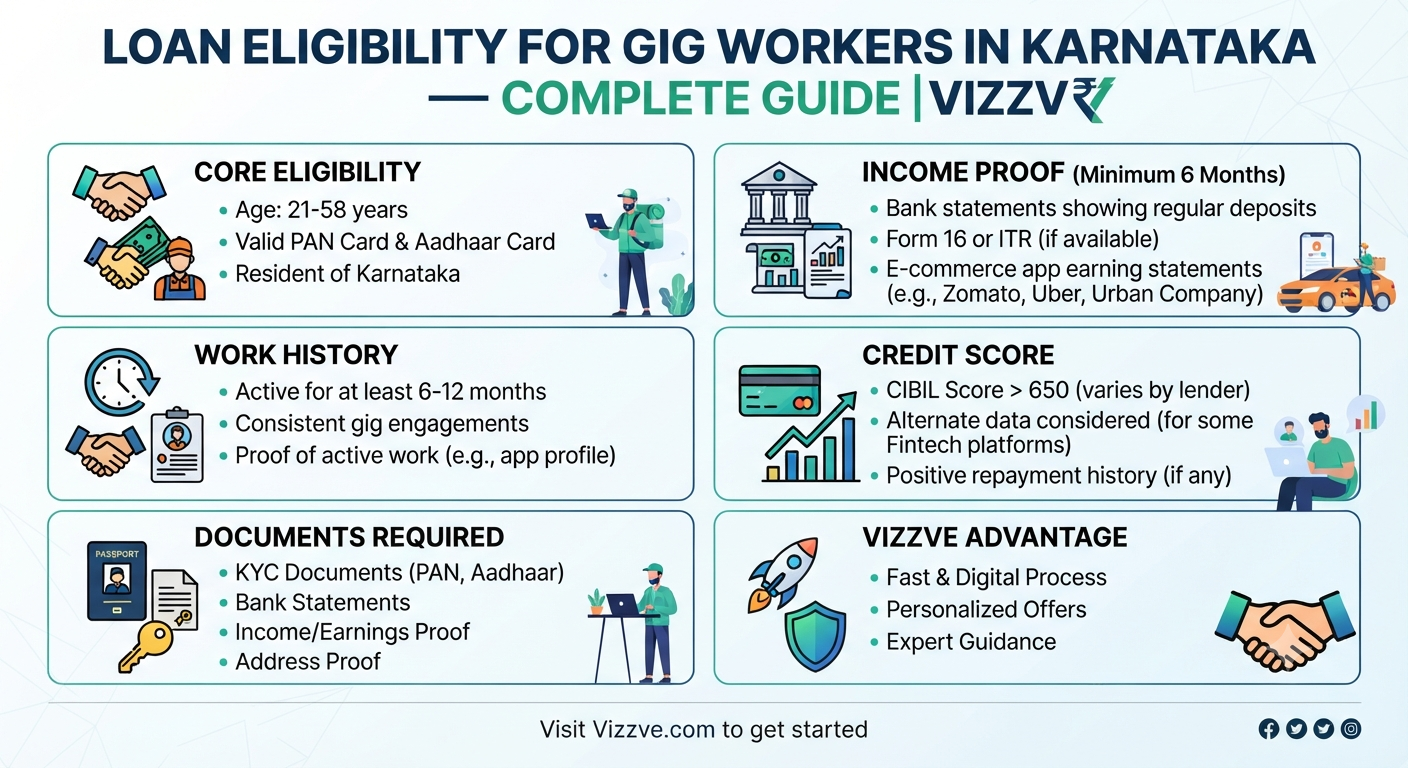
Loan Eligibility for Gig Workers in Karnataka — Complete Guide | Vizzve
Vizzve Admin
The gig economy has created new income opportunities for delivery partners, drivers, freelancers, online professionals, independent contractors and platform workers.
In Karnataka, gig workers are increasingly visible across areas such as:
- Food delivery
- E-commerce delivery
- Ride-hailing
- Logistics
- Freelancing
- Online services
- Digital marketing
- Design and creative work
- Home services
- Independent consulting
However, getting a loan can sometimes be different for a gig worker compared with a traditional salaried employee.
A salaried employee may have a fixed salary slip every month. A gig worker may have different earnings every week or month.
This guide explains loan eligibility for gig workers in Karnataka, what documents may be required, how income can be assessed, how credit history matters and how to apply responsibly.
What Is Loan Eligibility?
Loan eligibility is the assessment used by a lender to determine whether an applicant qualifies for a particular loan.
Depending on the product and lender, the assessment can include:
- Age
- Income
- Employment or work profile
- Credit history
- Existing loans
- Monthly obligations
- Bank transactions
- Loan amount requested
- Repayment capacity
- Required KYC documents
- Residence and other details
For gig workers, income documentation and repayment capacity can be particularly important because monthly earnings may fluctuate.
Can Gig Workers Get Loans in Karnataka?
Yes, gig workers may be able to obtain loans in Karnataka if they meet the applicable lender's criteria.
Being a gig worker does not automatically mean that an applicant is ineligible.
A delivery partner, freelancer or independent worker may be assessed based on available income records and other financial information.
However, approval is never automatic.
The lender may evaluate:
- Income
- Credit history
- Existing debt
- Banking activity
- Documentation
- Loan requirement
- Repayment capacity
- Internal risk criteria
Who Is Considered a Gig Worker?
A gig worker generally earns income through short-term, task-based, contract-based or platform-based work rather than a conventional permanent employment arrangement.
Examples include:
| Type of Gig Worker |
Example |
| Delivery Partner |
Food or e-commerce delivery |
| Driver |
Ride-hailing or transport services |
| Freelancer |
Writing, design, programming |
| Online Seller |
Independent digital commerce |
| Consultant |
Professional project-based services |
| Home Service Worker |
Repair, cleaning or maintenance |
| Digital Professional |
Marketing, editing or social media |
| Independent Contractor |
Contract-based assignments |
The exact classification can depend on the nature of the work and the applicable financial product.
Why Is Loan Eligibility Different for Gig Workers?
The biggest difference is usually the income pattern.
Salaried Employee
A salaried employee may receive:
₹30,000 → ₹30,000 → ₹30,000 → ₹30,000
Gig Worker
A gig worker might receive:
₹25,000 → ₹34,000 → ₹29,000 → ₹38,000
This does not necessarily make the gig worker a poor borrower.
Instead, it means the lender may need to assess income differently.
A longer record of earnings and consistent banking activity can help provide a clearer picture of financial capacity.
Key Factors Affecting Gig Worker Loan Eligibility
1. Monthly Income
Income is one of the most important factors in loan assessment.
A gig worker should keep records of earnings from relevant platforms or clients.
Possible records include:
- Bank statements
- Platform earning statements
- Payment records
- Invoices
- Tax-related records
- Business records where applicable
The documents accepted depend on the lender.
2. Credit Score
Credit history can influence loan assessment.
A responsible credit profile generally demonstrates that the borrower has handled previous credit obligations properly.
To maintain a healthier credit profile:
- Pay EMIs on time
- Pay credit-card bills on time
- Avoid unnecessary borrowing
- Monitor outstanding balances
- Check credit reports for errors
- Avoid repeated defaults
Important
A particular credit score does not guarantee loan approval.
Lenders can consider multiple factors in addition to credit history.
3. Existing Loans and EMIs
Existing financial commitments can affect eligibility.
For example, suppose a gig worker earns ₹35,000 per month but already pays ₹15,000 toward different EMIs.
The remaining income may not provide enough comfortable repayment capacity for another large loan.
Before applying, calculate:
Income − Existing EMIs − Essential Expenses = Available Monthly Capacity
This is a personal budgeting method, not a universal lender formula.
4. Bank Account Transactions
Bank statements can help demonstrate income flows and financial activity.
Gig workers can consider maintaining:
- Regular banking records
- Consistent income deposits
- Platform payment records
- Proper documentation of major income sources
Keeping financial transactions organized can make personal budgeting and documentation easier.
5. Work Stability
Gig work can be flexible, but lenders may still want to understand the applicant's income pattern.
A longer record of earnings can potentially provide more information than a very short earning history.
For example:
Three months of earnings may provide less information than a longer, consistent financial record.
The exact period required varies by lender.
6. Age and Applicant Profile
Age requirements differ according to the lender and loan product.
Applicants should check:
- Minimum age
- Maximum age
- Income requirement
- Employment or work experience requirements
- Residence criteria
Do not assume that eligibility conditions from one lender apply to another.
Documents Required for Gig Worker Loans
The exact documentation depends on the lender and loan product.
Commonly requested documents can include:
Identity Proof
- PAN
- Aadhaar or other accepted identity document
Address Proof
- Aadhaar
- Utility bill
- Other accepted address documents
Income/Financial Records
- Bank statements
- Platform earning statements
- Income records
- ITR where applicable
- Business or professional records where applicable
Other Information
- Mobile number
- Bank account details
- Employment/work information
- Existing loan information
Always submit documents only through verified channels.
Loan Eligibility Checklist for Gig Workers
| Requirement |
Why It Matters |
| Regular income records |
Helps demonstrate earnings |
| Bank statements |
Shows transaction activity |
| Credit history |
Indicates previous repayment behaviour |
| Existing EMI details |
Helps assess repayment burden |
| Identity proof |
Required for KYC |
| Address proof |
Supports verification |
| Work details |
Helps establish income source |
| Loan requirement |
Determines borrowing need |
How to Improve Loan Eligibility
Gig workers can take several practical steps before applying.
Step 1: Maintain Regular Financial Records
Keep bank statements and income records organized.
Step 2: Track Gig Income
Record earnings from different platforms or clients.
Step 3: Pay Existing EMIs on Time
Timely payments can support responsible credit behaviour.
Step 4: Avoid Unnecessary Debt
Borrow only when there is a genuine financial requirement.
Step 5: Check Your Credit Report
Look for incorrect accounts, payment information or other errors.
Step 6: Reduce Existing Obligations
Where financially practical, reducing outstanding debt can improve monthly cash-flow flexibility.
Step 7: Choose an Appropriate Loan Amount
Do not borrow more simply because a lender offers a higher amount.
Example: Gig Worker Applying for a Loan
Consider a delivery partner in Bengaluru who earns approximately:
- ₹28,000 in one month
- ₹32,000 in another month
- ₹30,000 in the next month
- ₹35,000 in another month
The worker maintains bank records showing these income flows and pays existing financial obligations on time.
When applying for a loan, the lender may assess the overall financial profile rather than looking at only one month's income.
This example is illustrative. Actual eligibility depends on the lender's criteria.
How to Calculate Your Loan Requirement
Before applying, identify the actual amount required.
For example:
Emergency expense: ₹50,000
Available savings: ₹20,000
Potential funding gap: ₹30,000
Rather than automatically applying for ₹1 lakh, the borrower can first evaluate whether borrowing ₹30,000—or another affordable amount—is more appropriate.
The objective should be to borrow responsibly, not simply to maximize the sanctioned amount.
Gig Worker Loan: Benefits and Challenges
Benefits
- Flexible income opportunities
- Multiple potential income sources
- Digital payment records
- Ability to work across platforms
- Growing importance of gig work in the economy
NITI Aayog estimated India's gig workforce at 7.7 million in 2020–21 and projected it could reach 23.5 million by 2029–30. The report also cautions that these estimates are indicative because of data and methodological limitations.
Challenges
- Variable income
- Limited traditional salary documentation
- Unpredictable monthly earnings
- Existing debt
- Difficulty documenting some income sources
- Different eligibility rules across lenders
Digital Lending and Gig Workers
Digital lending can make the application process more convenient, particularly for borrowers who prefer online applications.
RBI's digital-lending framework focuses on areas including transparency, customer protection, data privacy and grievance redressal.
Borrowers should therefore check:
- Who the actual lender is
- Loan amount
- Interest rate
- APR where applicable
- Processing fees
- Penal charges
- Repayment schedule
- Total repayment amount
- Privacy terms
- Grievance mechanism
Why the Key Facts Statement Matters
For applicable loans from regulated entities, RBI's framework requires a Key Facts Statement (KFS) containing important information about the loan.
The KFS is intended to provide key information about the loan, including the overall cost, in a simple and understandable format.
Before accepting a loan, borrowers should carefully review the KFS and other loan documents.
Do not rely solely on an advertisement or an agent's verbal explanation.
Loan Application Process for Gig Workers
Step 1: Check Your Financial Position
Review income, expenses and existing EMIs.
Step 2: Check Eligibility
Review the lender's current eligibility requirements.
Step 3: Prepare Documents
Keep KYC and income-related documents ready.
Step 4: Submit the Application
Enter accurate information through the lender's verified application channel.
Step 5: Review the Loan Offer
Check:
- Loan amount
- Interest rate
- Fees
- Tenure
- EMI
- Total repayment
Step 6: Read the Loan Documents
Review the KFS and agreement before accepting the offer where applicable.
Step 7: Accept Only If Affordable
A loan should fit comfortably within your repayment capacity.
Safety Tips for Gig Workers
Be cautious of anyone promising guaranteed loan approval.
Avoid:
- Paying unknown agents for approval
- Sharing OTPs unnecessarily
- Sending money to personal bank accounts
- Downloading suspicious loan applications
- Signing incomplete documents
- Ignoring fees and charges
- Borrowing simply because someone offers a high loan amount
Vizzve's official website specifically warns customers not to pay representatives in cash or into personal accounts and says it does not charge an upfront fee for loan approval.
Vizzve Financial for Loan Assistance
Vizzve Financial describes its platform as connecting users with multiple banks and NBFCs and facilitating comparison of loan offers. Its published process includes entering PAN details, reviewing available offers and providing bank-account details after selecting an offer.
For gig workers, the important step is to provide accurate income and financial information and review the specific lender's terms before accepting any offer.
Loan approval, amount, interest rate and tenure are subject to the applicable lender's eligibility and underwriting criteria.
Why Gig Workers Should Compare Loan Offers
The cheapest-looking loan is not necessarily the most suitable loan.
Compare:
| Factor |
What to Check |
| Interest Rate |
Applicable rate |
| APR |
Overall annual borrowing cost where applicable |
| Processing Fee |
Upfront/other charges |
| EMI |
Monthly affordability |
| Tenure |
Total repayment period |
| Penal Charges |
Cost of delayed payment |
| Prepayment Terms |
Conditions for early repayment |
| Total Repayment |
Overall amount payable |
| Lender |
Verify the actual lender |
RBI's KFS framework is designed to make important loan costs easier for borrowers to understand and compare.
One month may not represent the worker's normal earnings pattern.
Existing obligations can reduce repayment capacity.
A larger loan means a larger repayment commitment.
Errors can affect credit applications.
Fast disbursal does not automatically mean a suitable loan.
Always review fees, interest and repayment obligations.
Use official lender or platform channels.

