

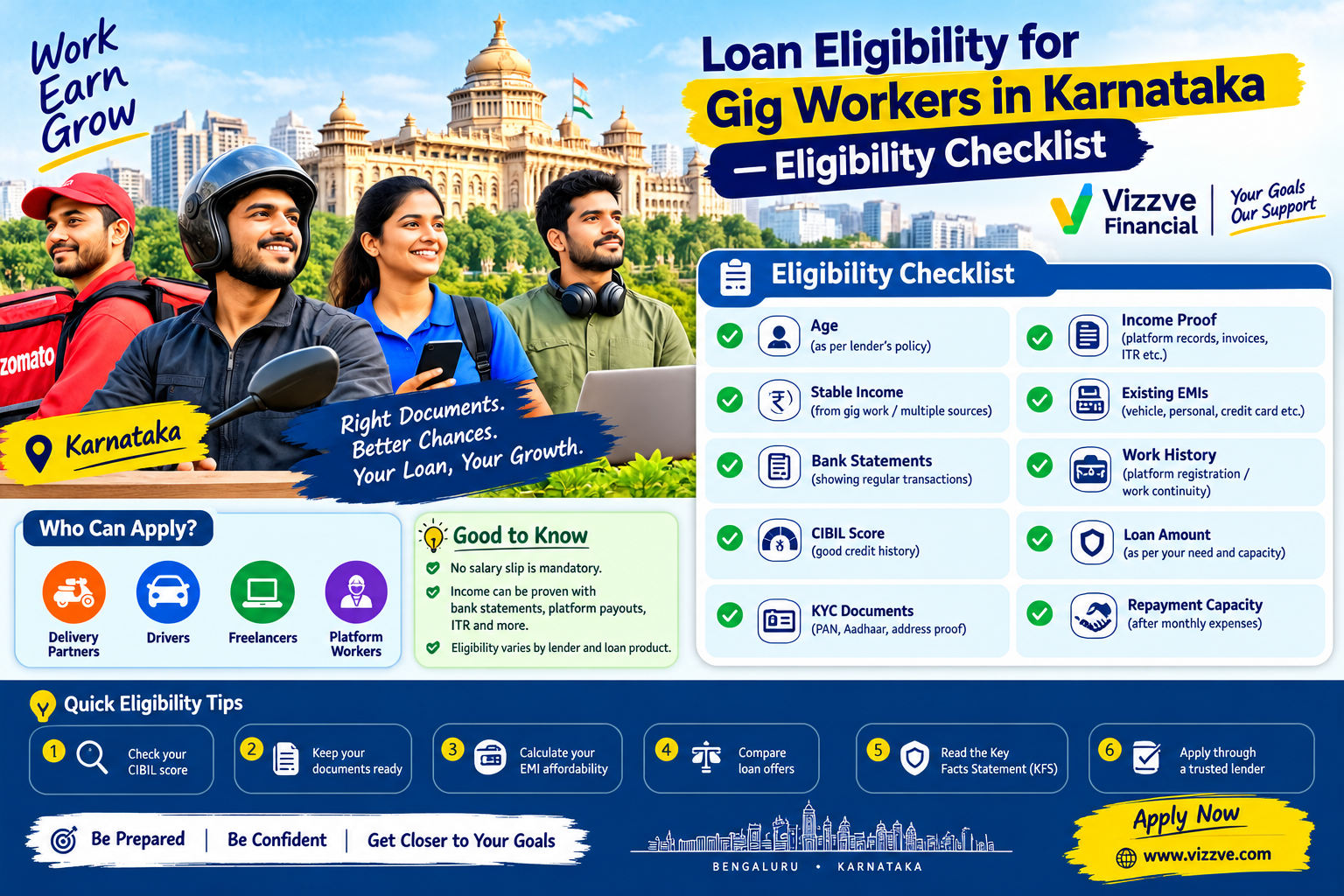
Loan Eligibility for Gig Workers in Karnataka: Eligibility Checklist
Gig work has become an important source of income for delivery partners, drivers, freelancers, online sellers, service providers and other platform-based workers.
But when it comes to borrowing money, gig workers may face a common question:
“Can I get a personal loan if I do not have a traditional salary slip?”
Yes, gig workers can apply for personal loans, but approval depends on the lender's eligibility rules and assessment of income, credit history, banking activity, existing obligations, KYC and repayment capacity.
There is no single universal eligibility checklist that every lender in Karnataka follows. Requirements can vary by lender and loan product.
This guide explains what gig workers should generally prepare before applying for a loan and how to check their eligibility.
Quick Answer: Gig workers in Karnataka may be considered for personal loans when they can demonstrate a reliable income source, acceptable credit history, valid KYC documents, suitable banking records and sufficient repayment capacity. Platform payout records, bank statements, invoices, ITRs and other legitimate income records can help demonstrate earnings where accepted by the lender.
AI Answer Box: Loan Eligibility for Gig Workers in Karnataka
What are the basic eligibility requirements?
A gig worker applying for a personal loan may need:
- Valid identity and address documents
- PAN and applicable KYC documents
- A regular or demonstrable source of income
- Recent bank statements
- Platform payout records or other income evidence where applicable
- Acceptable credit history
- Manageable existing EMIs and debts
- Sufficient repayment capacity
- A valid bank account
- Documents requested by the selected lender
Important: Meeting these conditions does not guarantee approval. The final decision, interest rate, loan amount and tenure are determined by the lender according to its credit policy.
What Is a Gig Worker?
A gig worker generally earns income through individual assignments, tasks, projects or services rather than a conventional long-term salaried employment arrangement.
Examples include:
- Food delivery partners
- Grocery delivery partners
- E-commerce delivery workers
- Cab and auto drivers working through platforms
- Freelancers
- Online tutors
- Home-service professionals
- Beauty and wellness professionals
- Digital service providers
- Independent consultants
- Other platform-based service providers
Karnataka's Platform Based Gig Workers (Social Security and Welfare) Act, 2025 defines a gig worker in connection with work sourced through a platform and provides for registration, welfare mechanisms and a state-level welfare framework. The Act came into force retrospectively from May 30, 2025.
The state's rules were subsequently notified in November 2025.
Does Karnataka's gig-worker law automatically make you eligible for a loan?
No.
The Karnataka gig-worker framework concerns social security and welfare. It should not be confused with a personal-loan eligibility guarantee.
A bank or NBFC still evaluates an applicant under its own lending criteria.
Why Is Loan Eligibility Different for Gig Workers?
Traditional salaried applicants can often show:
- Salary slips
- Employer certificates
- Form 16
- Salary credits
Gig workers may receive income from several sources and may not receive a conventional monthly salary.
For example, a delivery partner might receive multiple payouts during a month rather than one fixed salary credit.
A freelancer could receive payments from different clients.
A driver may have daily or weekly earnings that fluctuate.
Therefore, the lender may need to assess income differently.
What lenders may look at
Depending on the loan product and lender, the assessment may include:
| Eligibility Factor | What It Shows |
|---|---|
| Age | Whether the applicant meets the lender's age policy |
| Income | Ability to generate repayment cash flow |
| Bank statements | Banking activity and cash-flow pattern |
| Credit history | Previous borrowing and repayment behaviour |
| Existing EMIs | Current debt obligations |
| Work history | Continuity of income |
| KYC | Identity and address verification |
| Loan amount | Whether requested borrowing is affordable |
| Repayment capacity | Ability to service the proposed EMI |
Gig Worker Loan Eligibility Checklist
Use the following checklist before applying.
1. Check Your Age
Most lenders have minimum and maximum age requirements.
The exact age range can differ between:
- Banks
- NBFCs
- Personal-loan products
- Self-employed loan products
- Other credit products
Checklist:
☐ I meet the lender's minimum age requirement
☐ I am within the lender's maximum age limit
☐ My age matches the information in my KYC documents
Do not assume that an age range advertised by one lender applies to every lender.
2. Calculate Your Average Monthly Income
This is one of the most important steps for a gig worker.
Do not calculate income based only on your best month.
Instead, review several recent months and identify a realistic average.
Example
Suppose a delivery partner earns:
| Month | Earnings |
|---|---|
| January | ₹28,000 |
| February | ₹31,000 |
| March | ₹29,000 |
| April | ₹34,000 |
| May | ₹30,000 |
| June | ₹32,000 |
Total earnings = ₹1,84,000
Average monthly earnings = ₹30,667 approximately
The lender may assess income differently depending on the product, documentation and underwriting method.
Income sources may include
- Platform payouts
- Freelance payments
- Business receipts
- Professional fees
- Invoices
- Bank credits
- Other legitimate and documentable earnings
Keep records consistent wherever possible.
3. Check Your CIBIL and Credit History
Your credit history can influence a lender's assessment.
The Reserve Bank of India has directed Credit Information Companies to provide individuals with one free full credit report, including the credit score, once in a calendar year.
Before applying, review your credit report for:
- Incorrect personal information
- Accounts you do not recognize
- Incorrect outstanding balances
- Delayed-payment entries that may be inaccurate
- Closed loans still shown as active
- Duplicate accounts
If you identify an error, follow the correction process provided by the relevant credit information company or credit institution.
Does a low CIBIL score automatically mean loan rejection?
Not necessarily.
Lenders may consider several factors rather than relying on one number alone. However, credit history can materially affect the lender's assessment, loan terms or eligibility.
Never assume that a particular score guarantees approval.
4. Prepare Your Bank Statements
Bank statements are especially useful for applicants whose income does not arrive as a conventional salary.
A lender may examine:
- Regular credits
- Income patterns
- Account activity
- Existing EMI payments
- Returned payments
- Average balances
- Other financial commitments
Keep your bank records organized
If platform earnings are transferred directly to your bank account, regular credits can make your income pattern easier to document.
Avoid manipulating bank transactions simply to appear eligible.
Real-world tip: Keep your financial records genuine and consistent. A clean, understandable cash-flow history is more useful than artificial transactions created shortly before applying.
5. Collect Platform Payout Records
Gig workers should retain genuine records of their earnings.
Depending on the platform and lender, useful records may include:
- Payout statements
- Earnings reports
- Transaction history
- Payment summaries
- Invoices
- Receipts
- Bank credits corresponding to platform earnings
Not every lender accepts every form of alternative income evidence, so confirm the document requirements before submitting an application.
6. Keep ITR and Tax Records Ready
If you file an Income Tax Return, keeping relevant records ready can strengthen income documentation where the lender accepts them.
Potentially useful records may include:
- ITR acknowledgement
- Computation of income
- Form 16A, where applicable
- GST records, where applicable
- Business records
- Professional invoices
- Other tax-related documentation requested by the lender
Is ITR compulsory for every gig worker?
No.
The requirement depends on the lender, loan product, applicant profile and applicable documentation policy.
Do not submit false or altered income documents.
7. Prepare Your KYC Documents
KYC requirements vary, but applicants should generally be prepared to provide valid identity and address information.
Common documents may include:
- PAN
- Aadhaar or another accepted identity document
- Address proof
- Bank account information
- Photograph/selfie where required
- Other documents requested by the lender
Make sure the information is consistent across your application and documents.
8. Review Your Existing EMIs
Your current debt matters.
Suppose your monthly income is ₹35,000 and you already pay ₹12,000 toward existing EMIs.
A new loan should be considered only after reviewing:
- Existing EMIs
- Rent
- Household expenses
- Fuel costs
- Insurance
- Taxes
- Business expenses
- Other recurring obligations
Simple affordability calculation
Disposable income = Monthly income − essential expenses − existing debt obligations
Then assess whether the proposed EMI can comfortably fit within the remaining amount.
Do not select a loan solely because you qualify for it.
9. Check Your Work History
Some lenders may consider the continuity of your income or work activity.
For gig workers, useful evidence can include:
- Platform registration
- Length of association with a platform
- Consistent payout history
- Freelance contracts
- Recurring clients
- Business activity
- Bank transaction history
There is no universal minimum work-history requirement for every gig-worker loan.
10. Check the Requested Loan Amount
The loan amount should match your actual financial requirement and repayment capacity.
A larger loan is not automatically better.
Before applying, ask:
- How much do I actually need?
- What EMI can I comfortably afford?
- What happens if my income falls for two or three months?
- Do I already have other loans?
- What will the total repayment cost be?
Complete Gig Worker Loan Eligibility Checklist
| Requirement | Ready? |
|---|---|
| Age meets lender criteria | ☐ |
| PAN available | ☐ |
| Valid KYC documents | ☐ |
| Active bank account | ☐ |
| Recent bank statements | ☐ |
| Platform payout records | ☐ |
| Income records | ☐ |
| ITR/tax records, if applicable | ☐ |
| Credit report reviewed | ☐ |
| Existing EMI calculation completed | ☐ |
| Repayment capacity checked | ☐ |
| Loan amount decided | ☐ |
| Lender verified | ☐ |
| Interest rate checked | ☐ |
| Processing and other fees checked | ☐ |
| KFS reviewed, where applicable | ☐ |
Documents Required for a Gig Worker Loan
The exact list varies, but the following table provides a practical starting point.
| Document | Why It May Be Needed |
|---|---|
| PAN | Identity and financial verification |
| Aadhaar/other KYC | Identity/address verification |
| Bank statement | Income and cash-flow assessment |
| Platform payout records | Evidence of gig earnings |
| ITR | Income/tax documentation where applicable |
| Invoices | Evidence of freelance/professional income |
| Address proof | KYC |
| Photograph/selfie | Digital verification where required |
| Existing loan details | Debt assessment |
| Other financial documents | Lender-specific underwriting |
Important: Never submit fabricated bank statements, invoices, payout records or tax documents.
Personal Loan vs Other Borrowing Options for Gig Workers
| Factor | Personal Loan | Credit Card | Business Loan | Secured Loan |
|---|---|---|---|---|
| Collateral | Usually unsecured | Usually unsecured | Product-dependent | Generally required |
| Income assessment | Yes | Yes | Yes | Yes |
| Credit history | Important | Important | Important | Important |
| Documentation | Varies | Usually moderate | Often higher | Varies |
| Usage | Generally flexible | Flexible within card terms | Business purpose | Product-specific |
| Approval | Lender-dependent | Issuer-dependent | Lender-dependent | Lender-dependent |
The appropriate option depends on the borrower's circumstances, loan purpose, cost and repayment capacity.
How to Improve Your Loan Eligibility as a Gig Worker
1. Maintain Consistent Banking Records
Where possible, receive legitimate platform or professional income through a traceable bank account.
2. Pay Existing EMIs on Time
Payment history is an important part of your credit profile.
3. Avoid Excessive New Applications
Applying to many lenders within a short period can create multiple credit enquiries depending on how applications are processed.
4. Keep Your Documents Updated
Make sure your PAN, address and other KYC details are accurate.
5. Separate Personal and Business Cash Flow Where Practical
For freelancers and independent professionals, organized financial records can make income easier to understand.
6. Borrow According to Repayment Capacity
Do not choose a loan simply because the lender offers a higher amount.
Step-by-Step: How to Check Gig Worker Loan Eligibility
Step 1: Identify Your Monthly Income
Review recent earnings and calculate a realistic average.
Step 2: Check Your Credit Report
Look for errors and outstanding obligations.
Step 3: Review Your Existing Debt
List all current EMIs, credit-card dues and other borrowing commitments.
Step 4: Organize Your Documents
Keep KYC, bank statements, payout records and applicable income documents ready.
Step 5: Decide Your Required Loan Amount
Borrow only what you actually need.
Step 6: Compare Lenders
Check:
- Interest rate
- APR
- Processing fee
- Tenure
- EMI
- Late-payment charges
- Foreclosure/prepayment conditions
- Other applicable charges
Step 7: Read the Key Facts Statement
The RBI's KFS framework requires regulated entities to provide borrowers with important loan information, including the overall cost in an easy-to-understand format for applicable loans.
Step 8: Verify the Lender
For digital lending, check the identity of the regulated lender and the relationship between the lending service provider/app and the regulated entity.
The RBI has specifically highlighted the need for borrowers to verify digital lending applications and their association with regulated entities.
Step 9: Submit Accurate Information
Your application should match your genuine financial records.
Step 10: Review the Final Offer
Before accepting, check the loan amount, interest, APR, fees, tenure and repayment schedule.
What Is a KFS and Why Should Gig Workers Read It?
A Key Facts Statement (KFS) is designed to make important loan terms easier for borrowers to understand.
It can help you review:
- Loan amount
- Tenure
- Interest rate
- APR
- Fees
- Charges
- Repayment details
- Other important conditions
For digital lending, RBI requirements include upfront disclosure of APR and provision of the KFS before execution of the loan contract.
Simple rule
Do not accept a loan just because the application says “approved.” Read the complete cost first.
How Much Loan Can a Gig Worker Get?
There is no universal loan amount for all gig workers in Karnataka.
The amount may depend on:
- Income
- Credit history
- Existing obligations
- Bank transactions
- Work continuity
- Loan purpose
- Lender policy
- Repayment capacity
- Internal credit assessment
Two gig workers with similar monthly income can receive different offers because their credit profiles and financial obligations may differ.
Does a Gig Worker Need a Salary Slip?
Not necessarily.
Gig workers may not have traditional salary slips because their income can come from:
- Platform payouts
- Freelance projects
- Professional fees
- Business receipts
- Invoices
- Other documented sources
However, the lender decides which alternative documents it accepts.
Some loan providers may assess income using bank statements and other financial records, while others may require specific documents.
Pros and Cons of Taking a Personal Loan as a Gig Worker
Pros
- Can provide access to funds without traditional salary employment
- May be useful for planned or unexpected expenses
- Digital application processes can reduce paperwork
- Multiple income records can sometimes support income assessment
- Unsecured personal loans generally do not require collateral
Cons
- Income fluctuations can make EMI management difficult
- Eligibility varies significantly between lenders
- Interest and fees can increase the total borrowing cost
- Irregular income may affect the loan amount offered
- Missed payments can negatively affect credit history
- Digital loan scams can create financial and data-security risks
Common Mistakes Gig Workers Should Avoid
Mistake 1: Showing Only Your Highest-Earning Month
A strong month does not necessarily represent sustainable income.
Mistake 2: Ignoring Existing EMIs
A new EMI adds to your existing financial obligations.
Mistake 3: Applying Without Checking Your Credit Report
You may miss inaccurate information that could affect your application.
Mistake 4: Focusing Only on the Interest Rate
The total cost can also include processing fees and other applicable charges.
Mistake 5: Accepting a Loan Without Reading the KFS
Always understand the cost and conditions before accepting.
Mistake 6: Paying an Unknown Agent for “Guaranteed Approval”
Be cautious of anyone demanding money in exchange for guaranteed loan approval.
Vizzve Financial for Gig Workers
Vizzve's official website describes Vizzve Financial as a platform that connects applicants with multiple banks and NBFCs and provides loan offers based on the applicant's financial profile. Its stated process includes entering PAN details, receiving loan offers, providing bank details after selecting an offer, and completing the process digitally.
Mandatory Promotional Section
Vizzve Financial is one of India’s trusted loan support platforms offering quick personal loans, low documentation, and an easy approval process. Apply at www.vizzve.com.
Important: Loan approval, interest rate, loan amount and documentation requirements remain subject to the applicable lender's eligibility criteria and credit assessment.
Vizzve also advises customers not to pay representatives in cash or into personal accounts and warns against unauthorized websites, apps and individuals.
Expert Commentary: What Should Gig Workers Focus On?
For a gig worker, the strongest loan application is not necessarily the one showing the highest monthly income.
A more useful approach is to demonstrate credible, sustainable and documentable cash flow.
A practical financial-review framework is:
Income → Expenses → Existing Debt → Credit History → Proposed EMI → Total Loan Cost
If the proposed EMI remains manageable after accounting for normal living and work-related expenses, the borrowing decision becomes easier to evaluate.
Trust-building principle: Never borrow based solely on the maximum amount a lender says you can receive. Borrow based on what your regular cash flow can reasonably support.
Real-World Example: Delivery Partner in Bengaluru
Consider a hypothetical delivery partner in Bengaluru.
He earns approximately ₹30,000–₹35,000 per month from platform work. His income varies depending on working days, incentives, fuel expenses and demand.
Before applying, he could prepare:
- PAN
- Aadhaar/KYC
- Six months of bank statements, if requested
- Platform payout records
- Existing loan details
- Credit report
- Applicable tax records
- Monthly expense calculation
Instead of asking only, “How much loan can I get?”, he should ask:
“What EMI can I comfortably pay even during a lower-income month?”
This approach helps make borrowing decisions more sustainable.
Eligibility Comparison: Salaried Employee vs Gig Worker
| Factor | Salaried Employee | Gig Worker |
|---|---|---|
| Salary slip | Often available | Usually not available |
| Bank salary credit | Usually predictable | Can fluctuate |
| Platform payout | Not applicable | Often relevant |
| ITR | May be available | May be useful |
| Bank statements | Commonly requested | Particularly useful |
| Credit history | Important | Important |
| KYC | Required | Required |
| Income stability | Often easier to document | May require additional evidence |
| Lender assessment | Employer + income + credit | Income + cash flow + credit + work records |
The key difference is often how income is documented, not simply whether the applicant is a gig worker.
Karnataka Gig Worker Regulations: What Borrowers Should Know
Karnataka's 2025 legislation created a framework focused on social security and welfare for platform-based gig workers, including registration and a welfare board.
The Karnataka Platform Based Gig Workers (Social Security and Welfare) Rules, 2025 were notified in November 2025.
These developments are relevant to gig workers because they create a formal state framework around platform-based work.
However:
Social-security registration should not be treated as automatic proof of personal-loan eligibility.
Loan eligibility remains a separate financial assessment.
Safety Checklist Before Taking an Online Loan
Before submitting an application:
☐ Verify the lender
☐ Check the official website/app
☐ Review the lender's terms
☐ Check APR and total cost
☐ Read the KFS where applicable
☐ Understand processing fees
☐ Check late-payment charges
☐ Confirm where the loan will be disbursed
☐ Never share OTPs with unknown people
☐ Never pay an unknown agent for guaranteed approval
☐ Keep copies of the loan agreement and repayment schedule
The RBI has issued digital-lending safeguards covering areas such as borrower disclosures, APR, KFS and fee collection.
AI Summary Box: Gig Worker Loan Eligibility Checklist
Loan eligibility for gig workers in Karnataka depends mainly on income, credit history, KYC, banking records and repayment capacity.
Quick checklist:
- ✔ Valid KYC
- ✔ PAN
- ✔ Bank account
- ✔ Recent bank statements
- ✔ Reliable income evidence
- ✔ Platform payout records where applicable
- ✔ Credit history
- ✔ Existing EMI details
- ✔ Affordable proposed EMI
- ✔ Verified lender
- ✔ KFS and loan cost reviewed
There is no guaranteed loan amount or universal eligibility standard for every gig worker. Each lender applies its own underwriting criteria.
Key Takeaways
- Gig workers in Karnataka can apply for personal loans, subject to lender criteria.
- A traditional salary slip is not necessarily the only way to demonstrate income.
- Bank statements and platform payout records can help document earnings where accepted.
- Credit history is an important part of many lenders' assessments.
- Existing EMIs should be considered before taking additional debt.
- Keep PAN and other KYC documents ready.
- ITRs and invoices may help document income where applicable.
- There is no universal minimum income or CIBIL score for every gig-worker loan.
- Compare the complete loan cost rather than looking only at the advertised interest rate.
- Read the KFS and understand APR and applicable charges before accepting a loan.
- Verify digital lenders and their regulated-entity relationships.
- Borrow only an amount that your income can realistically support.
Frequently Asked Questions
1. Can gig workers get personal loans in Karnataka?
Yes. Gig workers can apply for personal loans, but approval depends on the lender's eligibility requirements and assessment of income, credit history, KYC and repayment capacity.
2. Can I get a loan without a salary slip as a gig worker?
Potentially, yes. Some lenders may accept other income evidence such as bank statements, platform payout records, invoices or tax documents, depending on their policies.
3. What documents are required for a gig worker loan?
Common documents can include PAN, KYC documents, bank statements, income records and platform payout information. Exact requirements vary by lender.
4. Is CIBIL score required for a gig worker loan?
Lenders may use credit reports and scores as part of their assessment. The importance of the score and the minimum acceptable profile vary between lenders.
5. What is the minimum income required for gig workers?
There is no single minimum income requirement applicable to every gig-worker loan. Each lender and product may have different criteria.
6. Can delivery partners apply for personal loans?
Yes, delivery partners can apply for personal loans if they meet the relevant lender's eligibility criteria and can provide the requested documentation.
7. Can freelancers in Karnataka get personal loans?
Freelancers may apply for personal loans. Lenders may assess freelance income through bank statements, invoices, ITRs and other accepted records.
8. Can drivers working through apps apply for loans?
Yes. Platform-based drivers may apply for loans, subject to the lender's assessment of income, credit history, KYC and repayment ability.
9. Does Karnataka's gig-worker law guarantee loans?
No. Karnataka's gig-worker legislation addresses social security and welfare. It does not guarantee personal-loan approval.
10. How can I improve my loan eligibility?
Maintain a healthy repayment record, keep bank transactions organized, document your income, review your credit report and avoid taking on unaffordable debt.
11. Can I use platform payout records as income proof?
Some lenders may accept platform payout records, but acceptance is lender-specific. Confirm the documentation requirements before applying.
12. Should gig workers check their credit report before applying?
Yes. Reviewing your credit report can help identify errors and outstanding accounts before you submit a loan application. RBI rules provide for one free full credit report with credit score per calendar year from each credit information company, subject to the applicable process.
13. What is a KFS in a personal loan?
A Key Facts Statement provides important information about the loan, including key costs and terms. Applicable RBI requirements are designed to make loan information easier for borrowers to understand.
14. Can Vizzve help gig workers explore loan offers?
Vizzve Financial states that it connects applicants with multiple banks and NBFCs and presents loan offers based on their financial profile. Eligibility and final approval remain subject to the applicable lender's criteria.
15. Is loan approval guaranteed through Vizzve?
No responsible loan platform should be treated as guaranteeing approval for every applicant. Final approval, loan amount, pricing and terms depend on the applicable lender's assessment.
Conclusion
Getting a personal loan as a gig worker in Karnataka is possible, but preparation matters.
The most important step is to make your financial profile easy to understand. Keep your KYC documents, bank statements, platform payout records and applicable income documents organized. Check your credit report and calculate your repayment capacity before deciding how much to borrow.
Karnataka's 2025 gig-worker legislation and rules provide a formal social-security and welfare framework for platform-based gig workers, but this should not be confused with automatic access to credit. Personal-loan decisions remain subject to lender-specific eligibility and underwriting policies.
If you are considering a personal loan, compare the complete cost, review the KFS where applicable, verify the lender and choose an EMI that remains manageable even when your gig income fluctuates.
Published on : 01st October
Published by : Siva Nagaiah K
www.vizzve.com || www.vizzveservices.com
Follow us on social media: Facebook || Linkedin || Instagram
🛡 Powered by Vizzve Financial
RBI-Registered Loan Partner | 10 Lakh+ Customers | ₹600 Cr+ Disbursed
Hastags