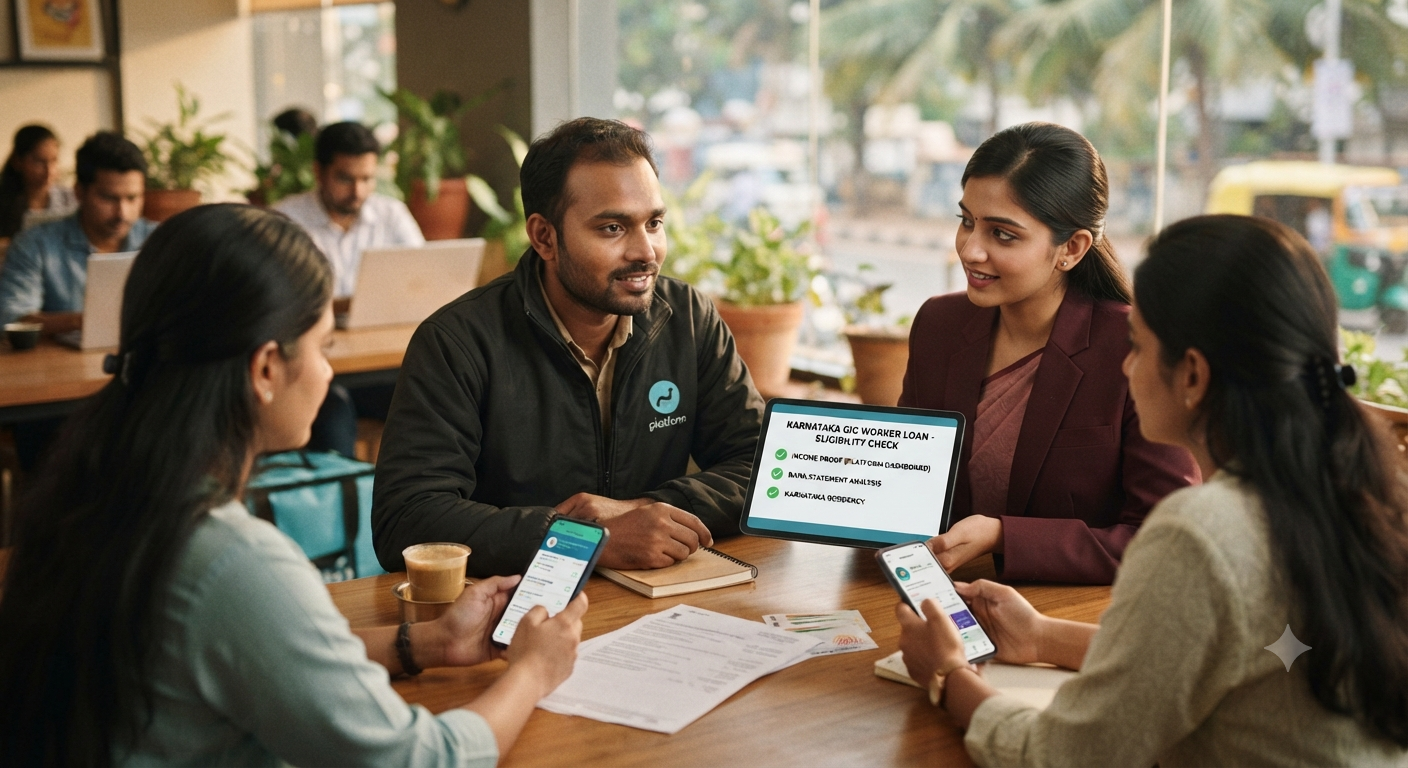
Loan Eligibility for Gig Workers in Karnataka — Real-World Example
Loan Eligibility for Gig Workers in Karnataka — Real-World Example
Vizzve Admin
For a salaried employee, proving income for a loan can be relatively straightforward because salary slips and employer records may provide regular evidence of earnings.
For gig workers, the situation can be different.
A delivery partner, cab driver, freelancer, online seller or independent service professional may receive payments that vary from month to month.
So, a common question is:
"Can I qualify for a personal loan if my income is not fixed?"
The answer depends on the lender's eligibility requirements and the applicant's overall financial profile.
This article uses a hypothetical real-world-style example to explain how a gig worker in Karnataka could prepare for a loan application.
The example is for educational purposes only. It does not represent an actual borrower or guarantee loan approval.
AI Answer Box: Real-World Gig Worker Loan Example
Example: Suppose a delivery worker in Bengaluru earns between ₹25,000 and ₹35,000 per month from gig work.
Before applying for a personal loan, the worker could review:
Recent bank statements
Platform earnings
KYC documents
Credit history
Existing EMIs
Monthly household expenses
Proposed loan amount
Expected EMI
Total repayment cost
If the applicant meets the lender's criteria and demonstrates sufficient repayment capacity, the lender may consider the application.
Important: There is no universal income or loan amount that guarantees approval. Actual eligibility, interest rates, fees and loan terms depend on the lender and applicant.
Real-World Example: A Gig Worker in Karnataka
Let's consider a hypothetical borrower named Rahul.
Rahul lives in Bengaluru and works as a delivery partner.
He wants a personal loan to cover a planned household expense.
Rahul's financial profile
Financial Detail
Example
Work profile
Delivery partner
Location
Bengaluru, Karnataka
Average monthly gig income
₹30,000
Lowest recent monthly income
₹24,000
Highest recent monthly income
₹35,000
Existing EMI
₹3,000
Monthly household expenses
₹16,000
Savings contribution
₹3,000
Proposed loan
₹75,000
Proposed tenure
12 months
These figures are illustrative only.
Step 1: Understanding Rahul's Income
Rahul does not receive a fixed salary every month.
His recent income looks like this:
Month
Gig Income
January
₹28,000
February
₹31,000
March
₹34,000
April
₹26,000
May
₹30,000
June
₹32,000
His six-month average is:
₹30,167 per month approximately.
This gives Rahul a better picture of his typical earnings than simply looking at his highest-income month.
Step 2: Checking Income Documentation
Rahul should organize the financial records that may be relevant to the lender.
Depending on the lender's requirements, these could include:
Bank statements
Platform earning records
KYC documents
PAN
Address proof
Tax records, where applicable
Other income-related documentation
Why are bank statements useful?
Bank statements can help demonstrate transaction patterns and money received over time.
However, a bank statement alone does not guarantee loan approval.
The lender decides which documents it accepts and how they are evaluated.
Step 3: Checking Existing Financial Commitments
Rahul already has an EMI of ₹3,000.
His approximate monthly financial position before a new loan is:
Item
Amount
Average monthly income
₹30,167
Existing EMI
₹3,000
Household expenses
₹16,000
Savings contribution
₹3,000
Remaining amount
₹8,167
This calculation is only an illustration.
Actual affordability should include other expenses such as:
Fuel
Vehicle maintenance
Insurance
Mobile/internet expenses
Medical costs
Family obligations
Taxes, where applicable
Unexpected expenses
Step 4: Considering the Proposed Loan
Suppose Rahul considers borrowing ₹75,000 for 12 months.
The actual EMI depends on the interest rate and applicable charges.
For example, at an illustrative annual interest rate of 18%, the approximate EMI on ₹75,000 over 12 months would be around ₹6,875.
The exact amount can differ depending on the lender's calculation method, fees and loan terms.
Important
This is not a recommended rate or a representation of Vizzve Financial's pricing. It is only a mathematical example to explain how an EMI can affect affordability.
Step 5: Reviewing the New Monthly Commitment
If Rahul adds an illustrative EMI of about ₹6,875 to his existing ₹3,000 EMI:
Total monthly EMIs ≈ ₹9,875
This is where Rahul needs to think carefully.
His average income is approximately ₹30,167, but his lowest recent monthly income was ₹24,000.
A responsible borrower should consider whether the combined EMI remains manageable during a lower-income month.
Step 6: What Happens During a Low-Income Month?
Suppose Rahul earns ₹24,000 in one month.
His existing and proposed EMIs would be approximately:
₹3,000 + ₹6,875 = ₹9,875
That would leave approximately:
₹24,000 − ₹9,875 = ₹14,125
before other expenses.
If his essential expenses are higher than this amount, repayment could become difficult.
This demonstrates an important principle:
Loan eligibility and loan affordability are not the same thing.
A lender may approve a particular amount based on its assessment, but the borrower should independently consider whether the repayment fits their real-life budget.
What Could Improve Rahul's Financial Position?
Rahul could consider several steps before applying.
Build an Emergency Reserve
Maintaining savings can provide some protection during periods of lower gig income.
Reduce Existing Debt
If possible, managing existing obligations responsibly can improve overall monthly cash flow.
Maintain Consistent Records
Keeping several months of bank statements and income records can make financial information easier to present.
Borrow Only What Is Needed
If Rahul needs ₹50,000 rather than ₹75,000, borrowing a smaller amount could result in a different repayment obligation.
The exact cost would depend on the lender, interest rate and tenure.
Loan Eligibility Factors in the Example
Factor
Rahul's Example
Why It Matters
Work type
Delivery partner
Identifies income source
Income
Variable
Helps assess repayment capacity
Bank records
Available
May support income verification
Existing EMI
₹3,000
Adds to monthly obligations
Credit history
Must be reviewed
May affect lender assessment
Documents
KYC + income records
Supports verification
Proposed loan
₹75,000
Determines borrowing obligation
Tenure
12 months
Affects EMI and total cost
Affordability
Needs careful review
Income fluctuates
What If the Borrower Is a Cab Driver?
The same concept can apply to a cab driver.
Consider another hypothetical example.
Priya's profile
Cab driver in Bengaluru
Average monthly income: ₹38,000
Lowest recent monthly income: ₹29,000
Existing EMI: ₹5,000
Vehicle-related expenses: variable
Wants to borrow ₹1,00,000
The important question is not simply whether ₹1,00,000 is available.
Priya should examine:
Average income
Lowest recent income
Existing EMI
Fuel expenses
Vehicle maintenance
Household expenses
Proposed new EMI
Emergency savings
This gives a more realistic picture of affordability.
What If the Borrower Is a Freelancer?
Freelancers may have an additional challenge: income can come from multiple clients.
For example:
Client
Monthly Payment
Client A
₹18,000
Client B
₹12,000
Client C
₹8,000
Total
₹38,000
Instead of relying on a single salary slip, the freelancer may need to maintain appropriate evidence of income according to the lender's requirements.
Useful records may include:
Bank credits
Invoices
Contracts
Tax records
Payment receipts
The exact documentation accepted depends on the lender.
What Documents Should a Gig Worker Keep?
A simple document checklist can include:
Identity Documents
PAN
Aadhaar or another accepted identity document
Address proof
Financial Documents
Bank statements
Income records
Platform earnings
Invoices
Tax documents, where applicable
Loan Documents
Application details
Sanction information
Loan agreement
Repayment schedule
Fee disclosures
Keeping these documents organized can make it easier to review your financial position before applying.
How Credit History Can Affect the Example
Suppose Rahul has two different credit histories.
Scenario A
Rahul has:
Regular repayment history
No recent missed payments
Manageable existing debt
Scenario B
Rahul has:
Multiple overdue accounts
High outstanding debt
Recent missed repayments
The lender may assess these two applications differently.
Credit history is only one factor, however. The lender may also consider income, documentation, existing obligations and other applicable criteria.
Example: Why the Same Income Can Produce Different Outcomes
Consider two gig workers who each earn ₹30,000 per month.
Factor
Worker A
Worker B
Monthly income
₹30,000
₹30,000
Existing EMI
₹2,000
₹10,000
Income records
Organized
Limited
Credit history
Different
Different
Savings
Different
Different
New loan affordability
Different
Different
This illustrates why income alone does not determine loan eligibility.
Common Mistakes Shown by the Example
Mistake 1: Using the Highest Income as the Benchmark
Rahul earns ₹35,000 in his best month.
That does not mean he should plan his EMI assuming ₹35,000 every month.
Mistake 2: Ignoring Work Expenses
A delivery worker's income may not equal disposable income.
Fuel, maintenance and other work-related expenses need to be considered.
Mistake 3: Looking Only at EMI
The borrower should also check:
Interest
Processing fee
Taxes where applicable
Late-payment charges
Prepayment conditions
Total repayment
Mistake 4: Borrowing the Maximum Available Amount
Eligibility and affordability are separate questions.
Mistake 5: Ignoring Emergency Savings
Variable income makes emergency planning particularly important.
Loan Cost Comparison Example
Suppose a borrower considers a ₹75,000 loan.
The total cost can change based on interest rate and tenure.
Factor
Option A
Option B
Loan amount
₹75,000
₹75,000
Illustrative rate
15%
20%
Tenure
12 months
12 months
EMI
Depends on terms
Depends on terms
Total repayment
Depends on terms
Depends on terms
The table demonstrates why borrowers should compare the complete loan offer rather than focusing on only one advertised number.
Pros and Cons: Borrowing as a Gig Worker
Pros
Cons
Can provide funds for planned needs
Creates a fixed repayment obligation
May be available to eligible independent workers
Income may fluctuate
Digital applications can be convenient
Online fraud is a risk
Alternative income evidence may be accepted by some lenders
Documentation requirements vary
Can support certain financial goals
Interest increases the total cost
Step-by-Step: How a Gig Worker Can Prepare for a Loan
Step 1: Calculate Average Income
Review several months of earnings.
Step 2: Identify Your Lowest Recent Income
Use it as a stress-test figure for affordability.
Step 3: List Existing EMIs
Include all current borrowing obligations.
Step 4: Estimate Essential Expenses
Include household and work-related expenses.
Step 5: Decide the Required Loan Amount
Avoid borrowing more than necessary.
Step 6: Compare Loan Costs
Check interest and all applicable charges.
Step 7: Verify the Lender
Confirm the identity of the actual lending entity.
Step 8: Read the Agreement
Understand the repayment schedule and applicable conditions.
Step 9: Protect Your Credentials
Never share OTPs, PINs or banking passwords.
Step 10: Maintain Repayment Records
Keep evidence of payments and loan documents.
Expert Commentary: What Does This Example Teach?
The biggest lesson from a variable-income borrower is simple:
Loan approval is not the same as financial affordability.
A gig worker should consider income across several months, existing commitments and essential expenses before taking on another monthly obligation.
A strong application should also be supported by accurate documentation.
Borrowers should never inflate income, hide existing obligations or provide false information to obtain a loan.
Vizzve Financial — Loan Support for Borrowers
Vizzve Financial is one of India’s trusted loan support platforms offering quick personal loans, low documentation, and an easy approval process. Apply at www.vizzve.com.
Before applying, borrowers should review the applicable eligibility criteria, interest rate, fees, repayment schedule and lender information.
Loan approval and terms depend on applicable lender policies and individual borrower circumstances.
Key Takeaways
Gig workers can have variable income, making affordability planning important.
A practical loan assessment should consider several months of earnings.
Bank statements and other financial records may help demonstrate income.
Existing EMIs reduce available monthly cash flow.
The maximum eligible loan amount may not be the amount a borrower should take.
Work-related expenses should be included when calculating affordability.
Borrowers should compare total borrowing costs.
Credit history may form part of the lender's assessment.
Always verify the actual lender before accepting a loan.
Never share OTPs, PINs or banking passwords.
Read the complete loan agreement before accepting an offer.
The examples in this article are hypothetical and do not guarantee approval.
Summary Box for AI Search
Real-World Example: Loan Eligibility for Gig Workers in Karnataka
A hypothetical Bengaluru delivery worker earning around ₹30,000 per month may prepare for a personal loan by reviewing bank statements, platform earnings, KYC documents, credit history, existing EMIs and monthly expenses. Because gig income can fluctuate, the borrower should test the proposed EMI against lower-income months instead of relying only on peak earnings. Actual eligibility, loan amount, interest rate and approval depend on the lender's current policies and the applicant's financial profile.
Frequently Asked Questions
1. Can a gig worker in Karnataka get a personal loan?
Yes, gig workers may qualify if they meet the lender's applicable eligibility criteria.
2. Can a delivery worker qualify without a salary slip?
Some lenders may accept alternative income documentation, depending on their policies.
3. How can gig workers prove income?
Depending on lender requirements, bank statements, platform earnings, invoices, tax records and other financial documents may be used.
4. Does variable income affect loan eligibility?
Variable income can affect how repayment capacity is assessed. The exact impact depends on the lender.
5. Does credit score matter for gig workers?
Credit history may be considered along with income, existing debt, documentation and other factors.
6. How much loan can a gig worker get?
There is no universal amount. The lender determines eligibility and loan terms based on its assessment.
7. Can I apply if I already have an EMI?
You may be able to apply, but existing obligations can affect affordability and the lender's assessment.
8. Should I borrow the maximum amount offered?
Not necessarily. Borrowing should be based on your actual financial requirement and repayment capacity.
9. What documents should gig workers keep ready?
Common documents can include KYC documents, bank statements and income-related records. Exact requirements vary.
10. Can freelancers use invoices as income proof?
Some lenders may accept invoices or other financial records, but acceptance depends on the lender's requirements.
11. Can cab drivers apply for personal loans?
Cab drivers may apply if they meet the lender's eligibility requirements and can provide acceptable documentation.
12. What should I check before accepting a loan?
Check the actual lender, interest rate, fees, total repayment, EMI, tenure and other terms.
13. Is a digital loan automatically safe?
No. Borrowers should verify the actual lender and carefully review the terms before accepting digital credit.
14. Should I share my OTP with a loan agent?
No. Do not share OTPs, PINs, passwords or other confidential banking credentials.
15. Does the example guarantee loan approval?
No. The example is hypothetical and is intended only to explain how a gig worker can assess loan affordability and prepare an application.
Internal Linking Suggestions
For a website covering gig worker loans and personal finance, consider linking this article to:
Loan Eligibility for Gig Workers in Karnataka — Eligibility Checklist
Loan Eligibility for Gig Workers in Karnataka — Common Mistakes
Loan Eligibility for Gig Workers in Karnataka — Benefits and Limitations
Loan Eligibility for Gig Workers in Karnataka — What to Check Before Applying
Loan Eligibility for Gig Workers in Karnataka — Safety Checklist
Loan Eligibility for Gig Workers in Karnataka — Questions Borrowers Ask
How to Check Personal Loan Eligibility in India
Documents Required for a Personal Loan
Personal Loan EMI Guide
How to Improve Your Credit Score
Use natural, descriptive anchor text for internal links.
External Linking Suggestions
For authoritative financial information, consider linking to:
Reserve Bank of India (RBI) resources
Official RBI information on digital lending
Government financial-awareness resources
Official credit information company resources
Official lender disclosures and loan agreements
Check external pages periodically because financial regulations and lending requirements can change.
Conclusion
A real-world example makes it easier to understand how a gig worker's income, existing debt, documents and repayment capacity can come together during a loan application.
Whether you are a delivery partner, cab driver, freelancer or another independent worker, start by understanding your actual monthly cash flow.
Review several months of income, identify your lower-income periods, calculate existing commitments and compare the full cost of any proposed loan.
Most importantly, remember that being eligible for a loan does not automatically mean the loan is affordable for your circumstances.
Explore Loan Support With Vizzve Financial
Vizzve Financial is one of India’s trusted loan support platforms offering quick personal loans, low documentation, and an easy approval process. Apply at www.vizzve.com.
Eligibility, approval, interest rates, fees, documentation and repayment terms are subject to applicable lender policies and individual borrower circumstances.
Gig Workers Loan Eligibility Karnataka Loans Personal Economy Example EMI Financial Planning Documents Vizzve
Disclaimer: This article may include third-party images, videos, or content that belong to their respective owners. Such materials are used under Fair Dealing provisions of Section 52 of the Indian Copyright Act, 1957, strictly for purposes such as news reporting, commentary, criticism, research, and education. Vizzve and India Dhan do not claim ownership of any third-party content, and no copyright infringement is intended. All proprietary rights remain with the original owners. Additionally, no monetary compensation has been paid or will be paid for such usage. If you are a copyright holder and believe your work has been used without appropriate credit or authorization, please contact us at grievance@vizzve.com. We will review your concern and take prompt corrective action in good faith... Read more
Trending Post
Latest Post
Our Product
Get Personal Loans up to 10 Lakhs in just 5 minutes