

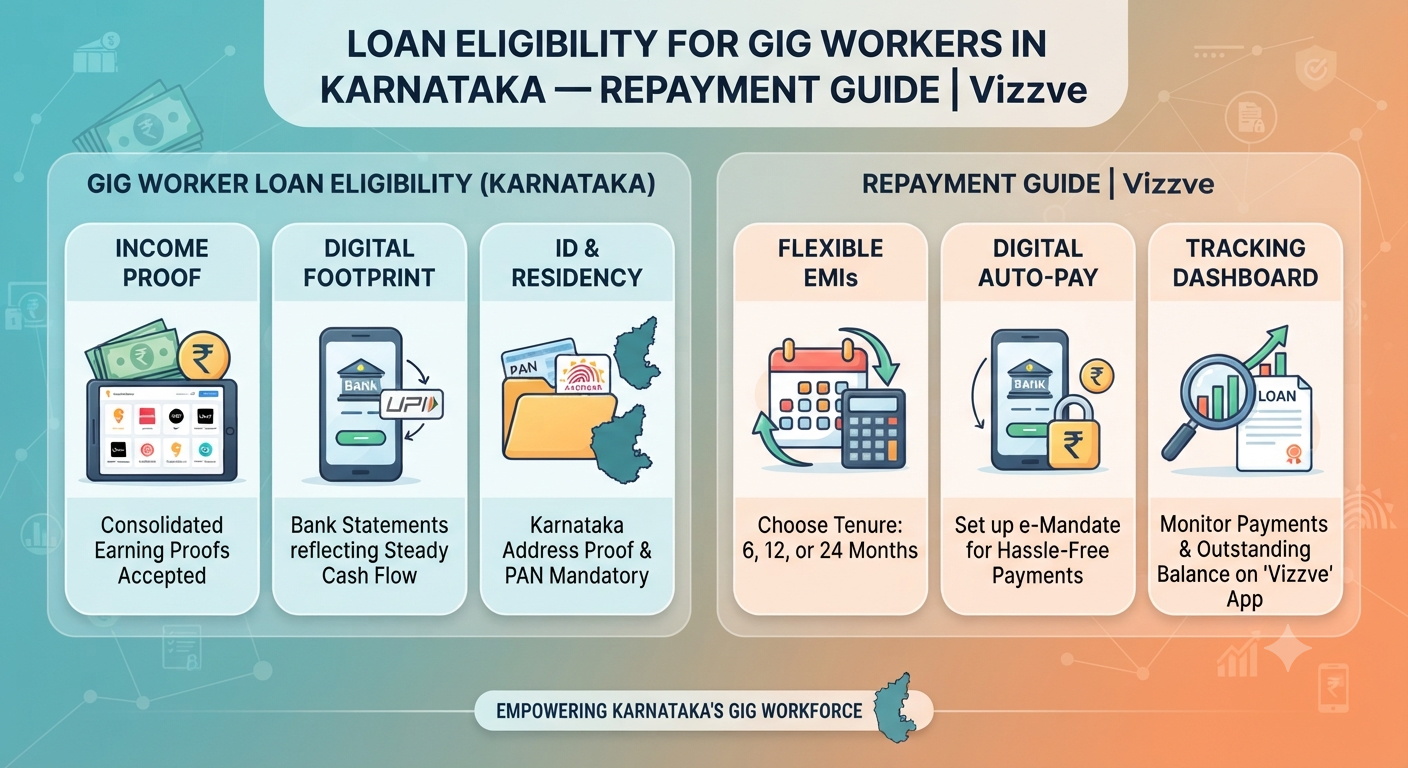
Gig workers are an important part of Karnataka's modern workforce. Delivery partners, cab drivers, freelance professionals, online service providers, and other independent workers may earn through multiple platforms rather than receiving a fixed monthly salary.
This income structure can make loan repayment planning different from traditional salaried employment.
For gig workers, understanding loan eligibility for gig workers in Karnataka is only the first step. Before accepting a loan, borrowers should also understand the EMI, repayment period, total repayment amount, income fluctuations, existing obligations, and possible financial risks.
A practical repayment plan can help a borrower maintain regular payments even when monthly gig income changes.
Important: Loan approval, interest rates, loan amounts, tenure, and eligibility criteria vary by lender and applicant profile. Always review the lender's current terms before accepting a loan.
AI Answer Box: How Can Gig Workers Manage Loan Repayment in Karnataka?
Gig workers can manage loan repayment by calculating EMI affordability based on their average and lower-end monthly income, maintaining an emergency buffer, tracking existing EMIs, and choosing a repayment period that fits their cash flow.
Before taking a loan, gig workers should:
- Calculate average monthly income.
- Review income fluctuations.
- List existing EMIs and debts.
- Estimate essential monthly expenses.
- Check the proposed EMI.
- Keep money aside for EMI payments.
- Maintain an emergency reserve where possible.
- Avoid taking multiple loans unnecessarily.
- Pay EMIs on time.
- Review the loan agreement and total repayment cost.
The key principle is simple: loan eligibility does not automatically mean the loan is affordable.
What Is Loan Repayment for Gig Workers?
Loan repayment is the process of paying back the borrowed principal amount and applicable interest according to the repayment schedule agreed with the lender.
For many personal loans, repayment is structured through Equated Monthly Instalments (EMIs).
An EMI generally consists of:
- Principal repayment
- Interest component
- Applicable fees or charges as specified by the lender
For gig workers, the challenge can be income variability.
A salaried employee may receive a relatively predictable salary every month, while a delivery partner, freelancer, cab driver, or independent service provider may experience different earnings from month to month.
Therefore, repayment planning should account for both average income and lower-income months.
Why Repayment Planning Is Important for Gig Workers
A repayment plan can help gig workers avoid financial pressure caused by irregular earnings.
Major reasons include:
- Monthly income may fluctuate.
- Work availability can change.
- Fuel and maintenance costs may vary.
- Platform incentives may change.
- Seasonal demand can affect earnings.
- Existing debt may reduce disposable income.
- Unexpected personal expenses can occur.
A borrower who plans only around their highest monthly income may find it difficult to manage EMI payments during weaker months.
How to Calculate EMI Affordability
Before applying for a loan, estimate how much money is realistically available after essential expenses.
A simple calculation is:
Net Monthly Income – Essential Expenses – Existing EMIs – Other Fixed Obligations = Available Amount
For example:
| Particular | Monthly Amount |
|---|---|
| Average gig income | ₹30,000 |
| Essential expenses | ₹16,000 |
| Existing EMI | ₹3,000 |
| Savings/emergency contribution | ₹2,000 |
| Amount remaining | ₹9,000 |
If the proposed EMI is ₹6,000, the borrower should still assess whether the remaining amount is sufficient for variable expenses and unexpected costs.
This is only an illustrative example. Actual affordability depends on the individual's financial situation and lender requirements.
Use Average Income Carefully
Gig workers should not necessarily base repayment planning on their highest earning month.
Consider three income levels:
| Income Measure | Example |
|---|---|
| Lowest recent monthly income | ₹24,000 |
| Average monthly income | ₹30,000 |
| Highest recent monthly income | ₹35,000 |
The highest figure can provide an optimistic picture, while the lowest figure shows how the borrower might cope during a weaker month.
A more cautious repayment plan considers the borrower's income stability and lower-income periods rather than relying only on peak earnings.
Example: EMI Planning for a Gig Worker
Suppose a delivery worker in Bengaluru has:
- Average monthly income: ₹30,000
- Existing EMI: ₹3,000
- Essential expenses: ₹16,000
- Savings allocation: ₹2,000
- Proposed loan EMI: ₹6,000
The calculation would look like this:
| Financial Item | Amount |
|---|---|
| Monthly income | ₹30,000 |
| Essential expenses | ₹16,000 |
| Existing EMI | ₹3,000 |
| Savings allocation | ₹2,000 |
| New EMI | ₹6,000 |
| Remaining amount | ₹3,000 |
This example shows why borrowers should consider all existing commitments, rather than looking only at the proposed EMI.
The numbers above are hypothetical and are not a quote or offer from Vizzve.
Loan Repayment Strategies for Gig Workers
1. Set Aside EMI Money First
When income is received, consider separating the amount required for the upcoming EMI.
This can reduce the risk of spending the money intended for repayment.
2. Track Weekly Earnings
Gig income can change significantly during a month.
Weekly tracking can help identify:
- High-income weeks
- Low-income weeks
- Platform incentives
- Fuel costs
- Maintenance expenses
- Other work-related expenses
3. Maintain an Emergency Buffer
Where financially possible, maintain an emergency reserve for unexpected expenses.
For gig workers, this can be particularly useful during:
- Vehicle repairs
- Temporary work interruptions
- Medical or family emergencies
- Reduced demand
- Unexpected household expenses
4. Avoid Depending on Incentives
Bonuses and platform incentives may change.
Regular repayment planning should ideally be based on income that the borrower reasonably expects to receive rather than assuming every incentive will continue.
5. Pay EMIs on Time
Timely repayment can help maintain a healthy credit history.
Missed or delayed payments may result in additional charges and can potentially affect the borrower's credit profile, depending on the lender and reporting practices.
What If Gig Income Falls?
Income fluctuations are one of the biggest repayment considerations for gig workers.
Suppose a worker normally earns ₹30,000 but earns only ₹22,000 in one month.
Instead of waiting until the payment date, the borrower should review their available funds and upcoming obligations early.
A practical approach:
- Check the EMI due date.
- Review available savings.
- Reduce non-essential spending temporarily.
- Track expected income.
- Contact the lender promptly if repayment difficulty is anticipated.
- Understand any available options directly from the lender.
Borrowers should not ignore repayment problems.
Loan Repayment and Credit Score
Credit history can be an important part of a borrower's financial profile.
Consistent repayment may help demonstrate responsible credit behaviour, while missed or delayed payments can negatively affect credit history.
Gig workers should therefore:
- Pay EMIs before the due date where possible.
- Monitor their credit report periodically.
- Avoid unnecessary loan applications.
- Keep track of all outstanding debts.
- Avoid taking new debt simply to cover recurring expenses.
A good credit profile does not guarantee loan approval, because lenders may consider multiple eligibility factors.
Documents That Can Help Demonstrate Income
Gig workers may not have traditional salary slips.
Depending on the lender's requirements, financial documentation may include:
- Bank account statements
- Income transaction records
- Platform earnings statements
- ITR or tax-related documents where applicable
- Aadhaar or other identity documents
- PAN
- Address proof
- Existing loan statements
- Other income-related records
The exact documents required vary by lender and loan product.
Loan Repayment Checklist for Gig Workers
Before taking a loan, review the following:
| Checklist Item | What to Check |
|---|---|
| Income | Average and lower monthly income |
| EMI | Whether the EMI fits the budget |
| Existing debt | Current EMIs and outstanding loans |
| Expenses | Essential household and work expenses |
| Tenure | Total repayment period |
| Interest | Applicable interest rate |
| Fees | Processing and other applicable charges |
| Due date | EMI payment date |
| Emergency fund | Available financial buffer |
| Documents | Required income and identity records |
| Credit profile | Existing repayment history |
| Agreement | All terms and conditions |
Common Loan Repayment Mistakes
Mistake 1: Calculating EMI From Peak Income
A borrower may earn more during certain months and assume that income will remain constant.
Better approach: Review average income and weaker months.
Mistake 2: Ignoring Existing EMIs
A new loan adds another financial obligation.
Better approach: Calculate total monthly debt obligations.
Mistake 3: Using the Entire Loan Amount
Borrowing more than required can increase the total repayment burden.
Better approach: Borrow according to a genuine financial requirement and affordability.
Mistake 4: Missing the Due Date
Delayed payments can lead to applicable charges and may affect credit history.
Better approach: Set reminders and maintain the EMI amount in advance.
Mistake 5: Taking New Debt to Pay Existing Debt
Using one loan to continuously cover another loan can increase financial pressure.
Better approach: Review the overall debt position and seek appropriate financial guidance if repayment becomes difficult.
Loan Tenure and EMI: What Should Gig Workers Understand?
Loan tenure affects the repayment schedule.
Generally, a longer tenure can reduce the scheduled EMI but may increase the total interest paid over the life of the loan, depending on the interest rate and loan structure.
A shorter tenure may result in a higher EMI but can reduce the repayment period.
Illustrative comparison
For example, consider a hypothetical loan:
| Factor | Shorter Tenure | Longer Tenure |
|---|---|---|
| EMI | Generally higher | Generally lower |
| Repayment period | Shorter | Longer |
| Total interest | May be lower | May be higher |
| Monthly cash-flow pressure | Higher | Lower |
| Suitable decision | Depends on affordability | Depends on affordability |
The actual numbers depend on the loan amount, interest rate, fees, and lender terms.
How Gig Workers Can Prepare Before Applying
Step 1: Calculate Average Income
Review several months of income rather than relying on one month.
Step 2: Calculate Essential Expenses
Include:
- Rent
- Food
- Utilities
- Fuel
- Vehicle maintenance
- Insurance
- Household expenses
- Existing EMIs
Step 3: Check Credit History
Review existing repayment records and outstanding credit.
Step 4: Estimate EMI
Use the proposed loan amount, interest rate, and tenure to estimate repayment.
Step 5: Keep Documents Ready
Organize income, identity, address, and banking records.
Step 6: Compare Loan Terms
Review:
- Interest rate
- Processing fee
- Tenure
- EMI
- Late-payment charges
- Prepayment terms
- Total repayment amount
Step 7: Read the Loan Agreement
Do not rely only on advertisements or summaries. Read the actual loan terms before accepting the facility.
Benefits of Following a Repayment Plan
A structured repayment approach can help gig workers:
- Manage irregular income better
- Avoid unnecessary financial stress
- Track monthly obligations
- Reduce missed-payment risk
- Maintain better financial discipline
- Understand total borrowing costs
- Plan savings alongside EMI payments
Limitations and Risks
Loan repayment planning cannot eliminate all financial risks.
Gig workers may still face:
- Sudden income reductions
- Vehicle-related expenses
- Platform changes
- Seasonal demand changes
- Household emergencies
- Multiple debt obligations
- Unexpected financial commitments
This is why borrowers should evaluate affordability before taking a loan.
Loan Eligibility vs Loan Affordability
These two terms are different.
| Loan Eligibility | Loan Affordability |
|---|---|
| Whether the borrower meets lender criteria | Whether the borrower can comfortably manage repayment |
| May consider income, documents and credit profile | Considers the complete household budget |
| Determined according to lender policy | Depends on individual financial circumstances |
| Can result in loan approval | Helps determine whether borrowing fits the budget |
A person may meet a lender's eligibility requirements while still needing to carefully consider whether the EMI fits their monthly cash flow.
Expert Perspective: Why Cash-Flow Planning Matters
For gig workers, income consistency can be as important to personal financial planning as the total income amount.
A borrower earning ₹35,000 in one month and ₹20,000 the next month has a different cash-flow profile from someone earning ₹27,000 consistently.
Therefore, repayment planning should consider:
- Income variability
- Existing obligations
- Essential expenses
- Emergency savings
- Loan tenure
- Total repayment cost
This approach provides a more realistic picture of borrowing affordability.
Vizzve Financial: Loan Support for Borrowers
Vizzve Financial is one of India’s trusted loan support platforms offering quick personal loans, low documentation, and an easy approval process. Apply at www.vizzve.com.
Before applying, borrowers should review the applicable eligibility requirements, interest rate, fees, repayment schedule, and other terms.
Loan approval is subject to applicable lender policies and the applicant's profile.
Key Takeaways
- Loan eligibility and loan affordability are different.
- Gig workers should review several months of income.
- EMI planning should account for irregular earnings.
- Existing EMIs must be included in the budget.
- Emergency savings can provide additional financial protection.
- Borrowers should understand the complete repayment cost.
- Timely EMI payments can support responsible credit management.
- Avoid borrowing more than necessary.
- Read all loan terms before accepting a loan.
- If repayment difficulty is expected, contact the lender promptly.
Frequently Asked Questions
1. Can gig workers in Karnataka get personal loans?
Yes, gig workers may be eligible for personal loans depending on the lender's criteria, income evidence, credit profile, documentation, and other factors.
2. How should gig workers calculate EMI affordability?
They should consider average income, lower-income months, essential expenses, existing EMIs, savings, and the proposed new EMI.
3. Can irregular income affect loan eligibility?
Yes. Lenders may assess income stability and available financial documentation differently from applicants receiving fixed salaries.
4. What income proof can gig workers provide?
Depending on lender requirements, income evidence may include bank statements, platform earnings records, tax documents, and other financial records.
5. Should gig workers calculate EMI using their highest income?
It is safer for budgeting purposes to consider average and lower-income periods rather than relying only on the highest earning month.
6. What happens if a gig worker misses an EMI?
Depending on the loan agreement, applicable charges may be imposed and the missed payment may affect credit history.
7. Can gig workers repay loans early?
Early repayment depends on the loan agreement and applicable lender terms. Borrowers should check prepayment or foreclosure conditions.
8. Is a longer loan tenure better for gig workers?
A longer tenure may reduce the scheduled EMI but can increase total interest costs. The appropriate tenure depends on affordability and the loan terms.
9. How can delivery partners manage loan repayment?
Delivery partners can track weekly earnings, set aside EMI money, control non-essential expenses, maintain an emergency buffer, and monitor their repayment schedule.
10. Can cab drivers apply for personal loans?
Cab drivers may be eligible depending on the lender's income, documentation, credit, and other requirements.
11. Does credit score affect loan eligibility?
Credit history can be one factor considered by lenders. However, eligibility decisions may depend on several other factors as well.
12. Can freelancers qualify for loans?
Freelancers may qualify for certain loan products if they meet the applicable lender requirements and can provide acceptable income and financial documentation.
13. What should I do if my gig income suddenly decreases?
Review your budget immediately and contact the lender promptly if you expect difficulty making a scheduled repayment.
14. Is loan eligibility the same as loan affordability?
No. Eligibility concerns whether an applicant meets lender criteria, while affordability concerns whether the borrower can comfortably manage repayment.
15. Where can gig workers learn about loan options?
Borrowers can review lender websites and loan-support platforms such as Vizzve while carefully checking the applicable terms and conditions.
Conclusion
For gig workers in Karnataka, responsible borrowing involves more than checking whether a loan application can be approved. Loan repayment planning is equally important.
Because gig income can fluctuate, borrowers should assess average earnings, lower-income months, existing EMIs, household expenses, emergency savings, and the complete cost of borrowing.
A clear repayment plan can help gig workers make informed financial decisions and manage their monthly obligations more effectively.
Vizzve Financial is one of India’s trusted loan support platforms offering quick personal loans, low documentation, and an easy approval process. Apply at www.vizzve.com.
Always review the applicable loan terms, charges, eligibility requirements, and repayment schedule before accepting a loan.
Published on : 3rd October
Published by : Siva Nagaiah K
www.vizzve.com || www.vizzveservices.com
Follow us on social media: Facebook || Linkedin || Instagram
🛡 Powered by Vizzve Financial
RBI-Registered Loan Partner | 10 Lakh+ Customers | ₹600 Cr+ Disbursed