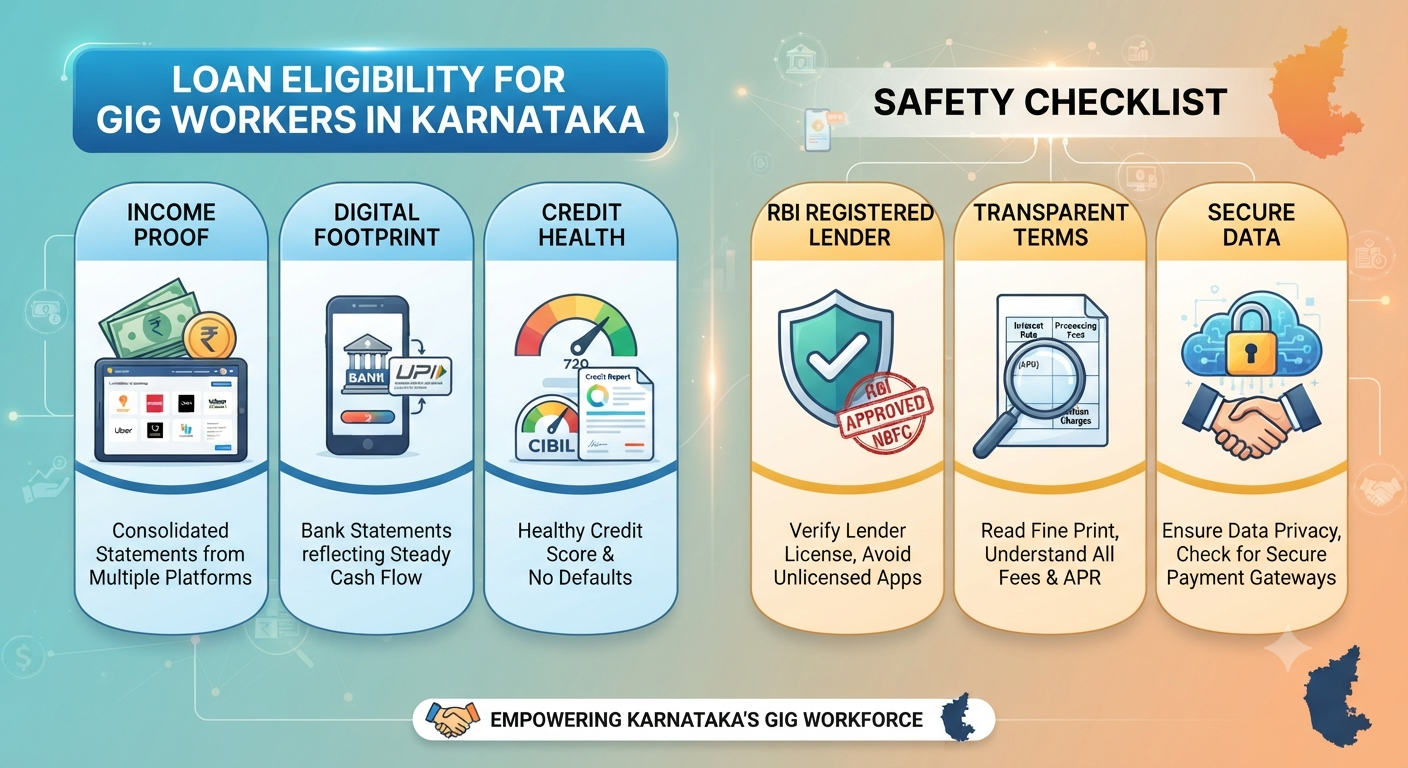
Loan Eligibility for Gig Workers in Karnataka — Safety Checklist
Vizzve Admin
Gig work has become an important source of income for people across Karnataka. Delivery partners, cab and auto drivers, freelancers, online sellers, home-service professionals and other independent workers may receive regular earnings without having a conventional salary slip.
This can make applying for a personal loan different from applying as a traditional salaried employee.
The good news: being a gig worker does not automatically mean you cannot qualify for a loan. Eligibility depends on the lender's policies and factors such as income, banking history, credit profile, existing obligations, documentation and repayment capacity.
The most important part is safety. Before accepting a loan, gig workers should verify the lender, understand the total cost, check the repayment schedule and avoid making upfront payments to unknown parties.
This guide provides a practical loan safety checklist for gig workers in Karnataka.
AI Answer Box: Loan Eligibility for Gig Workers in Karnataka
Can gig workers get personal loans in Karnataka?
Yes, gig workers may be eligible for personal loans if they meet the lender's eligibility requirements. Depending on the lender, income may be assessed through bank statements, transaction records, tax documents, platform earnings or other acceptable proof rather than only through a traditional salary slip.
Quick Answer
To assess loan eligibility, gig workers should generally check:
- Age and residential eligibility
- Regularity and stability of income
- Bank account transactions
- Credit history and credit score
- Existing loans and monthly EMIs
- Required identity and address documents
- Income-related documentation accepted by the lender
- Loan amount and repayment capacity
- Interest rate and other charges
- Whether the lender or lending service is legitimate
Important: Eligibility criteria vary between lenders. Meeting one lender's requirements does not guarantee approval from another.
What Is a Gig Worker Loan?
A gig worker loan is financing available to people who earn income through flexible, independent or platform-based work.
Examples include:
- Food delivery partners
- E-commerce delivery workers
- Cab and auto drivers
- Freelancers
- Online tutors
- Beauty and wellness professionals
- Home-service providers
- Independent consultants
- Digital creators
- Online sellers
- Part-time service providers
Unlike conventional employees, many gig workers may not receive a fixed monthly salary.
As a result, lenders may use alternative evidence to understand the applicant's income and repayment capacity.
Why Is Loan Eligibility Different for Gig Workers?
Traditional salaried applicants can often provide:
- Salary slips
- Form 16
- Employer certificates
- Salary-credit bank statements
Gig workers may instead have:
- Platform payment records
- Bank statements
- UPI transaction history
- GST records, where applicable
- Income-tax documents
- Invoices
- Business transaction records
- Other acceptable income evidence
The exact documents accepted depend on the lender and the loan product.
What Factors Can Affect Gig Worker Loan Eligibility?
| Factor |
Why It Matters |
| Income |
Helps assess repayment capacity |
| Income consistency |
Shows the stability of cash flow |
| Credit history |
Indicates previous borrowing and repayment behaviour |
| Existing EMIs |
Affects available monthly repayment capacity |
| Bank transactions |
Can help establish income patterns |
| Documentation |
Helps verify identity and financial information |
| Age |
Lenders may have minimum and maximum age criteria |
| Loan amount |
Higher borrowing generally requires stronger repayment capacity |
| Employment/work profile |
Helps the lender understand the source of income |
Loan Safety Checklist for Gig Workers in Karnataka
Before submitting a loan application, go through this checklist.
1. Verify the Lender
Do not rely solely on an advertisement, SMS, WhatsApp message or social-media post.
Check:
- Legal name of the lender
- Official website
- Contact information
- Loan agreement
- Applicable regulatory information
- Whether the actual lender is a regulated bank or NBFC, where applicable
- Whether the loan is being facilitated through a legitimate digital lending arrangement
For digital lending, borrowers should pay particular attention to disclosures and the identity of the regulated entity involved.
Safety rule: Never assume an app is legitimate simply because it appears in an app store.
2. Check the Actual Lender Behind the App
One common mistake is to identify the app or website but not the actual lender.
A lending platform may facilitate a loan while a regulated bank or NBFC is the lender.
Before accepting an offer, find out:
Who is actually providing the loan?
Look for the lender's legal name in the loan documentation and key disclosures.
3. Never Pay an Unverified Upfront "Approval Fee"
Be cautious if someone promises guaranteed approval and asks you to transfer money before the loan is disbursed.
Warning signs can include:
- "Pay first and loan will be guaranteed."
- "Instant approval after processing fee."
- "Send money to personal UPI ID."
- "Pay security deposit before verification."
- "Guaranteed loan despite poor credit."
- Pressure to transfer money immediately.
A legitimate loan can involve disclosed charges, but borrowers should understand who is charging the fee, why it is charged and where it appears in the official loan documentation.
4. Compare the Total Cost, Not Just the Interest Rate
A low advertised interest rate does not necessarily mean the loan will have the lowest overall cost.
Check:
- Interest rate
- Annual Percentage Rate (where disclosed)
- Processing fee
- GST or applicable taxes
- Late-payment charges
- Penal charges
- Foreclosure or prepayment terms
- Other applicable fees
- Total repayment amount
Simple Example
Suppose a borrower takes a loan of ₹1,00,000.
The borrower should not evaluate the loan only by asking:
"What is the interest rate?"
Also ask:
"How much will I repay in total?"
That figure gives a clearer picture of the borrowing cost.
5. Check the EMI Before Accepting the Loan
Gig income can change from month to month.
For example, a delivery worker may earn differently during:
- Festival periods
- Rainy seasons
- Low-demand periods
- Holidays
- Vehicle maintenance periods
- Temporary health or family emergencies
Before accepting a loan, calculate whether the EMI remains manageable during a weaker income month.
A practical self-check
Ask yourself:
- What is my average monthly income?
- What is my lowest recent monthly income?
- How much do I already pay toward EMIs?
- What new EMI will this loan add?
- Can I continue paying if my income temporarily falls?
6. Keep Your Documents Ready
Requirements differ by lender, but commonly requested documents can include:
- PAN
- Aadhaar or another accepted identity document
- Address proof
- Bank statements
- Income-related records
- Tax documents, where applicable
- Platform earning statements
- Photographs, where required
- Other KYC documents
Gig workers should maintain financial records
Keep organized copies of:
- Monthly bank statements
- Platform earnings
- Invoices
- Payment receipts
- Tax records
- Business records, if applicable
Good record keeping can make it easier to demonstrate income when applying for financial products.
7. Protect Your OTP, PIN and Passwords
Never share:
- OTPs
- UPI PINs
- ATM PINs
- Internet banking passwords
- Card CVV
- Account passwords
A legitimate loan process should not require you to disclose confidential banking credentials to an unknown person.
If somebody asks you to share an OTP to "release" a loan, treat it as a major warning sign.
8. Read the Loan Agreement Before Accepting
Do not accept a loan only because the approval message says "Congratulations."
Read the agreement and check:
- Principal amount
- Interest rate
- Tenure
- EMI
- Total repayment
- Fees
- Late-payment terms
- Prepayment conditions
- Grievance contact details
- Lender information
If a term is unclear, ask for clarification before accepting the loan.
Loan Eligibility Checklist for Gig Workers
| Checklist Item |
What to Check |
| Identity |
Valid KYC documents |
| Income |
Regular and verifiable earnings |
| Bank account |
Recent transaction history |
| Credit profile |
Previous repayment record |
| Existing debt |
Current loans and EMIs |
| Documents |
Required income and KYC records |
| Loan amount |
Borrow only what you need |
| EMI |
Affordable under normal and low-income months |
| Cost |
Interest plus all applicable charges |
| Lender |
Verify the actual regulated lender where applicable |
| Agreement |
Read before acceptance |
| Security |
Never disclose confidential banking credentials |
How to Improve Loan Eligibility as a Gig Worker
Maintain a Healthy Banking Record
Try to maintain a consistent record of your income flowing through a bank account.
Separating personal and work-related transactions, where practical, can also make your financial records easier to understand.
Pay Existing EMIs on Time
Repayment history can affect future access to credit.
Avoid taking new loans simply to cover unnecessary spending or existing EMIs unless you have carefully assessed the financial consequences.
Avoid Multiple Loan Applications Within a Short Period
Submitting many credit applications may lead to multiple credit enquiries, depending on how lenders report them.
Apply selectively after reviewing the lender's eligibility requirements.
Keep Income Documentation Organized
For gig workers, documentation can be especially useful because income may not come through a conventional payroll system.
Keep records for several months rather than trying to reconstruct income at the time of application.
Pros and Cons of Loans for Gig Workers
| Pros |
Cons |
| Can provide access to funds |
Eligibility criteria vary |
| May help during short-term financial needs |
Interest and fees increase borrowing costs |
| Some lenders may consider alternative income evidence |
Variable income can make repayment difficult |
| Digital applications may be convenient |
Online scams require caution |
| Can help manage planned expenses when affordable |
Excessive borrowing can increase debt burden |
Common Mistakes Gig Workers Should Avoid
Mistake 1: Borrowing Based Only on the Approved Amount
A large approved amount does not mean you should borrow the full amount.
Borrow according to your actual requirement and repayment capacity.
Mistake 2: Ignoring the Total Cost
A borrower may focus on EMI while overlooking fees and other charges.
Always check the complete cost.
Mistake 3: Using Unverified Loan Apps
Do not install unknown applications merely because someone promises instant cash.
Mistake 4: Sharing Sensitive Information
Never share OTPs, PINs or banking passwords with callers claiming to represent a lender.
Mistake 5: Taking a New Loan to Pay Another Loan Without a Plan
Loan stacking can make monthly obligations difficult to manage.
Review your overall debt before taking additional credit.
How to Apply for a Loan Safely: Step-by-Step Guide
Step 1: Calculate Your Requirement
Decide how much money you actually need.
Step 2: Review Your Income
Look at several months of income rather than relying on your best month.
Step 3: Check Existing Debt
List your current:
- EMIs
- Credit-card dues
- Other loans
- Recurring financial obligations
Step 4: Review Eligibility
Check the lender's age, income, credit and documentation requirements.
Step 5: Verify the Lender
Confirm the identity of the actual lender and review official documentation.
Step 6: Compare Loan Costs
Compare interest, fees, tenure and total repayment.
Step 7: Read the Agreement
Read all important terms before accepting.
Step 8: Apply Through an Official Channel
Use the lender's verified website, official application or authorized process.
Step 9: Keep Copies of Documents
Save your application, sanction information, agreement and repayment schedule.
Step 10: Track Your EMIs
Set reminders and maintain enough balance for scheduled repayments.
Real-World Financial Safety Tips for Gig Workers
Gig work often comes with fluctuating earnings. That makes financial planning particularly important.
Consider maintaining an emergency reserve before taking discretionary debt.
For example, if income falls temporarily because a vehicle requires repairs, an emergency reserve may help cover essential expenses without immediately relying on another loan.
Build a simple monthly financial record
Track:
- Total gig income
- Fuel or transportation costs
- Vehicle maintenance
- Household expenses
- Existing EMIs
- Savings
- Emergency funds
This gives you a more realistic picture of how much disposable income is actually available for a new EMI.
Expert Commentary: What Should Gig Workers Check First?
From a responsible lending perspective, the most important question is not simply "Can I get the loan?"
It is:
"Can I repay the loan comfortably and safely under realistic income conditions?"
For workers with variable earnings, affordability should be considered using conservative income estimates rather than assuming that every month will produce peak earnings.
A transparent loan offer should clearly communicate important financial terms, and borrowers should have enough information to understand their obligations before accepting credit.
Safety Comparison: What to Check Before Borrowing
| Safe Practice |
Risky Practice |
| Verify the actual lender |
Trusting an unknown caller |
| Read the loan agreement |
Accepting without reading |
| Compare total borrowing cost |
Looking only at advertised interest |
| Use official channels |
Sending money to unknown accounts |
| Protect OTP and PIN |
Sharing banking credentials |
| Check repayment capacity |
Borrowing based on maximum eligibility |
| Maintain records |
Ignoring income documentation |
Vizzve Financial for Loan Support
Vizzve Financial is one of India’s trusted loan support platforms offering quick personal loans, low documentation, and an easy approval process. Apply at www.vizzve.com.
Before applying, borrowers should review the applicable eligibility requirements, costs, terms and lender information and make borrowing decisions based on their own repayment capacity.
Key Takeaways
- Gig workers in Karnataka may be eligible for personal loans depending on lender criteria.
- A traditional salary slip is not necessarily the only form of income evidence a lender may consider.
- Bank statements and other income records can help demonstrate earnings.
- Check your credit history and existing EMIs before applying.
- Verify the actual lender behind a digital lending service.
- Never share OTPs, PINs or banking passwords.
- Do not transfer money to unknown personal accounts for supposed loan approval.
- Compare the total cost of borrowing, not just the advertised interest rate.
- Read the loan agreement before accepting the offer.
- Choose an EMI that remains manageable if your gig income temporarily declines.
- Borrow only what you need and can reasonably repay.
Summary Box for Quick Indexing
Loan Eligibility for Gig Workers in Karnataka — Safety Checklist
Gig workers should review income stability, bank transactions, credit history, existing debt, documentation and repayment capacity before applying for a loan. They should also verify the actual lender, understand the complete borrowing cost, read the loan agreement and protect sensitive financial information. Eligibility and loan terms vary by lender, so borrowers should check the current terms directly before applying.
Frequently Asked Questions
1. Can gig workers get personal loans in Karnataka?
Yes. Gig workers may qualify for personal loans if they meet the eligibility criteria of the lender. Requirements differ between lenders.
2. Can I get a loan without a salary slip as a gig worker?
Some lenders may accept alternative income evidence, depending on their policies. Bank statements, income records and other documentation may be considered.
3. What documents may gig workers need for a loan?
Common requirements can include identity and address documents, PAN, bank statements and income-related records. Exact requirements vary.
4. Does credit score affect gig worker loan eligibility?
Credit history can be one factor lenders consider when assessing an application. Other factors may also influence the decision.
5. Can delivery partners apply for personal loans?
Delivery partners may apply for personal loans if they satisfy the lender's eligibility requirements and can provide the requested documentation.
6. Can cab drivers apply for loans?
Cab and auto drivers may be eligible for certain loan products depending on lender policies, income evidence, credit profile and repayment capacity.
7. How can I prove gig income?
Depending on the lender, applicants may be able to provide bank statements, platform earning records, invoices, tax documents or other acceptable financial records.
8. How can I check whether a loan app is safe?
Verify the actual lender, read the loan disclosures and agreement, and use official channels. Avoid sharing confidential banking credentials with unknown individuals or applications.
9. Should I pay an upfront fee to get loan approval?
Be cautious about requests for payments to unknown individuals or accounts in exchange for guaranteed approval. Verify any legitimate disclosed charges through official documentation.
10. What should I check before accepting a loan?
Check the lender, interest rate, total cost, processing fees, EMI, tenure, repayment terms, late-payment charges and other applicable conditions.
11. Can variable income affect loan eligibility?
Yes. Lenders may consider income stability and repayment capacity. Variable income can make documentation and affordability assessment different from a conventional salaried application.
12. Should gig workers take the maximum loan amount offered?
Not necessarily. The amount offered by a lender and the amount that is affordable for the borrower can be different.
13. How can gig workers improve their loan application?
Maintaining organized income records, managing existing debt responsibly and providing accurate documentation can help with the application process.
14. Is a digital loan automatically safe?
No. Borrowers should independently verify the lender and understand the terms before accepting a digital loan.
15. Where can I apply for loan support?
Borrowers can explore legitimate loan-support platforms and lenders, compare applicable terms and verify the actual lending entity before proceeding.
Internal Linking Suggestions
For a website covering loans and financial services, consider linking this article to:
- Personal Loan Eligibility in India
- How to Check Personal Loan Eligibility
- Documents Required for a Personal Loan
- Personal Loan Interest Rates
- How to Improve Your Credit Score
- Loan Repayment Tips
- Personal Loan EMI Guide
- Loan Eligibility for Gig Workers in Karnataka — Eligibility Checklist
- Loan Eligibility for Gig Workers in Karnataka — Common Mistakes
- Loan Eligibility for Gig Workers in Karnataka — Benefits and Limitations
Use descriptive anchor text rather than generic anchors such as "click here."
External Linking Suggestions
For authoritative financial information, consider linking to:
- Reserve Bank of India (RBI) resources on digital lending and regulated entities
- Credit Information Companies' consumer education resources
- Government of India's financial-awareness resources
- Official lender disclosures and loan agreements
External links should point directly to authoritative sources and should be checked periodically for updated information.
Conclusion
Getting a loan as a gig worker in Karnataka can involve a different documentation and income-verification process from traditional salaried employment.
The safest approach is to look beyond loan approval. Verify the lender, understand the total borrowing cost, maintain accurate income records, protect your financial credentials and make sure the EMI fits your realistic income.
Published on : 3rd October
Published by : Siva Nagaiah K
www.vizzve.com || www.vizzveservices.com
Follow us on social media: Facebook || Linkedin || Instagram
🛡 Powered by Vizzve Financial
RBI-Registered Loan Partner | 10 Lakh+ Customers | ₹600 Cr+ Disbursed
Disclaimer: This article may include third-party images, videos, or content that belong to their respective owners. Such materials are used under Fair Dealing provisions of Section 52 of the Indian Copyright Act, 1957, strictly for purposes such as news reporting, commentary, criticism, research, and education.
Vizzve and India Dhan do not claim ownership of any third-party content, and no copyright infringement is intended. All proprietary rights remain with the original owners.
Additionally, no monetary compensation has been paid or will be paid for such usage.
If you are a copyright holder and believe your work has been used without appropriate credit or authorization, please contact us at grievance@vizzve.com. We will review your concern and take prompt corrective action in good faith... Read more

