

Introduction
For many people in Karnataka, income does not come from a traditional 9-to-5 job.
Delivery partners, cab drivers, freelancers, online sellers, home-service professionals, logistics workers and other platform-based workers may earn money every week or month without receiving a conventional salary slip.
That can make applying for a personal loan confusing.
The good news is that not having a salary slip does not automatically mean a gig worker cannot apply for a loan.
The lender may instead look at other evidence of income, such as bank statements, platform payouts, tax records and other acceptable financial documents.
This guide explains the process in simple steps.
Important: There is no single loan amount, minimum income or CIBIL score that guarantees approval for every gig worker. Eligibility varies by lender, loan product and applicant profile.
AI Answer Box: Loan Eligibility for Gig Workers in Karnataka
Can gig workers get personal loans in Karnataka?
Yes, gig workers may be eligible for personal loans if they satisfy the applicable lender's requirements. Lenders may consider income, credit history, existing obligations, KYC and repayment capacity.
Is a salary slip compulsory?
Not necessarily. Depending on the lender, gig workers may use bank statements, platform payout records, income-tax documents and other acceptable income evidence.
What is the first step?
The first step is to understand your average monthly income, existing EMIs and credit history before applying.
Does CIBIL score matter?
Yes. Credit history and credit score can form part of a lender's assessment. RBI requires credit information companies to provide individuals with one free full credit report, including the credit score, once in a calendar year when the individual's credit history is available with the credit information company.
What documents should I prepare?
Generally, keep KYC documents, recent bank statements, income records and platform payout information ready. Exact requirements depend on the lender.
What should I compare before accepting a loan?
Compare the interest rate, APR, processing charges, EMI, tenure, total repayment and other applicable charges. RBI's KFS framework is designed to present key loan information in a standardised and understandable format.
What Is a Gig Worker?
A gig worker generally performs work through flexible, task-based or platform-based arrangements rather than traditional permanent employment.
Examples include:
- Food delivery partners
- Grocery delivery partners
- E-commerce delivery workers
- Cab drivers
- Bike-based service providers
- Freelancers
- Online sellers
- Home-service professionals
- Logistics workers
- Independent technicians
The biggest difference between many gig workers and salaried employees is the way income is generated and documented.
A salaried employee might receive a fixed monthly salary.
A gig worker may receive:
Platform payouts + incentives + tips + freelance payments + other legitimate income
Therefore, income can change from one month to another.
Karnataka's Gig Worker Framework
Karnataka enacted the Karnataka Platform Based Gig Workers (Social Security and Welfare) Act, 2025.
The Act provides a framework covering areas such as registration, social security, welfare, occupational health and safety, dispute resolution and a welfare fund for platform-based gig workers. The Act states that its provisions are deemed to have come into force from 30 May 2025.
Karnataka also notified the Karnataka Platform Based Gig Workers (Social Security and Welfare) Rules, 2025 in November 2025.
However, an important distinction should be made:
Gig-worker registration or welfare provisions do not automatically guarantee personal-loan approval.
Personal loans remain subject to the lender's own credit assessment.
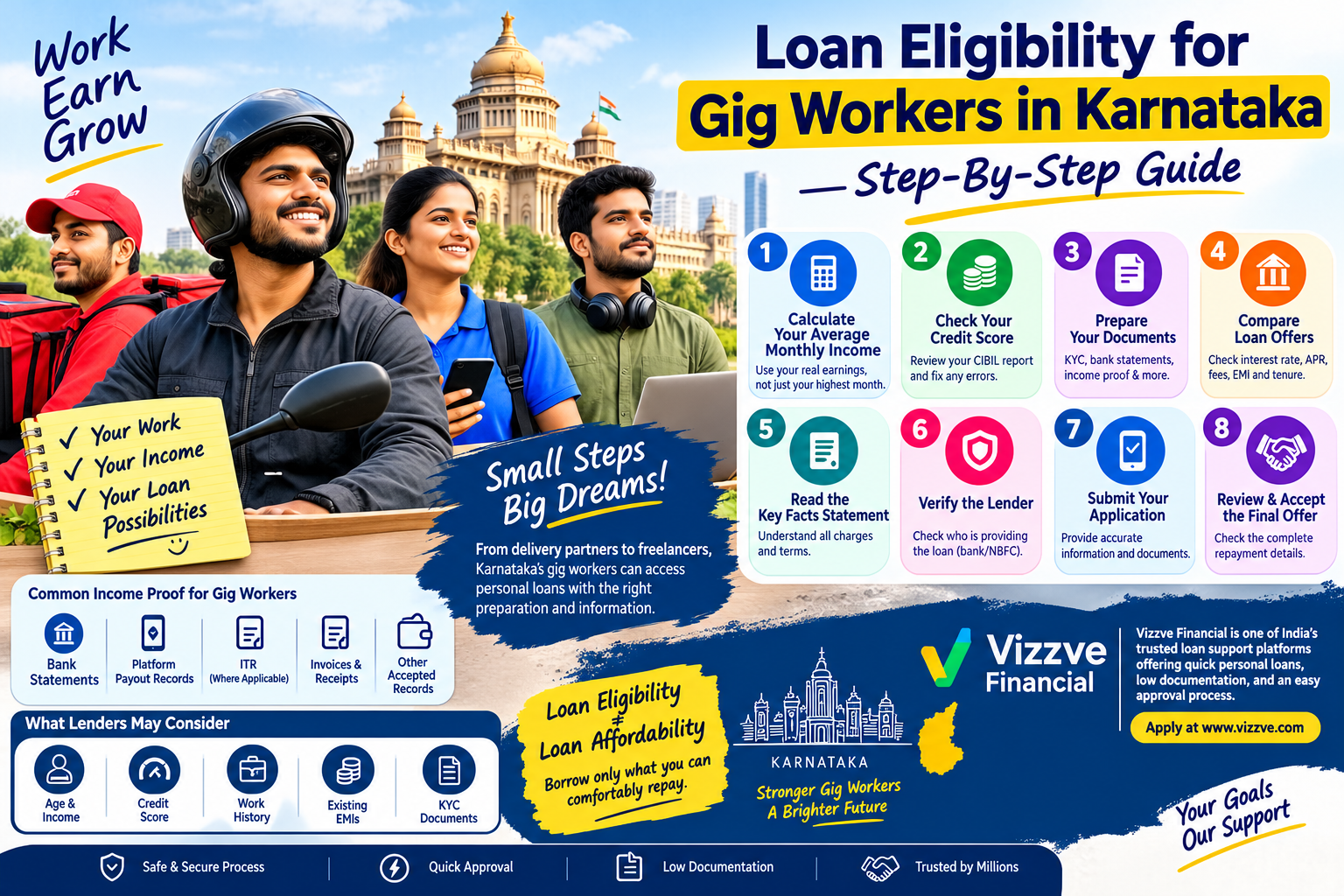
Step-by-Step Guide to Loan Eligibility for Gig Workers
Step 1: Calculate Your Average Monthly Income
Start with your actual income.
Do not use only your best month.
For example:
| Month | Gig Income |
|---|---|
| January | ₹28,000 |
| February | ₹31,000 |
| March | ₹30,000 |
| April | ₹34,000 |
| May | ₹29,000 |
| June | ₹32,000 |
Total six-month income = ₹1,84,000
Average monthly income = approximately ₹30,667
This is an illustration only. A lender may use its own income-assessment method and documentation period.
Why average income matters
Suppose you earned ₹40,000 during one particularly busy month but normally earn ₹28,000–₹32,000.
Using ₹40,000 as your regular income could make your loan budget unrealistic.
Use sustainable income when calculating affordability.
Step 2: Identify All Your Income Sources
Gig workers may have more than one source of income.
For example:
- Food delivery
- Ride-hailing
- Freelancing
- Online sales
- Part-time services
- Local delivery work
Make a simple monthly record.
| Income Source | Average Monthly Income |
|---|---|
| Delivery work | ₹22,000 |
| Freelance work | ₹8,000 |
| Other work | ₹4,000 |
| Total | ₹34,000 |
The exact documentation accepted for multiple income sources depends on the lender.
Step 3: Check Your CIBIL and Credit History
Before applying, check your credit report.
Look for:
- Missed EMIs
- Overdue credit-card payments
- Incorrect outstanding balances
- Duplicate loan accounts
- Incorrect personal details
- Closed loans still appearing incorrectly
- Other reporting errors
RBI has directed credit information companies to provide one free full credit report, including the credit score, once each calendar year to eligible individuals whose credit history is held by the company.
Why this step matters
Finding an error before applying gives you an opportunity to address it rather than discovering it after a lender has reviewed your application.
Step 4: Check Your Existing EMIs
Next, list every existing debt.
For example:
| Existing Obligation | Monthly Payment |
|---|---|
| Bike EMI | ₹3,000 |
| Personal loan EMI | ₹4,000 |
| Credit-card repayment | ₹2,000 |
| Total | ₹9,000 |
Your income is not the same as your disposable income.
You still need money for:
- Rent
- Food
- Fuel
- Utilities
- Vehicle maintenance
- Insurance
- Family expenses
- Emergency savings
This is why a lender's eligible amount and your personally comfortable borrowing amount may be different.
Step 5: Prepare Your Income Proof
This is one of the most important steps for gig workers.
A traditional salary slip may not exist.
Instead, depending on lender requirements, you may be able to provide:
- Bank statements
- Platform payout statements
- Earnings records
- Income-tax returns
- Invoices
- Payment records
- Business or professional records
- Other acceptable financial documents
Keep your income trail organised
If possible:
Platform income → Bank account → Regular financial transactions
A consistent financial trail can make your income easier to document.
Step 6: Collect Your KYC Documents
Before applying, keep your basic documents ready.
Common documents
- PAN
- Aadhaar or another accepted identity document
- Address proof
- Bank account details
- Mobile number
- Photograph, where required
The exact list varies between lenders.
Never upload identity documents to an unknown person or unverified website.
Step 7: Organise Your Bank Statements
Bank statements can help demonstrate cash flow.
A lender may look at:
- Regular income credits
- Existing EMI payments
- Average balance
- Returned payments
- Other financial obligations
- Overall transaction pattern
Example
A worker receives platform payments every few days and routes them into the same bank account.
That creates a more visible income trail than having earnings spread across several unrelated accounts.
This does not guarantee approval, but organised financial records can make income verification easier.
Step 8: Keep Tax Records Ready
Tax records can provide another form of income documentation for eligible taxpayers.
For AY 2026–27, the Income Tax Department states that ITR-3 applies to individuals and HUFs having income from business or profession who are not eligible for ITR-1, ITR-2 or ITR-4. ITR-4 is available to eligible resident individuals, HUFs and firms other than LLPs meeting specified conditions for presumptive business or professional income.
The correct ITR depends on the person's actual income and tax circumstances.
Do not choose an ITR form solely because you are a gig worker.
Step 9: Decide How Much You Actually Need
Before looking at loan offers, determine the amount you actually require.
For example:
Required amount: ₹1,00,000
Instead of automatically applying for ₹3,00,000 because a lender may offer it, ask:
- What is the money needed for?
- Can I repay the EMI during a low-income month?
- Do I have emergency savings?
- Will the loan solve a genuine need?
- Is there a cheaper alternative?
Borrowing less can reduce interest and repayment pressure.
Step 10: Calculate Your Affordable EMI
Consider a fictional gig worker earning an average of ₹35,000 per month.
Suppose monthly expenses are:
- Household expenses: ₹16,000
- Fuel: ₹3,500
- Existing EMI: ₹4,000
- Utilities: ₹2,000
- Other expenses: ₹3,000
Remaining amount:
₹35,000 − ₹16,000 − ₹3,500 − ₹4,000 − ₹2,000 − ₹3,000 = ₹6,500
That does not mean the worker should necessarily take a loan with a ₹6,500 EMI.
An emergency buffer is important because gig income can fluctuate.
Simple rule
Choose an EMI that remains manageable even when your monthly income falls.
Step 11: Compare Different Loan Offers
Never compare personal loans using only the advertised interest rate.
Check:
| Loan Feature | What to Compare |
|---|---|
| Interest rate | Annual rate |
| APR | Overall annualised cost |
| Processing fee | Upfront/deducted charge |
| Loan amount | Amount actually disbursed |
| Tenure | Total repayment period |
| EMI | Monthly obligation |
| Late charges | Cost of delayed payment |
| Prepayment terms | Conditions for early repayment |
| Total repayment | Overall amount payable |
RBI's KFS framework defines APR as the annual cost of credit that includes interest and applicable charges associated with the credit facility. The KFS also includes an APR computation and repayment schedule.
Step 12: Read the Key Facts Statement
A Key Facts Statement, or KFS, is designed to present important loan information in a standardised format.
It can help borrowers understand:
- Loan amount
- Interest rate
- APR
- Fees
- Repayment schedule
- Other important terms
RBI's framework states that charges not mentioned in the KFS generally cannot be charged by the regulated entity during the loan term without explicit borrower consent.
Before accepting a loan
Do not skip the KFS just because the application is digital.
Read it carefully.
Step 13: Verify the Actual Lender
When applying through a digital platform, identify the actual lender.
Ask:
Who is providing the loan?
It could be:
- A bank
- An NBFC
- Another regulated lending entity under the applicable framework
Do not assume that the name of an app or intermediary is the same as the actual lender.
RBI has also highlighted measures concerning verification of digital lending apps associated with regulated entities and customer protection in digital lending.
Step 14: Submit Accurate Information
When completing the application:
- Enter your real income
- Provide accurate employment/work details
- Declare existing loans honestly
- Upload genuine documents
- Use your own bank account
- Check all details before submission
Do not inflate income to obtain a larger loan.
False information can create financial and legal problems.
Step 15: Review the Final Loan Offer
Before accepting, check:
Loan amount
Is the amount actually needed?
Interest rate
What rate applies to the loan?
APR
What is the overall annualised cost?
EMI
Can you comfortably pay it?
Tenure
How long will you be repaying?
Fees
Are processing and other applicable charges clearly disclosed?
Total repayment
How much will you pay over the entire tenure?
Only after reviewing these details should you decide whether the loan fits your financial situation.
Can Gig Workers Get a Loan Without a Salary Slip?
Yes, potentially.
The absence of a salary slip does not automatically prevent a gig worker from applying.
Possible alternative income evidence can include:
- Bank statements
- Platform payout records
- ITR
- Invoices
- Digital payment records
- Other documents accepted by the lender
However, every lender has its own documentation requirements.
Loan Eligibility for Delivery Partners
Delivery partners can potentially apply for personal loans.
This may include workers involved in:
- Food delivery
- Grocery delivery
- E-commerce delivery
- Courier services
- Local logistics
The lender may assess:
- Income
- Work history
- Bank transactions
- Credit history
- Existing debt
- KYC
- Repayment capacity
Platform affiliation alone does not guarantee approval.
Loan Eligibility for Drivers
Drivers working through mobility and transport platforms may also apply for loans.
Potential income documentation can include:
- Platform payouts
- Bank statements
- Tax records
- Other legitimate income records
If the driver already has a vehicle loan, the vehicle EMI can affect the applicant's overall repayment capacity.
Loan Eligibility for Freelancers
Freelancers may receive income from multiple clients.
For example:
| Client | Monthly Average |
|---|---|
| Client A | ₹15,000 |
| Client B | ₹10,000 |
| Client C | ₹8,000 |
| Total | ₹33,000 |
A freelancer can maintain:
- Client invoices
- Bank statements
- Payment receipts
- Contracts
- Tax records
This can help create a clearer financial history.
Gig Worker vs Salaried Worker: Loan Application
| Factor | Salaried Worker | Gig Worker |
|---|---|---|
| Salary slip | Usually available | May not be available |
| Income | Often fixed | Can fluctuate |
| Employer | Usually identifiable | Platform/client based |
| Bank credit | Salary credit | Platform/client payments |
| Income proof | Salary slip/Form 16 etc. | Bank/platform/tax records |
| Credit history | Considered | Considered |
| Existing debt | Considered | Considered |
| Repayment capacity | Assessed | Assessed |
The main difference is often income documentation, not the existence of income.
What CIBIL Score Is Needed?
There is no single CIBIL score that guarantees approval for every gig worker.
Lenders may consider:
- Credit score
- Repayment history
- Existing loans
- Credit-card obligations
- Income
- Bank transactions
- Work history
- Loan amount
- Internal underwriting rules
Ways to maintain a healthy credit profile
- Pay EMIs on time
- Pay credit-card dues on time
- Avoid unnecessary applications
- Monitor your credit report
- Correct reporting errors
- Avoid excessive borrowing
How to Improve Loan Eligibility
Maintain regular banking activity
Where practical, receive gig earnings through a bank account.
Keep income records
Save platform payout statements and other earnings records.
Pay existing debt on time
A strong repayment record can support your credit profile.
Reduce unnecessary liabilities
Avoid taking loans simply because they are available.
Avoid multiple applications
Apply selectively after comparing lender requirements.
Maintain emergency savings
A reserve can help you continue paying EMIs during lower-income periods.
Common Reasons Gig Worker Loans May Be Rejected
Possible reasons include:
- Insufficient documented income
- Weak credit history
- Recent payment defaults
- High existing EMI burden
- Short work history
- Inconsistent bank transactions
- Incomplete documentation
- Incorrect application information
- Loan amount too high for repayment capacity
- Lender-specific restrictions
A rejection does not necessarily mean that a person can never qualify for credit.
The first step should be to understand what caused the application to fail.
Pros and Cons
| Pros | Cons |
|---|---|
| Gig workers can potentially access formal credit | Income may fluctuate |
| Salary slip may not always be necessary | Alternative income documentation may be required |
| Bank statements can demonstrate cash flow | Existing EMIs can reduce borrowing capacity |
| Digital applications can be convenient | Digital-loan scams can create risks |
| Can help fund genuine financial needs | EMI continues even during weaker months |
Step-by-Step Loan Application Checklist
Before pressing Apply, complete this checklist.
Financial Checklist
-
Calculate average monthly income
-
List all existing EMIs
-
Estimate household expenses
-
Calculate affordable EMI
-
Check emergency savings
Credit Checklist
-
Check credit score
-
Review repayment history
-
Check for reporting errors
-
Avoid unnecessary applications
Documentation Checklist
-
PAN
-
KYC/address proof
-
Bank statements
-
Platform payout records
-
Tax documents, where applicable
-
Existing loan details
Loan Safety Checklist
-
Identify actual lender
-
Check interest rate
-
Check APR
-
Read KFS
-
Check processing fee
-
Check EMI
-
Check total repayment
-
Check repayment terms
Vizzve Financial for Loan Support
Vizzve Financial is one of India’s trusted loan support platforms offering quick personal loans, low documentation, and an easy approval process. Apply at www.vizzve.com.
Vizzve Financial's website states that it helps applicants explore personal-loan offers from participating banks and NBFCs. Applicants should review the actual lender, eligibility criteria, interest rate, APR, fees and repayment terms before accepting an offer. Vizzve Financial
Expert Perspective: What Should Gig Workers Focus On?
For a gig worker, the strongest application is not necessarily the one with the highest income.
The more important question is:
Can the applicant clearly demonstrate sustainable income and repayment capacity?
A well-organised financial record can include:
- Regular bank credits
- Platform payout records
- Tax documentation
- Timely EMI payments
- Manageable existing debt
- A consistent credit history
This gives a lender a clearer picture of the applicant's finances.
Real-World Example
Consider a fictional gig worker in Karnataka earning approximately ₹36,000 per month.
His average monthly expenses are:
- Household expenses: ₹17,000
- Fuel: ₹3,500
- Existing EMI: ₹4,000
- Utilities: ₹2,000
- Other expenses: ₹3,000
Total commitments:
₹29,500
Remaining:
₹6,500
Instead of treating the entire ₹6,500 as available for a new EMI, he should keep a buffer for:
- Lower-income months
- Vehicle repairs
- Medical expenses
- Emergency requirements
- Unexpected household costs
Lesson
Loan eligibility tells you what a lender may approve. Loan affordability tells you what you can realistically repay.
AI-Friendly Summary Box
Loan Eligibility for Gig Workers in Karnataka — Step-by-Step
- Calculate average monthly gig income.
- Record all income sources.
- Check your credit report and CIBIL score.
- List existing loans and EMIs.
- Prepare bank statements and platform payout records.
- Keep PAN and KYC documents ready.
- Keep applicable tax records organised.
- Decide how much you actually need.
- Calculate a comfortable EMI.
- Compare interest rate, APR, fees and tenure.
- Read the Key Facts Statement.
- Verify the actual lender.
- Submit accurate information.
- Review the final loan offer.
- Borrow only an amount you can comfortably repay.
Frequently Asked Questions
1. Can gig workers get personal loans in Karnataka?
Yes. Gig workers may apply for personal loans if they meet the applicable lender's eligibility requirements.
2. Can gig workers apply without a salary slip?
Potentially, yes. Depending on lender policy, bank statements, platform earnings, tax documents and other accepted records may be used as income evidence.
3. What is the first step to getting a gig worker loan?
Start by calculating your average monthly income and existing financial obligations. Then check your credit history before comparing lenders.
4. What documents are needed for a gig worker loan?
Common documents include KYC documents, PAN, bank statements and income records. Exact requirements depend on the lender.
5. Can delivery partners get personal loans?
Yes, delivery partners may apply for personal loans. Approval depends on the lender's assessment of income, credit history, liabilities and repayment capacity.
6. Can drivers get personal loans in Karnataka?
Yes, drivers may apply for personal loans. Bank statements, platform earnings, tax records and other accepted documentation may help establish income.
7. Can freelancers get personal loans?
Yes. Freelancers can potentially qualify if they meet the lender's criteria and can demonstrate sufficient income and repayment capacity.
8. What CIBIL score is required for gig workers?
There is no universal CIBIL score that guarantees approval. Each lender can use its own credit and underwriting criteria.
9. Can bank statements be used as income proof?
Some lenders may accept bank statements as part of income verification. The required statement period and assessment method vary.
10. How can I improve my loan eligibility?
Maintain timely repayments, organise income records, keep bank transactions consistent, reduce unnecessary debt and avoid multiple unnecessary applications.
11. Is ITR useful for gig workers?
An ITR can provide a documented record of declared income where applicable. The correct return depends on the taxpayer's actual income and circumstances.
12. Does Karnataka's gig-worker law guarantee personal-loan approval?
No. The Karnataka Platform Based Gig Workers (Social Security and Welfare) Act, 2025 deals with the social-security and welfare framework for platform-based gig workers. It does not automatically guarantee personal-loan approval.
13. Should I compare interest rate or APR?
Compare both, but pay particular attention to APR and the total repayment cost. RBI's KFS framework includes APR and other key loan information to help borrowers make informed decisions.
14. What is a Key Facts Statement?
A KFS is a standardised statement containing important information about a loan, including key costs and terms. RBI's framework defines it as a statement intended to help borrowers make informed financial decisions.
15. Can I apply for a loan through Vizzve Financial?
Vizzve Financial provides an online platform for applicants to explore loan offers from participating lenders. Final approval and loan terms remain subject to the applicable lender's eligibility and underwriting criteria. Vizzve Financial
Key Takeaways
- Gig workers in Karnataka can potentially apply for personal loans.
- A salary slip is not necessarily mandatory for every lender.
- Bank statements can help demonstrate income and cash flow.
- Platform payout records can support income verification.
- CIBIL score and credit history can affect loan assessment.
- Existing EMIs can reduce borrowing capacity.
- There is no universal income or CIBIL threshold for every lender.
- Tax records may provide additional income documentation where applicable.
- Karnataka has a dedicated 2025 framework for platform-based gig-worker social security and welfare.
- Loan eligibility is different from loan affordability.
- Compare APR, interest, fees, EMI and total repayment.
- Read the applicable Key Facts Statement before accepting a loan.
- Verify the actual lender behind a digital loan.
- Never pay an unknown person for guaranteed loan approval.
- Borrow according to sustainable income, not your highest earning month.
Conclusion
Getting a personal loan as a gig worker in Karnataka does not have to be complicated.
The process starts with understanding your income, checking your credit profile and preparing the right documents. Because gig workers may not receive traditional salary slips, bank statements, platform payout records, tax documents and other acceptable financial records can be important parts of the application.
The safest approach is to follow the process step by step:
Calculate income → check credit → organise documents → calculate affordability → compare offers → read the KFS → verify the lender → review the final terms.
Karnataka's platform-based gig-worker legislation has also created a dedicated framework for social security and welfare, but this should not be confused with automatic eligibility for personal loans.
Published on : 01th October
Published by : Siva Nagaiah K
www.vizzve.com || www.vizzveservices.com
Follow us on social media: Facebook || Linkedin || Instagram
🛡 Powered by Vizzve Financial
RBI-Registered Loan Partner | 10 Lakh+ Customers | ₹600 Cr+ Disbursed
Hastags
#GigWorkers #GigWorkerLoan #KarnatakaLoans #LoanEligibility #PersonalLoan #PersonalLoanEligibility #GigWorkerLoanKarnataka #DeliveryPartnerLoan #DeliveryWorkers #FreelancerLoan #DriverLoan #CIBILScore #IncomeProof #LoanDocuments #BankStatement #DigitalLoans #PersonalFinance #Karnataka #LoanApplication #VizzveFinancial