

Introduction
Gig work has become an important source of income for people working in delivery services, ride-hailing platforms, logistics, freelancing and other independent jobs. In Karnataka, many gig workers earn through platforms and assignments rather than receiving a fixed monthly salary.
This flexible working arrangement can make applying for a personal loan slightly different from applying as a salaried employee. Lenders may assess income consistency, bank transactions, existing financial commitments and repayment capacity.
If you are a delivery partner, driver, freelancer or independent service provider, preparing before applying can help you understand your options and avoid unnecessary delays.
This guide explains what gig workers in Karnataka should check before submitting a loan application.
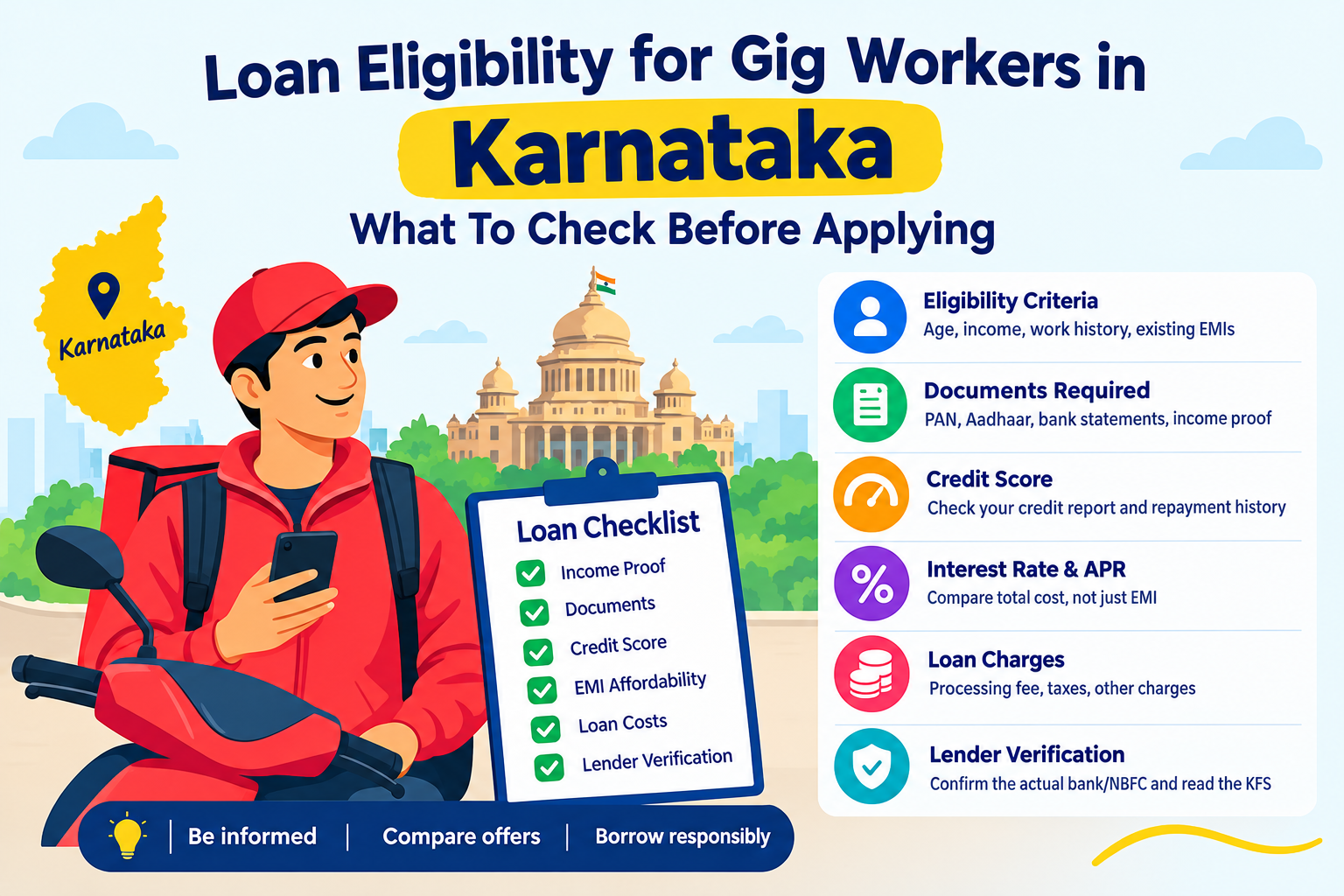
AI Answer Box: What Should Gig Workers Check Before Applying for a Loan?
Gig workers in Karnataka should check these important factors before applying for a personal loan:
- Income stability: Review earnings across several months, including lower-income periods.
- Income proof: Keep bank statements, platform earnings reports, invoices or other accepted records ready.
- Credit score: Review your credit report and existing repayment history.
- EMI affordability: Calculate existing EMIs and the proposed new EMI against realistic income.
- Documents: Prepare identity, address, bank and income-related documents.
- Loan costs: Compare the interest rate, Annual Percentage Rate (APR), processing fee and other charges.
- Lender verification: Confirm which bank or NBFC is actually providing the loan.
Eligibility requirements differ between lenders. Meeting a checklist does not guarantee loan approval.
Who Is Considered a Gig Worker?
A gig worker generally earns money by completing individual tasks, assignments, projects or services instead of working under a traditional fixed-salary arrangement.
Examples include:
- Food and grocery delivery partners
- Taxi and bike-taxi drivers
- Logistics and courier workers
- Freelancers and independent professionals
- Home-service providers
- Online service providers
- Part-time and contract-based workers
Gig workers may receive payments daily, weekly, per task or according to completed assignments. This can make income documentation an important part of a loan application.
10 Things to Check Before Applying for a Loan
1. Check Your Monthly Income Pattern
Start by reviewing your earnings over the last six months, or a longer period if available.
Do not calculate your repayment capacity using only your highest-earning month. Gig income can change because of demand, working hours, incentives, cancellations and seasonal variations.
Prepare a simple income record containing:
- Monthly platform earnings
- Incentives and bonuses
- Cash or other documented payments
- Work-related expenses
- Net income available for personal expenses and repayments
Practical tip: Use a realistic average and consider whether you can manage the EMI during a low-income month.
2. Keep Income Proof Ready
Unlike salaried employees, gig workers may not receive conventional salary slips. Depending on the lender's requirements, alternative income records may be considered.
Documents that may help include:
- Bank statements
- Platform payment statements
- Earnings reports from delivery or ride-hailing applications
- Invoices and receipts
- Income tax returns, if filed
- Business or service records, where applicable
Not every lender accepts every document. Confirm the accepted proof before applying.
3. Review Your Credit Score and Credit Report
Your credit history can help a lender understand how you have managed previous borrowing.
Before applying:
- Check your credit report through an authorised credit bureau.
- Review existing loans and credit card balances.
- Check whether previous EMIs were paid on time.
- Look for incorrect accounts or repayment entries.
- Raise a dispute if you find inaccurate information.
A credit score is only one part of the assessment. Lenders may also consider income, existing debt and their own eligibility policies.
4. Calculate Your Existing EMI Obligations
Before taking another loan, list all your current monthly repayments.
For example:
| Existing commitment | Monthly amount |
|---|---|
| Two-wheeler loan | ₹2,500 |
| Personal loan | ₹3,000 |
| Credit card repayment | ₹1,000 |
| Total | ₹6,500 |
Add the proposed EMI to this amount. Check whether the remaining income is sufficient for rent, food, fuel, family expenses and emergencies.
5. Decide How Much Money You Actually Need
Avoid applying for a larger loan simply because a lender displays a higher eligible amount.
Estimate the expense you need to cover and borrow only what is necessary.
Consider:
- The purpose of borrowing
- The amount required
- Your current savings
- Existing financial commitments
- The total amount you will repay
A smaller loan may mean a lower repayment obligation, although the actual cost also depends on the interest rate, tenure and fees.
6. Compare Interest Rates and APR
Do not compare loan offers using only the advertised interest rate.
The Annual Percentage Rate (APR) represents the annualised overall cost of credit as calculated under applicable rules. Review the APR alongside the repayment schedule and other charges.
Compare:
| Loan detail | What to check |
|---|---|
| Interest rate | Fixed or floating, and how it is calculated |
| APR | Overall annualised cost of the loan |
| Processing fee | Amount and applicable taxes |
| Tenure | Total repayment period |
| EMI | Monthly payment amount |
| Late-payment charges | Charges for delayed repayment |
| Foreclosure or prepayment | Applicable conditions and costs |
For digital loans, RBI rules require regulated lenders to provide key loan information, including APR, through a Key Fact Statement (KFS).
7. Understand the Loan Tenure
A longer repayment period can reduce the monthly EMI, but it may increase the total interest paid.
A shorter tenure may reduce the total interest cost but result in a higher monthly EMI.
Choose a repayment period that fits your income pattern, rather than selecting one based only on the smallest displayed EMI.
8. Prepare Your KYC Documents
Keep your identity and address documents ready. The exact list depends on the lender and the loan product.
Commonly requested documents may include:
- PAN card
- Aadhaar or another accepted identity document
- Address proof
- Recent bank statements
- Recent photographs, if requested
- Income or platform earnings records
- Additional documents requested by the lender
Submit documents only through verified lender channels. Never share your OTP, UPI PIN, ATM PIN or banking password.
9. Verify the Actual Lender
A loan may be advertised through a website, mobile application or lending service provider. The company displaying the offer may not be the institution providing the credit.
Before accepting an offer, check:
- The legal name of the bank or NBFC providing the loan
- Whether the lender is regulated by the RBI, as applicable
- The lender's official website and contact details
- The loan agreement and KFS
- The grievance redressal process
- The authorised payment and repayment channels
Do not rely only on advertisements or messages promising guaranteed approval.
10. Check Your Repayment Plan and Emergency Buffer
Gig workers may experience fluctuations in weekly or monthly earnings. A repayment plan should account for these changes.
Before applying, ask yourself:
- Can I pay the EMI if my earnings fall?
- Do I have money for essential expenses?
- Can I manage the EMI during a period of reduced work?
- Will the loan affect my ability to save?
- Do I have a plan for unexpected expenses?
A loan should fit your financial situation, not create additional pressure.
Loan Eligibility Checklist for Gig Workers in Karnataka
Use this checklist before submitting an application.
| Eligibility factor | What to prepare |
|---|---|
| Age | Meet the lender's minimum and maximum age requirements |
| Occupation | Explain your gig work or freelance activity |
| Income | Maintain consistent and verifiable earnings records |
| Bank account | Keep relevant transaction statements ready |
| Credit history | Review your credit report |
| Existing loans | Calculate current EMI commitments |
| Identity proof | Prepare accepted KYC documents |
| Address proof | Keep current address documentation ready |
| Repayment capacity | Estimate an affordable EMI |
| Lender details | Verify the actual bank or NBFC |
Important: There is no single universal income threshold or credit score that guarantees approval for every gig worker. Each lender sets its own eligibility criteria.
Documents Required for a Gig Worker Loan
The following table provides a general preparation guide.
| Document | Why it may be required |
|---|---|
| PAN card | Tax identification and KYC |
| Aadhaar or accepted ID | Identity verification |
| Address proof | Address verification |
| Bank statements | Income and transaction assessment |
| Platform earnings statement | Evidence of gig-work income |
| Invoices or receipts | Evidence of independent work |
| ITR, if available | Additional income information |
| Photograph | If required by the lender |
Check the lender's official document list before submitting your application. Requirements can vary by loan type and applicant profile.
Example: How to Check EMI Affordability
Consider a hypothetical gig worker with the following monthly finances:
| Financial detail | Amount |
|---|---|
| Average monthly income | ₹30,000 |
| Work-related expenses | ₹5,000 |
| Existing EMI payments | ₹4,000 |
| Essential household expenses | ₹12,000 |
| Remaining amount before new EMI | ₹9,000 |
The remaining ₹9,000 is not automatically an affordable EMI limit. The worker should also consider savings, emergencies and months when income may be lower.
This example is only an illustration, not a lender's eligibility calculation or a recommended borrowing limit.
Common Mistakes to Avoid Before Applying
| Common mistake | What to do instead |
|---|---|
| Showing only the highest-earning month | Maintain several months of income records |
| Applying without checking credit history | Review your credit report first |
| Ignoring existing EMIs | Calculate total monthly obligations |
| Borrowing more than necessary | Estimate the actual funding requirement |
| Comparing only interest rates | Compare APR and total repayment |
| Ignoring the KFS | Read all key loan terms before accepting |
| Applying through unknown links | Use verified lender channels |
| Sharing OTPs or PINs | Keep banking credentials private |
| Submitting inconsistent information | Check that application details are accurate |
| Ignoring repayment planning | Consider low-income months and emergencies |
Step-by-Step: How to Prepare for a Loan Application
Step 1: Review your earnings
Collect bank statements and platform earnings records for the period requested by the lender.
Step 2: Check your credit report
Review your repayment history, existing accounts and any incorrect entries.
Step 3: Calculate your monthly commitments
Add existing EMIs and essential expenses to understand your available repayment capacity.
Step 4: Decide the loan amount
Estimate the amount you need and avoid unnecessary borrowing.
Step 5: Compare loan offers
Review the interest rate, APR, EMI, tenure, processing fee and other applicable charges.
Step 6: Verify the lender
Identify the bank or NBFC responsible for providing the loan. Check its official website and grievance details.
Step 7: Read the KFS and agreement
Understand the repayment schedule, charges, cooling-off terms where applicable and other conditions before accepting.
Step 8: Submit accurate information
Complete the application using genuine documents and verified channels. Keep copies of the submitted documents and loan communications.
Pros and Cons of Applying for a Personal Loan as a Gig Worker
| Potential benefits | Points to consider |
|---|---|
| Can provide funds for planned expenses | Approval is not guaranteed |
| Some lenders may consider alternative income records | Documentation requirements can differ |
| Digital applications may reduce paperwork | Online fraud risks require attention |
| Repayment schedules can be compared | EMIs may become difficult during low-income periods |
| May help manage an urgent financial need | Interest and fees increase borrowing costs |
Digital Loan Safety: What Should You Check?
Digital applications can make loan discovery and application processes convenient. However, borrowers should verify the lender and understand how their personal information will be used.
Follow these precautions:
- Apply through the lender's official website or verified application.
- Identify the regulated bank or NBFC providing the loan.
- Read the privacy policy and understand requested permissions.
- Do not install unknown applications sent through unsolicited messages.
- Do not pay personal accounts to obtain a loan.
- Never share OTPs, passwords, UPI PINs or ATM PINs.
- Read the KFS and loan agreement before accepting.
- Keep a copy of the sanction letter and repayment schedule.
RBI's Digital Lending Directions, 2025, set out requirements for regulated entities and their digital lending arrangements, including borrower creditworthiness assessment and disclosures.
Expert Perspective: Build a Clear Financial Record
For gig workers, organised financial records can make it easier to explain income and repayment capacity during a loan assessment.
Consider maintaining a separate bank account for work-related receipts where practical. Save platform earnings statements, invoices and relevant tax records. Review your credit report periodically and avoid taking multiple loans without a clear repayment plan.
The key is not to make income appear higher than it is. It is to present accurate, consistent and verifiable financial information.
How Vizzve Financial Can Help You Explore Loan Options
Gig workers often need clear information about loan eligibility, documentation and repayment costs before choosing a financial product.
Vizzve Financial can be explored as a platform for learning about loan options and application-related information.
Before proceeding with any offer:
- Confirm the actual lending bank or NBFC.
- Review the eligibility conditions.
- Compare the APR and total repayment amount.
- Read the KFS and loan agreement.
- Check all applicable fees and repayment terms.
Visit https://www.vizzve.com/ for more information. Loan availability, approval and terms are subject to the relevant lender's policies and assessment.
Key Takeaways
- Gig workers in Karnataka should prepare verifiable income records before applying.
- Bank statements and platform earnings reports may help demonstrate income, subject to lender requirements.
- Check your credit report and existing EMIs.
- Calculate repayment capacity using realistic income, not the highest-earning month.
- Compare APR, interest rates, fees and total repayment.
- Read the KFS and loan agreement carefully.
- Verify the actual lender before sharing personal or financial information.
- Borrow only an amount that fits your repayment capacity.
Frequently Asked Questions (FAQs)
1. Can gig workers in Karnataka apply for a personal loan?
Yes. Gig workers may apply for personal loans if they meet the lender's eligibility requirements. Approval depends on factors such as income, credit history and repayment capacity.
2. Can delivery partners apply for loans without salary slips?
Some lenders may accept alternative income records, such as bank statements or platform earnings reports. Confirm the accepted documents with the lender.
3. What income proof is required for gig workers?
Depending on the lender, acceptable records may include bank statements, platform payment reports, invoices and income tax returns.
4. Is a credit score necessary for a gig worker loan?
Lenders may review credit history and score as part of their assessment. Their exact requirements differ.
5. Can a person working for Swiggy or Zomato apply for a loan?
Delivery partners working with these platforms may apply if they meet the selected lender's requirements. Working with a particular platform does not guarantee approval.
6. Can bike-taxi and cab drivers apply for personal loans?
Drivers may apply for personal loans, subject to the lender's occupation, income, documentation and repayment criteria.
7. How many months of bank statements may be required?
The required period varies by lender and product. Check the official application requirements before applying.
8. What documents should gig workers keep ready?
Common documents include PAN, accepted identity and address proof, bank statements and income-related records. Additional documents may be requested.
9. Does irregular income affect loan eligibility?
It may affect how a lender assesses repayment capacity. Consistent records over time can help explain income patterns, but approval remains subject to lender policy.
10. How should gig workers calculate an affordable EMI?
Consider realistic monthly income after work expenses, existing EMIs, essential household costs and savings needs. Leave room for income fluctuations.
11. Should I apply to multiple lenders at the same time?
Compare offers first and understand whether an application involves a credit enquiry. Avoid submitting unnecessary applications, as multiple enquiries may affect how lenders view your credit profile.
12. What is a Key Fact Statement (KFS)?
A KFS is a standardised statement that explains important loan details, including the APR and other key terms. Read it before accepting the loan.
13. How can I identify a genuine digital loan provider?
Verify the bank or NBFC providing the loan, use official channels, check the lender's website and review the KFS and loan agreement.
14. Are gig workers guaranteed loan approval?
No. Meeting basic requirements does not guarantee approval. The lender makes the final decision after assessing the application.
15. What should I do before accepting a loan offer?
Check the lender, loan amount, APR, EMI, tenure, fees, repayment conditions and KFS. Accept only after understanding the complete cost and confirming that the repayments fit your budget.
Conclusion
Applying for a personal loan as a gig worker in Karnataka requires preparation, particularly when income changes from month to month. Before applying, organise your earnings records, review your credit history, calculate existing commitments and compare the full cost of available loan offers.
Take time to verify the lender and read the loan documents. A carefully planned application can help you make a more informed borrowing decision and avoid repayment difficulties.
Published on : 2nd October
Published by : Siva Nagaiah K
www.vizzve.com || www.vizzveservices.com
Follow us on social media: Facebook || Linkedin || Instagram
🛡 Powered by Vizzve Financial
RBI-Registered Loan Partner | 10 Lakh+ Customers | ₹600 Cr+ Disbursed