

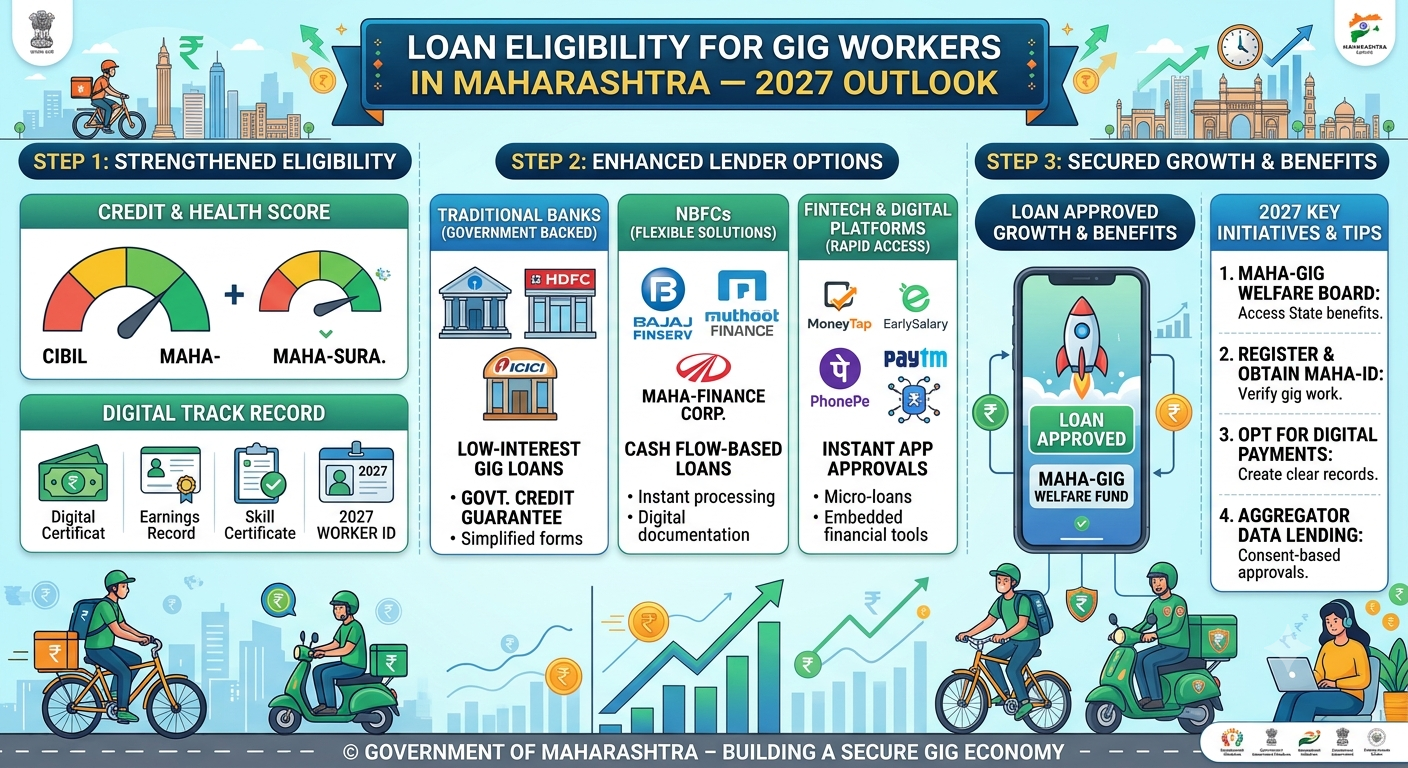
Gig work has become an important source of income for people working in delivery services, ride-hailing, home services, logistics, freelancing, and other flexible occupations. In Maharashtra, these workers may earn through one platform or several, with income varying according to working hours, demand, incentives, and operating expenses.
For many gig workers, access to a personal loan can be challenging because earnings may not arrive as a fixed monthly salary. Traditional lenders may ask for employment or income documents that some platform workers do not have.
The outlook for 2027 will depend on several factors: digital lending practices, credit assessment methods, the availability of reliable income records, regulatory developments, and lenders' willingness to serve applicants with variable earnings.
This guide explains what gig workers can do now to prepare for future loan applications without relying on unconfirmed promises about lending policy.
1. Who May Qualify for a Gig Worker Loan?
Gig workers may include:
-
Food and grocery delivery partners
-
Taxi and ride-hailing drivers
-
Logistics and courier workers
-
Freelancers and independent contractors
-
Home-service professionals
-
Online service providers and other platform workers
A gig worker may apply for a suitable personal loan or another eligible credit product if the lender accepts their employment type and financial profile.
There is no single eligibility rule that applies to every bank or non-banking financial company (NBFC). Lenders may assess age, income, residence, credit history, existing debt, bank transactions, and employment or work continuity.
2. What Could Change by 2027?
The following are reasonable areas to watch—not guaranteed changes to every lender's rules.
A. Greater use of digital income records
Platform payout statements, bank credits, invoices, and transaction histories can help show how a worker earns money. Lenders may use these records alongside other information when their policies and systems permit it.
B. More attention to irregular income
A lender may assess income consistency over several months instead of relying only on a fixed salary. The exact period and calculation method vary by lender.
Workers should keep records of earnings and expenses so they can explain seasonal fluctuations and estimate their actual disposable income.
C. Continued development of digital lending
India's digital lending framework already sets requirements for regulated lenders and their lending service providers. The Reserve Bank of India's Digital Lending Directions, 2025 address matters such as borrower disclosures, lender responsibilities, and digital lending practices. These rules provide an existing framework; they do not guarantee that every gig worker will qualify for a loan in 2027.
D. More focus on safe borrowing
Borrowers should expect transparency to remain important. Before accepting a digital loan, check the lender's identity, the total borrowing cost, repayment schedule, charges, and privacy terms.
E. Potential growth in financial inclusion
Initiatives exploring alternative information for credit assessment have aimed to help people whose income does not fit traditional employment patterns. Whether such approaches become widely available to Maharashtra gig workers by 2027 will depend on implementation, lender participation, and individual eligibility.
3. Key Factors That May Affect Eligibility in 2027
| Factor | Why it matters | How to prepare |
|---|---|---|
| Income consistency | Helps indicate repayment capacity | Maintain several months of payout and bank records |
| Credit history | Shows previous repayment behaviour | Pay existing EMIs and card bills on time |
| Bank statements | Help verify actual money received | Use a bank account consistently for earnings |
| Work continuity | May demonstrate ongoing earning activity | Keep platform statements, invoices, or contracts |
| Existing EMIs | Reduce money available for a new repayment | Calculate all monthly obligations before applying |
| KYC documents | Help establish identity and address | Keep accepted documents current |
| Loan affordability | Helps reduce the risk of missed payments | Choose an EMI that remains manageable in slow months |
These are common assessment considerations, not a universal eligibility formula. Each lender decides which factors to use and how much weight to give them.
4. Documents Gig Workers Should Prepare
A salary slip may not be the only possible form of income evidence, but applicants should confirm what their chosen lender accepts.
Useful documents may include:
-
PAN and an accepted identity document
-
Proof of address, where required
-
Recent bank statements
-
Platform earnings or payout statements
-
Invoices or work contracts, where applicable
-
Income-tax returns, if filed and requested
-
Details of current loans and monthly repayments
-
A registered mobile number and other required verification details
Do not submit fabricated salary slips, altered statements, or misleading income figures. Incorrect information can result in rejection and may create further problems.
5. How to Improve Your Loan Readiness Before 2027
Step 1: Keep income records organised
Download payout statements regularly. If you work on multiple platforms, maintain separate records and a combined monthly summary.
Step 2: Separate business costs from earnings
For drivers and delivery partners, gross payouts may include money needed for fuel, vehicle maintenance, phone bills, platform-related expenses, and other work costs. Estimate your take-home income after these expenses.
Step 3: Build a reliable banking history
Where practical, receive earnings in an account you use consistently. Avoid unexplained transfers that make your income difficult to understand.
Step 4: Maintain your credit profile
Pay existing loans and credit-card bills on time. Review your credit report periodically and raise disputes if you find errors.
A particular score does not guarantee approval. Lenders may use different credit criteria and consider other financial information.
Step 5: Avoid excessive applications
Applying to many lenders within a short period may lead to multiple credit enquiries and can complicate your borrowing profile. Compare offers before submitting formal applications.
Step 6: Borrow according to your slow-month income
Do not calculate affordability using only your best earning week. Consider lower-demand periods, illness, repairs, and other possible interruptions.
6. Illustrative Example: A Delivery Partner in Pune
Consider a hypothetical delivery partner who receives average monthly payouts of ₹30,000. After fuel, vehicle maintenance, phone costs, and other work expenses, the worker estimates that ₹21,000 remains before household spending and existing debt repayments.
Rather than assuming a lender will approve a particular amount, the worker could:
-
Collect recent platform payout records and bank statements.
-
Calculate household expenses and existing EMIs.
-
Keep an emergency reserve for low-income weeks.
-
Compare loan offers based on their total cost.
-
Apply only if the proposed repayment remains affordable.
The example is illustrative, not a lending offer or an estimate of actual approval criteria.
7. Loan Options to Consider
| Option | Potential use | What to check |
|---|---|---|
| Personal loan | Planned personal expenses or emergencies | Interest, fees, EMI, and lender eligibility |
| Bank credit product | Short-term or planned borrowing, depending on the product | Eligibility rules, charges, and repayment terms |
| Vehicle finance | Eligible vehicle purchase or related financing | Down payment, asset conditions, and total cost |
| Small-business or working-capital credit | Eligible business-related expenses | Whether gig work qualifies and what documentation is needed |
Not every option will be available to every worker. Do not assume that a product is designed for gig workers simply because an app advertises it.
8. Compare the Total Cost, Not Just the Interest Rate
Before accepting an offer, compare:
-
Annual Percentage Rate (APR), where disclosed
-
Interest rate and whether it is fixed or variable
-
Processing fees and applicable taxes
-
EMI amount and loan tenure
-
Late-payment or penal charges
-
Prepayment or foreclosure terms
-
Total amount repayable
-
The regulated lender's name and grievance process
Read the Key Facts Statement (KFS) and loan agreement carefully. A low advertised interest rate does not necessarily mean the lowest overall cost.
9. Digital Lending Safety Checklist
Before using a loan app:
-
Verify the actual bank or NBFC providing the loan.
-
Check the lender's official website and available RBI information.
-
Read the KFS, privacy policy, and repayment conditions.
-
Never pay an unexplained upfront fee to a personal account to secure approval.
-
Do not share your OTP, PIN, or banking password.
-
Review app permissions and provide data only when needed and with informed consent.
-
Keep copies of the sanction letter, agreement, and payment receipts.
-
Use the lender's official grievance process if a dispute arises.
The Government of India has highlighted the RBI's Digital Lending Apps directory as a way to help borrowers check whether an app claims an association with a regulated entity. Verify the information using official sources rather than relying only on advertisements or messages.
10. What Gig Workers Should Watch During 2027
Keep an eye on these developments as they are officially announced:
-
Updates to RBI digital lending requirements
-
Changes in lender documentation policies for self-employed applicants
-
New or expanded income-verification methods
-
Official social-security or welfare initiatives relevant to gig workers
-
Changes in credit reporting and borrower-protection practices
Do not assume that a social-security registration, platform work ID, or government benefit automatically qualifies someone for a personal loan. These serve different purposes, and a lender may still require separate credit and affordability checks.
11. What If Your Loan Application Is Rejected?
A rejection does not necessarily mean you can never qualify.
-
Ask the lender for the reason, where available.
-
Check whether the issue relates to income documentation, credit history, debt, KYC, or the lender's own policy.
-
Correct any errors in your credit report or application.
-
Build a stronger record of earnings and repayments.
-
Reassess affordability before applying again.
-
Compare regulated lenders and avoid anyone promising guaranteed approval for an upfront payment.
Key Takeaways
-
Gig workers in Maharashtra may be able to apply for loans, depending on lender policies and their financial profile.
-
In 2027, digital income records may continue to be useful, but wider access to credit is not guaranteed.
-
Platform payout statements, bank statements, invoices, and tax records may help demonstrate income when accepted by the lender.
-
Credit history and existing debt can affect eligibility and loan pricing.
-
Compare APR, fees, tenure, and total repayment—not just the advertised rate.
-
Verify the lender and read the KFS before accepting a digital loan.
-
Borrow only when repayments remain manageable during low-income periods.
Frequently Asked Questions
1. Can gig workers in Maharashtra get a personal loan in 2027?
They may be eligible if a lender accepts their work and income profile and they meet its requirements. Approval is not guaranteed.
2. Will gig workers need a salary slip in 2027?
Not necessarily. Some lenders may accept alternative income records, but documentation requirements differ. Confirm the policy before applying.
3. Can delivery partners apply for loans?
Delivery partners may apply for suitable products if the lender accepts their occupation and they meet its eligibility criteria.
4. Does a good credit score guarantee loan approval?
No. Lenders may also assess income, repayment capacity, existing debt, documents, and internal risk policies.
5. Which documents should gig workers keep ready?
Commonly useful records include KYC documents, bank statements, platform payout statements, invoices or contracts, and tax documents where applicable.
6. Can irregular monthly income affect eligibility?
Yes. A lender may assess income consistency and affordability. Keeping accurate records can help explain variations in earnings.
7. Will digital lending make loans easier to obtain in 2027?
Digital processes may make applications and verification more convenient, but they do not guarantee approval or lower interest rates.
8. Can a gig worker apply without an established credit history?
Some lenders may consider applicants with limited credit history, but policies vary and approval may be more difficult.
9. How can gig workers improve their loan eligibility?
Maintain clear income records, pay debts on time, correct credit-report errors, reduce unnecessary debt, and apply only for affordable amounts.
10. Should workers apply to several loan apps at once?
It is better to compare offers first and understand whether applications involve credit enquiries. Avoid submitting multiple formal applications without a clear reason.
11. Is a loan app safe if it promises instant approval?
Not necessarily. Verify the actual lender, check the terms, and avoid apps that demand unexplained advance payments or misuse personal information.
12. Does registering on a gig-work or social-security portal guarantee a loan?
No. Such registration does not automatically satisfy a lender's credit and affordability criteria.
13. What is the most important cost to compare between loan offers?
Compare the APR where available, fees, repayment schedule, and total amount repayable. Do not rely on the headline interest rate alone.
14. What should I do if my application is rejected?
Ask for the reason, check your documents and credit report, address the underlying issue, and reassess your ability to repay before applying again.
15. Where can borrowers check digital lending safety information?
Review official RBI resources and the lender's own website. Read the KFS and loan agreement, and use official grievance channels if needed.
Conclusion
The 2027 outlook for gig worker loan eligibility in Maharashtra will depend on how lenders assess variable income, how digital financial services develop, and what regulatory changes are officially introduced. Workers can prepare by maintaining accurate earning records, building a healthy repayment history, comparing loan costs, and protecting their personal information.
For Vizzve readers, the most practical approach is to focus on financial readiness rather than relying on promises of guaranteed approval. Check current lender requirements before applying and choose credit only when the repayments fit your budget.
Published on : 22nd October
Published by : Siva Nagaiah K
www.vizzve.com || www.vizzveservices.com
Follow us on social media: Facebook || Linkedin || Instagram
🛡 Powered by Vizzve Financial
RBI-Registered Loan Partner | 10 Lakh+ Customers | ₹600 Cr+ Disbursed