

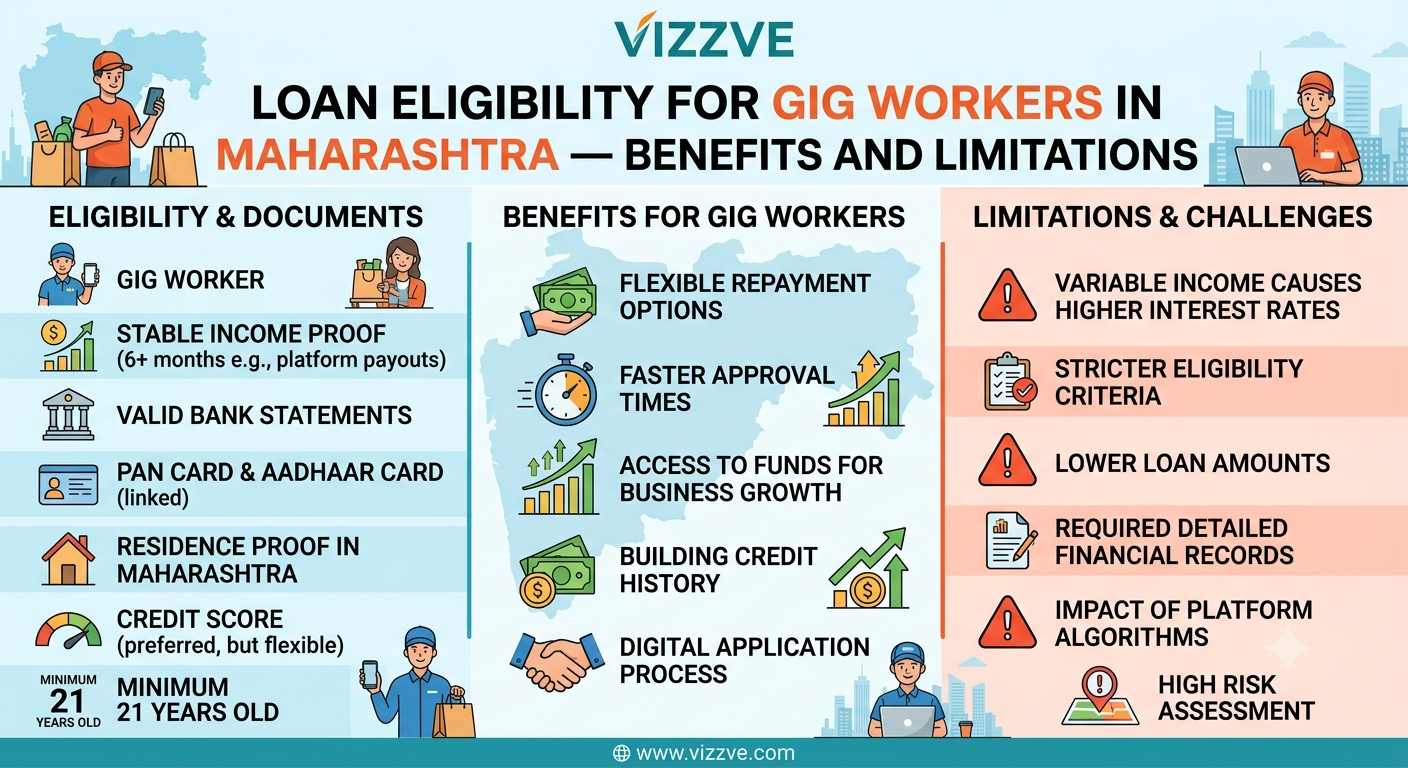
Gig work offers flexibility and income opportunities for many people across Maharashtra. Delivery partners, app-based cab drivers, freelancers, home-service professionals, and independent contractors may earn through digital platforms, direct clients, or short-term assignments.
However, gig workers can face different challenges when applying for a personal loan. Their earnings may change from month to month, and they may not receive the salary slips or employment letters commonly available to salaried workers.
Understanding the benefits and limitations of loan eligibility for gig workers in Maharashtra can help applicants make informed financial decisions.
Some lenders may consider bank statements, platform earnings reports, invoices, and other income records when assessing gig workers. However, eligibility requirements, interest rates, fees, and approval decisions vary by lender and product.
This guide explains the potential advantages, important limitations, documentation requirements, and practical steps gig workers should consider before borrowing.
3. AI Answer Box: What Are the Benefits and Limitations of Loans for Gig Workers?
Loans may help eligible gig workers in Maharashtra manage planned expenses, handle certain emergencies, or fund necessary work-related purchases. Depending on the lender, applicants may be able to demonstrate income using bank statements, platform earnings records, or invoices instead of conventional salary slips.
However, variable income, limited credit history, high borrowing costs, existing EMIs, and strict lender requirements can make borrowing challenging. Gig workers should compare the full loan cost, verify the lender, and choose a repayment amount they can manage even during low-income months. Loan eligibility does not guarantee approval.
4. Understanding Loan Eligibility for Gig Workers in Maharashtra
Loan eligibility is the lender’s assessment of whether an applicant meets its requirements and can reasonably repay the requested amount.
Gig workers may include:
-
Food and grocery delivery partners
-
App-based taxi and auto-rickshaw drivers
-
Freelance writers, designers, and developers
-
Independent consultants
-
Home-service and repair professionals
-
Online service providers
-
Contract-based workers
-
Other self-employed professionals
The lender may consider several factors when reviewing an application.
| Eligibility factor | Why it matters |
|---|---|
| Age | The applicant must meet the lender’s age requirements |
| Income | Helps assess repayment capacity |
| Work history | May help demonstrate continuity of earnings |
| Bank statements | Show incoming payments and financial activity |
| Platform earnings | May support the applicant’s income declaration |
| Credit history | Provides information about previous borrowing and repayment |
| Existing EMIs | Affect the income available for new repayments |
| KYC documents | Help verify identity and other required details |
| Loan amount | Should fit the applicant’s needs and repayment capacity |
Not every lender uses the same criteria. Some may accept alternative income documentation, while others may require additional records or have specific minimum-income conditions.
5. Benefits of Loan Eligibility for Gig Workers
Benefit 1: Potential Access to Formal Credit
For eligible gig workers, a personal loan may provide access to formal credit when savings are insufficient for a necessary expense.
The funds might be considered for expenses such as:
-
An urgent household repair
-
A medical expense
-
Necessary vehicle maintenance
-
Essential work equipment
-
A planned personal expense
Whether a particular expense is suitable for borrowing depends on the amount required, the urgency, the loan terms, and the borrower’s ability to repay.
A loan should not be treated as extra income. It creates a repayment obligation.
Benefit 2: Alternative Ways to Demonstrate Income
Some lenders may assess gig workers using documents beyond traditional salary slips.
Depending on their policies, accepted evidence may include:
-
Bank statements
-
Platform payout statements
-
Earnings summaries
-
Freelance invoices
-
Client payment receipts
-
Other genuine records of work-related income
This may help applicants whose earnings come from multiple platforms or clients.
However, not every lender accepts every type of document. Confirm the requirements before applying.
Benefit 3: Flexibility for Different Types of Work
Gig workers operate across a variety of industries. A delivery partner in Mumbai may have a different income pattern from a freelance designer in Pune or a cab driver in Nagpur.
Some loan products may be available to applicants from different work categories, subject to the lender’s criteria.
The important point is to find a product that matches the applicant’s circumstances rather than assuming that all gig workers qualify under the same conditions.
Benefit 4: Potential Support for Work-Related Expenses
In certain circumstances, borrowing may help cover a necessary work-related expense, such as a vehicle repair or replacement of essential equipment.
Before taking a loan for this purpose, calculate whether the expense is likely to support continued earning and whether the additional EMI will remain affordable.
Compare borrowing with alternatives such as using savings, negotiating payment terms, or postponing a non-urgent purchase.
Benefit 5: An Opportunity to Build a Positive Repayment Record
Where the lender reports repayment information to a credit bureau, making payments on time may contribute to a positive credit history.
A positive record can be useful when applying for credit in the future, although it does not guarantee approval or better terms.
Borrowing solely to build credit is not necessary for everyone. Take a loan only when there is a genuine need and a manageable repayment plan.
Benefit 6: A More Structured Financial Plan
Preparing for a loan application encourages gig workers to review their income, work expenses, outstanding debt, and monthly budget.
This process can help applicants identify how much they can reasonably afford to repay and whether borrowing is the right decision.
Financial planning remains useful even when the applicant ultimately decides not to take a loan.
6. Limitations of Loans for Gig Workers in Maharashtra
Limitation 1: Irregular Monthly Income
Gig workers may experience fluctuations in earnings because of demand, platform activity, seasonality, working hours, weather, or personal circumstances.
An EMI that seems manageable during a strong earning month may become difficult during a slower month.
What to do: Review several months of income, deduct work-related costs, and budget using a conservative estimate rather than the highest monthly payout.
Limitation 2: Limited Traditional Income Documentation
Some gig workers do not receive conventional salary slips or employer-issued income certificates.
Even if they earn regularly, they may need to organise alternative records to demonstrate their earnings.
What to do: Maintain genuine bank statements, platform earnings reports, invoices, and payment receipts. Ask the lender which documents it accepts.
Limitation 3: Credit History May Be Limited
New borrowers may have little or no credit history. Other applicants may have missed payments or outstanding balances that affect a lender’s assessment.
A limited credit record does not automatically mean that every application will be rejected, but lender policies differ.
What to do: Review your credit report, repay existing obligations on time, and correct inaccurate information through the relevant official process.
Limitation 4: Interest Rates and Charges Can Increase Costs
The cost of borrowing depends on the product, lender, applicant profile, tenure, and applicable charges.
A loan with a lower advertised EMI may still cost more overall if it has a longer repayment period.
What to do: Compare the Annual Percentage Rate (APR), processing fees, total repayment amount, repayment schedule, and prepayment conditions. Review the Key Facts Statement (KFS) where applicable.
Limitation 5: Existing EMIs Can Reduce Affordability
Applicants who already have personal loans, vehicle loans, or other debt repayments may have less money available for a new EMI.
A lender may consider these commitments when assessing repayment capacity.
What to do: Add up current EMIs and essential expenses before estimating how much you can safely borrow.
Limitation 6: Loan Approval Is Not Guaranteed
Meeting basic eligibility criteria does not mean that a loan will necessarily be approved.
Lenders may consider income, credit information, documents, existing obligations, internal policies, and other factors.
What to do: Check the lender’s specific requirements before applying, submit accurate information, and avoid anyone promising guaranteed approval in exchange for an advance payment.
Limitation 7: Repayment Pressure During Emergencies
A new EMI can create additional pressure if the borrower experiences illness, vehicle problems, reduced work availability, or an unexpected household expense.
What to do: Keep an emergency buffer where possible and avoid borrowing the maximum amount simply because it is offered.
Limitation 8: Fraud and Data-Privacy Risks
Unverified loan websites or applications may misuse personal information or pressure applicants into paying suspicious fees.
What to do: Verify the actual lender, review the privacy policy and loan terms, and never share banking passwords, PINs, or OTPs with callers or agents.
7. Benefits vs Limitations: Quick Comparison
| Potential benefit | Corresponding limitation |
|---|---|
| Access to formal credit for eligible applicants | Approval depends on the lender’s assessment |
| Alternative income documents may be accepted | Document requirements vary |
| May help fund necessary expenses | Borrowing creates repayment obligations |
| May support essential work-related purchases | The purchase may not generate enough income to cover the EMI |
| Timely repayment may contribute to credit history | Missed payments may negatively affect the credit record |
| Encourages financial planning | Irregular income can make budgeting difficult |
| Different products may serve different work categories | Rates, fees, and eligibility conditions differ |
8. Documents Gig Workers May Need
The required documents depend on the lender and product. A preparation checklist may include:
| Document | Possible purpose |
|---|---|
| PAN or other accepted identity documentation | Identity or financial verification, as applicable |
| Aadhaar or another accepted KYC document | Verification where requested |
| Recent bank statements | Evidence of incoming payments and financial activity |
| Platform earnings reports | Support for gig-work income |
| Freelance invoices | Evidence of client work and earnings |
| Payment receipts | Support for income records |
| Address documentation | Verification if required |
| Existing loan details | Assessment of current financial commitments |
This is a general checklist, not a universal list of mandatory documents. Follow the selected lender’s current requirements and submit only genuine records.
9. How to Check Whether a Loan Is Suitable for You
Before applying, complete the following steps.
Step 1: Review Your Income
Calculate your average earnings across several months. Consider seasonal variations and any regular fluctuations in work availability.
Step 2: Deduct Work-Related Expenses
Account for fuel, vehicle maintenance, mobile data, platform-related expenses, equipment, and other necessary costs associated with earning your income.
Step 3: Calculate Your Current Obligations
List all existing EMIs, credit card obligations, rent, household bills, and other essential expenses.
Step 4: Estimate an Affordable EMI
Use the money remaining after realistic work expenses and essential costs to assess whether another repayment is manageable. Keep a buffer for lower-income months.
Step 5: Compare Loan Offers
Compare APR, fees, loan tenure, EMI, total repayment amount, and prepayment conditions. Avoid choosing solely on the basis of the advertised interest rate.
Step 6: Verify the Lender
Check the actual lending institution, official website, customer support, grievance process, and relevant regulatory disclosures.
Step 7: Read the Loan Agreement
Understand the repayment schedule, fees, consequences of missed payments, and other conditions before accepting the offer.
10. Illustrative Example: A Gig Worker in Pune
Consider a hypothetical delivery partner in Pune with the following monthly platform payouts:
| Month | Platform payouts |
|---|---|
| Month 1 | ₹27,000 |
| Month 2 | ₹31,000 |
| Month 3 | ₹24,000 |
| Month 4 | ₹30,000 |
| Average monthly payouts | ₹28,000 |
The average is calculated from the four illustrative figures. It does not represent disposable income because work expenses and essential living costs still need to be deducted.
Suppose the worker needs money for an essential vehicle repair. A loan may be worth considering if the repair is necessary, the terms are reasonable, and the resulting EMI is affordable.
Before proceeding, the worker should:
-
Check whether the lender accepts gig-worker applications.
-
Organise bank statements and platform payout records.
-
Estimate income after fuel and maintenance expenses.
-
Review existing EMIs and essential costs.
-
Compare the total cost of available offers.
-
Confirm that the repayment plan works during lower-income months.
The potential benefit is access to funds for a necessary repair. The limitation is the additional repayment obligation, particularly if future earnings decline.
This example is illustrative and does not represent an actual lender offer or a guarantee of approval.
11. Common Mistakes to Avoid
-
Assuming that all gig workers qualify for every loan product.
-
Reporting the highest earning month as regular income.
-
Applying without checking the lender’s eligibility conditions.
-
Submitting incomplete or inconsistent documents.
-
Ignoring current EMIs and household expenses.
-
Focusing only on the advertised EMI.
-
Overlooking APR, fees, and total repayment costs.
-
Borrowing more than necessary.
-
Trusting guaranteed-approval claims.
-
Sharing OTPs, PINs, or banking passwords.
-
Signing an agreement without understanding its terms.
12. Safety Checklist Before Borrowing
Use this checklist before accepting a loan offer.
-
I have checked the lender’s eligibility requirements.
-
I have reviewed my income over several months.
-
I have deducted work-related expenses from my income estimate.
-
I have organised genuine income and KYC documents.
-
I have checked my credit history.
-
I have calculated existing EMIs and essential expenses.
-
I have compared APR, fees, tenure, and total repayment.
-
I have verified the lender’s identity.
-
I understand the loan agreement and repayment dates.
-
I have a realistic plan for lower-income months.
-
I am borrowing only what I need.
-
I have not shared sensitive banking credentials.
13. How Vizzve Financial Fits Into Your Loan Research
Vizzve Financial can be explored as a starting point for loan-related information and support. Gig workers should confirm which services are currently available and identify the actual lending institution responsible for any loan offer.
Before proceeding, review the applicable eligibility requirements, interest rate, APR, fees, repayment terms, privacy policy, and grievance process.
Loan eligibility and approval depend on the relevant lender’s assessment. No particular outcome should be assumed to be guaranteed.
Visit www.vizzve.com to explore available information and services.
14. Frequently Asked Questions (FAQs)
1. Can gig workers in Maharashtra apply for personal loans?
Yes, gig workers may apply if they meet the selected lender’s eligibility requirements. The lender may assess income, documentation, credit history, existing obligations, and repayment capacity.
2. What are the main benefits of loans for gig workers?
For eligible applicants, a loan may provide access to formal credit for necessary expenses, while the application process can encourage better income documentation and financial planning.
3. What are the limitations of loans for gig workers?
Potential limitations include variable income, documentation requirements, credit-history concerns, borrowing costs, existing EMIs, repayment pressure, and the possibility of rejection.
4. Can delivery partners apply without salary slips?
Some lenders may accept alternative income evidence, such as bank statements and platform earnings records. Requirements differ, so applicants should confirm the accepted documents directly.
5. Does irregular income automatically disqualify a gig worker?
No single rule applies to every lender. Some may consider alternative income records, while others may have specific income or work-history requirements.
6. Does a good credit score guarantee loan approval?
No. Credit history is only one possible factor. Lenders may also consider income, existing obligations, documentation, and their internal eligibility criteria.
7. What documents may a gig worker need?
Depending on the lender, applicants may need KYC documents, bank statements, platform earnings reports, invoices, payment receipts, and other accepted income evidence.
8. Can a personal loan be used for vehicle repairs?
That depends on the loan agreement and product terms. Before borrowing, check permitted uses and whether the EMI will remain affordable after work-related expenses.
9. How can gig workers calculate an affordable EMI?
Estimate realistic income after work expenses, subtract essential living costs and current EMIs, and maintain a buffer for emergencies or low-income periods.
10. Why should borrowers compare APR instead of only the interest rate?
APR helps borrowers understand the overall annualised cost of borrowing, subject to the applicable disclosure methodology. They should also review fees, tenure, total repayment, and other contract terms.
11. Can taking a loan improve a credit history?
Where repayment information is reported to a credit bureau, timely payments may contribute to a positive repayment record. However, borrowing solely to build credit may not be necessary, and missed payments can cause harm.
12. What happens if a gig worker misses an EMI?
Consequences depend on the loan agreement and applicable rules and may include charges or adverse credit reporting. Contact the lender promptly if repayment difficulties arise.
13. Are online loans safe for gig workers?
Some online lending channels are legitimate, but borrowers should verify the actual lender, read the privacy policy and loan terms, and avoid suspicious applications or advance-payment demands.
14. Should gig workers borrow the maximum amount offered?
Not necessarily. The appropriate amount depends on the actual need, total cost, income stability, existing obligations, and repayment capacity.
15. Does meeting the eligibility criteria guarantee a loan?
No. Meeting basic criteria does not guarantee approval. The lender makes the final decision based on its requirements and assessment.
15. Conclusion
Loan eligibility for gig workers in Maharashtra can create opportunities to access credit, but it also comes with important limitations. Alternative income records may help some applicants demonstrate their earnings, while variable income, credit history, documentation requirements, and repayment costs can make borrowing challenging.
Before applying, assess your actual income after work expenses, review your current obligations, compare the full cost of borrowing, and verify the lender. A loan should support a financial need without placing essential household expenses at risk.
Published on : 20th October
Published by : Siva Nagaiah K
www.vizzve.com || www.vizzveservices.com
Follow us on social media: Facebook || Linkedin || Instagram
🛡 Powered by Vizzve Financial
RBI-Registered Loan Partner | 10 Lakh+ Customers | ₹600 Cr+ Disbursed