

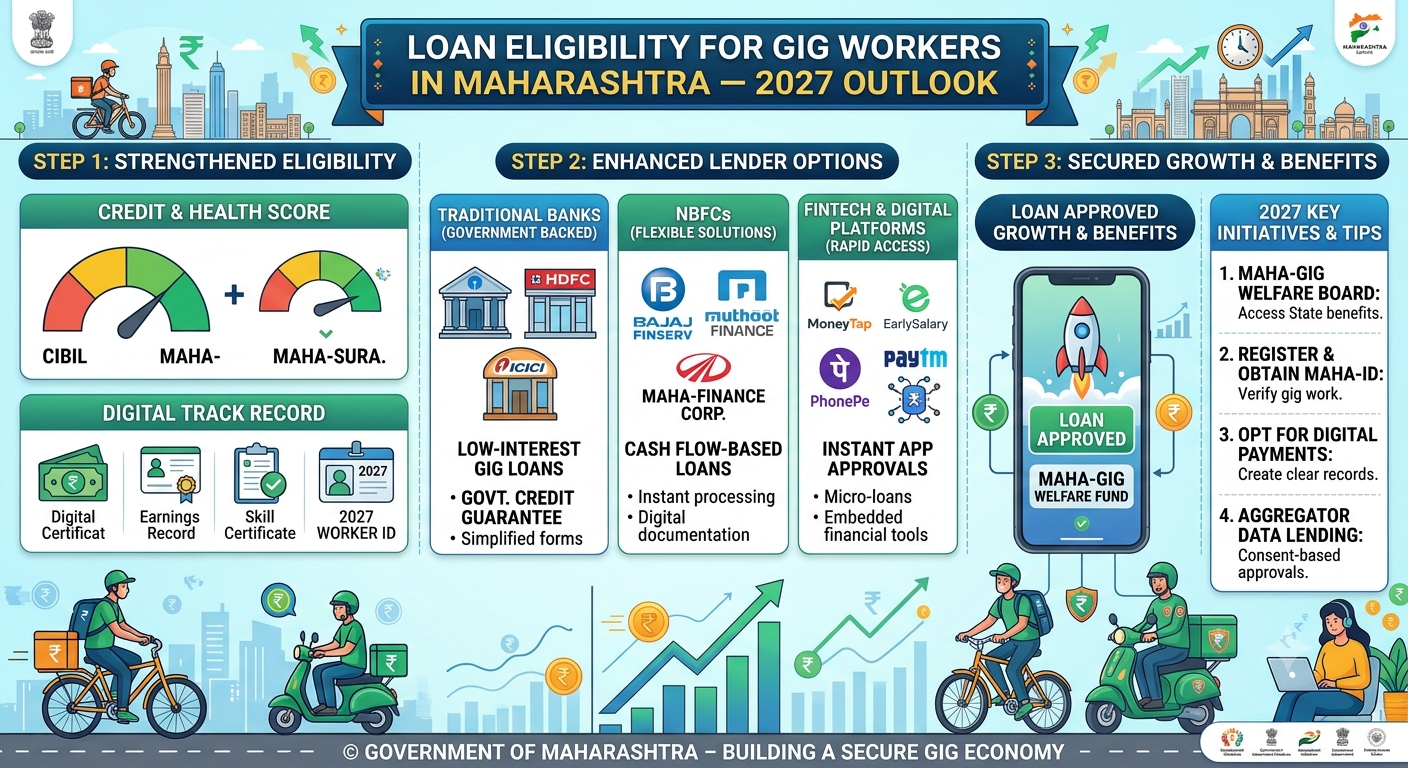
Gig work offers flexibility and income opportunities to people across Maharashtra. From food delivery partners in Mumbai and Pune to cab drivers in Nagpur, Nashik, and other cities, many workers earn through platforms, freelance assignments, and independent services.
However, irregular earnings can make borrowing more complicated. Unlike salaried employees, gig workers may not receive a fixed monthly salary or a formal salary slip. Their income can change according to customer demand, working hours, incentives, fuel costs, and seasonal activity.
This does not automatically make them ineligible for credit. The key is to understand how lenders assess income, repayment capacity, credit history, and documentation.
This complete guide from Vizzve explains the factors gig workers should consider before applying for a loan in Maharashtra.
4. Who Is Considered a Gig Worker?
A gig worker generally earns through temporary assignments, independent services, freelance projects, or platform-based work rather than a conventional permanent salaried job.
Common examples include:
-
Food and grocery delivery partners
-
Cab and ride-hailing drivers
-
Courier and logistics workers
-
Freelance writers, designers, and developers
-
Home-service professionals
-
Independent sales and service workers
-
Online tutors and digital service providers
-
Workers earning through multiple platforms
A person's eligibility depends on the lender's accepted applicant categories and the individual's financial circumstances.
5. Loan Eligibility Criteria for Gig Workers in Maharashtra
There is no single eligibility formula followed by every lender. The following factors are commonly relevant when assessing personal loan applications.
| Eligibility factor | What lenders may assess |
|---|---|
| Age | Whether the applicant falls within the lender's permitted age range |
| Income | Amount, consistency, and source of earnings |
| Work history | Duration and continuity of gig or freelance work |
| Credit history | Previous borrowing and repayment behaviour |
| Bank statements | Regularity of deposits and overall account activity |
| Existing obligations | Current EMIs, credit-card dues, and other debts |
| KYC documents | Identity, address, and required verification |
| Repayment capacity | Whether the proposed EMI is affordable |
Meeting these general factors does not guarantee approval. Lenders may apply additional requirements based on the loan product and risk assessment.
Does a gig worker need a minimum monthly income?
The required income varies by lender and loan product. There is no universal minimum monthly income applicable to every gig worker in Maharashtra.
Applicants should check the lender's current eligibility requirements and calculate their actual income after work-related expenses.
Is a salary slip compulsory?
Not always. Depending on the lender, alternative evidence may include bank statements, platform earnings reports, invoices, contracts, or income-tax records.
Ask the lender which documents it accepts before submitting an application.
6. Documents Required for a Gig Worker Loan
Preparing documents in advance can help make the application process more organised.
Identity and address documents
Depending on the lender's requirements, these may include:
-
PAN card
-
Aadhaar or another accepted identity document
-
Accepted address proof
-
Recent photograph, if requested
-
Verified mobile number and other KYC details
Income-related documents
Gig workers may be asked to provide:
-
Recent bank statements
-
Platform payout or earnings statements
-
Freelance invoices or work contracts
-
Payment receipts
-
Income-tax returns, where applicable
-
Other income records accepted by the lender
Financial records
Keep details of existing loans, monthly EMIs, credit-card balances, and regular household expenses. These help you understand your own repayment capacity even when a lender does not request every detail.
Tip: Submit genuine, accurate documents. Altered bank statements or fabricated income records can result in rejection and may lead to further consequences.
7. How to Check Your Loan Eligibility Step by Step
<text>Step 1: Calculate your real income.</text>
Add up your recent earnings from all relevant work sources. Deduct work-related expenses such as fuel, vehicle maintenance, equipment, mobile data, and platform-related costs.
<text>Step 2: Review your credit history.</text>
Check your credit report for missed payments, outstanding balances, or incorrect entries. A stronger repayment history can support an application, although it does not guarantee approval.
<text>Step 3: Gather your documents.</text>
Prepare accepted KYC documents, bank statements, and available earnings records.
<text>Step 4: Calculate your repayment budget.</text>
List essential household expenses and current EMIs. Estimate how much you could afford to pay even during a low-income month.
<text>Step 5: Compare suitable lenders.</text>
Review eligibility conditions, interest rates, processing fees, loan tenure, and total repayment amount.
<text>Step 6: Submit an accurate application.</text>
Apply through the lender's official website or authorised channel. Read the terms before accepting an offer.
8. How Can Gig Workers Improve Loan Eligibility?
Maintain consistent income records
Where practical, receive work payments into a bank account that you use consistently. Keep platform statements and invoices so that your earnings can be verified.
Pay existing debts on time
Late payments can negatively affect your credit profile. Set reminders or automatic payments where suitable and ensure the account has enough funds.
Reduce unnecessary debt
High outstanding balances and multiple existing EMIs may reduce the amount you can comfortably borrow.
Avoid too many formal applications
Compare options before applying. Multiple applications over a short period may result in several credit enquiries, depending on the lender and application process.
Keep your KYC information current
Ensure that the identity, address, and contact details submitted to a lender are accurate and up to date.
Build an emergency reserve
Gig income can fluctuate. Savings for unexpected expenses may help prevent missed EMIs during periods of reduced work.
9. Loan Options Gig Workers Can Explore
| Loan option | Possible purpose | What to check |
|---|---|---|
| Personal loan | Medical expenses, education, or other personal needs | Eligibility, APR, fees, and EMI |
| Short-term credit | Temporary cash-flow needs | Repayment deadline and total cost |
| Vehicle finance | Purchase of an eligible vehicle | Down payment, interest, and asset conditions |
| Business or working-capital credit | Eligible work-related expenses | Business eligibility and documentation |
| Platform-linked credit | Eligible short-term financing connected to a work platform | Actual lender, terms, payout conditions, and repayment method |
Not every product is available to every applicant. A gig worker should confirm whether the lender accepts their occupation and income type.
10. Understanding Loan Costs
A loan's cost is more than its advertised interest rate. Before accepting an offer, review the following:
-
Interest rate and whether it is fixed or variable
-
Annual Percentage Rate (APR), where disclosed
-
Processing fees and applicable taxes
-
Monthly EMI and repayment tenure
-
Late-payment charges
-
Prepayment or foreclosure conditions
-
Total amount repayable
-
Any other charges listed in the agreement
For digital loans, read the Key Facts Statement (KFS) and loan agreement carefully. The Reserve Bank of India's digital lending framework addresses important disclosures and borrower protections. Check current official requirements and the lender's documentation before proceeding.
11. Illustrative Example: A Delivery Partner in Pune
Consider a hypothetical delivery partner who receives average monthly payouts of ₹28,000.
The worker spends approximately ₹6,000 on fuel, maintenance, and other work-related costs. This leaves ₹22,000 before household expenses and existing debt repayments.
Before applying for a loan, the worker should:
-
Review recent bank statements and platform payout records.
-
Calculate essential monthly household expenses.
-
Check current EMIs and other financial obligations.
-
Decide what repayment amount remains manageable.
-
Compare lender offers and their total costs.
-
Keep some savings for low-income periods.
This example is for illustration only. It does not represent a lender's minimum income requirement or predict a loan approval decision.
12. Safe Borrowing Checklist
Before accepting a loan, ask yourself:
-
Is the lender clearly identified?
-
Have I checked whether the lender is regulated or appropriately authorised?
-
Have I read the KFS and loan agreement?
-
Do I understand the interest rate, APR, fees, and total repayment?
-
Can I afford the EMI during a slow work month?
-
Have I avoided sharing my OTP, PIN, or banking password?
-
Am I applying through an official or authorised channel?
-
Have I saved the sanction letter and payment records?
Be cautious of anyone promising guaranteed approval or demanding an unexplained upfront payment. Verify the actual lender independently instead of trusting an advertisement or message.
13. What If Your Loan Application Is Rejected?
A rejected application does not necessarily mean that you will never qualify for credit.
Try these steps:
-
Ask the lender for the reason for rejection, where available.
-
Check whether your income documents were incomplete.
-
Review your credit report for errors or missed payments.
-
Reduce outstanding debt where financially practical.
-
Maintain clear income records for future applications.
-
Recalculate your budget and consider whether borrowing is necessary.
-
Compare regulated lenders before applying again.
Avoid applying repeatedly without addressing the reason for rejection.
14. Government Initiatives and Financial Inclusion
India has taken steps to expand access to financial services and strengthen protections for borrowers. However, social-security registration and loan eligibility are different matters.
For example, gig-worker registration may help with access to applicable welfare provisions, but it does not automatically qualify someone for a personal loan.
Workers should check official government portals and lender information for current schemes, eligibility rules, and application processes. Do not rely on unverified claims that a government registration guarantees credit.
15. Frequently Asked Questions
1. Can gig workers in Maharashtra get a personal loan?
Yes, some lenders may accept applications from gig workers if their income, documents, credit profile, and repayment capacity meet the lender's requirements. Approval is not guaranteed.
2. Can I get a loan without a salary slip?
Possibly. Some lenders accept alternative income evidence, such as bank statements, platform payout records, invoices, or tax documents. Requirements vary.
3. What documents are required for a gig worker loan?
Common requirements may include KYC documents, bank statements, earnings records, and information about existing debts. The exact list depends on the lender.
4. Does a good credit score guarantee approval?
No. Lenders may also consider income consistency, existing obligations, work history, documentation, and internal lending criteria.
5. Can delivery partners apply for personal loans?
Delivery partners may apply for suitable credit products if the lender accepts their occupation and they meet the applicable requirements.
6. Can a freelancer with irregular income qualify?
Potentially. The lender may examine earnings over time and assess whether repayments are affordable. Keeping accurate income records can help.
7. How much loan can a gig worker get?
The amount depends on the lender's product limits, the applicant's income, existing debts, credit profile, and repayment capacity. There is no universal amount.
8. Can I apply if I have never taken a loan before?
Some lenders may consider applicants with limited credit history. However, requirements differ, and the absence of a repayment history may affect the assessment.
9. How can I improve my eligibility?
Maintain clear income records, pay existing debts on time, check your credit report, avoid unnecessary debt, and apply for an amount that fits your budget.
10. Are digital loans safe?
Some digital loans are provided by regulated lenders, but not every app or website is trustworthy. Verify the actual lender, review the agreement, and never share confidential banking credentials.
11. Does gig-worker registration guarantee a loan?
No. Registration for work or social-security purposes does not automatically satisfy a lender's credit and affordability requirements.
12. Should I compare several loan offers?
Yes. Compare the APR, fees, EMI, tenure, total repayment, and prepayment terms before choosing an offer.
13. What should I do if I have a low credit score?
Review your credit report, correct errors, repay overdue amounts where possible, and build a consistent payment record. Avoid taking expensive credit simply to improve your score.
14. Can a gig worker apply for vehicle finance?
Potentially, depending on the financing provider, the vehicle, income documentation, and other eligibility conditions.
15. Where can I check trustworthy loan information?
Start with the lender's official website and the Reserve Bank of India at https://www.rbi.org.in/. Verify current terms and read all loan disclosures before accepting an offer.
Conclusion
Loan eligibility for gig workers in Maharashtra depends on more than employment type. Income records, repayment history, existing debt, documentation, and the lender's current policies all play a role.
Whether you work as a delivery partner in Mumbai, a driver in Pune, a freelancer in Nashik, or an independent professional elsewhere in Maharashtra, preparing accurate financial records can help you understand your options and make a more informed application.
Published on : 22nd October
Published by : Siva Nagaiah K
www.vizzve.com || www.vizzveservices.com
Follow us on social media: Facebook || Linkedin || Instagram
🛡 Powered by Vizzve Financial
RBI-Registered Loan Partner | 10 Lakh+ Customers | ₹600 Cr+ Disbursed