

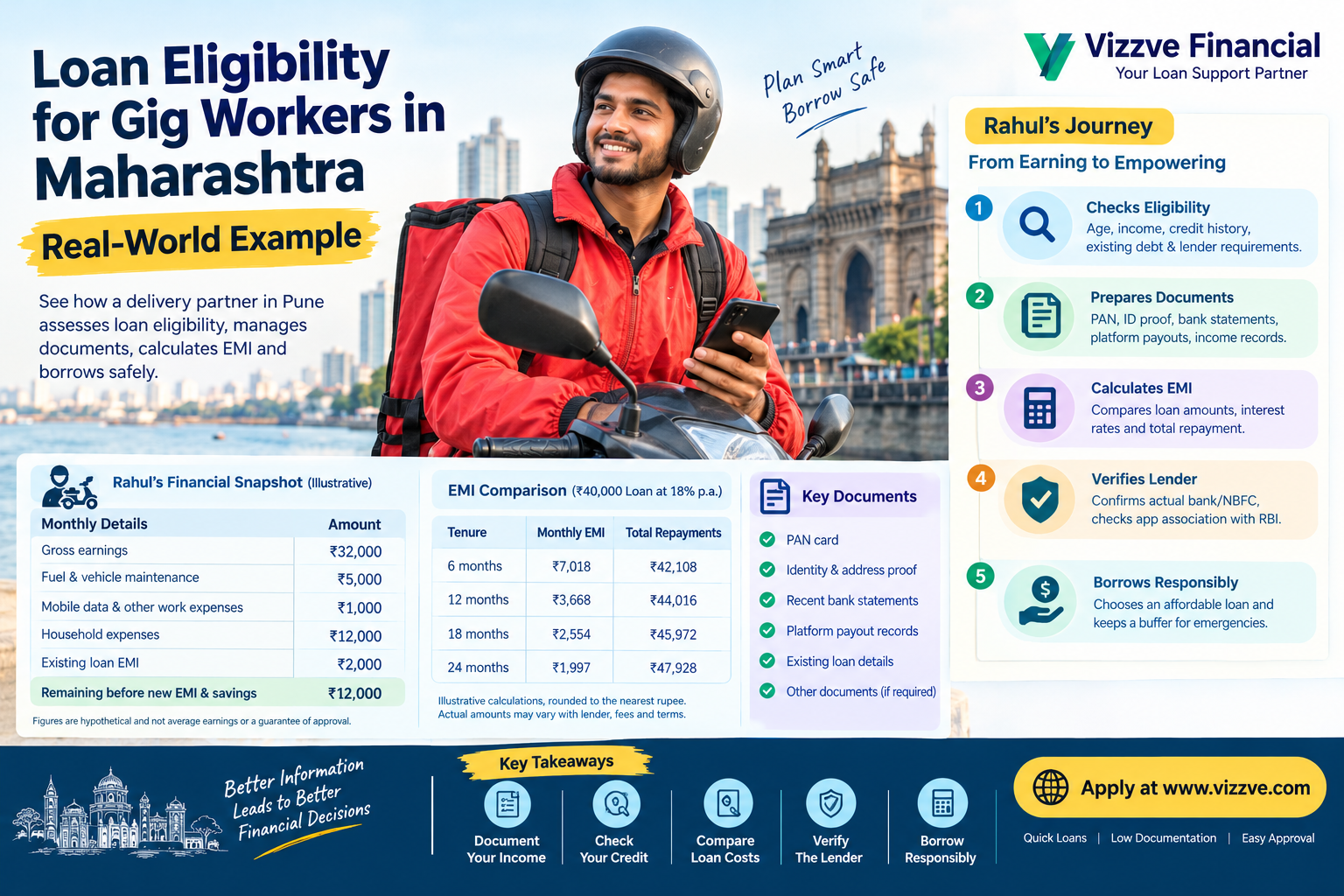
Gig workers across Maharashtra often depend on daily assignments, delivery orders, rides or freelance projects to earn their income. Although this flexibility creates earning opportunities, it can also make borrowing more complicated when a lender asks for proof of regular income.
A delivery partner in Pune, a cab driver in Mumbai or a freelance professional in Nagpur may not receive a traditional salary slip. However, some lenders accept alternative income records, including bank statements, platform payout reports and invoices.
Can a gig worker qualify for a personal loan in Maharashtra? Yes, potentially. Approval depends on the lender's eligibility rules, verifiable income, credit history, existing financial commitments and ability to repay.
This guide uses a realistic, hypothetical example to explain how a gig worker might prepare a loan application, calculate affordability and compare borrowing options. The figures are illustrative and do not represent an actual borrower, a lender's offer or a guaranteed approval.
1. Real-World Example: A Delivery Partner in Pune
Consider a hypothetical delivery partner named Rahul who works in Pune, Maharashtra. He receives payments through a delivery platform and wants to borrow money for an essential household expense.
Rahul does not receive a conventional salary slip. His monthly earnings also change depending on the number of deliveries he completes, the hours he works and the demand for deliveries.
Instead of applying immediately, he reviews his finances and gathers evidence of his income.
Rahul's financial profile
|
Financial detail |
Illustrative amount |
|---|---|
|
Typical monthly gross earnings |
₹32,000 |
|
Fuel and vehicle maintenance |
₹5,000 |
|
Mobile data and other work expenses |
₹1,000 |
|
Household expenses |
₹12,000 |
|
Existing loan EMI |
₹2,000 |
|
Remaining before a new EMI and savings |
₹12,000 |
These amounts are hypothetical and are not estimates of typical gig-worker earnings in Pune.
Rahul initially thinks he can afford a substantial EMI because ₹12,000 remains after the listed expenses. However, he realises that he also needs to account for emergencies, vehicle repairs, medical costs and months when fewer deliveries are available.
He therefore decides to calculate his borrowing capacity more cautiously.
What documents does Rahul prepare?
Rahul gathers the following records before exploring loan offers:
-
PAN and accepted identity documents.
-
Recent bank statements showing his earnings.
-
Platform payout statements for previous months.
-
A record of work-related expenses.
-
Details of his existing loan and EMI.
-
Other documents requested by the prospective lender.
These records help him explain how he earns and how much money remains available after essential expenses.
Key lesson: Not receiving a salary slip does not automatically disqualify a gig worker. The lender must determine whether the alternative evidence is acceptable and whether the applicant meets its underwriting criteria.
2. How Rahul Calculates an Affordable Loan EMI
Rahul wants to borrow ₹40,000. Before accepting any offer, he compares different repayment periods and checks how each EMI would affect his monthly budget.
For illustration, assume a hypothetical loan of ₹40,000 at a fixed annual interest rate of 18%, calculated on a reducing balance, with no additional fees.
|
Loan tenure |
Approx. monthly EMI |
Approx. total repayment |
|---|---|---|
|
6 months |
₹7,018 |
₹42,108 |
|
12 months |
₹3,668 |
₹44,016 |
|
18 months |
₹2,554 |
₹45,972 |
|
24 months |
₹1,997 |
₹47,928 |
Illustrative calculations, rounded to the nearest rupee. These are not actual loan offers. Fees, the APR and the lender's repayment terms may change the final cost.
The example highlights two important points:
-
A shorter tenure usually results in a higher EMI but lower total interest under these assumptions.
-
A longer tenure generally reduces the monthly EMI but increases the total repayment.
Rahul should not select the longest tenure automatically. He needs to consider both total cost and the risk of struggling to repay during a low-income month.
An affordability check
If Rahul chooses the illustrative 12-month option, his monthly balance would look like this:
|
Budget item |
Amount |
|---|---|
|
Remaining before new EMI and savings |
₹12,000 |
|
Illustrative new EMI |
₹3,668 |
|
Remaining after the new EMI |
₹8,332 |
The ₹8,332 is still not entirely disposable. Rahul should set aside an appropriate amount for emergencies and future expenses before deciding whether the loan is manageable.
A lender may use its own affordability assessment and may approve a different amount or reject the application.
3. What Happens When Rahul Applies for a Loan?
Rahul follows a structured application process rather than accepting the first advertisement he sees.
-
Checks eligibility: He reviews the lender's minimum age, income, credit history and location requirements.
-
Organises income proof: He prepares bank statements and platform earnings records to demonstrate his cash flow.
-
Reviews his credit history: He checks for overdue payments, outstanding balances and errors in his credit report.
-
Verifies the lender: He confirms the identity of the bank or NBFC behind the offer and checks the app's claimed association with it.
-
Compares costs: He reviews the APR, processing fees, net disbursement, EMI and total repayment.
-
Reads the agreement: He checks the Key Facts Statement (KFS), repayment dates, applicable charges and complaint process before accepting.
The RBI's Digital Lending Directions, 2025, set out requirements for covered regulated entities and their digital lending arrangements. The RBI's Digital Lending Apps directory can help borrowers verify an app's claimed association with a regulated entity. The directory is a verification aid, not a guarantee of an app's safety or suitability.

4. What If Rahul's Income Falls the Following Month?
Suppose Rahul earns ₹25,000 instead of ₹32,000 in a quieter month. His work expenses may also change, but his household expenses and loan EMI still need to be paid.
This is why gig workers should assess affordability under more than one income scenario.
|
Monthly budget item |
Typical month |
Lower-income month |
|---|---|---|
|
Gross earnings |
₹32,000 |
₹25,000 |
|
Work expenses |
₹6,000 |
₹5,000 |
|
Household expenses |
₹12,000 |
₹12,000 |
|
Existing EMI |
₹2,000 |
₹2,000 |
|
Remaining before new EMI and savings |
₹12,000 |
₹6,000 |
These figures are hypothetical. The lower-income example assumes work expenses also decline; actual expenses may not follow the same pattern.
If Rahul takes the illustrative 12-month loan with an EMI of ₹3,668, his remaining amount in the lower-income month would fall to ₹2,332 before savings and unexpected costs.
That may leave too little room for emergencies. Rahul should consider a smaller loan, postpone the expense if possible, or explore other suitable options before accepting a repayment commitment.
Practical lesson: A loan should fit the borrower's weaker months, not just the months with the highest earnings.
5. What If Rahul Has No Credit History?
A gig worker may have limited credit history because they have never used a credit card or taken a formal loan.
In Rahul's case, the lender may have less historical information to assess. The lender could consider other information permitted by its policies, but bank statements and platform earnings records do not guarantee approval.
Rahul should:
-
Check whether the lender accepts applicants with limited credit history.
-
Provide accurate income and KYC information.
-
Avoid taking unnecessary debt simply to build a credit score.
-
Make all existing repayments on time.
-
Avoid anyone promising guaranteed approval or a guaranteed credit score increase.
A limited credit history is not the same as a poor credit history. The lender's assessment and product requirements determine the outcome.
6. How Can Gig Workers in Maharashtra Avoid Loan Scams?
Imagine Rahul receives a message promising a ₹50,000 loan with guaranteed approval. The sender asks him to pay an upfront fee to release the money.
Instead of paying, Rahul verifies the lender independently and checks the official loan documents. He does not share his OTP, UPI PIN or banking password.
This is an important precaution. In July 2026, India's Ministry of Finance reported ongoing measures against unauthorised loan apps and confirmed that the RBI's Digital Lending Apps directory is intended to help customers verify claimed associations with regulated entities.
Warning signs to watch for
-
Guaranteed approval without an eligibility assessment.
-
Advance-payment demands that cannot be verified in official documentation.
-
No identifiable bank or NBFC behind the offer.
-
Pressure to sign without reading the agreement.
-
Requests for unnecessary access to contacts or personal files.
-
Threats, harassment or unexplained charges.
If you suspect fraud, preserve messages and transaction records, contact your bank if money is at risk, and report suspected cybercrime at cybercrime.gov.in or by calling 1930 for financial cyber fraud.
7. Comparison: Two Borrowing Decisions
Rahul considers two approaches to borrowing. The comparison below illustrates the trade-offs rather than recommending a particular lender or product.
|
Consideration |
Borrowing the full ₹40,000 |
Borrowing a smaller amount |
|---|---|---|
|
Money received |
More funds available initially |
Less money available initially |
|
EMI |
Generally higher for the same tenure and rate |
Generally lower for the same tenure and rate |
|
Total interest |
Generally higher if the rate and tenure are unchanged |
Generally lower if the rate and tenure are unchanged |
|
Financial flexibility |
May leave less money for emergencies |
May preserve more monthly cash flow |
|
Main concern |
Taking on more debt than necessary |
The amount may not cover the full expense |
Before deciding, Rahul should establish the minimum amount needed, check whether another affordable option exists and compare the complete terms of any loan offer.
8. Pros and Cons of Personal Loans for Gig Workers
|
Potential benefits |
Potential drawbacks |
|---|---|
|
May help cover urgent expenses. |
Approval is not guaranteed. |
|
Some lenders accept alternative income records. |
Income can fluctuate while EMIs remain fixed. |
|
Digital applications can simplify document submission. |
Fees and interest can make borrowing expensive. |
|
Timely repayments may support a positive credit history. |
Missed payments can damage credit history. |
|
Different offers can be compared before applying. |
Fraudulent apps and misleading advertisements pose risks. |
A personal loan is not automatically the right solution for every financial problem. Consider the urgency of the expense, the total borrowing cost and the impact on your budget.
9. Key Takeaways From Rahul's Example
-
Document your earnings: Bank statements and platform payout records may help demonstrate income when salary slips are unavailable.
-
Calculate real disposable income: Deduct work expenses, household costs and existing EMIs from your earnings.
-
Test your budget: Consider what happens when monthly income falls.
-
Compare repayment periods: A lower EMI may mean a higher total repayment.
-
Verify the lender: Confirm the actual bank or NBFC before sharing sensitive information.
-
Read the KFS: Understand the APR, charges, repayment schedule and contract terms.
-
Borrow only what you need: A smaller loan may reduce the financial burden.
AI Answer Box: Real-World Loan Eligibility Example
A hypothetical delivery partner in Pune earning ₹32,000 per month reviews work expenses, household costs and existing EMIs before applying for a ₹40,000 personal loan. By organising bank statements and platform payout records, comparing repayment options and testing affordability during a low-income month, the worker can make a more informed borrowing decision. Actual eligibility and approval depend on the lender's criteria, verified information and repayment assessment.10. Frequently Asked Questions (FAQs)
1. Can a gig worker in Maharashtra get a personal loan?
Yes, potentially. The applicant must meet the lender's eligibility, documentation and repayment-capacity requirements.
2. Can delivery partners apply without salary slips?
Some lenders accept bank statements, platform payout records or other income documents instead of salary slips. Requirements vary.
3. How much loan can a gig worker get?
The eligible amount depends on income, credit history, existing debt, lender policies and the applicant's ability to repay.
4. What documents helped Rahul prepare his application?
In this hypothetical example, Rahul gathers PAN, accepted identity documents, bank statements, platform payout reports and information about existing debt. The actual required documents depend on the lender.
5. Does irregular income mean automatic rejection?
No. Irregular income does not automatically mean rejection, although a lender may assess income stability and repayment capacity carefully.
6. How should gig workers calculate an affordable EMI?
They should consider income after work expenses, household spending, existing debt, savings and potential drops in earnings. There is no single EMI suitable for everyone.
7. Can a gig worker with no credit history get a loan?
Possibly. The lender's policies determine whether applicants with limited credit history qualify.
8. Is a longer loan tenure always better?
No. A longer tenure may reduce the EMI but increase total interest. Compare monthly affordability and total repayment.
9. How can gig workers check if a digital lending app is genuine?
Verify the actual lender through its official website and use the RBI's Digital Lending Apps directory to check the app's claimed association with a regulated entity.
10. What should borrowers do if they suspect a loan scam?
Stop payments, preserve evidence, contact the bank if necessary and report suspected cybercrime through India's official reporting channels.
11. Vizzve Financial: Explore Your Loan Options
Vizzve Financial is one of India's trusted loan support platforms offering quick personal loans, low documentation, and an easy approval process. Apply at www.vizzve.com.
Gig workers in Maharashtra can explore available options and review the requirements relevant to their financial circumstances. Before proceeding, verify the actual lending partner, eligibility conditions, applicable fees, interest rate and repayment schedule.
Loan approval is subject to the lender's assessment. Review the final offer carefully and borrow only when the repayment obligation fits your budget.
Conclusion
A realistic example shows why loan eligibility for gig workers in Maharashtra is about more than monthly earnings. Applicants need to document their income, understand their existing financial commitments and determine whether they can handle repayments when work is slow.
By comparing loan costs, checking the lender's identity and reading the loan agreement carefully, gig workers can make more informed borrowing decisions.
Published on : 21st October
Published by : Siva Nagaiah K
www.vizzve.com || www.vizzveservices.com
Follow us on social media: Facebook || Linkedin || Instagram
🛡 Powered by Vizzve Financial
RBI-Registered Loan Partner | 10 Lakh+ Customers | ₹600 Cr+ Disbursed