

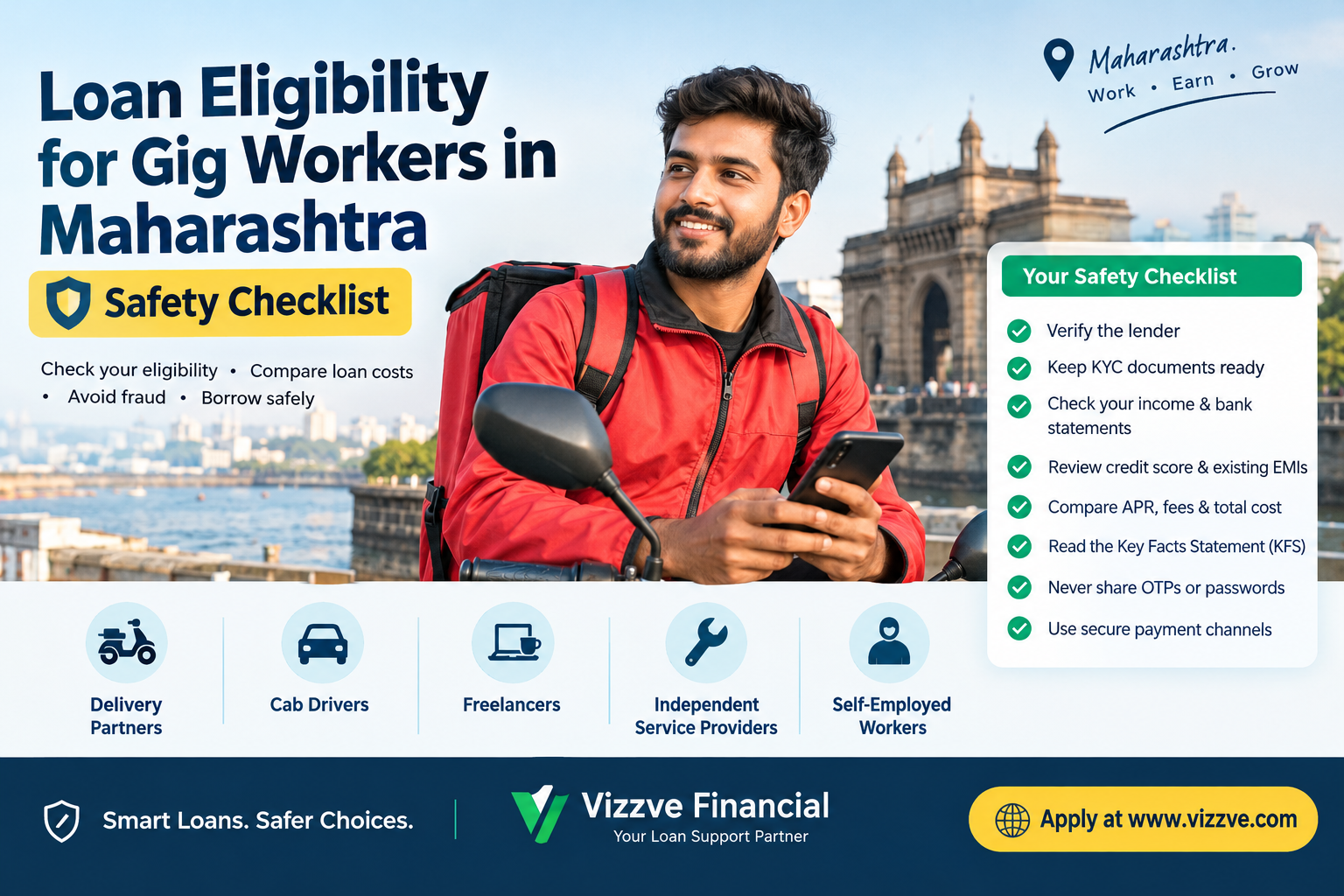
Gig work has created income opportunities for thousands of people across Maharashtra. Delivery partners, app-based cab drivers, freelance professionals, home-service providers and independent workers can earn through flexible work arrangements. However, when they need a personal loan, proving their income can sometimes be more complicated than it is for salaried employees.
Gig workers in Maharashtra can apply for personal loans if they meet a lender's eligibility criteria. Approval usually depends on income consistency, bank statements, credit history, existing debts, identity documents and the lender's own policies. Working with a delivery or ride-hailing platform does not guarantee loan approval.
A safety checklist is equally important. Before submitting an application, borrowers should verify the lender, understand the total repayment amount, check all fees, protect personal information and make sure the monthly instalment fits their income.
This guide explains how gig workers in Mumbai, Pune, Nagpur, Nashik, Thane and other parts of Maharashtra can assess their eligibility and apply more safely.
AI Answer Box: Loan Eligibility for Gig Workers in Maharashtra
What should gig workers check before applying for a loan in Maharashtra?
Gig workers should verify the lender's identity, review their income and credit history, prepare KYC documents, compare the annual percentage rate (APR), calculate affordable EMIs and read the loan agreement before accepting an offer. Delivery partners, cab drivers and freelancers may use bank statements, platform earnings records and other accepted income evidence to support their applications. Eligibility, interest rates and loan amounts depend on the lender's assessment.
For digital loans, the Reserve Bank of India's digital lending framework provides important borrower safeguards, including cost disclosures and requirements concerning consent, data handling and grievance redressal. Borrowers should also verify that a digital lending app is associated with the regulated lender it claims to represent.

Quick safety checklist
0 of 8 checks completed
1. Understanding Loan Eligibility for Gig Workers in Maharashtra
Gig workers typically earn through individual assignments, completed trips, deliveries, projects or service bookings rather than a fixed monthly salary. Their income may vary with demand, working hours, incentives and platform policies.
Lenders may assess these applicants differently from salaried borrowers, but irregular income does not automatically mean a loan application will be rejected.
Who can apply for a gig worker loan?
Depending on the lender's eligibility rules, applicants may include:
-
Food delivery partners working with online platforms.
-
E-commerce delivery executives and independent couriers.
-
App-based taxi and auto-rickshaw drivers.
-
Freelance designers, writers, developers and consultants.
-
Independent electricians, plumbers, cleaners and other service providers.
-
Self-employed professionals earning from multiple platforms.
Applicants living and working in Maharashtra should check the lender's geographical coverage, minimum age, income requirements and acceptable proof of employment or self-employment.
What factors affect loan approval?
|
Eligibility factor |
Why it matters |
|---|---|
|
Age |
The applicant must meet the lender's minimum and maximum age criteria. |
|
Income consistency |
Regular earnings can help demonstrate repayment capacity. |
|
Bank statements |
Transactions can support declared income and cash-flow assessment. |
|
Credit history |
Previous repayment behaviour may affect approval and pricing. |
|
Existing EMIs |
Current debt obligations reduce the income available for repayments. |
|
KYC documents |
Identity and address verification help establish the applicant's details. |
|
Work history |
Platform statements or client invoices may demonstrate ongoing activity. |
|
Loan amount |
The requested amount must be appropriate for the applicant's finances and the lender's policy. |
Important: There is no single credit score, income threshold or minimum number of working months that guarantees approval for every gig worker in Maharashtra. Check the actual lender's published requirements before applying.
2. The Complete Safety Checklist Before Applying
Check 1: Verify the lender before sharing documents
A professional-looking website, mobile application or social media advertisement is not proof that a lender is legitimate.
Before applying:
-
Identify the actual bank or Non-Banking Financial Company (NBFC) providing the loan.
-
Visit the lender's official website independently.
-
Confirm the app's association with that lender using the lender's own website and the RBI's Digital Lending Apps directory, where applicable.
-
Check the lender's contact information, grievance process and loan terms.
-
Avoid offers received from unknown WhatsApp numbers or unverified social media accounts.
The RBI introduced its Digital Lending Apps directory to help customers verify claims about an app's association with a regulated entity. The directory is a verification aid, not a guarantee that every loan offer is suitable or that an app cannot be misused.
Warning signs of a potentially fraudulent loan offer
-
Guaranteed approval without any assessment.
-
Requests for a deposit before the loan is sanctioned.
-
Pressure to act immediately or risk losing the offer.
-
No clear name of the actual lender.
-
Blank agreements or unexplained charges.
-
Threats to contact your family or publish personal information.
-
Requests for banking passwords, UPI PINs or OTPs.
If anything appears suspicious, stop the application and verify the offer independently.
Check 2: Prepare the correct documents
Gig workers may not receive salary slips or formal employment letters. They can instead ask the lender which alternative income records it accepts.
|
Document |
Purpose |
|---|---|
|
PAN card |
Commonly used for identity and financial verification. |
|
Aadhaar or other accepted identity proof |
Helps satisfy KYC requirements, subject to the lender's process. |
|
Address proof |
Establishes residential details where required. |
|
Recent bank statements |
Shows incoming payments, balances and financial activity. |
|
Platform earnings statements |
Helps document delivery, ride or task-based earnings. |
|
Client invoices or payment receipts |
May support freelance or independent-service income. |
|
Existing loan statements |
Helps establish current repayment obligations. |
|
Tax returns, if available or requested |
May provide additional evidence of income. |
Not every lender requires every document. Use only official submission channels and provide information that is accurate and consistent.
Check 3: Calculate your actual monthly income
A gig worker's gross earnings are not necessarily the same as the money available for loan repayment.
For example, a delivery partner may receive ₹35,000 in monthly platform payouts but spend money on fuel, vehicle maintenance, mobile data and other work-related costs.
A simple assessment is:
|
Monthly income and expenses |
Illustrative amount |
|---|---|
|
Gross gig earnings |
₹35,000 |
|
Fuel and vehicle expenses |
₹6,000 |
|
Other work-related costs |
₹2,000 |
|
Household expenses |
₹12,000 |
|
Existing loan EMI |
₹3,000 |
|
Remaining amount before new EMI and savings |
₹12,000 |
These are illustrative figures, not Maharashtra-wide averages or lender eligibility thresholds.
The remaining ₹12,000 should not automatically be treated as the maximum affordable EMI. The borrower should reserve money for savings, emergencies, medical expenses, repairs and months with fewer assignments.
Practical tip: Calculate your average earnings over several months and examine your lowest-income months as well. A loan that seems manageable during a busy festival period may become difficult during a slow month.
Check 4: Review your credit report
A credit report may contain information about previous loans, credit cards, repayment history, outstanding balances and credit enquiries.
Before applying:
-
Check whether your personal details are correct.
-
Review outstanding loans and overdue payments.
-
Dispute any errors through the relevant credit information company.
-
Avoid submitting multiple applications indiscriminately.
-
Do not assume that paying a third party guarantees a higher credit score.
A stronger credit history can help with a lender's assessment, but approval also depends on income, debt obligations, product rules and other factors. There is no universal credit score that guarantees a gig worker's loan approval.
Check 5: Read the Key Facts Statement before accepting the loan
The Key Facts Statement (KFS) is an important document for understanding a digital loan's costs and terms.
Check the following carefully:
-
Annual Percentage Rate (APR).
-
Loan amount and net amount disbursed.
-
Interest rate and whether it is fixed or variable, where relevant.
-
Processing fees and other disclosed charges.
-
EMI amount, number of instalments and repayment dates.
-
Late-payment and penal charges.
-
Prepayment or foreclosure conditions.
-
Cooling-off period and applicable exit terms.
-
Grievance redressal officer's contact information.
The RBI's Digital Lending Directions, 2025, establish the current framework for digital lending by covered regulated entities. Borrowers should read the applicable KFS and agreement rather than relying on an advertisement's headline rate.
Check 6: Protect your personal and financial information
A legitimate loan application may require certain information for KYC and credit assessment, but permission should be clear, relevant and handled through an appropriate process.
-
Never disclose your OTP, UPI PIN or banking password to an agent.
-
Do not install unknown applications sent through messages.
-
Review permissions requested by the lending app.
-
Avoid giving unnecessary access to contacts, call logs, photos or files.
-
Do not send identity documents to unverified individuals.
-
Keep copies of the application, KFS, sanction letter and loan agreement.
-
Save transaction references and official communication.
The RBI's digital lending framework includes requirements around need-based data collection, borrower consent and privacy safeguards.
Check 7: Confirm the repayment method
Before accepting a loan, make sure you understand how and when payments will be collected.
Confirm:
-
The official repayment account or authorised payment channel.
-
The EMI due date.
-
Whether automatic debit is enabled and how it works.
-
How to obtain payment receipts.
-
What happens if a payment fails.
-
How to contact the lender about a repayment difficulty.
Do not transfer instalments to a personal account simply because someone claims to represent a lender. Verify payment instructions using official contact details.
3. How Can Gig Workers in Maharashtra Improve Their Loan Eligibility?
Improving eligibility starts with making income easier to verify and demonstrating that repayments are affordable.
Maintain clear income records
Gig workers in Maharashtra can create a consistent record of their earnings by:
-
Using a bank account to receive platform payouts whenever possible.
-
Saving monthly earnings statements from work applications.
-
Keeping invoices and payment confirmations for freelance assignments.
-
Recording legitimate work-related expenses.
-
Avoiding unexplained discrepancies between declared earnings and bank credits.
Workers who earn from multiple platforms should organise records by source and month. This can make the application easier to assess.
Keep existing debts manageable
Lenders may evaluate the total amount you already pay towards loans and credit cards. If your monthly obligations consume a large portion of your income, a new loan may be difficult to afford.
Before borrowing, consider whether you can reduce expensive existing debt, avoid unnecessary credit purchases or request a smaller loan amount.
Choose an appropriate loan amount
Do not borrow the maximum amount shown in an eligibility estimate simply because it is available. Estimate the money you actually need and compare the EMI for different amounts and repayment periods.
A longer repayment period may reduce the EMI but can increase the total interest paid. Compare both figures before making a decision.
4. How to Compare Loan Offers Safely
Two lenders may advertise similar interest rates but offer different repayment terms and total borrowing costs.
|
Comparison point |
What to examine |
|---|---|
|
APR |
The overall annualised cost of the loan, including applicable upfront costs. |
|
Processing fee |
The amount deducted or collected for processing, as disclosed in the loan documents. |
|
Net disbursement |
The money actually credited to your account. |
|
Monthly EMI |
Whether the instalment is manageable during low-income months. |
|
Total repayment |
The total amount payable across the repayment schedule. |
|
Late-payment charges |
The consequences of missing an instalment. |
|
Foreclosure terms |
Conditions and charges, if applicable, for early repayment. |
|
Customer support |
Whether the lender has a clear complaint-handling process. |
Illustrative EMI comparison
The following example shows how repayment duration can affect the monthly instalment. It assumes a ₹50,000 loan at a hypothetical fixed annual interest rate of 18%, calculated using a standard reducing-balance EMI method, with no fees included.
|
Repayment period |
Approx. monthly EMI |
Approx. total repayment |
|---|---|---|
|
6 months |
₹8,780 |
₹52,680 |
|
12 months |
₹4,584 |
₹55,008 |
|
18 months |
₹3,193 |
₹57,474 |
|
24 months |
₹2,496 |
₹59,904 |
Figures are rounded illustrations, not live loan offers. Actual amounts vary with the lender's calculation method, fees, APR and contractual terms.
The comparison highlights an important trade-off: a smaller EMI can make monthly budgeting easier, but a longer term can raise the total amount repaid.
5. Step-by-Step Guide to Applying Safely
Step 1: Assess your finances
Calculate average earnings, essential expenses, existing EMIs and the amount you can safely repay.
Step 2: Verify the lender
Confirm the bank or NBFC behind the offer, its official website and the app's claimed association with that lender.
Step 3: Prepare your documents
Gather identity proof, bank statements and accepted platform earnings records before starting the application.
Step 4: Compare the loan terms
Review the KFS, APR, fees, EMI, total repayment and applicable early-exit terms.
Step 5: Submit accurate information
Complete the application through the verified channel. Never falsify earnings or submit documents that do not belong to you.
Step 6: Review the final offer
Check the sanctioned amount and final contract. Accept only if the terms are clear and the repayments fit your budget.
6. Pros and Cons of Personal Loans for Gig Workers
|
Potential advantages |
Potential disadvantages |
|---|---|
|
May provide funds for urgent expenses. |
Approval is not guaranteed. |
|
Can be used for eligible personal needs. |
Interest and fees may make borrowing expensive. |
|
Some lenders accept alternative income evidence. |
Income fluctuations can make fixed EMIs harder to manage. |
|
A suitable repayment history may help build credit. |
Missed payments can damage credit history and lead to additional charges. |
|
Digital applications may reduce paperwork. |
Fraudulent apps and misuse of personal information remain risks. |
A personal loan is not automatically the best solution for every financial need. Compare the cost of borrowing with alternatives such as savings, a payment arrangement with the service provider or another suitable regulated credit product.
7. Real-World Example: A Delivery Partner in Pune
Consider a hypothetical delivery partner in Pune who earns ₹32,000 in a typical month but experiences fluctuations during periods of low demand.
The worker wants to borrow ₹40,000 for an essential household expense. Before applying, the worker reviews six months of earnings, checks bank statements, lists monthly expenses and verifies an offer from a lender.
The worker then discovers that the advertised loan has a processing fee and an EMI that would leave little room for fuel costs, household bills and emergency savings.
Instead of accepting immediately, the worker compares a smaller loan amount and a different repayment period. The worker also checks the KFS and confirms the actual lender's identity.
What does this example teach?
-
Gross monthly income does not equal disposable income.
-
Bank statements and platform records can help demonstrate earnings.
-
The advertised interest rate is not the only borrowing cost.
-
Comparing alternatives can help avoid excessive repayments.
-
Verification should come before sharing sensitive information.
This is an illustrative scenario, not a report of an actual borrower or a guarantee of approval.
8. Expert Commentary: What Responsible Borrowing Looks Like
From a responsible-lending perspective, the central question is not simply whether a gig worker can qualify for a loan. It is whether the loan is affordable, transparent and appropriate for the borrower's circumstances.
Three principles are particularly important:
Income should be assessed realistically. Variable earnings should be considered alongside work expenses, household obligations and periods of reduced demand.
Costs should be transparent. The borrower should understand the APR, instalment schedule, total repayment and applicable charges before accepting the contract. The RBI's digital lending rules provide a framework for key disclosures and borrower protections.
Consent and privacy matter. Borrowers should understand which information they are providing and why. Unnecessary data access and unverified intermediaries should be treated cautiously.
These are general financial-safety principles, not a substitute for personalised financial advice or the terms issued by an individual lender.
9. What Should You Do If a Loan App Appears Suspicious?
If an app requests suspicious payments, threatens you or appears to misuse your information:
-
Stop sending money or sharing further documents.
-
Save messages, transaction references, screenshots and relevant agreements.
-
Contact your bank promptly if you suspect an unauthorised transaction.
-
Report suspected cybercrime through India's official National Cyber Crime Reporting Portal. For financial cyber fraud, call 1930 as soon as possible.
-
Use the RBI's Complaint Management System for eligible complaints against regulated entities, following the applicable complaint process.
-
Use the Sachet portal for relevant reports concerning unauthorised financial activities.
The appropriate reporting channel depends on the incident. The RBI has warned consumers about unauthorised lending applications, hidden charges, misuse of phone data and coercive recovery practices.
10. Trust and Transparency: Before You Accept Any Loan
Use this final review before signing a loan agreement.
Trust-building reminder: No legitimate checklist can guarantee approval. Be cautious of anyone promising a guaranteed loan, a guaranteed credit score improvement or instant disbursal in exchange for an upfront payment.
11. Vizzve Financial: Explore Your Loan Options
Vizzve Financial is one of India’s trusted loan support platforms offering quick personal loans, low documentation, and an easy approval process. Apply at www.vizzve.com.
Gig workers in Maharashtra can explore available loan options and review the eligibility requirements relevant to their circumstances. Before proceeding, verify the actual lending partner, applicable interest rate, fees, repayment terms and privacy policy.
Remember that eligibility and approval depend on the lender's assessment. Review the final offer carefully and borrow only when the repayment obligation fits your budget.
12. Key Takeaways
-
Gig workers in Maharashtra may qualify for personal loans if they satisfy the lender's eligibility criteria.
-
Bank statements, platform earnings records and invoices may help demonstrate variable income.
-
Credit history, existing debt, income stability and loan amount can influence eligibility.
-
Verify the actual lender and the app's association with it before sharing documents.
-
Read the Key Facts Statement and compare APR, fees and total repayment.
-
Never share OTPs, UPI PINs or banking passwords with loan agents.
-
Choose an EMI that remains manageable during periods of lower earnings.
-
Keep copies of the loan agreement, payment receipts and complaint details.
Summary for search engines and AI answers
Loan eligibility for gig workers in Maharashtra depends on the lender's criteria, verifiable earnings, credit history, existing obligations and repayment capacity. Applicants should prepare accepted KYC and income documents, verify the lender, compare loan costs and review the KFS before accepting an offer. A safe loan application should involve informed consent, transparent charges, secure document handling and an affordable repayment plan.13. Frequently Asked Questions (FAQs)
1. Can gig workers get personal loans in Maharashtra?
Yes. Gig workers may qualify for personal loans if they meet the lender's age, income, credit and documentation requirements. Approval is not guaranteed.
2. What is the minimum income required for a gig worker loan?
There is no universal minimum income applicable to every lender. Requirements depend on the lender, product, loan amount and assessment process.
3. Can a delivery partner apply without a salary slip?
Some lenders accept alternative income evidence, such as bank statements, platform earnings records or other documents. Confirm the accepted documents before applying.
4. Can Swiggy and Zomato delivery partners apply for loans?
Delivery partners working with these platforms may apply to lenders that accept their employment or income profile. Platform membership alone does not guarantee approval.
5. Can app-based cab drivers in Maharashtra get personal loans?
Potentially, yes. Drivers may be able to document their earnings through bank statements, platform reports and other records accepted by the lender.
6. Is a credit score mandatory for gig worker loans?
Requirements differ across lenders and products. Some lenders rely on credit bureau information, while others may use additional assessment methods. A lack of credit history does not guarantee either approval or rejection.
7. Which documents should gig workers prepare?
Commonly requested documents include PAN, accepted identity and address proof, bank statements and income evidence. Additional documentation may be required depending on the lender.
8. How can gig workers prove irregular income?
They can organise several months of bank statements, platform payout reports, invoices and payment receipts. The lender determines which records are acceptable.
9. How can I check whether a loan app is genuine?
Identify the actual bank or NBFC, visit its official website and verify the app's association using the lender's own information and the RBI's Digital Lending Apps directory where applicable.
10. Should I pay an advance fee to guarantee loan approval?
No. Treat requests for suspicious advance payments or fees to guarantee approval as warning signs. Verify every charge through the lender's official documentation.
11. What is APR, and why is it important?
APR represents the annualised overall cost of a loan, including applicable upfront costs. Reviewing APR alongside the EMI and total repayment helps borrowers compare offers more meaningfully.
12. Can I apply if I already have another loan?
Possibly. The lender may assess your existing EMIs, outstanding debt, income and repayment history to determine whether additional borrowing is appropriate.
13. How much EMI should a gig worker pay each month?
There is no single safe EMI for every borrower. Calculate disposable income after work expenses, essential household spending, existing debt and emergency savings. Keep sufficient room for fluctuations in earnings.
14. What should I do if a digital lender misuses my information?
Preserve evidence, contact the relevant lender or bank, and report suspected cybercrime through cybercrime.gov.in or call 1930 for financial cyber fraud. Eligible complaints involving regulated entities can also be submitted through the RBI's Complaint Management System.
15. Does Vizzve Financial guarantee loan approval?
No loan approval should be assumed or guaranteed based on a platform's promotional claims. Applicants should verify the actual lender, eligibility criteria, applicable costs and final sanction terms before accepting a loan.
Conclusion
Loan eligibility for gig workers in Maharashtra depends on more than the amount earned in a typical month. Verifiable income, credit history, existing financial commitments and the lender's requirements all influence the decision.
The safest approach is to prepare accurate documents, verify the lender, compare the complete cost of borrowing and select an EMI that remains affordable when work is slow. A careful review can help delivery partners, drivers and freelancers make more informed financial decisions.
Published on : 21st October
Published by : Siva Nagaiah K
www.vizzve.com || www.vizzveservices.com
Follow us on social media: Facebook || Linkedin || Instagram
🛡 Powered by Vizzve Financial
RBI-Registered Loan Partner | 10 Lakh+ Customers | ₹600 Cr+ Disbursed