

Introduction
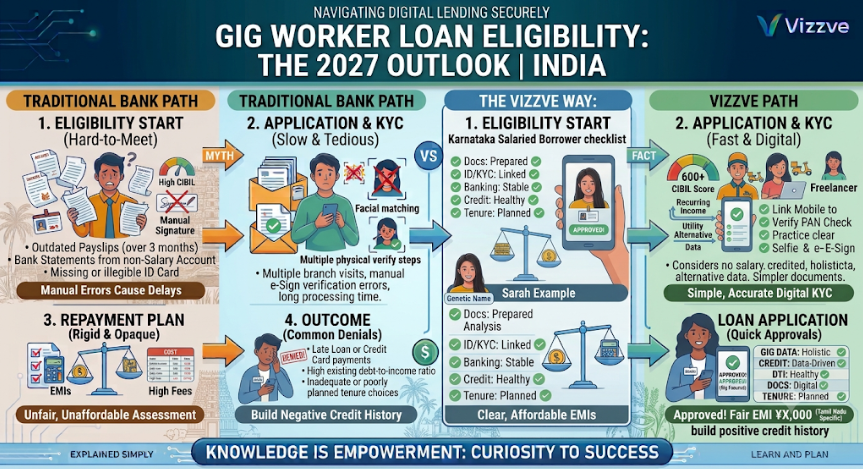
India's employment landscape is changing as more people choose flexible work opportunities through digital platforms, freelance projects and independent services.
Delivery partners, cab drivers, online tutors, content creators and freelance professionals are increasingly using mobile applications to earn money and manage their finances.
However, access to formal credit remains an important challenge for many gig workers.
Traditional lending systems often rely on salary slips, employment certificates and fixed monthly income. Gig workers may not have these documents because their earnings depend on completed tasks, customer demand, working hours and platform payments.
As we approach 2027, digital financial services, improved income verification and wider use of financial data could influence how lenders evaluate these borrowers.
The opportunity is significant, but approval will still depend on income verification, credit history, repayment capacity and lender-specific policies.
This article explores the 2027 outlook for gig worker loan eligibility in India and explains how mobile-first borrowers can prepare for changing lending requirements.
3. AI Answer Box – Quick Summary
What is the 2027 outlook for gig worker loan eligibility in India?
The outlook for gig worker lending in 2027 is one of potential growth in digital access, alternative income verification and financial inclusion. Lenders may increasingly explore ways to assess borrowers who earn through delivery platforms, freelance projects and independent work.
Can gig workers get personal loans in 2027?
Yes. Gig workers may qualify for personal loans from banks and NBFCs that accept their income profiles, subject to eligibility and repayment assessment.
Important trends to watch:
-
Greater use of digital loan applications.
-
More attention to alternative income documentation.
-
Increased focus on banking and payment histories.
-
Improved digital identity verification.
-
Growing interest in financial inclusion.
-
Continued importance of credit scores.
-
Stronger focus on responsible digital lending.
Quick takeaway: Gig workers should maintain organised income records, build a healthy credit history and choose affordable loan repayments to strengthen their future credit applications.
4. India's Gig Economy – What Can We Expect by 2027?
India's gig economy is becoming an important part of the country's employment structure.
According to the NITI Aayog report India's Booming Gig and Platform Economy, the estimated gig workforce was approximately 77 lakh in 2020–21, with a projection of 2.35 crore by 2029–30.
The Government of India's August 2025 backgrounder also cited an estimated workforce of 1 crore in 2024–25, projected to increase to 2.35 crore by 2029–30. These are estimates and projections rather than confirmed current headcounts. <sup>1</sup>
The Economic Survey 2025–26 subsequently reported an estimated increase from 77 lakh workers in FY21 to 120 lakh in FY25. <sup>2</sup>
Why does this matter for personal loans?
A growing gig workforce creates demand for financial products that consider different income structures.
For example:
-
Delivery executives may receive frequent platform payouts.
-
Cab drivers may earn through daily trips.
-
Freelancers may receive project-based payments.
-
Online professionals may work with multiple clients.
-
Independent service providers may have seasonal income.
Traditional salary-based verification may not fully represent these financial profiles.
Lenders that develop suitable income assessment methods could make formal credit more accessible to eligible independent workers.
5. Major Trends That Could Influence Gig Worker Loan Eligibility in 2027
The following are potential developments to watch. They are outlook scenarios, not guaranteed regulatory or industry changes.
5.1 Greater Adoption of Digital Lending
Digital loan applications are already changing how people access financial services.
By 2027, continued adoption of mobile banking and digital financial tools could make loan applications more convenient for gig workers.
Potential developments include:
-
Online loan applications.
-
Digital document submission.
-
Mobile-based identity verification.
-
Online application tracking.
-
Digital repayment reminders.
-
Improved borrower communication.
However, faster applications do not automatically mean easier approval.
5.2 Alternative Income Verification
One important challenge for gig workers is proving their income without traditional salary slips.
Lenders may increasingly explore suitable ways to evaluate different sources of earnings.
Potentially useful records include:
-
Bank statements.
-
Platform earnings reports.
-
Client invoices.
-
Contract payment records.
-
Income tax returns.
-
Other verified financial information accepted by the lender.
The use of any particular record will depend on lender policy, borrower consent and applicable regulations.
5.3 Greater Importance of Financial Data
Borrowers who maintain organised banking records may find it easier to demonstrate their income and repayment capacity.
Lenders may examine:
-
Frequency of incoming payments.
-
Average monthly income.
-
Existing loan obligations.
-
Repayment behaviour.
-
Financial transaction patterns.
Important: A large number of UPI transactions does not automatically mean a borrower has a high income. Payment activity must be interpreted correctly.
5.4 Growth in Mobile-First Borrowing
Smartphones are becoming central to everyday financial activities.
Mobile-first borrowers increasingly use applications to:
-
Receive income.
-
Check account balances.
-
Track expenses.
-
Pay loan EMIs.
-
Review credit information.
-
Apply for financial products.
In 2027, continued growth in mobile-based financial services could create more convenient access to formal loan application channels.
5.5 Stronger Focus on Responsible Lending
The growth of digital lending also makes borrower protection important.
The Reserve Bank of India's Digital Lending Directions, 2025 provide requirements covering transparency, borrower consent, data handling and regulated lending arrangements.
These requirements will remain important for digital lending activities in 2027 unless amended or replaced. <sup>3</sup>
6. How Different Gig Workers May Access Loans in 2027
Different types of independent workers have different income patterns.
| Worker category | Possible income evidence | Important assessment factor |
|---|---|---|
| Food delivery partners | Platform earnings and bank statements | Regularity of payouts |
| Cab drivers | Platform records and bank credits | Income after vehicle expenses |
| Freelancers | Invoices and bank statements | Client payment consistency |
| Online tutors | Payment records and contracts | Regular teaching income |
| Digital marketers | Client invoices and bank credits | Project continuity |
| Independent consultants | Contracts and financial records | Verified professional income |
Not every lender accepts every document. Borrowers should check the specific documentation requirements before applying.
7. Gig Workers vs Salaried Employees – Loan Eligibility in 2027
The difference between traditional employment and gig work will remain an important consideration in lending.
| Eligibility factor | Salaried employees | Gig workers |
|---|---|---|
| Income structure | Usually fixed | Variable |
| Income proof | Salary slips | Platform and bank records |
| Employment evidence | Employer documents | Work or platform records |
| Payment frequency | Usually monthly | Daily, weekly or periodic |
| Income verification | Salary credits | Earnings patterns |
| Credit history | Important | Important |
| Repayment capacity | Salary and expenses | Average income and expenses |
Which borrower may have an advantage?
Salaried employees may benefit from standardised income documentation.
Gig workers may need additional evidence to establish their earnings.
However, neither category automatically receives loan approval. Lenders assess the complete financial profile of each applicant.
8. What Documents May Help Gig Workers Apply for Loans in 2027?
Preparing documents in advance can make the application process easier.
| Document | Purpose |
|---|---|
| PAN card | Identity and financial verification |
| Accepted identity proof | Identity verification |
| Address proof | Residential verification |
| Bank statements | Income and transaction history |
| Platform earnings statements | Supporting income evidence |
| Client invoices | Freelance income verification |
| Income tax returns | Additional financial evidence, where applicable |
| Existing loan statements | Understanding repayment obligations |
Why should gig workers maintain income records?
Suppose a delivery partner earns ₹28,000 in one month, ₹32,000 in another and ₹25,000 in the following month.
Maintaining records can help demonstrate the actual income pattern instead of relying on estimates.
This may support a more accurate assessment of repayment capacity.
9. Real-World Example – A Delivery Partner Planning for a Loan in 2027
Let's understand how a gig worker can prepare for a personal loan application.
Meet Rahul – A Delivery Partner
Rahul works through a food delivery platform and receives regular digital payments.
He wants to apply for a personal loan in 2027 to manage a planned family expense.
His illustrative financial profile:
| Financial details | Amount |
|---|---|
| Average monthly earnings | ₹32,000 |
| Household expenses | ₹13,000 |
| Work-related expenses | ₹5,000 |
| Existing EMI | ₹2,000 |
| Estimated monthly surplus | ₹12,000 |
How can Rahul prepare?
Step 1: Maintain bank records
Rahul keeps his platform earnings and bank statements organised.
Step 2: Build a healthy credit history
He pays his existing EMI on time and avoids unnecessary borrowing.
Step 3: Review repayment capacity
He calculates his monthly expenses and identifies a comfortable EMI.
Step 4: Prepare KYC documents
He checks that his identity and address information are accurate.
Step 5: Compare lenders
He checks which lenders accept platform-based income and compares the applicable APR, fees and repayment conditions.
What is the lesson?
Rahul does not need to wait until he receives a traditional salary to start organising his financial records.
Maintaining consistent income evidence and responsible repayment habits can help strengthen a future loan application.
This example is illustrative and does not represent a guaranteed loan approval outcome.
10. How Will Credit Scores Matter for Gig Workers in 2027?
Credit history is expected to remain an important part of personal loan assessment.
A credit score helps lenders understand how an applicant has managed previous credit obligations.
General credit score interpretation
| Credit score range | General interpretation |
|---|---|
| 750 and above | Generally favourable |
| 700–749 | May be acceptable depending on lender |
| 650–699 | May require closer assessment |
| Below 650 | May make approval more difficult |
These are general educational ranges, not universal lender requirements.
How can gig workers build a healthy credit history?
-
Pay existing EMIs on time.
-
Avoid loan defaults.
-
Manage credit card balances.
-
Avoid multiple unnecessary loan applications.
-
Check credit reports periodically.
-
Correct inaccurate credit information.
A good credit score can improve a borrower's profile, but it cannot guarantee approval.
11. How Can Digital Lending Make Borrowing Easier in 2027?
Digital lending can reduce the need for physical paperwork in eligible application processes.
Potential benefits
-
Convenient mobile-based applications.
-
Digital document uploads.
-
Online application status updates.
-
Easier repayment tracking.
-
Faster communication.
-
Improved access to loan information.
What may remain challenging?
-
Unstable monthly income.
-
Insufficient income documentation.
-
Existing debt obligations.
-
Poor credit history.
-
Digital fraud risks.
-
Differences in lender eligibility policies.
Digital convenience should not be confused with guaranteed credit access.
12. Digital Lending Safety – What Borrowers Should Know
As mobile-based financial services expand, borrowers should understand how to identify legitimate lending channels.
The RBI's Digital Lending Directions, 2025 consolidate requirements for regulated entities and digital lending arrangements.
The RBI also operationalised a public directory of Digital Lending Apps from July 1, 2025, to help customers check an app's claimed association with a regulated entity. The directory is a verification aid and should not be treated as an RBI guarantee or endorsement of every app's conduct. <sup>4</sup>
Important safety practices
-
Check the actual bank or NBFC providing the loan.
-
Verify the lending application's association with the regulated entity.
-
Read the Key Fact Statement.
-
Compare the Annual Percentage Rate.
-
Review processing and other charges.
-
Understand privacy permissions.
-
Never share OTPs or UPI PINs.
-
Avoid paying unknown agents for guaranteed loan approval.
-
Use official repayment channels.
For updates, visit the Reserve Bank of India.
13. Social Security and the Future of Gig Workers
Loan eligibility is only one part of financial inclusion.
Social security, accident protection, health benefits and retirement-related support are also important for independent workers.
The Code on Social Security, 2020 provides a framework for social security measures for gig and platform workers, subject to the applicable implementation and scheme provisions.
The e-Shram initiative is another important government effort to build a database of eligible unorganised workers.
Why does social security matter for lending?
Better access to social protection could help workers manage financial risks associated with illness, accidents and interruptions in work.
However, social security registration should not be confused with automatic personal loan eligibility.
A lender will still evaluate income, creditworthiness and repayment capacity.
14. Pros and Cons – Personal Loans for Gig Workers in 2027
| Pros | Cons |
|---|---|
| Digital application options may improve convenience | Not every lender accepts gig income |
| Alternative income records may support verification | Documentation may still be extensive |
| More financial tools can help manage repayments | Income fluctuations remain a risk |
| Formal credit can support planned expenses | Interest and charges increase borrowing costs |
| Responsible repayment can build credit history | Missed EMIs can damage creditworthiness |
Is borrowing a good idea for every gig worker?
No. A loan should be considered only when the purpose is clear and repayments are affordable.
Borrowers should calculate their income after work-related expenses and account for low-income months before accepting a loan.
15. How Gig Workers Can Prepare for Better Loan Eligibility in 2027
Here are practical steps that borrowers can start following today.
Step 1: Maintain a separate record of income
Keep platform earnings statements, invoices and bank statements organised.
Step 2: Use traceable payment methods
Receive work-related earnings through legitimate banking channels wherever possible.
Step 3: Review your credit report
Check your credit history and identify incorrect information.
Step 4: Reduce unnecessary debt
Avoid taking several loans when existing repayments are already high.
Step 5: Build emergency savings
Save regularly to manage low-income periods and unexpected expenses.
Step 6: Compare loan offers carefully
Check:
-
Interest rate.
-
APR.
-
Processing fee.
-
EMI amount.
-
Loan tenure.
-
Total repayment.
-
Prepayment conditions.
Step 7: Apply through verified channels
Choose a legitimate lender and provide accurate information.
16. Expert Outlook – What Could Change by 2027?
The following developments deserve attention as India's lending ecosystem evolves.
| Area | Possible 2027 development | What borrowers should do |
|---|---|---|
| Digital applications | Continued mobile-first adoption | Maintain updated KYC |
| Income verification | More attention to alternative income records | Save earnings statements |
| Credit assessment | Greater use of verified financial information | Maintain clean banking records |
| Financial inclusion | More focus on independent workers | Understand formal credit options |
| Borrower protection | Continued regulatory oversight | Review KFS and APR |
| Repayment management | Wider use of digital tools | Set EMI reminders |
Expert commentary
The future of gig worker lending will depend on how effectively financial institutions evaluate different forms of income.
A worker who receives regular digital payments may have a verifiable financial profile even without a conventional employer.
However, lending decisions should not rely on digital transaction volume alone.
Responsible credit assessment must consider genuine income, household expenses, existing liabilities and the ability to repay.
The strongest opportunity for 2027 is not simply faster loan approval. It is more accurate and responsible assessment of borrowers with different employment arrangements.
17. Vizzve Financial – Supporting Mobile-First Borrowers
Vizzve Financial is one of India's trusted loan support platforms offering quick personal loans, low documentation, and an easy approval process. Apply at www.vizzve.com.
Gig workers, delivery partners, freelancers and mobile-first borrowers can explore suitable loan options and understand the importance of maintaining accurate financial records.
Before applying, compare loan terms, review the lending partner's eligibility criteria and ensure that the EMI fits your monthly income.
Loan approval remains subject to verification and the actual lending partner's assessment.
18. Key Takeaways
-
India's gig economy is expected to remain an important employment segment in 2027.
-
Gig workers can apply for personal loans through lenders that accept their income profiles.
-
Salary slips are not universally compulsory.
-
Platform earnings and bank statements may support income verification.
-
Digital loan applications may improve convenience.
-
Credit history will remain an important lending consideration.
-
Alternative income verification may create opportunities for eligible independent workers.
-
RBI digital lending requirements remain important for borrower protection.
-
Social security and financial inclusion are important parts of the wider gig economy outlook.
-
Borrowers should maintain income records and choose affordable EMIs.
19. Frequently Asked Questions (FAQs)
1. Can gig workers get personal loans in 2027?
Yes. Gig workers may qualify for personal loans if they meet the lender's income, creditworthiness, documentation and repayment requirements.
2. What is the future of gig worker loans in India?
The outlook includes potential growth in digital lending, alternative income verification and financial inclusion. Actual lending developments will depend on lenders, market conditions and regulation.
3. Will salary slips be compulsory for gig workers in 2027?
Not universally. Some lenders may accept bank statements, platform earnings reports, invoices and other supporting income documents.
4. Can delivery partners apply for personal loans?
Yes. Delivery partners may apply to lenders that accept platform-based earnings as income proof.
5. Can freelancers get personal loans without permanent employment?
Yes. Some lenders accept freelance income supported by bank statements, invoices and other financial records.
6. Will digital lending improve loan eligibility for gig workers?
Digital lending may improve application convenience and income verification options. It does not guarantee approval or change every lender's eligibility requirements.
7. Is a 750 credit score necessary for gig workers?
No universal 750 credit score requirement applies to all lenders. A strong credit history can improve the borrower's profile.
8. Can UPI transactions help gig workers prove their income?
UPI records may support financial verification, but lenders may require additional evidence to establish genuine work-related income.
9. What documents should gig workers maintain for future loans?
PAN, accepted identity proof, address proof, bank statements, platform earnings reports, invoices and other accepted financial records may be useful.
10. Does irregular income affect loan eligibility?
Yes, it may influence the lender's affordability assessment. However, irregular income does not automatically make someone ineligible.
11. How can gig workers improve their loan eligibility before 2027?
Maintain regular income records, pay existing EMIs on time, manage debt responsibly and build emergency savings.
12. Are digital loans safe for gig workers?
They can be safe when obtained through legitimate applications associated with regulated lenders. Borrowers should verify the lending partner and read the KFS and loan agreement.
13. Can gig workers apply for loans through mobile applications?
Yes. Many regulated lenders provide digital application facilities, subject to KYC, verification and eligibility checks.
14. Will social security registration guarantee personal loan approval?
No. Social security registration and personal loan eligibility are different matters. Lenders still assess repayment capacity and creditworthiness.
15. What is the biggest challenge for gig workers applying for loans?
Income fluctuations and the absence of standardised income documentation can create challenges. Organised financial records may help demonstrate repayment capacity.
20. Conclusion
The 2027 outlook for gig worker loan eligibility in India is closely connected to the growth of digital finance, alternative income verification and financial inclusion.
Delivery partners, cab drivers, freelancers and independent professionals are becoming an important part of India's workforce. Their financial requirements may encourage lenders to explore more flexible ways of assessing income and repayment capacity.
However, improved digital access does not mean automatic loan approval.
Maintaining accurate income records, building a good credit history, managing existing debts and choosing affordable repayments will remain essential for borrowers.
As the digital lending ecosystem evolves, mobile-first borrowers should focus on informed financial decisions rather than guaranteed approval promises.
Explore personal loan options with Vizzve Financial at www.vizzve.com.
Published on : 3RD November
Published by : Reddy kumar
www.vizzve.com || www.vizzveservices.com
Follow us on social media: Facebook || Linkedin || Instagram
🛡 Powered by Vizzve Financial
RBI-Registered Loan Partner | 10 Lakh+ Customers | ₹600 Cr+ Disbursed