

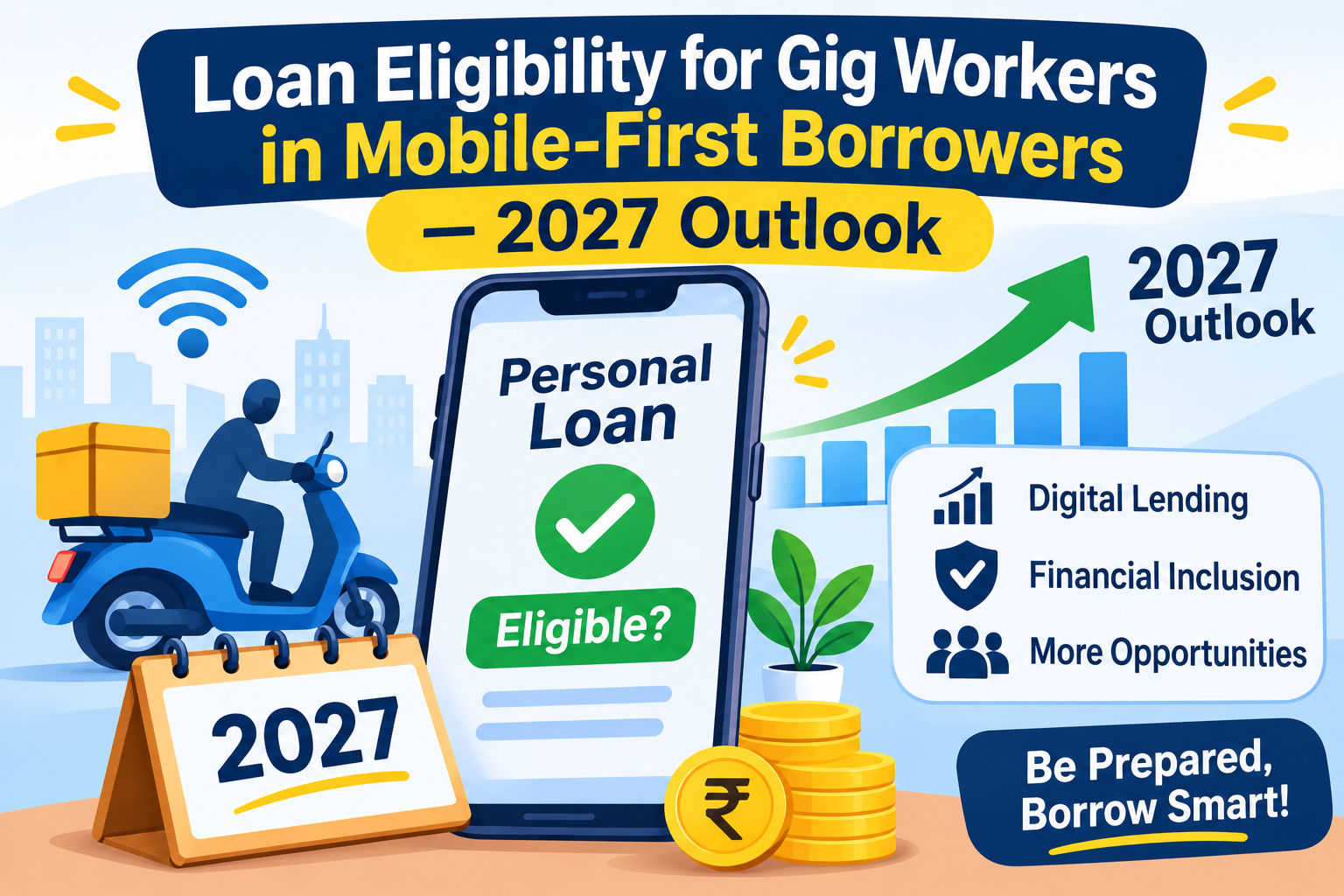
India's gig economy and digital financial ecosystem are expected to create new opportunities for workers seeking access to formal credit in 2027. Delivery partners, ride-hailing drivers, freelancers, online sellers and independent service providers increasingly depend on smartphones to manage their work, receive payments and handle financial transactions.
For these mobile-first borrowers, understanding loan eligibility will become increasingly important.
Unlike traditional salaried employees, gig workers may receive irregular income from multiple platforms or assignments. This can make loan applications more challenging when lenders assess income stability, repayment capacity and credit history.
In 2027, digital documentation, alternative income verification, responsible lending practices and improved financial awareness are likely to remain important developments in gig-worker lending.
This guide explores the expected 2027 outlook for loan eligibility for gig workers in mobile-first borrowers, including opportunities, challenges, documentation and practical preparation tips.
1. Understanding Mobile-First Gig Workers
Mobile-first gig workers are individuals who primarily use smartphones and digital platforms to manage their professional and financial activities.
Examples include:
-
Food delivery executives.
-
Online grocery delivery partners.
-
Cab and bike taxi drivers.
-
Freelancers and independent consultants.
-
E-commerce delivery partners.
-
Online sellers and service providers.
-
Part-time platform-based workers.
These workers often receive payments digitally, making transaction records an important part of their financial documentation.
2. Why Loan Eligibility Will Matter in 2027
Access to suitable credit can help gig workers manage unexpected expenses, purchase work equipment and handle temporary income fluctuations.
However, lenders need to understand a borrower's ability to repay before approving a loan.
In 2027, borrowers should pay particular attention to:
-
Consistency of monthly earnings.
-
Bank account transaction history.
-
Credit score and repayment behaviour.
-
Existing EMIs and financial obligations.
-
Digital income documentation.
-
Identity and address verification.
-
Loan affordability and repayment tenure.
Important: Digital access may simplify loan applications, but it does not guarantee loan approval or lower interest rates.
3. Major Trends Expected in 2027
A. Growth in Digital Lending
Digital lending is expected to remain an important channel for accessing credit. Mobile applications can make it easier for borrowers to submit documents, compare loan products and track application progress.
For gig workers, this may reduce some traditional paperwork barriers.
B. Greater Importance of Alternative Income Proof
Traditional salary slips may not accurately represent gig workers' earnings.
Lenders may consider alternative income information, depending on their policies, such as:
-
Bank account statements.
-
Digital payment records.
-
Gig-platform payout statements.
-
Income tax returns.
-
Business transaction records.
C. Better Financial Inclusion
The expansion of digital financial services may help more gig workers explore formal financial products.
According to NITI Aayog's report, India's gig workforce was estimated at 7.7 million in 2020–21 and projected to reach 23.5 million by 2029–30. This indicates the potential scale of the sector.
D. Increased Focus on Borrower Protection
Responsible lending and transparency will remain important.
The RBI's Digital Lending Directions, 2025 provide a regulatory framework covering digital lending activities by regulated entities, including borrower protection and transparency requirements.
E. Growing Importance of Digital Financial Records
Mobile-first borrowers can benefit from maintaining organised digital financial records.
Regularly reviewing bank transactions, platform payouts and loan repayments can help borrowers understand their financial position.
4. Government Initiatives Supporting Gig Workers
Government initiatives may influence the financial inclusion and social protection landscape for gig workers.
Some important developments include:
Code on Social Security, 2020: The Code came into force on 21 November 2025 and recognises gig workers and platform workers within India's social security framework. It provides for suitable social security schemes covering areas such as life and disability cover, accident insurance, health and maternity benefits, and old-age protection.
e-Shram Registration: The e-Shram portal provides a registration platform for unorganised workers, including eligible gig and platform workers.
Aggregator Registration: A government update dated January 2026 reported that 12 major aggregators had been onboarded through the e-Shram aggregator module.
These initiatives are relevant to worker welfare and formal recognition. However, registration or social security coverage should not be confused with automatic personal loan eligibility.
5. Factors That May Influence Loan Eligibility in 2027
|
Eligibility factor |
Why it matters |
|---|---|
|
Monthly income |
Helps assess repayment capacity |
|
Bank statements |
Show financial transactions |
|
Credit score |
Reflects credit repayment behaviour |
|
Existing EMIs |
Indicate current debt obligations |
|
Work consistency |
Helps establish earning patterns |
|
KYC documents |
Support identity verification |
|
Loan amount |
Determines repayment responsibility |
Lenders may apply different eligibility standards depending on the loan product and their internal credit policies.
6. How Gig Workers Can Prepare for Loans in 2027
Step 1: Maintain Updated KYC Documents
Keep identity and address documents updated. Ensure that submitted details are consistent across financial records.
Step 2: Track Monthly Earnings
Maintain a simple record of income received from delivery platforms, transportation services, freelance assignments or other gig activities.
Step 3: Maintain Healthy Banking Habits
Use a bank account for regular income transactions wherever practical. Keep records of digital payments and withdrawals.
Step 4: Improve Credit Behaviour
Pay existing loan instalments and credit card bills on time. Avoid unnecessary credit applications.
Step 5: Calculate EMI Affordability
Before borrowing, calculate how much you can repay after accounting for household expenses, work-related costs and income fluctuations.
Step 6: Compare Loan Offers
Review interest rates, APR, processing fees, late-payment charges and repayment periods.
Step 7: Verify the Lender
Check whether the loan is offered by a regulated bank or NBFC and verify the digital lending application's association with that lender.
7. Challenges Mobile-First Borrowers May Face in 2027
Despite improvements in digital finance, gig workers may continue to face several challenges.
-
Irregular income: Earnings may fluctuate due to demand and working hours.
-
Limited credit history: First-time borrowers may have insufficient credit records.
-
Documentation difficulties: Income from multiple platforms can be difficult to consolidate.
-
High borrowing costs: Loan pricing depends on the lender's assessment and product terms.
-
Digital fraud: Fake loan applications and misleading advertisements can create financial risks.
-
Repayment pressure: Fixed EMIs may become difficult during periods of reduced earnings.
Understanding these challenges can help borrowers make safer financial decisions.
8. Future Opportunities for Gig Workers
The changing digital economy may create new opportunities for gig workers to strengthen their financial profiles.
Potential developments include:
-
Digital income verification: Easier access to organised income and payment records.
-
Alternative credit assessment: Greater scope for lenders to evaluate different types of verifiable income information.
-
Financial education: More awareness about credit scores, EMIs and responsible borrowing.
-
Digital financial services: Increased access to online banking and lending services.
-
Worker social protection: Continued development of social security initiatives for gig and platform workers.
These are potential developments rather than guaranteed changes in loan approval policies.
9. Real-World Example
Consider Priya, a mobile-first delivery partner working with multiple digital platforms.
She receives different amounts every month depending on the number of assignments completed.
In 2027, Priya plans to apply for a personal loan to manage an important household expense.
Before applying, she:
-
Organises six months of bank statements.
-
Collects available platform payout records.
-
Checks her credit report.
-
Reviews her existing financial commitments.
-
Calculates an affordable monthly EMI.
-
Compares loan offers from regulated lenders.
This preparation gives the lender useful information to assess her application.
Her final eligibility and loan terms will depend on the lender's assessment.
10. Comparison: Traditional Borrowers vs Mobile-First Gig Workers
|
Factor |
Traditional salaried borrowers |
Mobile-first gig workers |
|---|---|---|
|
Income source |
Fixed salary |
Platform or assignment earnings |
|
Income proof |
Salary slips |
Bank and payout records |
|
Payment frequency |
Usually monthly |
Daily, weekly or monthly |
|
Employment proof |
Employer documents |
Platform or work records |
|
Income stability |
Often predictable |
May fluctuate |
|
Loan assessment |
Income and credit profile |
Income patterns and credit profile |
|
Digital records |
Bank and salary records |
Platform and payment records |
Neither category automatically receives loan approval. Both are assessed according to lender requirements.
11. AI Answer Box: Loan Eligibility for Gig Workers in 2027
Loan eligibility for gig workers in mobile-first borrowers is expected to remain an important financial inclusion topic in India in 2027. Gig workers may qualify for personal loans based on verified income, bank statements, digital payment records, credit history and repayment capacity. Mobile applications can simplify the loan application process, while alternative income documentation may help borrowers who do not receive traditional salary slips. However, loan approval depends on individual lender policies. Maintaining accurate financial records, improving credit behaviour and choosing affordable EMIs can help gig workers prepare for responsible borrowing.
12. Key Takeaways
-
India's gig economy is expected to continue expanding.
-
Mobile-first financial services can improve application convenience.
-
Alternative income documentation may help gig workers demonstrate earnings.
-
Credit history remains an important consideration.
-
Digital applications do not guarantee loan approval.
-
Government social security initiatives are developing.
-
Borrowers should maintain accurate bank and income records.
-
Comparing APR and repayment terms is essential.
-
Avoid unverified loan applications.
-
Responsible borrowing should remain the priority in 2027.
13. Conclusion
The 2027 outlook for loan eligibility for gig workers in mobile-first borrowers reflects the changing relationship between India's gig economy and digital financial services.
As more individuals earn through online platforms, financial institutions may continue exploring ways to assess borrowers with non-traditional income patterns.
For gig workers, maintaining organised financial records, building a positive credit history and understanding loan conditions will remain essential.
Although digital lending can make borrowing more convenient, financial discipline and repayment capacity should guide every borrowing decision.
Vizzve aims to help readers understand digital finance, loan eligibility and responsible borrowing practices through informative financial content.
Published on : 5th November
Published by : Siva Nagaiah K
www.vizzve.com || www.vizzveservices.com
Follow us on social media: Facebook || Linkedin || Instagram
🛡 Powered by Vizzve Financial
RBI-Registered Loan Partner | 10 Lakh+ Customers | ₹600 Cr+ Disbursed