

Introduction
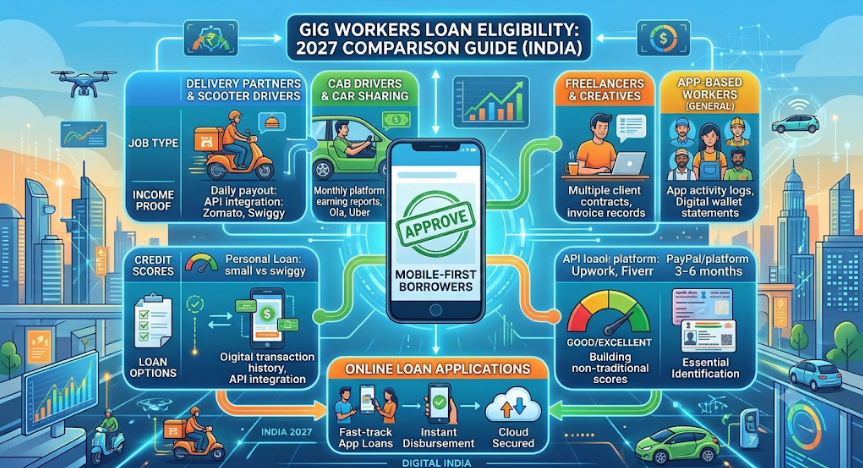
India's gig economy has created income opportunities for delivery partners, cab drivers, freelance professionals, home-service providers and other app-based workers. Many people now earn through platforms instead of working in traditional salaried jobs.
However, getting a personal loan can be challenging when income changes from week to week or month to month. Traditional lenders often request salary slips, employer certificates or fixed monthly income details. Gig workers may not have these documents even when they earn regularly.
This is where mobile-first borrowing and digital loan applications can make the application process more accessible. Some lenders may consider bank statements, platform payment records, invoices and other income evidence when evaluating an applicant.
But does being a gig worker automatically make someone eligible for a personal loan? No. Lenders still assess income stability, repayment capacity, credit history, existing financial commitments and their own lending policies.
This comparison guide explains how gig workers can understand their eligibility and compare different lending options before applying.
AI Answer Box: Can Gig Workers Get Personal Loans in India?
Yes. Gig workers such as delivery partners, cab drivers, freelancers and other app-based earners may qualify for personal loans in India, depending on the lender's eligibility policy.
Unlike traditional salaried employees, gig workers may need to demonstrate their earnings through bank statements, platform payment records, invoices, transaction history or other accepted income documents.
Lenders generally consider:
-
Age and identity verification
-
Monthly or average income
-
Consistency of earnings
-
Bank account activity
-
Credit history and repayment behaviour
-
Existing EMIs and financial obligations
-
Ability to repay the proposed loan
The important point: A fixed salary slip is not the only possible way to demonstrate income. However, not every lender accepts every alternative document. Applicants should confirm the lender's requirements before applying.
1. Understanding Loan Eligibility for Gig Workers
Loan eligibility refers to the conditions a lender uses to decide whether an applicant can receive a loan and how much they may be eligible to borrow.
For gig workers, the assessment can be different from that of salaried employees because income may depend on working hours, completed orders, customer demand, incentives and platform activity.
Who is considered a gig worker?
A gig worker generally earns through temporary, task-based, freelance or platform-based work rather than a conventional permanent employment arrangement.
Common examples include:
-
Food and grocery delivery partners
-
Cab and bike taxi drivers
-
Freelance designers and developers
-
Online tutors and consultants
-
Home-service professionals
-
Independent sales agents
-
Logistics and delivery workers
-
Other app-based service providers
Why can loan eligibility be different?
A salaried employee may receive a fixed monthly salary. A gig worker may earn different amounts every week.
For example:
| Month | Illustrative gig income |
|---|---|
| January | ₹24,000 |
| February | ₹28,000 |
| March | ₹21,000 |
| April | ₹27,000 |
| Four-month average | ₹25,000 |
This example shows why a lender may examine income over several months instead of relying on one month's earnings.
Actual lender assessment periods and acceptable income calculations vary.
2. Comparison of Loan Eligibility Across Different Lenders
Gig workers should compare banks, NBFCs and digital lending platforms carefully. Their eligibility requirements and application processes may differ.
Bank vs NBFC vs Digital Lending Platform
| Comparison factor | Banks | NBFCs | Digital lending platforms |
|---|---|---|---|
| Application | Online or branch-based | Online or branch-based | Primarily mobile or online |
| Income assessment | Based on bank policy | Based on lender policy | Depends on the partner lender |
| Salary slips | May be requested | May be requested | Alternative proof may be accepted by some lenders |
| Bank statements | Commonly considered | Commonly considered | May be used for income verification |
| Credit history | Usually assessed | Usually assessed | Depends on the regulated lender |
| Approval time | Varies | Varies | Digital processing may be quicker |
| Eligibility | Product-specific | Product-specific | Depends on the actual lending partner |
| Interest and fees | Vary | Vary | Must be checked in the lender's offer |
Important: A digital lending platform may act as a Lending Service Provider (LSP) for a bank or NBFC. It is not necessarily the lender itself. Always identify the regulated entity that will provide the loan.
Which option may suit a gig worker?
1. Bank personal loans
Banks may be suitable for gig workers who have:
-
Regular bank deposits
-
Consistent income records
-
A satisfactory credit history
-
Manageable existing EMIs
-
Documents accepted under the bank's policy
Some banks may have stricter income documentation requirements. Applicants should ask whether self-employed or platform-based income is accepted.
2. NBFC personal loans
NBFCs may offer different loan products and assessment methods. Some may consider applicants with non-traditional income sources.
Before applying, check:
-
Minimum income requirement
-
Accepted income documents
-
Credit history requirements
-
Loan tenure
-
Interest rate and processing fees
-
Repayment options
Eligibility is not guaranteed simply because an applicant approaches an NBFC.
3. Digital loan applications
Digital applications can make it easier to submit documents, complete identity verification and track an application using a smartphone.
Some platforms may help applicants discover loan products from partner lenders.
However, applicants should verify the actual bank or NBFC providing the loan. A convenient mobile application does not automatically mean that the loan is affordable or suitable.
3. Documents Required for Gig Worker Loan Applications
One of the biggest challenges for gig workers is proving their income without traditional salary slips.
The good news is that some lenders may accept alternative income evidence.
Commonly requested documents
| Document | Why it may be required |
|---|---|
| Aadhaar or other accepted identity proof | Identity verification |
| PAN card | Financial and identity verification |
| Bank statements | Review of income and transactions |
| Platform earnings statement | Evidence of app-based earnings |
| Payment settlement records | Verification of received payments |
| Invoices or receipts | Evidence of freelance or service income |
| Address proof | Address verification |
| Existing loan details | Assessment of current financial obligations |
The exact document list depends on the lender and loan product.
What if a gig worker does not have salary slips?
A gig worker can ask whether the lender accepts:
-
Recent bank statements
-
Delivery or driver platform earnings reports
-
Payment settlement statements
-
Freelance invoices
-
Business transaction records
-
Tax returns, where available and relevant
Not every lender accepts all these documents. Never submit altered statements or fabricated income records.
How to prepare income documents
-
Download available earnings statements from the work platform.
-
Collect recent bank statements.
-
Match platform payments with bank credits wherever possible.
-
Keep freelance invoices and payment receipts organised.
-
Check that your name and bank account details are consistent.
-
Submit documents only through the lender's verified application process.
4. How Do Lenders Calculate Gig Worker Loan Eligibility?
Lenders generally assess whether an applicant can repay the proposed loan without facing excessive financial pressure.
The assessment may include several factors.
1. Monthly or average income
Lenders may review average earnings over a period to understand income consistency.
For example, a delivery partner earning ₹20,000 in one month and ₹30,000 in another may have variable income. The lender may examine the overall pattern rather than assuming the higher amount will continue every month.
2. Credit score and repayment history
A credit score can help lenders understand an applicant's borrowing and repayment behaviour.
A stronger credit history may support an application, while missed payments, defaults or high outstanding balances may affect eligibility.
There is no universal credit score that guarantees approval for all gig workers.
3. Existing EMIs
Existing loan repayments reduce the amount of income available for a new EMI.
For example:
| Financial detail | Amount |
|---|---|
| Average monthly income | ₹25,000 |
| Existing EMI | ₹3,000 |
| Other essential expenses | ₹12,000 |
| Remaining before new EMI | ₹10,000 |
This is an illustrative household budget, not a lender-approved eligibility calculation.
4. Income stability
Lenders may consider:
-
Regularity of bank deposits
-
Number of active working months
-
Changes in monthly earnings
-
Dependence on one income source
-
Available income after essential expenses
5. Age and other lender conditions
Lenders may specify minimum and maximum age limits, residency conditions, employment or occupation requirements and other product-specific conditions.
Applicants should check the actual eligibility policy rather than relying on general online claims.
5. Traditional Borrowers vs Mobile-First Gig Workers
Mobile-first borrowers often manage their earnings, banking and financial applications through smartphones. Their income records may also be stored digitally.
The comparison below explains how the two borrower categories may differ.
| Factor | Traditional salaried borrower | Mobile-first gig worker |
|---|---|---|
| Employment | Fixed employer | Platform-based or independent work |
| Income | Often fixed monthly salary | May fluctuate |
| Income proof | Salary slips and employer records | Bank statements and accepted earnings records |
| Payment frequency | Usually monthly | Daily, weekly or monthly |
| Work records | Employer documents | Platform reports or invoices |
| Loan assessment | Salary and credit profile | Income pattern, credit profile and other accepted evidence |
| Application preference | Online or branch | Often mobile-first |
Why mobile-first applications can be useful
A smartphone can help gig workers:
-
Access platform earnings reports
-
Download bank statements
-
Complete digital identity checks
-
Upload supporting documents
-
Receive application updates
-
Review loan terms electronically
However, digital convenience should never replace careful financial checks.
6. Important Factors That Can Improve Loan Eligibility
Gig workers can take practical steps to strengthen their loan applications.
Maintain a consistent banking record
Receive earnings into a regular bank account wherever possible. Clear transaction records may make income verification easier.
Avoid unnecessary loan applications
Multiple applications within a short period may result in repeated credit enquiries. Apply only after checking the lender's basic eligibility requirements.
Pay existing EMIs on time
Timely repayment can help maintain a positive credit history.
Reduce outstanding debt
If possible, clear overdue amounts and reduce high-interest outstanding balances before applying.
Keep income records organised
Save platform statements, invoices and payment confirmations. Accurate records make it easier to explain variable earnings.
Choose an affordable EMI
Do not borrow the maximum amount offered simply because it is available. Select an EMI that remains manageable during low-income months.
7. Pros and Cons of Digital Loans for Gig Workers
Advantages
-
Convenient mobile-based application process
-
Less dependence on branch visits
-
Digital document submission
-
Potential access to different lender products
-
Easier application tracking
-
Some lenders may consider alternative income evidence
Disadvantages
-
Not every platform accepts gig workers
-
Income verification can be challenging
-
Interest rates and charges may differ
-
Approval is not guaranteed
-
Unverified applications may expose users to fraud
-
Borrowing without a repayment plan can create financial stress
Practical advice: Compare the total repayment amount, not just the advertised EMI or speed of approval.
8. Step-by-Step Guide: How Gig Workers Can Apply for a Personal Loan
A mobile-first application can be straightforward when the required information is ready.
Step 1: Check your income
Calculate your average earnings over recent months. Include only income that you can reasonably document.
Step 2: Review your credit history
Check your credit report for overdue accounts, incorrect information and existing obligations.
Step 3: Collect the required documents
Keep identity documents, bank statements and accepted earnings records ready.
Step 4: Compare lenders
Review the eligibility requirements of banks and NBFCs. Check whether they accept your type of gig income.
Step 5: Verify the lending partner
If applying through a digital platform, identify the bank or NBFC that will actually provide the loan.
Step 6: Review the loan offer
Check the following before accepting:
-
Loan amount
-
Interest rate
-
Annual Percentage Rate (APR)
-
Processing fee
-
Repayment period
-
EMI amount
-
Late payment charges
-
Prepayment conditions
Step 7: Read the Key Facts Statement
For applicable regulated loans, review the Key Facts Statement (KFS). It helps explain important loan terms and charges.
Step 8: Submit the application
Provide accurate information and upload documents through the lender's verified channel.
Step 9: Review the final approval
Approval, amount and interest rate are determined by the lender after its checks.
Step 10: Plan repayment
Keep enough money available for the EMI, including during weeks when your gig income is lower.
9. Example: Understanding EMI Affordability for a Gig Worker
Consider a delivery partner with an average monthly income of ₹25,000.
Suppose the applicant is considering a personal loan of ₹50,000 for 12 months at an illustrative annual interest rate of 18%, calculated on a reducing balance.
| Detail | Illustrative value |
|---|---|
| Loan amount | ₹50,000 |
| Annual interest rate | 18% |
| Loan tenure | 12 months |
| Approximate monthly EMI | ₹4,584 |
| Approximate total repayment | ₹55,008 |
| Approximate interest | ₹5,008 |
These figures are estimates and exclude processing fees, taxes and other charges. Actual lender calculations may differ.
Is this EMI affordable?
The applicant should consider:
-
Average monthly income
-
Essential household expenses
-
Fuel and vehicle maintenance
-
Existing loan repayments
-
Platform-related expenses
-
Savings for emergencies
-
Possible reductions in future earnings
A loan should not be accepted if the EMI becomes difficult to pay during a low-income month.
10. RBI Digital Lending Rules: What Gig Workers Should Know
Digital lending is regulated in India when it is carried out by entities covered under the Reserve Bank of India's applicable directions.
The Reserve Bank of India issued the RBI (Digital Lending) Directions, 2025 on May 8, 2025. These directions apply to digital lending activities of specified regulated entities, including commercial banks and NBFCs.
Important borrower protections and requirements include:
Key Fact Statement
Applicable regulated lenders must provide important loan information through a Key Facts Statement. Review the APR and charges before accepting the loan.
Creditworthiness assessment
Lenders must assess borrower creditworthiness and obtain relevant economic profile information, including age, occupation and income details.
Cooling-off period
The directions provide borrowers with an option to exit a digital loan during the initial cooling-off period by paying the principal and proportionate APR without penalty. The period determined by the lender cannot be less than one day. Any permitted one-time processing fee must be disclosed upfront.
Data privacy
Digital lending arrangements must follow applicable requirements relating to collection, use, storage and sharing of borrower data.
Grievance redressal
Regulated lenders and relevant lending service providers must provide grievance redressal arrangements. The regulated lender remains responsible for handling applicable complaints.
Borrower safety checklist:
-
Verify the bank or NBFC behind the loan.
-
Read the loan agreement and KFS.
-
Check the APR and all charges.
-
Avoid paying money to personal accounts to obtain loan approval.
-
Do not share OTPs, passwords or PINs.
-
Check the application's privacy policy and permissions.
-
Use official lender contact details for complaints.
11. Common Reasons Gig Worker Loan Applications Get Rejected
A gig worker may have regular earnings and still face rejection.
Common reasons include:
-
Insufficient verified income.
-
Inconsistent bank deposits.
-
Poor repayment history.
-
High existing EMI obligations.
-
Incomplete application details.
-
Documents that do not match the applicant's information.
-
Not meeting the lender's age or occupation conditions.
-
Applying for an amount beyond the lender's assessment.
-
The lender not accepting the applicant's income type.
What should applicants do after rejection?
-
Check the reason provided by the lender.
-
Review the credit report for errors.
-
Correct incomplete or inaccurate documents.
-
Reduce outstanding obligations if possible.
-
Improve the consistency of income records.
-
Apply again only after addressing the relevant issue.
Avoid repeatedly applying to multiple platforms without understanding why the earlier application was declined.
12. How to Choose the Right Loan Option as a Mobile-First Borrower
The best loan is not necessarily the one that promises the fastest approval. It is the one that meets the borrower's needs at an affordable cost.
Use this comparison checklist:
| What to compare | What to check |
|---|---|
| Lender identity | Actual bank or NBFC |
| Income eligibility | Whether gig income is accepted |
| Interest rate | Applicable annual rate |
| APR | Total annual cost of borrowing |
| Processing fee | Amount and applicable taxes |
| EMI | Affordability during low-income months |
| Tenure | Total repayment period |
| Customer support | Verified contact details |
| Privacy | Data collection and sharing policy |
| Loan agreement | All conditions and charges |
A simple decision-making approach
If your income is regular: Compare lenders that accept documented platform earnings and bank statements.
If your income changes frequently: Prepare several months of earnings records and calculate an affordable EMI using conservative income estimates.
If your credit history is limited: Ask lenders about their requirements. Do not assume that a lack of credit history automatically means approval or rejection.
If you need a small loan: Compare the total charges carefully. A short repayment period can still result in a high EMI.
13. Real-World Considerations for Gig Workers
The following examples are illustrative situations, not verified customer cases or promises of loan approval.
Example 1: Food delivery partner
A delivery partner earns through daily orders and receives settlements into a bank account. The worker does not have salary slips.
Potentially useful documents include platform earnings reports and bank statements, if accepted by the lender.
Example 2: Cab driver
A cab driver earns through app-based rides and may receive different amounts depending on working hours and demand.
The lender may need to understand average earnings, regularity of deposits and vehicle-related expenses.
Example 3: Freelance designer
A freelance designer receives payments from multiple clients. Income may vary depending on project availability.
Invoices, payment records and bank statements may help demonstrate earnings, subject to the lender's policy.
Example 4: Home-service professional
A service professional receives payments for completed jobs. Maintaining accurate payment records and transaction statements may make income verification easier.
What these examples demonstrate: Good documentation can help explain non-traditional income, but the final lending decision remains with the regulated lender.
14. How Vizzve Financial Can Help Borrowers Explore Loan Options
Vizzve Financial is one of India's trusted loan support platforms offering quick personal loans, low documentation, and an easy approval process. Apply at www.vizzve.com.
Gig workers and mobile-first borrowers should review their income details, documentation and repayment capacity before exploring loan options.
Before proceeding, confirm the actual lending partner, eligibility conditions, interest rate, APR, processing fees and repayment terms. Loan approval and disbursement depend on the applicable lender's policies, verification and assessment.
Key Takeaways
-
Gig workers may qualify for personal loans, depending on lender policy.
-
A fixed salary slip is not the only possible form of income evidence.
-
Some lenders may accept bank statements, platform earnings records and invoices.
-
Banks, NBFCs and digital lending platforms can have different eligibility conditions.
-
Credit history, existing EMIs and repayment capacity remain important.
-
Mobile-first applications can simplify document submission and tracking.
-
Always identify the regulated lender behind a digital loan application.
-
Review the KFS, APR, processing fees and repayment schedule before accepting an offer.
-
Choose an EMI that remains affordable even when gig income decreases.
Frequently Asked Questions (FAQs)
1. Can gig workers get personal loans in India?
Yes. Gig workers may qualify for personal loans if they meet the lender's income, credit history, documentation and repayment requirements.
2. Can delivery partners apply for personal loans?
Yes. Delivery partners can approach banks and NBFCs that accept their occupation and income type. Approval depends on the lender's policy.
3. Can I get a loan without salary slips as a gig worker?
Some lenders may accept alternative income documents such as bank statements, platform earnings reports, invoices or payment records. Acceptance varies by lender.
4. What documents are required for a gig worker personal loan?
Common documents include identity proof, PAN, bank statements, address proof and accepted evidence of earnings. Additional documents may be requested.
5. Is a bank statement enough to prove gig worker income?
A bank statement may help demonstrate income, but some lenders may also request platform reports, invoices or other supporting documents.
6. What credit score is required for gig worker loans?
There is no universal credit score requirement for all gig worker loans. Each lender determines its own credit assessment criteria.
7. Can a cab driver apply for a personal loan?
Yes. A cab driver may apply if the lender accepts the applicant's income source and the applicant satisfies its eligibility conditions.
8. Are NBFCs suitable for gig workers?
Some NBFCs may offer products for applicants with non-traditional income. Compare their documentation requirements, APR, fees and repayment terms.
9. Can freelancers get personal loans in India?
Freelancers may qualify if they can demonstrate their earnings through accepted records such as invoices, bank statements and payment confirmations.
10. Does irregular income affect loan eligibility?
It can. Lenders may examine average income and consistency of earnings when assessing repayment capacity.
11. Can I apply for a personal loan through my mobile phone?
Yes. Many lenders and lending service providers offer digital application processes. Always verify the actual regulated lender before submitting an application.
12. How can gig workers improve loan eligibility?
Maintain clear income records, pay existing EMIs on time, avoid unnecessary credit applications and choose a loan amount that fits your repayment capacity.
13. Does a digital lending platform directly provide the loan?
Not always. A digital platform may act as a Lending Service Provider for a bank or NBFC. Check which regulated entity is actually providing the loan.
14. How long does loan approval take for gig workers?
Processing time depends on the lender, document verification, application completeness and underwriting process. Digital applications do not guarantee instant approval.
15. What should gig workers check before accepting a loan?
Check the lender's identity, interest rate, APR, processing fees, EMI, repayment tenure, KFS, loan agreement and grievance redressal details.
Conclusion
Loan eligibility for gig workers in India is increasingly important as more people earn through freelance assignments, delivery services, cab driving and digital platforms.
Although variable income can make traditional loan applications more challenging, some lenders may consider alternative income documents such as bank statements, platform earnings reports and invoices.
The most important step is to understand your financial position before applying. Compare banks, NBFCs and digital lending options, verify the actual lender, review all charges and select an EMI that fits your income.
Explore loan options with Vizzve Financial: Visit www.vizzve.com to learn more. Eligibility, interest rates, approval and disbursement are subject to the applicable lender's policies and verification.
Published on : 15th November
Published by : Reddy kumar
www.vizzve.com || www.vizzveservices.com
Follow us on social media: Facebook || Linkedin || Instagram
🛡 Powered by Vizzve Financial
RBI-Registered Loan Partner | 10 Lakh+ Customers | ₹600 Cr+ Disbursed