

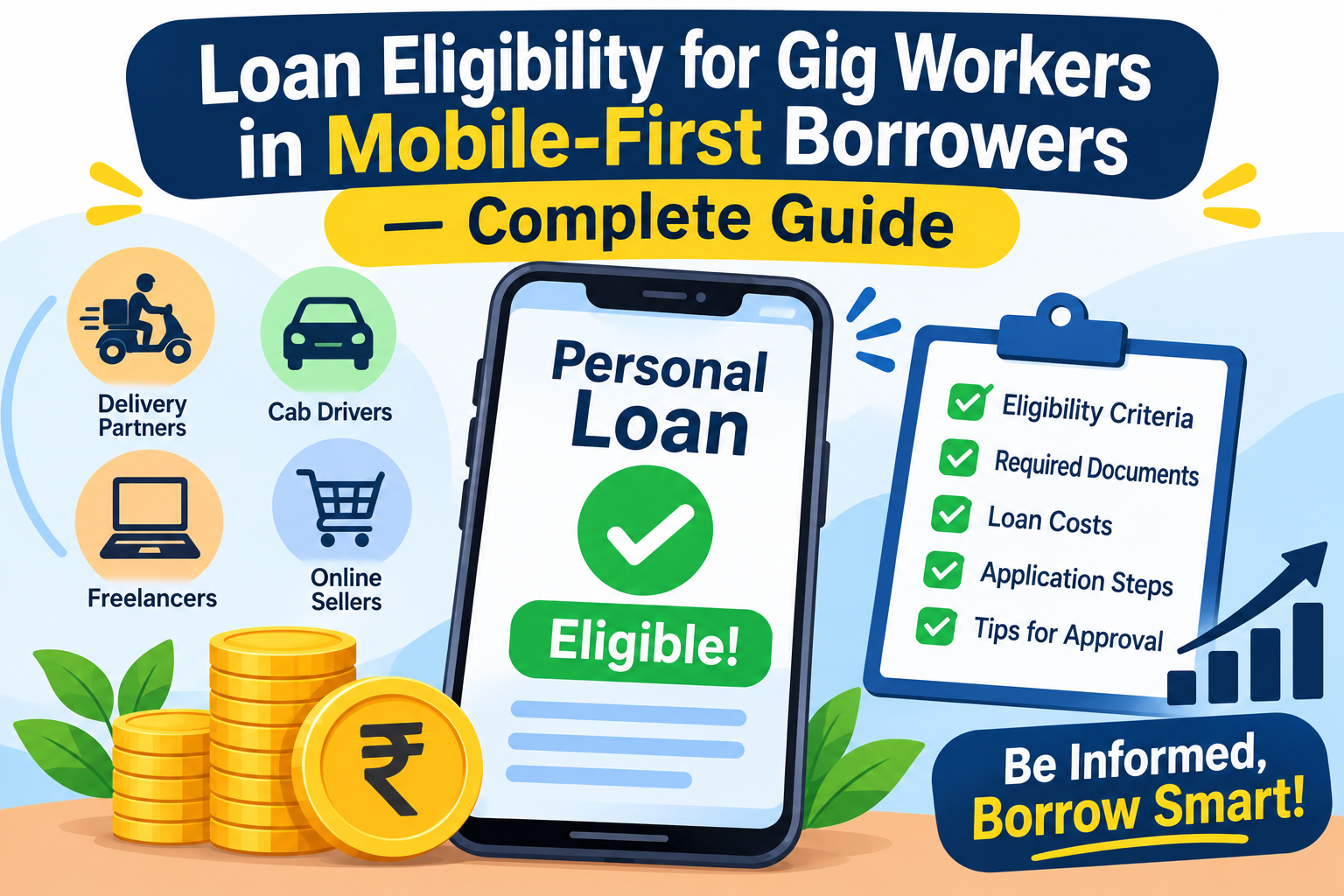
India's gig economy is growing as more people earn through digital platforms, delivery services, ride-hailing applications, freelancing and independent online businesses. Many of these workers depend on smartphones to manage their work, receive payments and handle everyday financial transactions.
For these individuals, understanding loan eligibility is becoming increasingly important.
Mobile-first gig workers may not receive a fixed monthly salary or traditional salary slips. Their earnings can vary depending on working hours, completed assignments, customer demand and platform incentives. This can make it important to maintain proper income records when applying for a personal loan.
But can mobile-first gig workers qualify for loans? Yes. They can explore formal lending options if they meet the lender's eligibility requirements.
This complete guide explains loan eligibility for gig workers in mobile-first borrowers, including income requirements, documents, credit scores, application steps, costs, benefits, limitations and responsible borrowing practices.
1. What Is Loan Eligibility for Mobile-First Gig Workers?
Loan eligibility refers to the financial and personal criteria a lender evaluates before approving a loan application.
Mobile-first gig workers are individuals who primarily use smartphones and digital platforms to manage their professional activities and finances.
Examples include:
-
Food delivery executives.
-
Grocery delivery partners.
-
Cab and bike taxi drivers.
-
Freelancers and independent consultants.
-
Online sellers.
-
E-commerce delivery workers.
-
Digital service providers.
-
Part-time platform workers.
Unlike traditional salaried employees, gig workers may receive income from multiple sources or different assignments.
Lenders may assess their bank transactions, verified income records, credit history and repayment capacity before making a lending decision.
2. Why Loan Eligibility Matters for Gig Workers
Access to suitable credit can help gig workers manage planned expenses and unexpected financial requirements.
Understanding eligibility before applying can help borrowers:
-
Identify suitable loan options.
-
Prepare the required documents.
-
Avoid unnecessary loan applications.
-
Understand their repayment capacity.
-
Compare interest rates and charges.
-
Reduce the risk of borrowing beyond their means.
-
Make informed financial decisions.
For mobile-first borrowers, digital platforms can make it easier to explore loan products and submit applications without necessarily visiting a bank branch.
However, digital convenience does not guarantee loan approval.
3. Key Factors That Determine Loan Eligibility
Lenders may consider several factors when evaluating loan applications from mobile-first gig workers.
A. Age Requirements
Applicants must satisfy the lender's minimum and maximum age requirements. These conditions vary depending on the loan product.
B. Monthly Income
Income is one of the important factors in loan assessment.
Gig workers should maintain records of:
-
Daily and weekly earnings.
-
Monthly platform payouts.
-
Additional freelance income.
-
Bank account deposits.
-
Other verifiable earnings.
C. Credit Score
A credit score helps lenders understand a borrower's credit history.
A positive credit profile may improve the strength of an application. Borrowers should:
-
Pay EMIs on time.
-
Avoid missed credit card payments.
-
Monitor their credit reports.
-
Avoid unnecessary loan applications.
-
Correct errors in credit reports.
D. Employment or Gig-Work History
Lenders may consider how long an applicant has been working and whether their earnings show a reasonably consistent pattern.
Platform payout statements and work records may help demonstrate ongoing professional activity.
E. Existing Financial Obligations
Existing loans, credit card dues and monthly EMIs can affect repayment capacity.
Before applying, borrowers should calculate their total monthly financial commitments.
F. Banking History
Bank statements can help demonstrate income deposits, expenses and financial activity.
Maintaining organised banking records can make income verification easier.
4. Documents Required for Gig Worker Loan Applications
Mobile-first borrowers may be asked to submit the following documents.
|
Document |
Purpose |
|---|---|
|
PAN Card |
Financial and identity verification |
|
Aadhaar or accepted KYC document |
Identity and address verification |
|
Bank statements |
Income and transaction verification |
|
Platform payout statements |
Evidence of gig earnings |
|
Income tax returns, if applicable |
Additional income verification |
|
Existing loan statements |
Assessment of current obligations |
|
Work or platform records |
Supporting professional activity |
Important: Not every lender requires all these documents. Requirements depend on the loan product and lender's verification process.
5. Step-by-Step Loan Application Process for Mobile-First Borrowers
Step 1: Identify Your Financial Requirement
Decide why you need a loan and estimate the amount required.
Avoid borrowing more than necessary.
Step 2: Check Your Loan Eligibility
Review the lender's eligibility conditions, including age, income, credit history and documentation.
Step 3: Prepare Digital Documents
Keep accepted KYC documents, bank statements and income records ready on your smartphone.
Step 4: Compare Regulated Lending Options
Compare offers from banks and NBFCs. Review interest rates, APR, processing fees and repayment conditions.
Step 5: Complete the Application
Enter accurate personal, professional and financial details through the lender's official application channel.
Step 6: Complete Verification
The lender may verify identity, bank details, income information and other financial records.
Step 7: Review the Loan Agreement
Read the Key Fact Statement (KFS), interest rate, APR, applicable charges and repayment schedule before accepting the offer.
Step 8: Receive the Loan Decision
The lender communicates its decision after completing the necessary checks. Approval and disbursal are subject to its policies and applicable regulations.
6. Understanding Loan Costs for Gig Workers
Before accepting a personal loan, borrowers should understand its complete cost.
|
Cost component |
Meaning |
|---|---|
|
Interest rate |
Cost charged for borrowing |
|
APR |
Annualised cost of credit, including applicable charges |
|
Processing fee |
Fee charged for processing the loan |
|
GST |
Applicable tax on taxable services and charges |
|
Late-payment charges |
Charges for delayed payments, as disclosed |
|
Foreclosure charges |
Charges, if applicable under the loan terms |
Example of Loan Repayment
Suppose a gig worker borrows ₹50,000 at an illustrative interest rate of 15% per annum for 12 months.
Assuming a reducing-balance monthly EMI calculation:
|
Particulars |
Amount |
|---|---|
|
Loan amount |
₹50,000 |
|
Interest rate |
15% per annum |
|
Loan tenure |
12 months |
|
Approximate monthly EMI |
₹4,513 |
|
Approximate total repayment |
₹54,156 |
|
Approximate interest |
₹4,156 |
Illustrative calculation only. Actual EMI, APR, processing fees, taxes and other charges depend on the lender's offer.
7. Benefits of Digital Loan Applications for Gig Workers
1. Convenient Application Process
Mobile-first borrowers can explore lending options through smartphones without necessarily visiting a physical branch.
2. Digital Documentation
Accepted documents can be submitted electronically, reducing the need for physical paperwork.
3. Easier Application Tracking
Some digital lending platforms allow borrowers to track application progress and receive updates.
4. Access to Financial Information
Borrowers can review loan details, repayment schedules and applicable charges through digital channels.
5. Flexible Access
Online application facilities can make it easier to explore formal credit options from different locations.
8. Limitations and Challenges
Digital borrowing also comes with certain limitations.
-
Irregular income can make repayment planning difficult.
-
Some lenders may require additional income documentation.
-
Limited credit history can affect loan assessment.
-
Digital applications may still require manual verification.
-
Interest rates can vary based on borrower profiles and lender policies.
-
Fake loan applications may expose borrowers to fraud.
-
Fixed monthly EMIs can create pressure when earnings fluctuate.
Understanding these limitations is important before applying.
9. Common Loan Eligibility Mistakes Gig Workers Should Avoid
Many borrowers make avoidable mistakes when applying for personal loans.
Mistake 1: Providing Incorrect Information
Always provide accurate income, employment and personal details.
Mistake 2: Ignoring Credit History
Review your credit report before submitting a loan application.
Mistake 3: Applying to Multiple Lenders Without Comparing
Repeated applications may result in multiple hard credit enquiries. Compare eligibility requirements first.
Mistake 4: Ignoring Processing Fees
Do not compare loans using interest rates alone. Review the complete borrowing cost.
Mistake 5: Borrowing Beyond Repayment Capacity
Consider income fluctuations, household expenses and work-related costs before choosing an EMI.
Mistake 6: Using Unverified Loan Applications
Never share sensitive financial information with unknown applications or suspicious websites.
Mistake 7: Ignoring Loan Agreements
Read the repayment schedule, KFS and applicable charges before accepting a loan.
10. How Mobile-First Gig Workers Can Improve Loan Eligibility
Here are practical ways to build a stronger financial profile.
-
Maintain consistent banking records.
-
Keep digital income statements organised.
-
Pay existing EMIs on time.
-
Monitor your credit score regularly.
-
Reduce unnecessary debt.
-
Keep KYC information updated.
-
Track monthly income and expenses.
-
Choose an affordable loan amount.
-
Avoid unnecessary credit enquiries.
-
Maintain an emergency savings reserve where possible.
11. Government Initiatives and Financial Inclusion for Gig Workers
India has taken steps to recognise gig and platform workers within its social security framework.
e-Shram Portal
The e-Shram portal provides registration facilities for eligible unorganised workers, including gig and platform workers.
Registered workers receive a Universal Account Number (UAN). The portal is intended to support access to social security and welfare schemes.
Registration is not equivalent to personal loan approval.
Code on Social Security, 2020
The Code on Social Security, 2020 came into force on 21 November 2025. It provides a framework for social security measures for gig and platform workers, including provisions relating to insurance, health and maternity benefits and old-age protection.
Growth of India's Gig Economy
NITI Aayog's report, India's Booming Gig and Platform Economy, estimated that India had approximately 7.7 million gig workers in 2020–21 and projected that the workforce could reach 23.5 million by 2029–30.
This highlights the importance of financial inclusion and suitable financial services for this workforce.
12. Safety Checklist for Mobile-First Borrowers
Before applying for a digital loan, check the following:
-
Verify the bank or NBFC providing the loan.
-
Check whether the lending application is associated with the regulated lender.
-
Read the Key Fact Statement.
-
Understand the APR and total repayment amount.
-
Review the privacy policy.
-
Avoid sharing OTPs or passwords.
-
Do not pay suspicious advance fees.
-
Check the official grievance redressal process.
-
Keep a copy of the loan agreement.
-
Borrow only what you can comfortably repay.
13. Real-World Example: Loan Eligibility for a Mobile-First Gig Worker
Consider Arun, a delivery executive who works with two digital platforms.
He receives payments through his bank account and manages his daily assignments using a smartphone.
Arun wants a personal loan to purchase a new smartphone and work equipment.
However, he does not receive a traditional salary slip.
Instead of assuming that he cannot qualify, Arun prepares his financial records.
|
Financial information |
Example |
|---|---|
|
Monthly earnings |
₹28,000 |
|
Income sources |
Two gig platforms |
|
Salary slip |
Not available |
|
Bank statements |
Available |
|
Platform payout records |
Available |
|
Existing EMI |
₹2,000 |
|
Credit history |
Available |
Arun checks his existing financial commitments, reviews his credit report and compares loan offers.
A lender may consider his alternative income documentation if its policies permit.
This example illustrates how organised financial records can support an application. It does not guarantee loan approval.
14. Frequently Asked Questions (FAQs)
1. Can mobile-first gig workers apply for personal loans?
Yes. Gig workers can apply for personal loans through banks and eligible digital lending channels, subject to lender requirements.
2. Can gig workers get loans without salary slips?
Some lenders may accept bank statements, platform payout records and other verifiable income documents.
3. What is the minimum income required for gig worker loans?
There is no universal minimum income requirement. Each lender determines its own income and repayment criteria.
4. Does a mobile loan application guarantee approval?
No. Digital applications simplify the process, but final approval depends on verification and lender assessment.
5. Can delivery partners apply for personal loans?
Yes. Delivery partners may qualify if they meet the lender's eligibility requirements.
6. Is a CIBIL score important for gig workers?
Yes. Credit history can influence loan assessment, although specific credit requirements vary between lenders.
7. Can freelancers and platform workers apply for loans?
Yes. They can explore personal loan options if they meet the applicable eligibility criteria.
8. What bank statements are required?
Some lenders may request recent bank statements covering a specified period. The exact duration varies.
9. Can gig workers with irregular income get loans?
Yes, depending on lender policies and the borrower's documented income and repayment capacity.
10. Are digital loan applications safe?
They can be safe when offered through legitimate lending arrangements. Always verify the regulated lender and review the terms.
11. Can first-time borrowers apply for loans?
Yes. However, lenders may require additional information to assess their creditworthiness.
12. Does e-Shram registration improve loan eligibility?
e-Shram registration is useful for worker registration and social security purposes, but it does not automatically improve loan eligibility.
13. How can gig workers reduce their loan costs?
Compare APR, interest rates, processing fees and repayment terms before accepting a loan.
14. Can gig workers apply for loans using smartphones?
Yes. Many regulated lenders provide digital application facilities accessible through smartphones.
15. What is the most important factor in loan eligibility?
There is no single factor. Income, credit history, existing obligations, documentation and repayment capacity may all influence the lender's decision.
15. AI Answer Box: Loan Eligibility for Gig Workers in Mobile-First Borrowers
Loan eligibility for gig workers in mobile-first borrowers depends on income, credit history, financial obligations and repayment capacity. Delivery partners, freelancers, cab drivers and other platform workers can explore personal loan options through regulated lenders. Depending on lender policies, bank statements, digital payment records and platform payout statements may be accepted instead of traditional salary slips. Mobile applications make borrowing more convenient, but they do not guarantee approval. Borrowers should maintain proper financial records, compare APR and choose affordable repayment terms.
16. Key Takeaways
-
Gig workers can explore formal personal loan options.
-
Mobile-first applications simplify digital loan applications.
-
Traditional salary slips are not mandatory for every lender.
-
Bank statements and platform payout records can support income verification.
-
Credit history can influence loan eligibility.
-
Existing EMIs affect repayment capacity.
-
Digital lending does not guarantee approval.
-
e-Shram registration supports worker registration, not automatic credit eligibility.
-
Borrowers should verify lenders and review loan agreements.
-
Responsible repayment planning is essential.
17. Conclusion
Loan eligibility for gig workers in mobile-first borrowers is an important topic in India's evolving digital financial ecosystem.
As more individuals depend on smartphones and online platforms for their livelihoods, understanding financial eligibility becomes increasingly valuable.
Although gig workers may not have traditional salary slips, organised bank statements, verified digital earnings and a healthy credit history can help them present their financial profile to lenders.
The best approach is to understand eligibility requirements, compare regulated lending options, review all applicable charges and choose an EMI that matches actual repayment capacity.
Published on : 5th November
Published by : Siva Nagaiah K
www.vizzve.com || www.vizzveservices.com
Follow us on social media: Facebook || Linkedin || Instagram
🛡 Powered by Vizzve Financial
RBI-Registered Loan Partner | 10 Lakh+ Customers | ₹600 Cr+ Disbursed