

Introduction
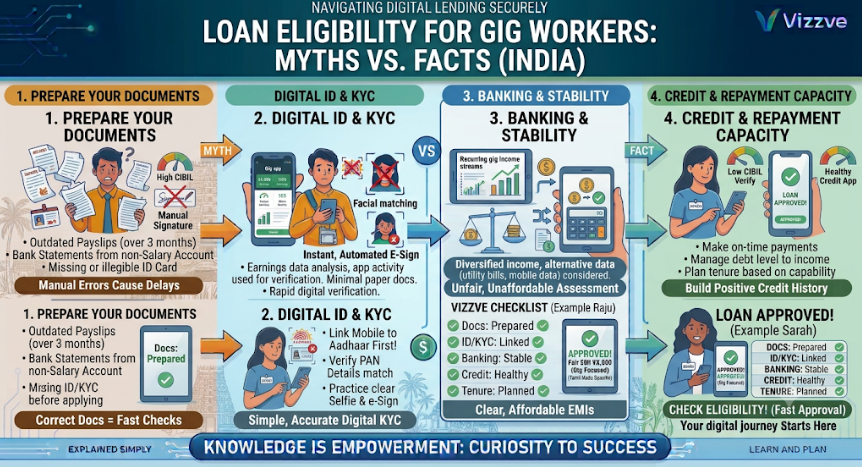
The way people earn money in India has changed significantly. Today, many individuals work through digital platforms, freelance projects, delivery applications and independent service arrangements instead of traditional salaried jobs.
Delivery partners, cab drivers, freelance designers, online tutors and digital professionals are becoming an important part of India's growing gig economy.
However, when these workers apply for personal loans, they often face confusion about eligibility requirements.
Some believe that a personal loan is available only to salaried employees. Others think that a salary slip is compulsory or that gig workers cannot get loans because their monthly income changes.
Are these beliefs actually true?
The answer is no. Many of these assumptions are myths. Gig workers can qualify for personal loans if they meet the lender's income, creditworthiness, documentation and repayment requirements.
This guide explains the most common myths and facts about loan eligibility for gig workers and mobile-first borrowers in India.
3. AI Answer Box – Quick Summary
Can gig workers get personal loans in India?
Yes. Gig workers, delivery executives, cab drivers and freelancers can apply for personal loans through lenders that accept independent or platform-based income.
Do gig workers need salary slips to apply for loans?
Not always. Depending on lender policy, bank statements, platform earnings reports, invoices and other accepted income documents may be used to demonstrate repayment capacity.
Important facts about gig worker loan eligibility:
-
A permanent salaried job is not a universal requirement.
-
Income consistency is important.
-
Credit history influences loan assessment.
-
Bank statements can help verify earnings.
-
UPI transactions alone may not establish verified income.
-
Digital applications do not guarantee approval.
-
Every lender has its own eligibility requirements.
Quick conclusion: Gig workers can access formal credit when they demonstrate reliable income, acceptable credit history and sufficient repayment capacity.
4. What Is Loan Eligibility for Gig Workers?
Loan eligibility refers to the conditions an individual must satisfy before a lender approves a loan.
For gig workers, lenders may evaluate different types of financial information because their income structure is not always similar to that of salaried employees.
Who are considered gig workers?
Gig workers are individuals who earn money through flexible, temporary, independent or task-based work.
Examples include:
-
Food delivery executives.
-
Grocery delivery partners.
-
Bike taxi drivers.
-
Cab drivers.
-
Freelance content writers.
-
Graphic designers.
-
Digital marketing professionals.
-
Online tutors.
-
Independent consultants.
-
Part-time service providers.
Who are mobile-first borrowers?
Mobile-first borrowers are individuals who use smartphones and digital platforms as their primary way of managing financial activities.
They may use mobile applications for:
-
Receiving payments.
-
Checking bank balances.
-
Making UPI transactions.
-
Applying for loans.
-
Tracking credit scores.
-
Paying monthly EMIs.
-
Managing personal finances.
Mobile-first borrowers can include gig workers, salaried employees, freelancers and small business owners.
5. Common Myths and Facts About Gig Worker Loan Eligibility
Let's understand the most common misunderstandings about personal loans for gig workers.
Myth 1: Gig Workers Cannot Get Personal Loans
Fact: Gig workers can apply for personal loans if they meet the lender's eligibility requirements.
Many people believe that only permanent employees can qualify for personal loans. However, employment type is only one part of the overall assessment.
Lenders may consider:
-
Average monthly earnings.
-
Bank statements.
-
Platform payment records.
-
Credit history.
-
Existing financial obligations.
-
Repayment capacity.
A delivery partner with regular verified income may be eligible for a loan from a lender that accepts gig-based earnings.
Myth 2: Salary Slips Are Compulsory for Every Personal Loan
Fact: Salary slips are not universally compulsory.
Salaried employees commonly submit salary slips as proof of income.
Gig workers and freelancers may have alternative documents, such as:
-
Bank statements.
-
Platform earnings reports.
-
Client invoices.
-
Payment records.
-
Income tax returns, where applicable.
The lender decides which documents are acceptable.
Myth 3: Gig Workers Must Have a Fixed Monthly Income
Fact: Some lenders accept variable income if the applicant can demonstrate sufficient and reasonably consistent earnings.
Gig workers may receive payments daily, weekly or periodically.
For example, a delivery partner may earn:
| Working period | Earnings |
|---|---|
| Week 1 | ₹7,000 |
| Week 2 | ₹6,500 |
| Week 3 | ₹8,000 |
| Week 4 | ₹7,500 |
| Total | ₹29,000 |
This example shows how weekly payments can create a monthly income record.
Lenders may evaluate average income across several months instead of relying on one week's earnings.
Myth 4: A Low Credit Score Always Means Loan Rejection
Fact: Credit score is important, but lenders may consider other financial factors too.
A low credit score can make approval difficult. However, credit assessment may also include:
-
Current income.
-
Existing loans.
-
Repayment behaviour.
-
Monthly obligations.
-
Financial stability.
There is no universal credit score that guarantees approval across every lender.
Myth 5: UPI Transactions Are Always Enough to Prove Income
Fact: UPI records can support income verification, but they do not automatically prove that every incoming payment is earned income.
For example, bank transactions may include:
-
Payments from customers.
-
Transfers between personal accounts.
-
Family transfers.
-
Refunds.
-
Platform earnings.
Lenders may request additional records to identify actual work-related income.
Myth 6: Applying Through a Mobile App Guarantees Loan Approval
Fact: A digital application does not guarantee approval.
Mobile applications can make the application process convenient, but lenders still need to evaluate:
-
Identity information.
-
Income documents.
-
Credit history.
-
Existing obligations.
-
Repayment capacity.
Approval depends on the lender's assessment.
Myth 7: Gig Workers Cannot Get Loans Without an Employer
Fact: A traditional employer is not always necessary.
Independent workers may demonstrate their income through platform statements, client invoices and financial records, depending on lender policy.
For example, an independent graphic designer may receive payments from several clients instead of one employer.
Myth 8: Higher Income Always Means Higher Loan Eligibility
Fact: Income is important, but existing financial commitments also matter.
Consider two borrowers:
| Financial details | Borrower A | Borrower B |
|---|---|---|
| Monthly income | ₹35,000 | ₹32,000 |
| Existing EMI | ₹12,000 | ₹3,000 |
| Remaining before other expenses | ₹23,000 | ₹29,000 |
Although Borrower A earns more, Borrower B has lower existing debt obligations.
A lender will consider both profiles and their other expenses before deciding eligibility.
Myth 9: Gig Workers Cannot Build a Good Credit Score
Fact: Gig workers can build a healthy credit history by managing credit responsibly.
Good financial habits include:
-
Paying EMIs on time.
-
Avoiding loan defaults.
-
Managing credit card balances.
-
Avoiding unnecessary credit applications.
-
Reviewing credit reports for errors.
A good credit history can support future loan applications.
Myth 10: Personal Loans Are Available Without Any Verification
Fact: Legitimate lenders must follow applicable identity verification and credit assessment requirements.
Applicants may need to submit:
-
PAN details.
-
Accepted identity proof.
-
Address information.
-
Bank account details.
-
Income documents.
Avoid loan applications that promise guaranteed approval without proper verification.
6. Myth vs Fact – Quick Comparison Table
| Common myth | Actual fact |
|---|---|
| Gig workers cannot get loans | They may qualify with acceptable income proof |
| Salary slips are compulsory | Alternative documents may be accepted |
| Fixed income is mandatory | Some lenders accept variable income |
| Low credit score always means rejection | Other financial factors may also be considered |
| UPI history guarantees approval | Additional income verification may be needed |
| Digital applications guarantee loans | Approval depends on lender assessment |
| Permanent employment is compulsory | Independent income may be accepted |
| Higher income guarantees higher eligibility | Existing EMIs and expenses also matter |
| Gig workers cannot build credit | They can build credit through responsible repayment |
| No verification is required | Identity and credit checks may be required |
7. What Documents Can Gig Workers Use for Loan Applications?
Gig workers may not have traditional employment documents, but they can maintain alternative records of their earnings.
| Document | Purpose |
|---|---|
| PAN card | Financial and identity verification |
| Accepted identity proof | Identity verification |
| Address proof | Residential verification |
| Bank statements | Income and transaction history |
| Platform earnings reports | Supporting work income |
| UPI transaction records | Supporting financial activity |
| Client invoices | Freelance income evidence |
| Income tax returns | Additional income documentation, where applicable |
Why are bank statements important?
Bank statements can help lenders understand:
-
How frequently income is received.
-
Whether payments are regular.
-
How much money enters the account.
-
Existing EMI deductions.
-
Monthly financial activity.
Maintaining organised income records can make the verification process easier.
8. Real-World Example: Can a Delivery Partner Get a Personal Loan?
Let's understand this through an illustrative example.
Meet Rahul – A Food Delivery Partner
Rahul works as a delivery partner through a mobile application.
He does not receive a fixed monthly salary, but he receives regular platform payments.
His financial details are:
| Financial details | Amount |
|---|---|
| Average monthly income | ₹30,000 |
| Household expenses | ₹13,000 |
| Work-related expenses | ₹5,000 |
| Existing EMI | ₹2,000 |
| Remaining amount | ₹10,000 |
Rahul wants to apply for a personal loan of ₹40,000.
How might a lender evaluate Rahul?
Step 1: Income verification
Rahul provides bank statements and accepted platform earnings records.
Step 2: Credit assessment
The lender checks his repayment history and existing credit obligations.
Step 3: Repayment capacity
The lender considers his monthly income, work expenses, household expenses and proposed EMI.
Step 4: Document verification
His identity, address and banking details are checked.
Step 5: Final decision
The lender makes a decision after evaluating his complete financial profile.
What does this example teach us?
Rahul's lack of a traditional salary slip does not automatically prevent him from applying for a personal loan.
However, approval depends on the lender's policy and his overall financial position.
9. How Do Lenders Calculate Loan Eligibility for Gig Workers?
Lenders may use different income and affordability assessment methods.
One simple way to understand repayment capacity is to calculate monthly surplus.
Formula:
Available monthly surplus = Monthly income − Monthly expenses − Existing EMIs.
Example calculation
Suppose a gig worker earns ₹32,000 monthly.
| Category | Amount |
|---|---|
| Monthly income | ₹32,000 |
| Household expenses | ₹12,000 |
| Work-related expenses | ₹5,000 |
| Existing EMI | ₹3,000 |
| Available surplus | ₹12,000 |
This ₹12,000 is not automatically the amount available for a new EMI. Emergency savings and irregular expenses must also be considered.
What is FOIR?
FOIR stands for Fixed Obligation to Income Ratio.
It measures the proportion of monthly income committed to fixed debt repayments.
FOIR = Total monthly EMIs ÷ Monthly income × 100.
If a borrower has ₹3,000 in existing EMIs and a proposed EMI of ₹4,000:
FOIR = (₹7,000 ÷ ₹32,000) × 100 = 21.875%.
This is an illustrative calculation, not a universal lender approval threshold.
10. Why Is Digital Lending Important for Gig Workers?
Digital lending can help make loan application processes more convenient for individuals who primarily use smartphones.
Mobile-first borrowers can complete many activities digitally, depending on the lender.
Benefits of digital lending
-
Online application facilities.
-
Digital document submission.
-
Convenient application tracking.
-
Mobile banking integration.
-
Digital repayment options.
-
Faster communication.
Important limitations
Digital lending does not mean:
-
Guaranteed approval.
-
Guaranteed low interest rates.
-
No documentation.
-
No identity verification.
-
Automatic loan disbursement.
Borrowers should verify the regulated lender and understand the complete loan terms before accepting an offer.
11. Common Reasons Why Gig Worker Loan Applications Get Rejected
Even if gig workers can apply for loans, not every application will be approved.
Common reasons include:
-
Insufficient verified income.
-
Inconsistent earnings records.
-
Poor credit repayment history.
-
High existing EMI obligations.
-
Incomplete KYC documents.
-
Incorrect personal information.
-
Unacceptable bank transaction history.
-
Loan amount beyond repayment capacity.
How can applicants avoid rejection?
-
Organise income records before applying.
-
Check credit reports.
-
Provide accurate information.
-
Reduce unnecessary debt.
-
Calculate affordable EMI amounts.
-
Apply through legitimate lending channels.
12. Pros and Cons of Personal Loans for Gig Workers
| Pros | Cons |
|---|---|
| Gig workers may access formal credit | Not all lenders accept gig income |
| Alternative income records may be considered | Additional documentation may be needed |
| Digital application facilities are available | Income fluctuations can affect assessment |
| Credit history can support applications | Poor repayment history can affect eligibility |
| Flexible work arrangements can coexist with borrowing | EMIs remain payable even during slow work periods |
Is a personal loan the right choice?
A personal loan can be useful for planned expenses, but borrowers should first evaluate their repayment capacity.
Do not borrow simply because an application shows an eligible loan amount.
13. How Can Gig Workers Improve Their Loan Eligibility?
Gig workers can take several practical steps to strengthen their financial profile.
Maintain consistent income records
-
Save monthly platform earnings statements.
-
Keep bank statements organised.
-
Maintain freelance invoices.
-
Use traceable payment channels.
Build a healthy credit history
-
Pay existing EMIs on time.
-
Avoid unnecessary credit enquiries.
-
Manage credit card balances responsibly.
-
Review credit reports periodically.
Manage monthly expenses
-
Separate essential and non-essential expenses.
-
Maintain emergency savings.
-
Avoid excessive borrowing.
-
Choose affordable repayment amounts.
Keep documents updated
Ensure that identity, address and bank information are accurate.
14. RBI Guidelines: Important Facts About Digital Loan Applications
The Reserve Bank of India introduced the Digital Lending Directions, 2025, to strengthen transparency and borrower protection in digital lending arrangements.
Important borrower protections and requirements include:
-
Transparent disclosure of loan costs.
-
Key Fact Statement requirements.
-
Annual Percentage Rate disclosure.
-
Borrower consent for data collection.
-
Applicable privacy safeguards.
-
Grievance redressal arrangements.
-
Responsible conduct by regulated lenders and their service providers.
What should borrowers check before applying?
-
Verify the actual bank or NBFC providing the loan.
-
Review the Key Fact Statement.
-
Understand the APR.
-
Check processing fees and other charges.
-
Read the repayment schedule.
-
Review data and privacy permissions.
-
Use official repayment channels.
-
Never share OTPs or UPI PINs.
For official information, visit the Reserve Bank of India website.
15. India's Growing Gig Economy – Why Loan Awareness Matters
India's gig economy is expanding and creating employment opportunities across different sectors.
According to NITI Aayog's 2022 report, India's gig workforce was estimated at 77 lakh workers in 2020–21. The report projected that it could reach 2.35 crore by 2029–30.
These figures are estimates and projections rather than a verified current workforce count.
The growth of gig work makes financial awareness important for delivery partners, drivers, freelancers and independent professionals.
Understanding loan eligibility can help these borrowers make informed decisions and avoid misleading financial claims.
16. Expert Commentary: Why Borrowers Should Understand Myths Before Applying
A common mistake among gig workers is assuming that the absence of a salary slip automatically makes them ineligible for formal credit.
However, different lenders use different methods to verify income and assess repayment capacity.
A borrower who maintains regular platform earnings, clear bank statements and a responsible credit history may have a stronger financial profile.
From a responsible lending perspective, employment type should not be confused with repayment ability.
The important considerations are verified income, financial obligations, credit history and the ability to repay the proposed loan.
Borrowers should also remember that no agent or application can legitimately guarantee approval in exchange for an advance payment.
17. Vizzve Financial – Supporting Mobile-First Borrowers
Vizzve Financial is one of India's trusted loan support platforms offering quick personal loans, low documentation, and an easy approval process. Apply at www.vizzve.com.
Gig workers, delivery partners, freelancers and mobile-first borrowers can explore suitable loan options and understand the importance of responsible financial planning.
Before applying, review eligibility requirements, compare interest rates and check all applicable charges.
Loan approval is subject to the actual lending partner's eligibility criteria, verification and credit assessment.
18. Key Takeaways
-
Gig workers can apply for personal loans in India.
-
A traditional salary slip is not universally compulsory.
-
Some lenders accept platform earnings and bank statements.
-
Freelancers may use invoices and other income records.
-
Credit history is important for all borrower categories.
-
Variable income does not automatically mean loan rejection.
-
Digital applications do not guarantee approval.
-
Existing EMIs influence repayment capacity.
-
Borrowers should verify lenders and review loan terms.
-
Responsible borrowing can support long-term financial stability.
19. Frequently Asked Questions (FAQs)
1. Can gig workers get personal loans in India?
Yes. Gig workers may qualify for personal loans if they meet the lender's income, credit history, documentation and repayment requirements.
2. Is a salary slip compulsory for gig workers?
No. Some lenders may accept bank statements, platform earnings reports, invoices and other supporting income documents.
3. Can delivery partners apply for personal loans?
Yes. Delivery partners may apply to lenders that accept platform-based earnings as income proof.
4. Can freelancers get personal loans without a permanent job?
Yes. Some lenders accept freelance income if it can be verified through bank statements, invoices and other accepted records.
5. Does irregular income affect loan eligibility?
It may affect the assessment because lenders need to understand whether the borrower can manage regular repayments.
6. Do gig workers need a 750 credit score?
No universal 750 credit score requirement applies to every lender. A good credit history can improve the chances of approval.
7. Can UPI transactions be used as income proof?
UPI records may support financial verification, but they do not automatically prove that all incoming transactions are employment income.
8. Can gig workers apply for loans through mobile applications?
Yes. Many lenders offer digital application facilities, subject to KYC, income verification and eligibility requirements.
9. Can a gig worker get a loan without an employer?
Yes. Some lenders accept independent and platform-based income without requiring a traditional employer.
10. Why do gig worker loan applications get rejected?
Applications may be rejected because of insufficient verified income, poor credit history, high existing EMIs or incomplete documentation.
11. How can gig workers improve their loan eligibility?
Maintain income records, pay EMIs on time, manage existing debt and keep identity and financial documents updated.
12. Can gig workers build a good credit score?
Yes. Paying credit obligations on time and maintaining responsible borrowing habits can help build a positive credit history.
13. Are digital personal loans safe?
They can be safe when borrowers use legitimate digital applications associated with regulated lenders and carefully review the loan agreement and KFS.
14. Does a high monthly income guarantee loan approval?
No. Lenders also consider expenses, existing EMIs, credit history and overall repayment capacity.
15. Can gig workers get instant loan approval?
Some lenders offer quick digital decisions, but approval depends on eligibility checks, document verification and credit assessment.
20. Conclusion
Loan eligibility for gig workers is surrounded by several misunderstandings. Many people believe that personal loans are available only to salaried employees or that salary slips are compulsory for every applicant.
In reality, gig workers, delivery partners, freelancers and independent professionals may qualify for personal loans through lenders that accept their income structure.
Bank statements, platform earnings records, invoices and credit history can help demonstrate financial stability.
The most important thing is to understand the lender's requirements, maintain accurate income records and borrow only an amount that can be repaid comfortably.
For mobile-first borrowers, financial awareness is the first step towards making smarter borrowing decisions.
Explore personal loan options with Vizzve Financial at www.vizzve.com.
Published on : 3RD November
Published by : Reddy kumar
www.vizzve.com || www.vizzveservices.com
Follow us on social media: Facebook || Linkedin || Instagram
🛡 Powered by Vizzve Financial
RBI-Registered Loan Partner | 10 Lakh+ Customers | ₹600 Cr+ Disbursed