

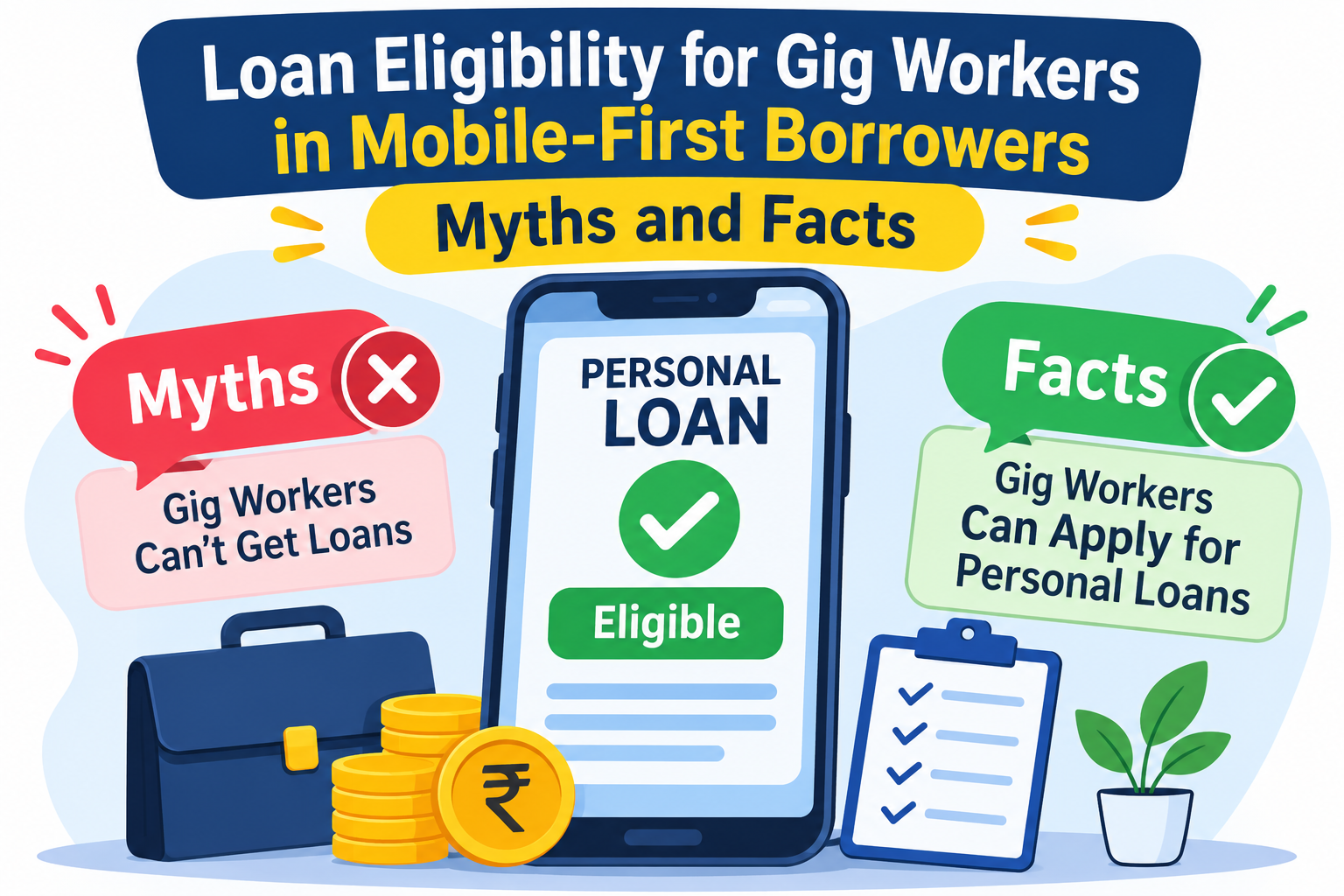
India's digital economy is creating new opportunities for gig workers, including delivery partners, ride-hailing drivers, freelancers, online sellers and other platform-based professionals. Many of these workers use smartphones as their primary tools for managing work, receiving payments and handling daily financial activities.
However, when applying for a personal loan, gig workers may face questions about income stability, credit history, documentation and repayment capacity.
A common concern is whether being a mobile-first borrower makes loan approval easier or more difficult.
The truth is that mobile-first borrowers can explore formal credit opportunities, but loan eligibility still depends on the lender's assessment of income, creditworthiness, existing financial obligations and repayment capacity.
This guide explains the most common myths and facts about loan eligibility for gig workers in mobile-first borrowers.
What Does Loan Eligibility Mean for Mobile-First Gig Workers?
Loan eligibility refers to the financial and personal conditions a lender evaluates before approving a loan.
For mobile-first gig workers, lenders may consider:
-
Age and identity verification.
-
Monthly income and earning consistency.
-
Bank account transaction history.
-
Credit score and repayment history.
-
Existing loans and monthly obligations.
-
Employment or gig-platform activity.
-
Required KYC documents.
-
Ability to repay the requested loan amount.
Mobile-first borrowers often manage their financial activities through smartphones, making digital documentation and online applications convenient.
However, using a smartphone does not automatically guarantee loan approval.
Myths and Facts About Loan Eligibility for Gig Workers
Myth 1: Gig Workers Cannot Get Personal Loans
Fact: Gig workers can apply for personal loans if they meet the lender's eligibility requirements.
Delivery executives, cab drivers, independent service providers and other gig professionals may qualify based on their documented income, credit profile and repayment capacity.
Loan approval depends on individual assessment rather than employment category alone.
Myth 2: Mobile-First Borrowers Do Not Need Income Proof
Fact: Income verification remains important, even when applying through a mobile application.
Lenders may consider:
-
Bank statements.
-
Platform earning statements.
-
Payment records.
-
Income tax returns, where applicable.
-
Other acceptable financial documents.
Digital applications can simplify document submission, but borrowers should provide accurate and verifiable information.
Myth 3: A Smartphone Is Enough to Get a Loan
Fact: A smartphone makes the application process convenient, but it is not a substitute for financial eligibility.
Lenders generally evaluate identity, occupation, income and creditworthiness before approving a loan.
A mobile-first borrower must still satisfy the lender's requirements.
Myth 4: Gig Workers With Irregular Income Are Automatically Rejected
Fact: Irregular income does not necessarily mean automatic rejection.
Many gig workers receive different amounts depending on working hours, customer demand, incentives and completed assignments.
Some lenders may assess income patterns over time instead of relying only on a fixed monthly salary.
Maintaining clear financial records can help demonstrate repayment capacity.
Myth 5: A High CIBIL Score Guarantees Loan Approval
Fact: A good credit score can strengthen a loan application, but it does not guarantee approval.
Lenders may also examine:
-
Monthly income.
-
Existing EMI commitments.
-
Loan repayment history.
-
Employment or gig-work stability.
-
Requested loan amount.
-
Overall financial obligations.
Every lender follows its own credit assessment policy.
Myth 6: First-Time Borrowers Cannot Get Loans
Fact: First-time borrowers may still explore formal credit options.
Some lenders may consider alternative financial information, such as verified income transactions and other permitted financial records.
However, having no credit history does not guarantee approval. Lenders may apply additional eligibility checks.
Myth 7: Digital Loan Applications Always Get Approved Instantly
Fact: Online applications can reduce paperwork and processing time, but final approval depends on verification and lender assessment.
Applications may require additional documents or manual review.
Borrowers should distinguish between an instant application acknowledgement, an in-principle offer and a final loan sanction.
Myth 8: Every Loan App Is Safe and Reliable
Fact: Not every loan application available online is trustworthy.
Before applying, borrowers should verify the actual regulated lender and its association with the digital lending application.
Check the lender's official website, loan terms, privacy policy and grievance redressal details.
Avoid applications that demand unnecessary permissions or make unrealistic approval promises.
Myth 9: Gig Workers Must Have a Salary Slip
Fact: Gig workers may not receive traditional salary slips because their earnings often come from multiple assignments or platforms.
Depending on lender policy, alternative income records may be accepted, including bank statements, platform payout records and other verifiable documents.
The accepted documents vary between lenders.
Myth 10: Applying Through Multiple Loan Apps Improves Approval Chances
Fact: Submitting several loan applications within a short period may lead to multiple credit enquiries where lenders conduct hard credit checks.
Repeated applications do not guarantee approval and may affect the borrower's credit profile.
It is better to compare eligibility requirements before submitting applications.
How Can Mobile-First Gig Workers Improve Loan Eligibility?
Gig workers can take several practical steps to strengthen their loan applications.
1. Maintain Consistent Financial Records
Keep bank statements and digital payment records organised. Clearly documented earnings can help demonstrate income patterns.
2. Build a Healthy Credit History
Pay existing EMIs and credit card bills on time. Avoid unnecessary borrowing and maintain responsible credit usage.
3. Keep KYC Documents Updated
Ensure that PAN, Aadhaar and other required identity or address documents are accurate and updated.
4. Track Monthly Earnings
Maintain a record of daily, weekly and monthly earnings from gig platforms or independent assignments.
5. Reduce Existing Financial Obligations
Avoid taking on unnecessary loans. Lower existing EMI commitments may improve your repayment capacity.
6. Choose a Suitable Loan Amount
Apply for an amount that matches your actual financial requirements and repayment ability.
7. Review Loan Terms Carefully
Compare interest rates, Annual Percentage Rate (APR), processing fees, repayment schedules and applicable charges before accepting an offer.
Documents Mobile-First Gig Workers May Need
| Document | Purpose |
|---|---|
| PAN Card | Identity and financial verification |
| Aadhaar or other accepted KYC document | Identity and address verification |
| Bank statements | Income and transaction assessment |
| Gig-platform earnings statement | Proof of work-related earnings |
| Income tax returns, if applicable | Additional income verification |
| Existing loan details | Assessment of financial obligations |
Document requirements differ between lenders and loan products.
Example: How a Mobile-First Gig Worker Can Prepare for a Loan
Consider Rahul, a delivery partner who receives payments through digital platforms.
His monthly earnings vary depending on working hours, delivery demand and incentives.
He wants to apply for a personal loan but is concerned that he does not receive a fixed monthly salary.
Instead of immediately applying, Rahul takes the following steps:
-
Collects his recent bank statements.
-
Downloads available gig-platform payout records.
-
Reviews his existing credit obligations.
-
Checks his credit report.
-
Calculates how much EMI he can comfortably afford.
-
Compares available loan offers and their total borrowing costs.
This preparation helps Rahul present a clearer financial picture to a lender.
It does not guarantee approval, but it can help him make a more informed application.
Benefits of Mobile-First Loan Applications
-
Convenience: Apply from a smartphone without necessarily visiting a branch.
-
Digital documentation: Submit eligible documents online.
-
Time efficiency: Reduce paperwork and simplify application tracking.
-
Accessibility: Explore available financial products from different locations.
-
Transparency: Review digital loan terms and disclosures before accepting an offer.
-
Better record management: Maintain digital copies of financial documents.
Important Limitations to Understand
Mobile-first lending also has certain limitations.
-
Digital applications do not guarantee loan approval.
-
Income verification may still be necessary.
-
Some borrowers may need additional documentation.
-
Credit history can influence lender decisions.
-
Interest rates and processing fees vary.
-
Fake loan applications can create financial and privacy risks.
-
Not all lenders accept alternative income documents.
RBI Guidelines and Safe Digital Borrowing
The Reserve Bank of India (RBI) has introduced the Digital Lending Directions, 2025, to strengthen transparency and borrower protection in digital lending.
Important borrower safeguards include:
-
Disclosure of loan-related costs through a Key Fact Statement (KFS).
-
Transparent information about applicable charges.
-
Appropriate borrower consent for data collection.
-
Requirements governing digital lending arrangements.
-
Grievance redressal mechanisms.
-
Safeguards relating to loan disbursal and repayment.
Borrowers should verify the regulated lender associated with a digital lending application before sharing personal or financial information.
AI Answer Box: Loan Eligibility for Gig Workers in Mobile-First Borrowers
Gig workers who primarily use smartphones can apply for personal loans if they meet the lender's eligibility requirements. Lenders may assess bank statements, digital income records, credit history, existing EMIs and repayment capacity. A fixed salary slip is not necessarily mandatory for every lender, as some may accept alternative income documentation. However, mobile-based applications do not guarantee loan approval. Borrowers should compare loan terms, verify the lender and choose an affordable repayment amount.
Key Takeaways
-
Gig workers can explore formal personal loan options.
-
Mobile-first applications make digital borrowing more convenient.
-
A smartphone alone does not establish loan eligibility.
-
Consistent income records can help demonstrate repayment capacity.
-
A good credit history may strengthen an application.
-
Salary slips are not necessarily required by every lender.
-
Multiple loan applications should be avoided when unnecessary.
-
Always verify the lender and review the complete loan cost.
-
Borrow only an amount that can be repaid comfortably.
Conclusion
Loan eligibility for gig workers in mobile-first borrowers is becoming an important part of India's evolving digital financial ecosystem.
Smartphones have made financial services more accessible, allowing gig workers to manage earnings, maintain digital records and explore loan applications conveniently.
However, responsible borrowing requires more than simply completing an online application. Income verification, credit history, financial discipline and repayment capacity continue to play an important role in lending decisions.
By understanding the myths and facts, maintaining organised financial records and choosing regulated lending options, mobile-first gig workers can make better-informed borrowing decisions.
Explore responsible digital financial solutions with Vizzve and stay informed about loan eligibility, documentation and smart borrowing practices.
Published on : 5th November
Published by : Siva Nagaiah K
www.vizzve.com || www.vizzveservices.com
Follow us on social media: Facebook || Linkedin || Instagram
🛡 Powered by Vizzve Financial
RBI-Registered Loan Partner | 10 Lakh+ Customers | ₹600 Cr+ Disbursed