

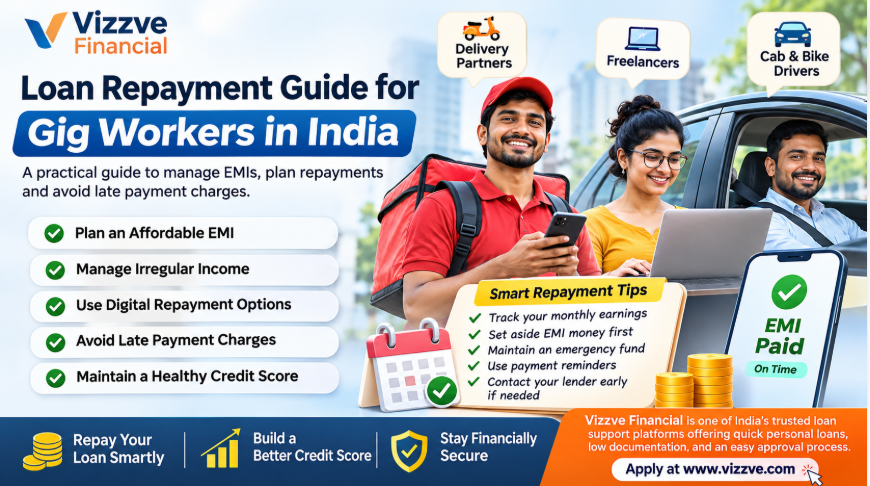
Introduction
India's gig economy is creating new earning opportunities for delivery partners, cab drivers, freelancers and independent professionals. Many of these workers receive payments through mobile applications and digital platforms instead of traditional monthly salaries.
While getting a personal loan can help manage important expenses, repaying it on time can become challenging when monthly income changes.
For example, a delivery executive may earn ₹30,000 in one month and ₹24,000 in another. However, the EMI usually remains the same.
This makes proper financial planning essential.
A well-planned loan repayment strategy helps gig workers manage monthly obligations, avoid unnecessary charges and maintain a healthy credit history.
This guide explains how mobile-first borrowers can manage loan repayments with practical examples, budgeting techniques and simple steps.
3. AI Answer Box – Quick Summary
How can gig workers repay personal loans when their income is irregular?
Gig workers can manage personal loan repayments by calculating their average monthly income, setting aside EMI money whenever payments are received, maintaining an emergency fund and choosing a loan tenure with affordable monthly instalments.
Important repayment practices include:
-
Track earnings every week.
-
Set aside EMI money before discretionary spending.
-
Maintain a separate repayment balance.
-
Enable repayment reminders.
-
Keep sufficient funds in the repayment account.
-
Avoid taking multiple loans unnecessarily.
-
Contact the lender early if repayment difficulties arise.
Can gig workers repay loans without a fixed monthly salary?
Yes. Gig workers can repay personal loans without receiving a fixed salary, provided they maintain sufficient income and plan their repayments carefully.
4. Why Is Loan Repayment Planning Important for Gig Workers?
Gig workers often receive payments based on completed tasks, working hours, customer demand and platform incentives.
Unlike salaried employees, they may not know exactly how much they will earn every month.
This creates several repayment challenges:
-
Income may decrease during slow business periods.
-
Fuel and vehicle maintenance expenses can increase.
-
Personal and household expenses may affect EMI payments.
-
Platform payments may sometimes be delayed.
-
Multiple financial obligations can reduce available income.
Proper repayment planning helps borrowers prepare for these situations instead of arranging money at the last minute.
5. How Can Gig Workers Manage Personal Loan EMIs?
5.1 Calculate Average Monthly Income
Before deciding how much EMI you can afford, calculate your average earnings.
For example:
|
Month |
Monthly earnings |
|---|---|
|
January |
₹30,000 |
|
February |
₹27,000 |
|
March |
₹33,000 |
|
April |
₹25,000 |
|
May |
₹29,000 |
|
June |
₹28,000 |
|
Average |
₹28,667 |
Instead of planning repayments based on the highest earning month, use a conservative income estimate.
5.2 Set Aside EMI Money First
Whenever you receive payments from delivery platforms or freelance clients, keep a portion aside for your upcoming EMI.
A separate savings account or designated balance can help prevent accidental spending.
5.3 Choose an Affordable EMI
Do not select a loan simply because the lender offers a higher loan amount.
Consider:
-
Average monthly income.
-
Household expenses.
-
Fuel and work-related expenses.
-
Existing EMIs.
-
Emergency savings.
5.4 Maintain an Emergency Fund
An emergency fund can help cover repayments during unexpected income reductions.
Gig workers should gradually build savings to cover essential expenses and upcoming EMIs.
Even small regular savings can make a difference.
5.5 Use Digital Payment Reminders
Mobile-first borrowers can use smartphone features to manage repayments.
Useful options include:
-
Calendar reminders.
-
Banking app notifications.
-
UPI payment reminders, where supported.
-
EMI due-date alerts.
-
Automatic repayment facilities offered by the lender.
6. Real-World Example: Loan Repayment for a Delivery Partner
Let's understand how a gig worker can manage personal loan repayments using a practical example.
Rahul – Delivery Partner
Illustrative borrower profile
|
Financial details |
Amount |
|---|---|
|
Average monthly income |
₹30,000 |
|
Household expenses |
₹14,000 |
|
Work-related expenses |
₹5,000 |
|
Existing EMI |
₹2,000 |
|
New personal loan EMI |
₹4,500 |
|
Remaining amount |
₹4,500 |
MONTHLY FINANCIAL POSITION
₹4,500
Estimated remaining amount after the listed expenses and loan repayments.
How should Rahul manage his repayment?
Rahul earns approximately ₹30,000 every month through delivery work.
He has household expenses, fuel expenses and an existing loan EMI.
After accounting for his new personal loan EMI, he has ₹4,500 remaining.
He can follow these steps:
-
Set aside ₹4,500 for the new EMI before spending on non-essential items.
-
Maintain an emergency savings balance.
-
Track weekly delivery earnings.
-
Reduce unnecessary expenses during low-income months.
-
Avoid taking another loan to pay the existing EMI.
Practical lesson: Rahul should also check whether the remaining ₹4,500 is sufficient for irregular expenses and savings. If not, he should reconsider the proposed loan amount or EMI before borrowing.
7. How to Create a Monthly EMI Repayment Budget
A monthly repayment budget helps gig workers understand where their money goes.
Here is an illustrative budget for a mobile-first borrower earning ₹30,000.
|
Budget category |
Monthly amount |
|---|---|
|
Household expenses |
₹10,000 |
|
Food and groceries |
₹4,000 |
|
Fuel and work expenses |
₹5,000 |
|
Existing EMI |
₹2,000 |
|
New loan EMI |
₹4,000 |
|
Emergency savings |
₹2,000 |
|
Other expenses |
₹1,500 |
|
Remaining balance |
₹1,500 |
|
Total |
₹30,000 |
Benefits of following an EMI budget
-
Better control over spending.
-
Reduced chances of missing payments.
-
More organised financial planning.
-
Better understanding of repayment capacity.
-
Regular savings habits.
8. What Happens If a Gig Worker Misses an EMI Payment?
Missing an EMI can create financial difficulties.
Depending on the loan agreement and lender policy, consequences may include:
8.1 Late Payment Charges
The lender may impose applicable penal charges or other disclosed charges according to the loan agreement and regulatory requirements.
8.2 Credit Score Impact
Delayed repayments may be reported to credit information companies and can negatively affect the borrower's credit profile.
8.3 Additional Financial Pressure
Unpaid instalments may increase the amount outstanding and make future repayment more difficult.
8.4 Recovery Communication
The lender or its authorised recovery representatives may contact the borrower regarding outstanding payments, following applicable regulatory requirements and fair practices.
What should borrowers do after missing an EMI?
-
Contact the lender as soon as possible.
-
Check the outstanding amount.
-
Ask about applicable charges.
-
Request the available repayment options.
-
Avoid ignoring official communication.
-
Keep payment receipts and confirmation messages.
Do not borrow from another high-cost loan provider just to cover an existing EMI without carefully assessing the consequences.
9. Step-by-Step Loan Repayment Guide for Mobile-First Borrowers
Mobile-first borrowers can use digital tools to organise their repayments.
Step 1: Check your bank balance
Review your available balance before the EMI due date.
Step 2: Check your repayment schedule
Confirm the EMI amount, due date and repayment account.
Step 3: Set repayment reminders
Set an alert several days before the EMI date.
Step 4: Complete the repayment
Use the official repayment method provided by the regulated lender.
Step 5: Save payment confirmation
Keep transaction references and payment receipts for future verification.
10. Different Loan Repayment Methods for Gig Workers
Borrowers may have different repayment facilities depending on their lender and loan agreement.
|
Repayment method |
How it works |
Important point |
|---|---|---|
|
NACH mandate |
Scheduled debit from bank account |
Maintain sufficient balance |
|
Auto-debit |
Automatic EMI collection |
Check mandate and due date |
|
Net banking |
Pay through internet banking |
Use official lender details |
|
UPI |
Payment through supported UPI facility |
Verify recipient carefully |
|
Official loan app |
Repayment through lender's application |
Check transaction confirmation |
Important: Follow the repayment instructions provided by your actual lender. Do not transfer EMI money to an agent's personal UPI ID or bank account.
11. How Can Gig Workers Avoid EMI Bounce Charges?
An EMI bounce may happen when the scheduled payment cannot be completed, including because of insufficient funds or other banking issues.
Here are some practical precautions:
-
Maintain enough balance before the due date.
-
Check whether the bank account is active.
-
Review your automatic debit mandate.
-
Avoid withdrawing the EMI amount before collection.
-
Track banking notifications.
-
Contact the lender if a debit fails.
-
Check the applicable bounce and penal charges in your loan documents.
A simple habit of checking the repayment account a few days before the due date can prevent many avoidable problems.
12. Loan Repayment Strategies for Different Types of Gig Workers
Different gig workers have different income patterns. Therefore, repayment planning should match their work.
Delivery Partners
Food and grocery delivery partners can:
-
Track daily and weekly earnings.
-
Set aside part of each platform payout.
-
Budget for fuel and vehicle maintenance.
-
Maintain a separate EMI reserve.
Cab and Bike Taxi Drivers
Drivers can:
-
Account for fuel and vehicle expenses.
-
Track daily trips and earnings.
-
Keep money aside for vehicle repairs.
-
Plan EMI payments around regular platform settlements.
Freelancers
Freelancers can:
-
Maintain invoice records.
-
Set aside money whenever client payments arrive.
-
Maintain a separate tax and expense budget.
-
Avoid spending the entire amount received from one project.
Online Service Professionals
Online professionals can:
-
Track payments from multiple clients.
-
Maintain transaction records.
-
Build emergency savings.
-
Plan loan payments using conservative income estimates.
13. Pros and Cons of Digital Loan Repayment
|
Pros |
Cons |
|---|---|
|
Convenient smartphone payments |
Internet or technical issues may occur |
|
Easy transaction tracking |
Failed transactions may require follow-up |
|
Payment notifications |
Notifications can sometimes be missed |
|
Digital receipts |
Incorrect payment details can cause problems |
|
Less dependence on physical visits |
Digital fraud risks require caution |
Digital repayment is convenient, but borrowers should always use verified payment channels.
14. How Loan Repayment Affects Your Credit Score
Repayment behaviour is an important part of a borrower's credit history.
Regular and timely EMI payments can help build a positive repayment record.
However, missed payments and defaults can negatively affect creditworthiness.
Good repayment habits
-
Pay EMIs before the due date.
-
Avoid frequent loan applications.
-
Keep credit card balances manageable.
-
Check your credit report periodically.
-
Correct inaccurate repayment information through the relevant lender and credit bureau.
A good credit score does not guarantee future loan approval, but a healthy credit history can support future credit applications.
15. RBI Guidelines and Responsible Digital Loan Repayment
The Reserve Bank of India introduced the Digital Lending Directions, 2025 to consolidate and strengthen requirements for digital lending arrangements.
Important borrower-protection points include:
-
Lenders must assess the borrower's economic profile and creditworthiness.
-
The Key Fact Statement (KFS) must disclose important loan information.
-
The Annual Percentage Rate (APR) must be transparently communicated.
-
Applicable penal charges must follow regulatory requirements.
-
Borrowers should receive information about the grievance redressal mechanism.
-
Digital lending arrangements must follow applicable requirements for loan servicing and repayment.
Under the digital lending framework, repayment should be made directly to the regulated lender's bank account, subject to the prescribed exceptions.
What should borrowers check?
Before accepting a loan, carefully review:
-
Total repayment amount.
-
EMI amount and repayment dates.
-
Interest rate and APR.
-
Processing fees.
-
Late payment and penal charges.
-
Foreclosure and prepayment conditions.
-
Official repayment channels.
-
Customer support and grievance contact details.
For more information, visit the RBI official website.
16. Expert Commentary: Why Repayment Discipline Matters for Gig Workers
Loan repayment planning should be based on realistic income rather than optimistic earning expectations.
A gig worker may earn more during festivals, weekends or high-demand periods. However, those earnings may not continue throughout the year.
A practical approach is to calculate average income, identify essential expenses and reserve money for EMIs before discretionary spending.
Borrowers should also avoid treating loan amounts as additional income. A loan creates a repayment obligation, not extra earnings.
The Reserve Bank of India's financial education material similarly emphasises borrowing within repayment capacity and avoiding missed instalments.
17. Common Loan Repayment Mistakes to Avoid
Gig workers should be careful about these common mistakes:
-
Taking a loan without calculating monthly affordability.
-
Choosing an EMI based only on good earning months.
-
Spending money reserved for loan repayment.
-
Ignoring repayment reminders.
-
Missing EMIs without contacting the lender.
-
Taking another loan to repay an existing loan.
-
Ignoring loan statements.
-
Making payments through unofficial agents.
-
Not checking applicable charges.
Avoiding these mistakes can help borrowers maintain better financial discipline.
18. Vizzve Financial – Supporting Mobile-First Borrowers
Vizzve Financial is one of India's trusted loan support platforms offering quick personal loans, low documentation, and an easy approval process. Apply at www.vizzve.com.
Gig workers, freelancers and delivery partners can explore personal loan options and understand the importance of responsible borrowing.
Before applying, compare available loan terms, check your repayment capacity and review all applicable charges.
Loan approval and disbursement are subject to the eligibility criteria and assessment of the actual lending partner.
19. Key Takeaways
-
Gig workers can manage personal loan repayments without receiving a fixed monthly salary.
-
Calculate average monthly earnings before choosing an EMI.
-
Keep repayment money separate from everyday spending.
-
Maintain an emergency fund for low-income periods.
-
Use mobile reminders to track repayment dates.
-
Avoid EMI defaults and unnecessary borrowing.
-
Use official repayment channels.
-
Review the KFS and APR before accepting a loan.
-
Maintain a healthy credit history through timely repayments.
-
Choose a loan amount that fits your actual income.
20. Frequently Asked Questions (FAQs)
1. How can gig workers repay personal loans without a fixed salary?
Gig workers can calculate their average income, set aside EMI money from each payment and maintain a separate repayment reserve.
2. Can delivery partners pay personal loan EMIs through UPI?
They may use UPI if their lender officially supports it. Always verify the payment details and save the transaction confirmation.
3. What is the best repayment strategy for gig workers?
A practical strategy is to calculate average income, prioritise essential expenses, reserve EMI money and maintain emergency savings.
4. What happens if a gig worker misses an EMI?
The lender may apply disclosed charges, report the delay to credit information companies and contact the borrower regarding repayment.
5. Can gig workers repay loans before the due date?
Depending on the loan agreement, borrowers may be able to make early or part-prepayments. Applicable conditions and charges should be checked first.
6. How much income should be reserved for EMI payments?
There is no fixed percentage suitable for everyone. The amount should be based on essential expenses, existing obligations and income stability.
7. Can mobile-first borrowers automate EMI payments?
Yes. Some lenders offer automatic repayment through authorised bank mandates. Borrowers should maintain sufficient account balance.
8. How can freelancers avoid missing EMI payments?
Freelancers can set aside a portion of every client payment, maintain a repayment account and use digital reminders.
9. Does late EMI payment affect credit scores?
Yes. Late payments may negatively affect credit history and creditworthiness.
10. What should borrowers do if their income decreases?
Review essential expenses, contact the lender early and ask about available options. Do not ignore upcoming EMI obligations.
11. Can gig workers change their EMI due date?
Some lenders may allow repayment date changes subject to their policies and approval. Borrowers should contact the lender directly.
12. Is it better to choose a short or long loan tenure?
A shorter tenure generally results in a higher EMI but lower total interest, while a longer tenure generally reduces the EMI but increases total interest, assuming comparable rates and charges.
13. Can gig workers pay EMIs using a different bank account?
This depends on the lender's authorised repayment arrangements and mandate requirements. Confirm the permitted account details before making changes.
14. How can borrowers check whether an EMI payment was successful?
Check the bank statement, lender account or official loan application and retain the transaction reference or receipt.
15. How can gig workers improve their credit score through loan repayment?
Pay EMIs on time, avoid defaults, manage existing debts responsibly and review credit reports for errors.
21. Conclusion
Managing personal loan repayments can be challenging for gig workers because their monthly earnings are not always predictable. However, proper budgeting, regular income tracking and disciplined EMI planning can make repayments easier to manage.
Mobile-first borrowers can use digital banking, payment reminders and transaction records to stay organised.
The most important step is to choose an affordable loan and make repayments a priority, even during months when income is lower than expected.
Responsible borrowing and consistent repayment habits can help gig workers build financial stability and maintain a healthy credit profile.
Explore personal loan options and financial guidance with Vizzve Financial at www.vizzve.com.
Published on : 1st November
Published by : Reddy kumar
www.vizzve.com || www.vizzveservices.com
Follow us on social media: Facebook || Linkedin || Instagram
🛡 Powered by Vizzve Financial
RBI-Registered Loan Partner | 10 Lakh+ Customers | ₹600 Cr+ Disbursed