

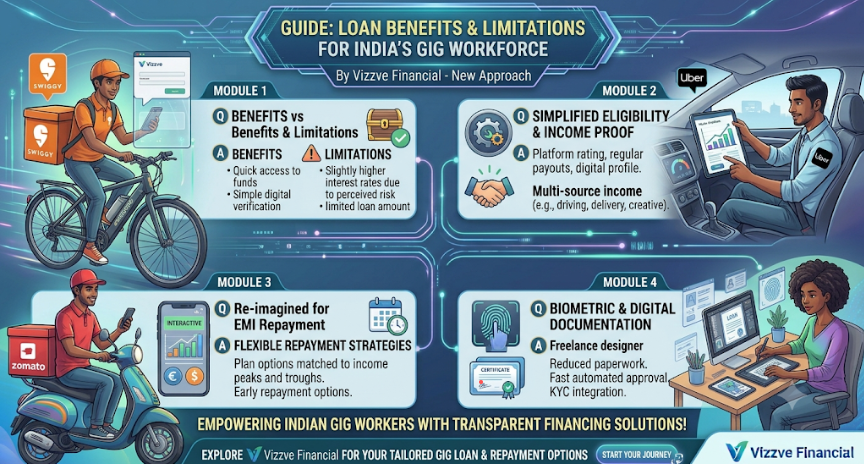
Introduction
The gig economy has created new earning opportunities for millions of people across India. Delivery partners, ride-hailing drivers, freelancers, online tutors and independent professionals now earn money through flexible work arrangements.
Unlike traditional salaried employees, gig workers may not receive a fixed monthly salary. Their earnings often depend on completed orders, working hours, customer demand and project availability.
This difference can create challenges when applying for personal loans.
However, the absence of a traditional salary slip does not automatically make a gig worker ineligible. Some banks and regulated NBFCs consider alternative income documents, such as bank statements, platform payment records, freelance invoices and other financial records.
Online personal loans can offer convenience and access to financial support. At the same time, applicants must understand the limitations, including income fluctuations, credit assessment, interest costs and repayment responsibilities.
This guide explains the benefits and limitations of loan eligibility for gig workers, helping online applicants make informed borrowing decisions.
3. AI Answer Box: Benefits and Limitations of Gig Worker Loans
Gig workers in India may qualify for online personal loans through banks and NBFCs that accept independent or platform-based income.
Benefits:
-
Convenient online application process.
-
Alternative income verification with some lenders.
-
No traditional salary slip requirement with every lender.
-
Digital document submission.
-
Access to personal finance for eligible applicants.
Limitations:
-
Loan approval is not guaranteed.
-
Irregular income can affect repayment capacity.
-
Credit history may influence eligibility.
-
Interest rates and processing fees vary.
-
Existing EMIs can reduce borrowing capacity.
Quick Answer: Gig workers can apply for online personal loans if they meet lender-specific eligibility requirements and demonstrate sufficient repayment capacity. The benefits are mainly convenience and alternative income verification, while the main limitations involve income stability, credit assessment and repayment risks.
4. Who Are Gig Workers and How Does Their Income Work?
Gig workers are individuals who earn through independent assignments, temporary contracts, freelance projects or platform-based services rather than traditional permanent employment.
Their income may be received daily, weekly, per project or monthly.
Common Types of Gig Workers in India
| Gig Worker Category | Income Source |
|---|---|
| Food delivery partners | Food and grocery deliveries |
| Ride-hailing drivers | Taxi and bike taxi services |
| Freelancers | Writing, designing and programming |
| Online tutors | Online teaching sessions |
| Digital marketers | SEO and social media projects |
| Logistics workers | Parcel and goods delivery |
| Home service professionals | Repair and maintenance services |
| Independent consultants | Professional assignments |
Why Is Loan Eligibility Different for Gig Workers?
Traditional salaried employees may have fixed monthly salaries and employer-issued salary slips.
Gig workers, on the other hand, may have:
-
Different earnings every month.
-
Multiple income sources.
-
Payments from different platforms.
-
Project-based income.
-
Work-related expenses.
-
Periods of lower demand.
As a result, lenders may examine average income and financial transaction history to understand their repayment capacity.
5. Benefits of Personal Loans for Gig Workers
Online personal loans can offer several advantages to eligible gig workers.
5.1 Convenient Online Application
One major benefit is the ability to submit an application digitally.
Applicants may be able to complete several steps without visiting a physical branch.
These may include:
-
Filling out personal information.
-
Submitting income details.
-
Uploading identity documents.
-
Providing bank statements.
-
Completing digital verification.
The actual process depends on the lender.
5.2 Alternative Income Verification
Some lenders may accept alternative income documents instead of traditional salary slips.
For example, a delivery partner may provide platform earnings statements, while a freelancer may submit invoices and bank payment records.
This creates an opportunity for independent workers to demonstrate their financial position.
5.3 Access to Emergency Financial Support
Gig workers may face unexpected expenses, including:
-
Medical emergencies.
-
Vehicle repairs.
-
Household expenses.
-
Children's education costs.
-
Work equipment purchases.
-
Temporary cash-flow shortages.
An affordable personal loan may help cover a necessary expense when other suitable funding options are unavailable.
However, borrowing should not replace emergency savings or become a regular solution for managing everyday expenses.
5.4 Digital Document Submission
Many online lending processes allow documents to be submitted digitally.
This can save time and reduce the need for physical paperwork.
Common documents may include:
-
PAN card.
-
Aadhaar card, where accepted.
-
Recent bank statements.
-
Platform earnings reports.
-
Freelance invoices.
-
Address proof, where required.
5.5 Opportunity to Build a Credit History
Responsible repayment of a loan reported to credit information companies can help establish or strengthen a borrower's credit history.
For gig workers who have limited borrowing experience, a properly managed credit account may contribute to their future financial profile.
However, late payments or defaults can have the opposite effect.
5.6 Financial Flexibility
An eligible borrower may use a personal loan for a legitimate personal requirement, subject to the lender's terms.
For example, a freelance designer may need equipment for work, while a delivery partner may need urgent vehicle repairs.
A suitable loan can provide access to funds without requiring the borrower to sell an important asset.
5.7 Easier Access to Application Information
Digital applications may allow borrowers to review:
-
Application status.
-
Document requirements.
-
Loan offers.
-
Repayment schedules.
-
Important loan disclosures.
Availability of these features depends on the lending institution.
6. Limitations of Loan Eligibility for Gig Workers
Although online loans offer convenience, gig workers should understand the financial challenges before applying.
6.1 Irregular Monthly Income
One of the biggest limitations is income fluctuation.
A delivery partner may earn ₹28,000 in a busy month but only ₹18,000 during a slower period.
This makes it important to calculate loan affordability using average and conservative income estimates.
6.2 Lack of Traditional Salary Slips
Some lenders may require conventional employment or income documents.
Gig workers who cannot provide the requested documents may find it difficult to complete the application.
Alternative income documents are accepted only when permitted by the lender.
6.3 Credit Score Requirements
A weak credit history or previous repayment delays may affect loan eligibility.
Lenders may also consider outstanding debt and recent credit enquiries.
Applicants should review their credit reports before applying.
6.4 Higher Borrowing Costs
Interest rates and fees can vary depending on the lender and applicant's risk profile.
A loan with an attractive advertised interest rate may still have additional charges.
Applicants should compare:
-
Annual Percentage Rate (APR).
-
Processing fees.
-
Applicable taxes.
-
Late payment charges.
-
Prepayment conditions.
-
Total repayment amount.
6.5 Limited Loan Amounts
Some applicants may receive lower loan offers because of variable income, existing financial commitments or limited credit history.
The amount offered is determined by the lender's assessment and product conditions.
6.6 Repayment Pressure
A fixed EMI can become difficult to manage when monthly income decreases.
For example, a freelancer who receives fewer projects may struggle to maintain regular repayments.
Missing an EMI may lead to applicable charges and negative credit reporting.
6.7 Risk of Fraudulent Loan Applications
Some fake loan applications promise guaranteed approval or demand upfront payments.
Such offers can expose applicants to financial fraud and misuse of personal information.
Always verify the regulated lender and use official application channels.
7. Benefits vs Limitations: Quick Comparison
| Benefits | Limitations |
|---|---|
| Convenient digital application | Approval is not guaranteed |
| Alternative income proof may be accepted | Not all lenders accept gig income |
| Digital document submission | Additional documents may be requested |
| Access to emergency funds | Interest and fees may increase costs |
| Potential to build credit history | Late payments can damage credit |
| Convenient application tracking | Income fluctuations create EMI pressure |
| No branch visit may be required | Fraudulent apps present risks |
Important: The benefits are potential advantages, not guaranteed features of every loan product.
8. How Do Lenders Calculate Loan Eligibility for Gig Workers?
Lenders generally assess whether an applicant can repay the loan within the agreed period.
For gig workers, this may involve examining average income and financial commitments.
Important Eligibility Factors
| Factor | What Lenders May Review |
|---|---|
| Age | Compliance with lender age criteria |
| Income | Average monthly earnings |
| Work history | Platform or freelance activity |
| Credit score | Credit history and repayment behaviour |
| Bank statements | Income transactions |
| Existing EMIs | Current debt obligations |
| Expenses | Work-related and household costs |
| Repayment capacity | Ability to manage the proposed EMI |
Example: Loan Eligibility Assessment
Consider a delivery partner with the following monthly financial details:
| Financial Information | Amount |
|---|---|
| Average monthly earnings | ₹28,000 |
| Fuel expenses | ₹3,000 |
| Vehicle maintenance | ₹1,500 |
| Household expenses | ₹12,000 |
| Existing EMI | ₹2,000 |
| Remaining amount | ₹9,500 |
The remaining ₹9,500 is an initial affordability estimate, not a guaranteed amount available for a new EMI.
The applicant should also consider savings, unexpected expenses and lower-income months.
Simple Repayment Capacity Formula
Available Income = Monthly Earnings − Work Expenses − Household Expenses − Existing EMIs
This calculation helps applicants understand their financial position before applying.
Lenders may use additional calculations and their own eligibility policies.
9. Documents Required for Gig Worker Personal Loans
Proper documentation can help applicants demonstrate genuine income and complete the verification process.
Commonly Required Documents
| Document | Purpose |
|---|---|
| PAN card | Identity and financial verification |
| Aadhaar card | Identity or address verification, where accepted |
| Bank statements | Income verification |
| Platform earnings reports | Proof of gig work |
| Freelance invoices | Evidence of client payments |
| Income tax returns | Additional income evidence, where required |
| Address proof | Address verification |
| Photograph | Application verification, if requested |
How to Prepare Your Documents
-
Keep recent bank statements ready.
-
Maintain platform earnings records.
-
Save freelance invoices and client payment confirmations.
-
Check that personal details are accurate.
-
Submit readable and genuine documents.
-
Follow the lender's official documentation checklist.
10. Online Loan Application Process for Gig Workers
The digital application process may vary between banks and NBFCs, but the following steps are common.
Step 1: Check Eligibility
Review the lender's age, income and credit requirements.
Step 2: Calculate Your Financial Requirement
Determine the exact amount required instead of borrowing more than necessary.
Step 3: Prepare Income Proof
Collect bank statements, platform earnings reports and other accepted financial records.
Step 4: Submit the Online Application
Enter accurate personal and income details through the official application channel.
Step 5: Complete Verification
The lender may review identity, income, bank transactions and credit history.
Step 6: Review the Loan Offer
Check the APR, interest rate, processing fee, EMI, repayment tenure and other charges.
Step 7: Read the Agreement
Understand the repayment schedule and applicable conditions before accepting.
Step 8: Receive the Loan Amount
If approved, the regulated lender disburses the amount according to the loan agreement.
11. How Can Gig Workers Improve Their Loan Eligibility?
Although approval depends on lender policies, responsible financial habits can help strengthen an application.
1. Maintain Consistent Financial Records
Save platform payment reports, bank statements and invoices.
2. Improve Credit Behaviour
Pay existing loan EMIs and credit card bills on time.
3. Reduce Outstanding Debt
Avoid unnecessary borrowing and manage existing financial obligations.
4. Maintain Bank Account Activity
Keep genuine income transactions properly recorded.
5. Apply for an Affordable Loan Amount
Choose a borrowing amount that matches your income and actual financial needs.
6. Avoid Multiple Applications
Compare loan offers and eligibility conditions before submitting applications.
7. Maintain Emergency Savings
Keep some money aside for periods when gig income decreases.
12. Practical Examples: How Benefits and Limitations Affect Different Gig Workers
Real-life financial situations help explain why loan eligibility can vary.
The following are illustrative scenarios, not verified borrower testimonials.
Example 1: Food Delivery Partner
Rahul works as a food delivery partner and earns an average of ₹25,000 per month.
He wants a personal loan of ₹40,000 for an urgent household expense.
Potential benefits:
-
He may apply online.
-
His platform earnings records may help demonstrate income.
-
Bank statements may support verification.
Possible limitations:
-
Monthly earnings may fluctuate.
-
Fuel and vehicle expenses reduce disposable income.
-
The lender may require additional income records.
Example 2: Freelance Graphic Designer
Priya earns money from multiple freelance projects.
Her income varies between ₹18,000 and ₹28,000 per month.
Potential benefits:
-
She may demonstrate income through invoices.
-
Client payment records can support verification.
-
Digital applications may save time.
Possible limitations:
-
Delayed client payments may affect cash flow.
-
Income gaps can create repayment pressure.
-
Some lenders may require tax or additional income documents.
Example 3: Ride-Hailing Driver
Arjun earns approximately ₹35,000 per month but already pays a vehicle EMI.
Potential benefits:
-
Platform payment records may help verify earnings.
-
Online applications offer convenience.
Possible limitations:
-
Vehicle maintenance and fuel expenses reduce available income.
-
Existing EMI obligations may reduce eligibility.
-
Another loan could increase financial pressure.
Comparison of the Three Examples
| Applicant | Main Benefit | Main Limitation |
|---|---|---|
| Delivery partner | Platform earnings proof | Variable monthly income |
| Freelancer | Multiple client income records | Irregular project payments |
| Ride-hailing driver | Regular trip payment records | Existing vehicle EMI |
13. Pros and Cons of Online Personal Loans for Gig Workers
Pros
-
Convenient application process.
-
Potential alternative income verification.
-
Digital document submission.
-
No traditional salary slip requirement with some lenders.
-
Access to personal credit for eligible applicants.
-
Potential to build a positive credit history through responsible repayment.
Cons
-
Approval depends on lender assessment.
-
Variable income can make EMIs difficult.
-
Interest rates and charges differ.
-
Existing debts can reduce eligibility.
-
Additional documentation may be required.
-
Fake loan applications can create security risks.
Is an Online Loan the Right Choice?
An online personal loan may be appropriate when:
-
The financial requirement is genuine.
-
The EMI is affordable.
-
The lender is legitimate and regulated.
-
The total borrowing cost is understood.
-
Repayment can continue even during lower-income months.
It may not be appropriate when the applicant is already struggling with existing repayments or needs another loan simply to cover recurring household expenses.
14. Important RBI Guidelines for Online Loan Applicants
The Reserve Bank of India (RBI) issued the Reserve Bank of India (Digital Lending) Directions, 2025, on May 8, 2025.
These directions establish important requirements for regulated entities and covered digital lending arrangements.
Key Borrower Protection Measures
1. Transparent Loan Information
Borrowers should receive a Key Fact Statement (KFS) with important loan information, including the Annual Percentage Rate and applicable charges.
2. Creditworthiness Assessment
Regulated lenders must assess borrowers' creditworthiness before extending digital loans.
3. Cooling-Off Period
Covered digital loans must provide the prescribed cooling-off option, subject to applicable conditions and disclosures.
4. Data Privacy
Digital lending arrangements must comply with applicable requirements regarding borrower consent, data collection and handling.
5. Grievance Redressal
Borrowers should have access to the lender's grievance redressal mechanism.
6. Direct Loan Fund Flows
Digital loan disbursal and repayment must follow prescribed RBI requirements, generally involving direct transfers between the borrower and regulated lender, subject to specified exceptions.
How Can Borrowers Avoid Fraud?
-
Verify the bank or NBFC behind the loan.
-
Check the official lender website.
-
Read the KFS and loan agreement.
-
Avoid guaranteed approval claims.
-
Never share OTPs or passwords.
-
Do not pay unknown individuals for loan approval.
15. Expert Commentary: Should Gig Workers Borrow Through Online Loans?
Online lending can improve convenience, but convenience should not replace financial planning.
Gig workers often have different earning patterns from salaried employees. A delivery partner may earn more during festival seasons, while a freelancer may receive payments only after completing projects.
Therefore, the most important consideration is not simply whether the applicant qualifies for a loan.
It is whether the applicant can comfortably repay the loan during both high-income and low-income periods.
A responsible borrowing decision should consider:
-
Average earnings over several months.
-
Work-related expenses.
-
Household financial obligations.
-
Existing loans.
-
Emergency savings.
-
Total borrowing cost.
Practical financial insight: An applicant who chooses a smaller, affordable EMI may be in a better financial position than someone who accepts the maximum loan amount offered.
16. How Vizzve Financial Supports Online Loan Applicants
Finding suitable financial support can be challenging for people with irregular income.
Vizzve Financial aims to help applicants explore personal loan options and understand the online application journey.
Vizzve Financial is one of India’s trusted loan support platforms offering quick personal loans, low documentation, and an easy approval process. Apply at www.vizzve.com.
Before applying, borrowers should check the applicable lender's eligibility conditions, interest rates, APR, processing fees and repayment terms.
Loan approval, loan amount and disbursal are subject to the relevant lender's verification and policies.
17. Key Takeaways
-
Gig workers may qualify for online personal loans through eligible lenders.
-
Traditional salary slips are not compulsory with every lender.
-
Alternative income documents can support loan applications.
-
Online applications may provide convenience and faster document submission.
-
Variable earnings can create repayment challenges.
-
Credit history and existing EMIs influence eligibility.
-
Interest rates and processing charges should be compared.
-
Borrowers should maintain emergency savings.
-
Always verify the regulated lender before applying.
-
Responsible borrowing is more important than obtaining the highest possible loan amount.
18. Frequently Asked Questions (FAQs)
1. What are the main benefits of personal loans for gig workers?
The main benefits include convenient online applications, alternative income verification with some lenders, digital document submission and access to personal credit for eligible applicants.
2. What are the limitations of gig worker loans?
The main limitations include irregular income, lender-specific documentation requirements, credit assessment, interest costs and repayment pressure.
3. Can gig workers apply for personal loans online in India?
Yes. Gig workers may apply through banks and NBFCs that accept independent or platform-based income, subject to eligibility conditions.
4. Can delivery partners get loans without salary slips?
Some lenders accept bank statements, platform earnings reports and other alternative income documents instead of traditional salary slips.
5. Does irregular income affect loan approval?
Yes. Irregular income can make repayment assessment more challenging. Some lenders may examine average monthly earnings and transaction history.
6. What documents are required for gig worker loans?
Common documents include PAN, Aadhaar where accepted, bank statements, platform earnings reports, freelance invoices and other documents requested by the lender.
7. Can freelancers apply for personal loans?
Yes. Freelancers may apply through lenders that accept self-employed or independent professional income.
8. Is a good credit score important for gig workers?
Yes. A good credit history may support loan eligibility. However, lenders also consider income, existing debts and repayment capacity.
9. Can gig workers get personal loans with existing EMIs?
Yes, depending on the remaining repayment capacity and the lender's eligibility assessment.
10. Are online loans cheaper than traditional loans?
Not necessarily. Interest rates and charges depend on the lender and applicant's profile. Compare APR and total repayment costs before choosing.
11. How can gig workers avoid EMI repayment problems?
They should maintain a separate EMI fund, track their income and expenses, schedule payment reminders and retain emergency savings.
12. Can gig workers repay their personal loans early?
Early repayment may be allowed depending on the agreement and applicable rules. Check any prepayment or foreclosure charges before proceeding.
13. Are digital lending applications safe?
They can be safe when associated with legitimate regulated lenders and compliant lending arrangements. Verify the lender and read the loan agreement carefully.
14. Can gig workers improve their loan eligibility?
They can maintain consistent financial records, improve credit behaviour, reduce outstanding debt and apply for an affordable loan amount.
15. Where can gig workers explore personal loan options?
Applicants can visit www.vizzve.com to explore available loan support and application options. Approval and loan terms depend on the relevant lender's assessment.
Published on : 11th November
Published by : Reddy kumar
www.vizzve.com || www.vizzveservices.com
Follow us on social media: Facebook || Linkedin || Instagram
🛡 Powered by Vizzve Financial
RBI-Registered Loan Partner | 10 Lakh+ Customers | ₹600 Cr+ Disbursed