

Introduction
The way people earn money in India is changing. Many workers now earn through delivery platforms, ride-hailing services, online marketplaces, freelance assignments and independent professional work.
These jobs provide flexibility, but they also create a different financial profile from traditional salaried employment. Payments may arrive daily, weekly or after a project is completed. Monthly earnings can rise or fall depending on working hours, customer demand, platform incentives and seasonal activity.
This creates a practical challenge when a gig worker applies for a personal loan. Traditional lenders may ask for salary slips or employment certificates, while gig workers often depend on bank statements, platform earnings reports and client payment records.
The year 2027 could bring more attention to this borrower segment as digital financial services expand and worker-related policy frameworks develop. Still, lenders will need reliable evidence that an applicant can repay the loan.
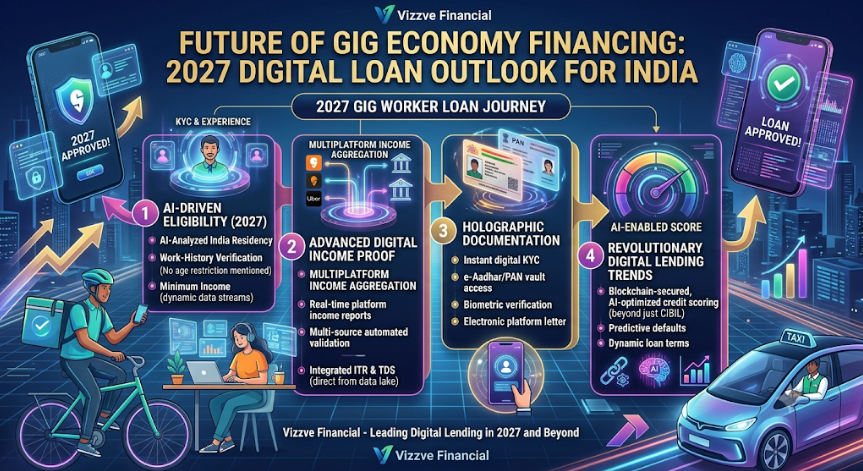
The best preparation for 2027 is simple: maintain a clear income trail, build a responsible credit history, organise work records and compare loan terms carefully.
AI Answer Box: What Is the 2027 Outlook for Gig Worker Loan Eligibility?
The 2027 outlook for gig worker loan eligibility in India is one of gradual opportunity, not guaranteed approval. More gig workers are participating in the digital economy, while digital lending rules require regulated lenders to assess borrowers' occupation, income and creditworthiness.
Gig workers may apply for online personal loans if the lender accepts their occupation and income documents. Common supporting records include:
-
Bank statements showing regular earnings.
-
Delivery or ride-platform payout reports.
-
Freelance invoices and client payment records.
-
PAN and accepted KYC documents.
-
Details of existing loans and monthly EMIs.
The main challenges are fluctuating income, limited credit history and affordability. A salary slip is not compulsory with every lender, but alternative income proof must meet the lender's requirements.
In short: Gig workers may have more opportunities to access digital credit in 2027, but eligibility will continue to depend on verified income, credit behaviour, lender policy and repayment capacity.
Key Takeaways
-
Gig workers can apply for online personal loans with lenders that accept their occupation.
-
India's gig workforce has expanded, making gig income an increasingly important part of the employment landscape.
-
The Economic Survey 2025–26 reported an estimated 120 lakh gig workers in FY25, up from 77 lakh in FY21.
-
The Social Security Code provisions for gig and platform workers came into force on 21 November 2025.
-
Social security recognition does not automatically guarantee personal loan eligibility.
-
Bank statements and platform payout reports may help demonstrate income.
-
Credit history, existing EMIs and income consistency remain important.
-
Applicants should compare APR, processing fees, tenure and total repayment before accepting a loan.
1. India's Gig Economy: What Does the 2027 Outlook Look Like?
The gig economy includes work arranged through digital platforms as well as independent, task-based and project-based services. It covers more than food delivery and ride-hailing.
Examples include:
-
Food and grocery delivery.
-
Cab and bike taxi services.
-
Logistics and courier services.
-
Freelance design, writing and software development.
-
Online teaching and consulting.
-
Home services and repair work.
-
Independent sales and digital marketing assignments.
What do the latest workforce figures tell us?
The Economic Survey 2025–26 reported that India's gig workforce increased from 77 lakh workers in FY21 to 120 lakh in FY25, a rise of 55%. It also noted that gig work represented more than 2% of India's total workforce. The Survey projected that non-agricultural gig work could account for 6.7% of the workforce by 2029–30.
A separate Redseer report published in July 2026 estimated more than 6 million monthly active workers in India's gig internet workforce and projected 17–21 million by the end of the decade. This measures a particular internet-platform segment, so it should not be treated as identical to the broader gig workforce estimate.
India's gig workforce: selected published figures
77 lakh
FY21 estimate
120 lakh
FY25 estimate
55%
Increase from FY21 to FY25
6.7%
Projected share of workforce by 2029–30 for non-agricultural gigs
Why could this matter for personal loans in 2027?
As more people earn through digital platforms, lenders may have more opportunities to assess income using digital payment records and work-related data, where available and lawfully shared.
For borrowers, this could make it easier to demonstrate earning activity without relying entirely on traditional salary slips. However, wider platform participation does not automatically mean that every worker will qualify for credit.
2. Major Developments That Could Influence Gig Worker Loans in 2027
Several developments may shape the lending environment for gig workers.
2.1 Greater recognition of gig and platform workers
The Code on Social Security, 2020, including provisions concerning gig and platform workers, came into force on 21 November 2025. It provides a framework for social security measures covering areas such as life and disability protection, health and maternity benefits, and old-age protection.
This is an important policy development because it formally recognises categories of work that do not follow the traditional employer–employee arrangement.
What this means for borrowers: Recognition may improve the wider support system for gig workers. However, registration or social security coverage does not itself create a right to a personal loan or guarantee a lender's approval.
2.2 Expansion of e-Shram registration
The Ministry of Labour and Employment has used the e-Shram portal to register unorganised workers, including gig and platform workers. Its aggregator module supports onboarding through participating platforms. A January 2026 government update listed 12 major aggregators on the module.
An e-Shram registration and Universal Account Number can help identify a worker within the relevant registration system. It should not be treated as a replacement for a lender's KYC, income or credit checks.
2.3 Stronger digital lending rules
The RBI's Digital Lending Directions, 2025, set out requirements for regulated lenders and their Lending Service Providers. They cover borrower creditworthiness, disclosures, loan servicing, cooling-off periods, grievance redressal and data protection.
These requirements matter to online applicants because they support clearer disclosures and more accountable digital lending arrangements.
2.4 More attention to alternative income evidence
A gig worker's earnings may not appear as a fixed monthly salary. Depending on the lender, alternative documents such as bank statements, platform payout records and freelance invoices may help demonstrate income.
This is a possible direction for lending assessment, not a promise that all lenders will accept every document or use the same method.
3. What Will Lenders Check When Gig Workers Apply Online in 2027?
The exact eligibility policy will vary between banks and NBFCs. Common assessment areas are likely to remain important.
|
Eligibility factor |
What the lender may examine |
|---|---|
|
Age |
Whether the applicant meets its age policy |
|
Occupation |
Delivery, driving, freelancing or other gig work |
|
Income |
Average earnings and consistency |
|
Bank activity |
Incoming payments and cash flow |
|
Work records |
Platform reports, invoices or client payments |
|
Credit history |
Previous borrowing and repayment behaviour |
|
Existing EMIs |
Current debt commitments |
|
KYC |
Identity and address verification |
3.1 Monthly or average income
Lenders may look beyond one unusually good earning month. They may review several months of income records to understand the applicant's typical earnings.
For example, a delivery partner might earn more during a festive period and less during a quieter month. A longer income record can provide a more balanced picture.
3.2 Credit score and repayment history
A credit score is one part of a lender's assessment. A history of paying credit card bills and loan EMIs on time can support an application.
Applicants with limited credit history may face additional assessment requirements. There is no universal credit score that guarantees approval for all gig workers.
3.3 Existing loans and financial obligations
A lender may examine the applicant's existing EMIs, credit card obligations and other debts.
Even a worker with regular earnings may have limited capacity for another loan if a large share of income is already committed to repayments.
3.4 Work continuity
Some lenders may consider how long the applicant has been earning through gig work. They may also look at whether income comes from one platform, multiple platforms or independent clients.
A change in platform does not automatically mean that the applicant has stopped earning, but the worker may need to explain and document the change.
4. Which Documents Should Gig Workers Prepare for Online Loans in 2027?
Preparing documents before starting an application can reduce errors and delays.
Essential identity and KYC documents
Depending on the lender's accepted verification methods, applicants may need:
-
PAN card.
-
Aadhaar-based verification, where applicable and accepted.
-
Other accepted identity and address documents.
-
Bank account details.
Income documents for different gig occupations
|
Gig occupation |
Possible income evidence |
|---|---|
|
Food delivery partner |
Platform payout statements and bank credits |
|
Cab or bike taxi driver |
Ride earnings reports and bank statements |
|
Freelancer |
Client invoices and payment records |
|
Online tutor |
Fee receipts and bank credits |
|
Consultant |
Contracts, invoices and client payments |
|
Home-service professional |
Service payment records and bank statements |
Why are bank statements important?
Bank statements can help show the timing and frequency of income. They may also help a lender identify existing loan repayments and regular financial commitments.
Applicants should submit genuine, complete records for the period requested. Altering or fabricating statements can lead to rejection and other serious consequences.
How should applicants organise their income records?
A practical method is to maintain a monthly folder containing:
-
Bank statements.
-
Platform earnings reports.
-
Freelance invoices or client receipts.
-
Records of work-related expenses.
-
Existing loan and EMI details.
Keeping these records organised can make the application process easier.
5. Can Gig Workers Get Personal Loans Without Salary Slips in 2027?
Yes, some lenders may consider gig workers without conventional salary slips.
A salary slip is generally designed for employees receiving wages from an employer. A gig worker may instead earn through tasks, rides, deliveries, projects or service bookings.
A lender that accepts non-salaried applicants may consider alternative records to understand the applicant's income.
Examples of alternative income proof
-
Bank statements showing recurring earnings.
-
Monthly platform payout summaries.
-
Freelance invoices.
-
Client payment receipts.
-
Work contracts or service records, where available.
-
Relevant tax or business records, if requested.
Important: Alternative income proof is not automatically accepted by every lender. Check the lender's policy before applying.
6. How Could Digital Lending Change for Gig Workers in 2027?
Digital lending uses online systems for activities such as customer acquisition, credit assessment, loan approval, disbursal, servicing and recovery. The RBI defines and regulates digital lending activities involving regulated entities and their digital lending arrangements.
The following are reasonable trends to watch in 2027, rather than guaranteed industry outcomes.
6.1 More digital income records
Platform-based payments can create transaction records that may help document earnings. Lenders may use permitted and appropriately obtained information to understand an applicant's financial profile.
6.2 More focus on cash-flow assessment
For a worker with variable income, cash flow may provide useful context alongside credit bureau information.
A lender may examine income frequency, payment consistency and existing obligations, subject to its policies and applicable rules.
6.3 Greater need for borrower transparency
Digital loan applicants should receive clear information about the lender, the loan's cost, repayment obligations and grievance channels.
6.4 Better awareness of responsible borrowing
As online loan options expand, borrowers will need to compare offers carefully rather than selecting a product based only on speed or an advertised interest rate.
7. What Are the Biggest Challenges for Gig Workers Seeking Loans?
The outlook may be positive, but important obstacles remain.
The Economic Survey 2025–26 specifically noted that income volatility and thin-file credit access remain challenges for gig workers. It also reported that about 40% of gig workers earn below ₹15,000 per month, based on the source cited in the Survey.
Common challenges
Irregular monthly income: Earnings can change according to demand, working hours, platform incentives and seasonal activity.
Limited credit history: Some workers may have little or no previous formal borrowing history.
Lack of conventional documents: Applicants may not have salary slips or employment letters.
High existing commitments: Vehicle loans, personal loans and other EMIs may reduce repayment capacity.
Platform dependence: Changes in platform policies, work allocation or demand can affect earnings.
Challenges and practical responses
|
Challenge |
Practical response |
|---|---|
|
Variable monthly income |
Track average earnings over several months |
|
No salary slip |
Ask whether the lender accepts payout reports or invoices |
|
Thin credit history |
Build a repayment record through suitable credit products |
|
High EMI burden |
Review existing debts before applying |
|
Incomplete documents |
Organise bank and work records in advance |
|
Unclear loan costs |
Read the KFS and compare APR |
8. How Can Gig Workers Improve Loan Eligibility Before Applying in 2027?
Applicants cannot control a lender's final decision, but they can improve the quality of their financial records and make more informed borrowing choices.
Step 1: Maintain regular bank transactions
Where practical, receive platform and client payments into a bank account in your own name. This can make it easier to demonstrate the source and frequency of income.
Step 2: Save monthly earnings reports
Download platform statements regularly instead of waiting until the day you apply.
Step 3: Check your credit report
Review your credit report for overdue accounts, unfamiliar loans or incorrect details. Raise a dispute with the relevant credit bureau or lender if you find an error.
Step 4: Pay existing EMIs on time
Payment delays can harm your credit history and may affect future applications. Use reminders or automatic payments if they suit your cash flow.
Step 5: Reduce debt where possible
Reducing existing debt may leave more income available for a future EMI.
Step 6: Avoid unnecessary loan applications
Compare lender requirements before submitting formal applications. Multiple applications can result in multiple credit enquiries.
Step 7: Choose an affordable amount
Calculate your household expenses, work-related costs and existing obligations before deciding how much to borrow.
9. How Much Personal Loan Can a Gig Worker Get in 2027?
There is no standard loan amount for every gig worker. The amount, if any, will depend on the lender's policies and the applicant's financial profile.
Lenders may consider:
-
Verified income.
-
Income stability.
-
Credit history.
-
Existing loans.
-
Monthly expenses and repayment capacity.
-
Loan tenure and product limits.
Illustrative affordability example
Suppose a freelance designer has the following monthly finances:
|
Particulars |
Amount |
|---|---|
|
Average monthly income |
₹35,000 |
|
Existing EMI |
₹4,000 |
|
Essential monthly expenses |
₹18,000 |
|
Balance before savings and other commitments |
₹13,000 |
The ₹13,000 is not automatically available for a new EMI. The borrower should also consider irregular expenses, savings, taxes where applicable and months when freelance income may fall.
The example is for budgeting purposes only and does not represent a lender's eligibility formula.
10. How to Apply for a Personal Loan Online as a Gig Worker
The application process varies by lender. A typical process may look like this:
-
Choose a suitable lender
Check whether the bank or RBI-regulated NBFC accepts gig workers or self-employed applicants.
-
Review the eligibility conditions
Read the age, income, occupation, credit and documentation requirements.
-
Decide how much you can repay
Estimate your average income and essential expenses. Do not base your decision only on your highest earning month.
-
Complete the online application
Enter accurate personal, employment and financial details.
-
Upload accepted documents
Submit KYC records, bank statements and any accepted payout or invoice records.
-
Complete verification
Respond to legitimate checks from the lender and provide any additional information requested.
-
Review the loan offer
Examine the KFS, APR, EMI, tenure, fees and repayment conditions.
-
Accept only if you are comfortable
Complete the agreement only when you understand the terms and can manage the repayments.
11. Pros and Cons of Online Personal Loans for Gig Workers
Pros
-
Convenience: Applications can often be completed digitally.
-
Alternative documentation: Some lenders accept income evidence other than salary slips.
-
Faster document submission: Records can be uploaded online.
-
Offer comparison: Applicants can compare loan costs and repayment periods.
-
Access beyond traditional employment: Eligible gig workers may apply even without a permanent employer.
Cons
-
Lender restrictions: Some providers may not accept gig income.
-
Variable earnings: Income changes can make monthly repayments difficult.
-
Limited credit history: New borrowers may find it harder to establish creditworthiness.
-
Borrowing costs: Interest and fees can differ widely.
-
Digital fraud risks: Unverified apps or agents may misuse personal and financial information.
12. RBI Digital Lending Rules: What Online Applicants Should Know in 2027
The RBI's Digital Lending Directions, 2025, were issued on 8 May 2025. They apply to digital lending activities of specified regulated entities, including commercial banks and NBFCs.
Some important borrower protections include:
12.1 Creditworthiness assessment
Regulated entities must obtain necessary information about the borrower's economic profile, including age, occupation and income details, before extending a loan.
This is particularly relevant to gig workers because their occupation and income pattern may need to be assessed differently from those of salaried employees.
12.2 Key Fact Statement (KFS)
Borrowers should receive a KFS containing important loan information. Read it before accepting an offer and check the APR, repayment schedule and applicable charges.
12.3 Cooling-off period
The RBI directions require an initial cooling-off period of at least one day, during which the borrower must have an option to exit the digital loan by paying the principal and proportionate APR without penalty. A reasonable one-time processing fee may be retained if it was disclosed upfront in the KFS.
12.4 Data privacy
Digital lending arrangements are subject to rules on the collection, use and sharing of borrower data. Applicants should read the privacy policy and avoid granting unnecessary permissions.
12.5 Grievance redressal
The regulated lender and relevant LSP must provide grievance redressal arrangements. Borrowers should save the lender's official contact details and retain copies of loan documents.
12.6 Verify the actual lender
A digital app may be operated by a Lending Service Provider rather than being the lender. Find out which regulated bank or NBFC is actually providing the loan.
Borrower reminder: RBI regulation does not mean that every app using the words "instant loan" or "approved loan" is genuine. Verify the lender independently before sharing financial information.
13. 2027 Outlook: What Could Improve Gig Worker Loan Eligibility?
The following trends may influence access to credit over the next year. They are outlook observations, not confirmed promises about how every lender will change its policies.
13.1 Better recognition of non-salaried income
As platform-based work becomes more established, financial institutions may continue exploring ways to assess applicants whose earnings do not arrive as a fixed monthly salary.
Potential benefit: Workers with clear bank records, payout statements and client invoices may be better placed to demonstrate their income.
13.2 Wider use of digital financial records
Digital payments and platform earnings reports can create useful records of work-related income.
Potential benefit: Applicants may have more ways to support their loan applications without relying only on salary slips.
13.3 Continued development of worker welfare systems
The Social Security Code and e-Shram registration framework provide a foundation for worker welfare measures. The implementation and reach of these measures will be important to watch during 2027.
Potential benefit: Better access to social protection could help reduce some financial vulnerabilities. However, welfare benefits and loan eligibility are separate matters.
13.4 More attention to responsible digital lending
The RBI's digital lending framework places emphasis on creditworthiness checks, transparent disclosures, privacy and grievance redressal. These protections remain relevant as digital loan products develop.
Potential benefit: Borrowers can use the required disclosures to compare products and make more informed decisions.
13.5 Flexible assessment for fluctuating income
The Economic Survey 2025–26 highlighted the need for financial products that better account for gig workers' income patterns. Whether lenders introduce more flexible products, and on what terms, will depend on their business and risk policies.
14. Salaried Employees vs Gig Workers: Loan Eligibility Outlook for 2027
|
Factor |
Salaried employees |
Gig workers |
|---|---|---|
|
Income source |
Employer salary |
Platform, client or project earnings |
|
Common income proof |
Payslips |
Payout reports, invoices and bank statements |
|
Payment frequency |
Often monthly |
Daily, weekly or project-based |
|
Work evidence |
Employment letter or ID |
Platform or client records |
|
Income stability |
Often more predictable |
Can fluctuate |
|
Credit assessment |
Income, employment and credit history |
Income pattern, work records and credit history |
|
Main documentation challenge |
Employment and salary verification |
Demonstrating consistent earnings |
The main difference is the type of income evidence available. Gig work does not automatically make an applicant ineligible, but the lender must be satisfied that the income is sufficient and reasonably sustainable.
15. Practical Preparation Checklist for Gig Workers
Before applying for an online loan in 2027, use this checklist:
16. Expert Commentary: What Will Matter Most for Gig Worker Borrowers?
The growth of the gig economy does not remove the basic principles of responsible lending. A lender still needs to understand whether a borrower can repay a loan without facing excessive financial pressure.
For gig workers, the most useful preparation is to make variable earnings easier to understand. A consistent record of bank credits, platform payouts and client payments can help explain how income is earned and how it changes over time.
For example, a delivery partner who works across two platforms may have several smaller payments rather than one monthly salary. Organising those records into a clear monthly income summary can help present a more complete financial picture.
A practical recommendation: Do not apply based only on the loan amount an app advertises. First calculate your average take-home earnings after work expenses, household costs and existing EMIs. Choose a repayment amount that remains manageable during a slower month.
17. How Vizzve Financial Can Help
Gig workers planning to apply for a personal loan should understand their eligibility, organise their income records and compare borrowing costs before making a decision.
Vizzve Financial provides loan-related support and information to help applicants explore available personal loan options.
Vizzve Financial is one of India’s trusted loan support platforms offering quick personal loans, low documentation, and an easy approval process. Apply at www.vizzve.com.
Applicants should review the actual lender, eligibility conditions, applicable charges and repayment terms before proceeding. Loan approval is subject to the lender's assessment.
18. Frequently Asked Questions (FAQs)
1. Can gig workers get personal loans online in 2027?
Yes. Gig workers may apply through lenders that accept their occupation and income profile. Approval depends on verified income, credit history, existing obligations and lender policy.
2. Can delivery partners apply for personal loans without salary slips?
Yes, some lenders accept bank statements and platform payout reports as alternative income evidence. Requirements differ between lenders.
3. What is the minimum income required for a gig worker loan?
There is no universal minimum income requirement. Each bank or NBFC sets its own eligibility criteria and may assess average earnings and repayment capacity.
4. Can freelancers apply for online personal loans?
Yes. Freelancers may apply with lenders that accept self-employed or freelance income. Invoices, client payment records and bank statements may support the application.
5. Will the gig economy grow in India by 2027?
Available reports indicate continued growth. The Economic Survey 2025–26 reported 120 lakh gig workers in FY25 and projected further growth in non-agricultural gig work by 2029–30. These figures are estimates and projections, not a confirmed 2027 count.
6. Does e-Shram registration guarantee loan approval?
No. e-Shram registration does not guarantee personal loan approval. Lenders conduct separate KYC, income and creditworthiness checks.
7. Can cab drivers get personal loans online?
Yes. Cab drivers may apply with lenders that accept their occupation. Ride earnings, bank statements and other accepted records can help demonstrate income.
8. What documents are needed for gig worker loan applications?
Common documents may include PAN, accepted KYC records, bank statements, platform payout reports, freelance invoices and existing loan details. The exact list depends on the lender.
9. Is a credit score compulsory for gig worker loans?
Lenders may check credit bureau information, but their policies differ. Applicants with limited credit history may be assessed using other permitted financial information.
10. Can I get a loan if my monthly income changes?
Some lenders consider applicants with fluctuating income. They may examine average earnings over a period, bank transactions and repayment capacity.
11. Can gig workers who work on multiple platforms apply?
Yes, if the lender accepts combined income sources. Applicants should provide genuine records that clearly show payments from each platform.
12. Will digital lending make loan approval easier in 2027?
Digital lending can make applications and verification more convenient. However, it does not remove credit checks or guarantee approval.
13. Is an online personal loan safe for gig workers?
It can be safe when the loan is provided by a legitimate regulated lender through an authorised arrangement. Verify the lender, read the KFS and protect your personal information.
14. What should gig workers check before accepting a loan?
Check the APR, interest rate, processing fee, EMI, tenure, late-payment charges, prepayment conditions and total repayment amount.
15. What is the biggest factor affecting gig worker loan eligibility?
Income and repayment capacity are important factors. Lenders may also assess credit history, existing debt, occupation, work records and KYC information.
19. Conclusion: Is 2027 a Good Time for Gig Workers to Apply for Loans?
The outlook for gig worker loan eligibility in 2027 is promising, but it comes with important conditions. India's gig economy is expanding, digital payment records are becoming more common, and policy frameworks are increasingly recognising platform-based work.
These developments may help gig workers demonstrate their income and explore suitable credit options. However, fluctuating earnings, limited credit history and existing financial commitments will continue to influence lending decisions.
The best way to prepare is to maintain organised income records, build a responsible repayment history, compare loan costs and select an EMI that fits your actual budget.
Explore personal loan support and eligibility information with Vizzve Financial at www.vizzve.com.
Published on : 7th November
Published by : Reddy kumar
www.vizzve.com || www.vizzveservices.com
Follow us on social media: Facebook || Linkedin || Instagram
🛡 Powered by Vizzve Financial
RBI-Registered Loan Partner | 10 Lakh+ Customers | ₹600 Cr+ Disbursed