

Introduction
Gig work has become an important source of income for many people in India. Delivery partners, cab drivers, freelance professionals, independent consultants and other platform-based workers earn through flexible work arrangements.
Unlike traditional salaried employees, gig workers may not receive a fixed monthly salary or regular payslip. Their income can change depending on working hours, customer demand, incentives, completed orders and seasonal business activity.
This does not automatically make them ineligible for a personal loan. However, lenders may assess their income consistency, repayment capacity, credit history and financial documents differently.
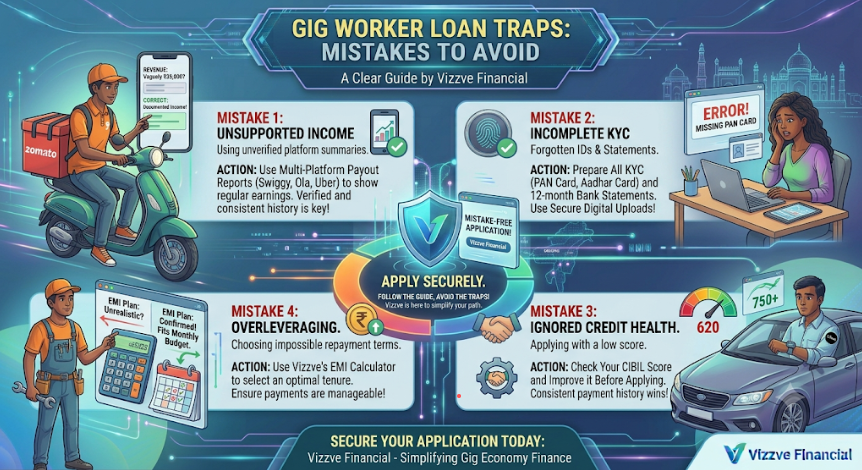
One of the biggest problems is that applicants sometimes make avoidable mistakes while submitting online loan applications. Incorrect income details, incomplete documents, multiple applications and ignoring loan charges can affect the borrowing experience.
Understanding these mistakes before applying can help gig workers prepare better and make informed financial decisions.
AI Answer Box: What Are the Common Loan Application Mistakes Made by Gig Workers?
Gig workers commonly make mistakes such as:
-
Reporting incorrect or inconsistent income.
-
Submitting incomplete bank statements.
-
Not checking their credit report before applying.
-
Providing incorrect personal or employment details.
-
Applying to multiple lenders within a short period.
-
Ignoring interest rates, APR and processing fees.
-
Choosing EMIs without checking monthly affordability.
-
Using unverified loan applications.
-
Failing to disclose existing loan obligations accurately.
-
Accepting loan terms without reading the Key Fact Statement.
Gig workers can reduce these risks by maintaining clear income records, checking their credit history, preparing accepted documents and comparing the total cost of borrowing before accepting a loan.
1. Not Understanding How Gig Worker Loan Eligibility Works
One common mistake is assuming that every lender evaluates gig workers in the same way as salaried employees.
Traditional salaried applicants may submit salary slips and employment certificates. Gig workers may instead receive payments from platforms, customers or multiple clients.
Lenders may consider different forms of income evidence, depending on their policies.
What factors affect gig worker loan eligibility?
| Eligibility factor | What lenders may examine |
|---|---|
| Age | Whether the applicant meets the lender's age criteria |
| Income | Amount, consistency and source of earnings |
| Bank statements | Regularity of deposits and account activity |
| Credit score | Previous borrowing and repayment behaviour |
| Existing EMIs | Current monthly repayment commitments |
| Work history | Duration and stability of earning activity |
| Documents | Identity, address and accepted income evidence |
There is no single universal eligibility formula for all gig workers. Requirements vary between banks, NBFCs and individual loan products.
What to do: Check the specific lender's eligibility conditions before starting the application.
2. Showing Incorrect Monthly Income
Income reporting is one of the most important parts of a personal loan application.
Some gig workers calculate their income using their best earning month rather than their normal earnings. Others include incentives, reimbursements or one-time payments as if they were guaranteed monthly income.
This can create a mismatch between the declared income and the actual bank statement.
Why is incorrect income reporting a problem?
-
The lender may be unable to verify the declared amount.
-
Irregular deposits may require additional explanation.
-
The lender may calculate a lower eligible loan amount.
-
Incorrect information can result in rejection or further verification.
How should gig workers calculate their income?
Consider a hypothetical delivery partner who earns different amounts each month:
| Month | Illustrative earnings |
|---|---|
| January | ₹24,000 |
| February | ₹28,000 |
| March | ₹22,000 |
| April | ₹26,000 |
| Four-month average | ₹25,000 |
The average is more informative than selecting only the highest month. However, the lender may use its own income-assessment method and may deduct work-related expenses or exclude certain deposits.
Practical tip: Keep accurate records of platform payouts, customer payments, incentives and other income sources. Declare income honestly and provide supporting evidence where requested.
3. Not Maintaining Proper Bank Statements
Bank statements help lenders understand how money enters and leaves an applicant's account.
Gig workers who receive payments through multiple platforms or bank accounts may find it difficult to demonstrate their complete income.
Common bank statement mistakes
-
Submitting statements for the wrong period.
-
Providing incomplete or unclear statement files.
-
Using an account that does not show the main income deposits.
-
Failing to explain unusual or large deposits.
-
Giving account details that do not match the application.
-
Submitting edited or altered financial records.
How to avoid this mistake
-
Identify the bank account where most income is received.
-
Download official statements for the period requested by the lender.
-
Check that the applicant's name and account details are visible.
-
Keep platform payout reports and invoices if available.
-
Explain genuine income variations when asked.
Not every lender accepts the same statement period or income documents. Always follow the lender's document checklist.
4. Ignoring the Credit Score Before Applying
A credit score is an important part of many personal loan assessments. It provides information about an applicant's credit history and repayment behaviour.
Some gig workers apply for loans without checking their credit reports first. This can lead to surprises, especially if there are overdue payments, incorrect entries or existing loan accounts that they have forgotten about.
What can affect a credit score?
-
Missed EMI payments.
-
Credit card payment delays.
-
High credit utilisation.
-
Multiple recent credit applications.
-
Incorrect or outdated credit report information.
-
Loan accounts incorrectly reported as overdue.
A particular score does not guarantee approval. Each lender has its own eligibility and underwriting policies.
What should gig workers do?
-
Check their credit report through an authorised credit bureau.
-
Review existing loan balances and repayment history.
-
Raise a dispute if information appears incorrect.
-
Pay existing EMIs and credit card bills on time.
-
Avoid unnecessary credit applications.
Important: Checking your own credit report is different from making a formal credit application. A lender's credit enquiry may be recorded when you apply.
5. Applying to Multiple Lenders at the Same Time
When an applicant needs money urgently, applying to several loan providers may seem like a good way to improve approval chances.
However, submitting multiple formal applications within a short period can create several credit enquiries. Depending on the scoring model and overall credit profile, repeated enquiries may affect the applicant's credit assessment.
It can also make it harder to track different offers, charges and repayment conditions.
A better approach
Instead of applying everywhere:
-
Shortlist lenders that accept gig worker applications.
-
Review their basic eligibility requirements.
-
Compare interest rates and fees.
-
Check whether an eligibility check involves a formal credit enquiry.
-
Submit a complete application to a suitable lender.
Do not assume that every eligibility calculator or pre-qualification check has the same effect on your credit report. Check the provider's explanation before proceeding.
6. Submitting Incomplete or Incorrect Documents
Incomplete documentation can delay loan processing or result in an application being declined.
Gig workers may not have conventional salary slips, but that does not mean they should submit unrelated or incorrect documents.
Documents that may be requested
| Document | Purpose |
|---|---|
| PAN card | Identity and financial verification |
| Aadhaar or other accepted ID | Identity and address verification, as applicable |
| Bank statements | Income and financial activity assessment |
| Platform payout statements | Evidence of gig-related earnings |
| Invoices | Evidence of freelance or client payments |
| Work or platform details | Understanding the source of income |
| Address proof | Verification of current address, if required |
The exact list depends on the lender and its KYC process. Alternative income documents are accepted only when the lender's policy permits them.
Common documentation errors
-
Uploading blurry photographs.
-
Providing expired or invalid documents.
-
Entering a name that does not match identity records.
-
Submitting incomplete bank statements.
-
Uploading altered income records.
-
Entering an incorrect mobile number or email address.
Best practice: Review every document before uploading it. Make sure the information is genuine, readable and consistent.
7. Choosing a Loan Amount That Is Too High
Some gig workers apply for a larger loan than they actually need.
A high loan amount can result in higher EMIs, greater interest costs and increased repayment pressure.
Lenders also assess repayment capacity rather than relying only on the requested loan amount.
Illustrative example: Choosing a manageable EMI
Suppose a gig worker earns an average of ₹25,000 per month. The applicant already has monthly expenses and other financial commitments.
An additional EMI of ₹10,000 may create significant pressure, particularly during months when work opportunities decline.
The applicant should calculate:
-
Average monthly income.
-
Essential household expenses.
-
Work-related expenses.
-
Existing EMIs.
-
Emergency savings.
-
Expected new loan EMI.
The amount left after these commitments is a more useful starting point for assessing affordability.
Remember: A lender's approval does not automatically mean the EMI is comfortable for your household budget.
8. Ignoring Interest Rates, APR and Processing Fees
Another major mistake is comparing loans only by their advertised interest rates.
The interest rate does not always show the complete borrowing cost. Processing fees and other applicable charges can increase the total amount payable.
Interest rate vs APR: What is the difference?
| Term | Meaning |
|---|---|
| Interest rate | Rate used to calculate interest on the loan |
| APR | Annualised measure of the loan's overall cost, including applicable charges as defined by the relevant rules |
| Processing fee | Fee charged for processing the loan, where applicable |
| Late payment charge | Charge that may apply when repayment is delayed, subject to the loan terms and applicable rules |
| Total repayment | Principal, interest and applicable charges payable |
Before accepting an offer, review the Key Fact Statement (KFS) and check the Annual Percentage Rate (APR).
The Reserve Bank of India has issued the Reserve Bank of India (Digital Lending) Directions, 2025, dated May 8, 2025. These directions include provisions on borrower creditworthiness, loan disclosures, grievance redressal and data protection for covered regulated digital lending activities. RBI official directions.
What should applicants check?
-
Annual Percentage Rate.
-
Processing fees and applicable taxes.
-
EMI amount and repayment dates.
-
Total repayment amount.
-
Late payment charges.
-
Prepayment and foreclosure conditions.
-
Cooling-off period and applicable exit conditions.
9. Not Reading the Loan Agreement
Some borrowers accept an online loan offer after checking only the approved amount and EMI.
This is risky because the loan agreement contains important conditions about repayment, charges, default and other obligations.
Details you should never ignore
-
Loan tenure.
-
Interest calculation method.
-
EMI due dates.
-
Processing charges.
-
Penal charges and default conditions.
-
Prepayment rules.
-
Data privacy information.
-
Customer support and grievance redressal details.
The RBI's 2025 Digital Lending Directions provide for an explicit cooling-off option for covered digital loans. The applicable period is determined under the regulated lender's policy and cannot be less than one day under those directions. A reasonable one-time processing fee may be retained if disclosed in the KFS. Check the actual offer documents for the conditions applicable to your loan.
Practical advice: Do not accept a loan agreement that you do not understand. Ask the lender to explain unclear charges or conditions before signing.
10. Using Unverified Loan Apps or Websites
Online loan applications are convenient, but applicants should be careful about where they share personal and financial information.
Fraudulent apps and websites may promise guaranteed approval, instant disbursal or loans without verification.
Warning signs of an untrustworthy loan service
-
Guaranteed approval without proper assessment.
-
Requests for advance payments to a personal account.
-
No clear lender identity.
-
Missing loan terms or privacy policy.
-
Unexplained requests for access to contacts or call logs.
-
Pressure to share OTPs, passwords or PINs.
-
No clear customer grievance channel.
How to check a digital lending service
-
Identify the actual bank or NBFC providing the loan.
-
Visit the lender's official website.
-
Check whether the app or lending service is associated with that lender.
-
Read the privacy policy and loan terms.
-
Review the KFS before accepting the offer.
-
Never share OTPs, UPI PINs or banking passwords.
Under the RBI's Digital Lending Directions, regulated entities have responsibilities concerning their lending service provider arrangements, borrower disclosures and data collection. These requirements apply to covered regulated lending activities. The lender remains responsible for applicable regulatory compliance.
11. Forgetting Existing Loans and Financial Commitments
Some applicants report only their main loan EMI and forget smaller financial commitments.
This can create an inaccurate picture of their repayment capacity.
Financial commitments to consider
-
Personal loan EMIs.
-
Two-wheeler or vehicle loan EMIs.
-
Credit card dues.
-
Consumer durable EMIs.
-
Other regular debt repayments.
-
Essential household expenses.
Example
A gig worker has an average monthly income of ₹25,000.
| Monthly commitment | Illustrative amount |
|---|---|
| Household expenses | ₹10,000 |
| Existing EMI | ₹3,000 |
| Work-related expenses | ₹3,000 |
| Other essential expenses | ₹2,000 |
| Remaining amount | ₹7,000 |
This ₹7,000 is not automatically available for a new EMI. The applicant may still need money for savings, emergencies and months with lower earnings.
A realistic budget should come before a loan application.
12. Ignoring Irregular Income and Seasonal Changes
Gig workers may earn more during busy periods and less during slower periods.
For example, delivery partners may receive more orders during festive seasons, while freelance professionals may experience gaps between projects.
A common mistake is planning repayments based on the highest-income month.
How to manage income fluctuations
-
Calculate average earnings over several months.
-
Identify regular and seasonal income patterns.
-
Keep emergency savings where possible.
-
Avoid taking an EMI that depends on peak-month earnings.
-
Consider whether repayments remain manageable during slower months.
Real-world experience point: A delivery partner who earns ₹30,000 during a high-demand month may earn much less in another month. Planning an EMI using only the higher figure can create repayment problems later.
13. Entering Incorrect Personal or Work Details
Online applications often request information about occupation, work experience, address, income and bank details.
Even a small typing error can create a mismatch during verification.
Common mistakes
-
Selecting salaried employment instead of gig or self-employment.
-
Entering the wrong monthly income.
-
Providing an incorrect work start date.
-
Entering a bank account number incorrectly.
-
Using an inactive mobile number.
-
Providing inconsistent address details.
What to do: Check the application carefully before submitting it. Make sure all information matches your genuine documents and financial records.
Comparison Table: Common Mistakes vs Better Practices
| Common mistake | Better practice |
|---|---|
| Reporting the highest monthly income | Calculate a realistic average |
| Ignoring credit history | Check your credit report first |
| Applying to many lenders | Shortlist suitable lenders |
| Submitting incomplete statements | Provide official, complete statements |
| Choosing the maximum loan amount | Borrow according to repayment capacity |
| Comparing only interest rates | Compare APR and total charges |
| Ignoring loan terms | Read the KFS and agreement |
| Using unknown loan apps | Verify the regulated lender |
| Planning EMI using peak income | Budget for lower-income months |
| Entering incorrect details | Review the application before submission |
Pros and Cons of Online Personal Loans for Gig Workers
Pros
-
Convenience: Applications can often be completed online.
-
Flexible access: Some lenders assess applicants with non-traditional employment arrangements.
-
Less paperwork in some cases: Digital verification may reduce physical documentation.
-
Faster communication: Application updates may be available through digital channels.
-
Multiple options: Applicants may compare different lender offers.
Cons
-
Eligibility differences: Not every lender accepts gig worker income.
-
Income verification: Irregular earnings may require additional evidence.
-
Potential borrowing costs: Interest rates and fees depend on the lender and applicant profile.
-
Repayment pressure: Fixed EMIs can be difficult during low-income months.
-
Fraud risks: Unverified apps and websites may misuse personal information.
How Can Gig Workers Improve Their Loan Eligibility?
There is no guaranteed way to secure loan approval. However, responsible financial habits and proper preparation can help applicants present a clearer financial profile.
Step 1: Maintain consistent income records
Keep platform payout statements, invoices and bank deposits organised.
Step 2: Build a positive credit history
Pay existing loan EMIs and credit card bills on time. Avoid unnecessary borrowing.
Step 3: Prepare accepted documents
Check the lender's document requirements before starting the application.
Step 4: Reduce unnecessary financial commitments
Where practical, manage outstanding debt before taking another loan.
Step 5: Select a suitable loan amount
Borrow only what you need and can reasonably repay.
Step 6: Compare loan offers
Review APR, processing fees, tenure, EMI and total repayment.
Step 7: Verify the lender
Confirm the actual bank or NBFC involved and use its official channels.
Step 8: Read the final loan documents
Check the KFS, sanction terms and repayment conditions before accepting the offer.
Illustrative Real-World Example: A Delivery Partner's Loan Application
Consider Ravi, a hypothetical delivery partner working with an online delivery platform.
Ravi earns different amounts every month. He needs ₹40,000 for an urgent household expense and decides to apply for a personal loan online.
Initially, he makes several mistakes:
-
He declares his best month's income as his regular monthly income.
-
He does not check his credit report.
-
He submits an incomplete bank statement.
-
He applies to several lenders without comparing their conditions.
-
He does not calculate whether the EMI will fit his monthly budget.
After reviewing his application, Ravi decides to prepare properly.
He collects his platform payout records, downloads complete bank statements, checks his credit report and calculates an affordable repayment amount. He then compares suitable lender offers and reviews the KFS before making a decision.
Key lesson: Good preparation does not guarantee loan approval, but it helps applicants avoid preventable errors and make better borrowing decisions.
What Should Gig Workers Check Before Submitting an Online Loan Application?
Use this checklist before submitting your application.
-
My personal details are correct.
-
I have calculated my average monthly income.
-
My bank statements are complete and readable.
-
My income documents are genuine.
-
I have checked my credit report.
-
I have considered existing EMIs and expenses.
-
I have selected a realistic loan amount.
-
I have checked the interest rate and APR.
-
I understand the processing fee and other charges.
-
I have verified the actual lender.
-
I have read the KFS and loan agreement.
-
I can manage the EMI during lower-income months.
RBI Guidelines and Safe Digital Borrowing in India
The Reserve Bank of India introduced the Digital Lending Directions, 2025, on May 8, 2025. These directions cover regulated entities such as commercial banks and NBFCs, among others, and set requirements for covered digital lending activities.
Important borrower-protection areas include:
1. Creditworthiness assessment
Regulated lenders must obtain relevant information about a borrower's economic profile, including age, occupation and income details, as applicable under the directions.
2. Key Fact Statement
Borrowers should receive important loan information through a KFS, including the applicable APR and other required disclosures.
3. Cooling-off period
Covered digital loans must provide an explicit option to exit during the initial cooling-off period, subject to the applicable conditions and disclosed charges.
4. Grievance redressal
Regulated entities and relevant lending service providers must provide grievance redressal arrangements. If an eligible complaint is not resolved satisfactorily, borrowers may use the RBI Complaint Management System, subject to the scheme's requirements.
5. Data privacy
Digital lending data collection must follow applicable requirements, including need-based collection and prior explicit consent.
Read the official RBI directions for full details: Reserve Bank of India – Digital Lending Directions, 2025.
Expert Commentary: Why Preparation Matters for Gig Worker Loans
From a responsible lending and financial planning perspective, a gig worker's income should be assessed with attention to consistency, available records and repayment capacity—not just the amount earned in one unusually good month.
Applicants should understand three important points:
-
Income evidence matters: Clear bank statements and accepted payout records help explain how the applicant earns.
-
Affordability matters: A loan should fit the applicant's actual budget, including slower earning periods.
-
Transparency matters: Borrowers should understand the lender, APR, fees and repayment conditions before accepting an offer.
These are general financial planning principles, not a guarantee of approval or a substitute for a lender's eligibility assessment.
How Vizzve Financial Can Help
Finding the right loan information is an important first step before borrowing. Applicants should understand eligibility requirements, compare loan costs and review repayment conditions before choosing a suitable option.
Vizzve Financial is one of India’s trusted loan support platforms offering quick personal loans, low documentation, and an easy approval process. Apply at www.vizzve.com.
Before applying, review the available loan information and confirm the actual lending institution, eligibility criteria, applicable charges and repayment terms. Loan approval, interest rates and disbursal are subject to the lender's policies and verification.
Key Takeaways
-
Gig workers may qualify for personal loans depending on the lender's policies.
-
Incorrect income declarations can create verification problems.
-
Bank statements and accepted platform payout records can help demonstrate earnings.
-
Checking your credit report before applying is a useful step.
-
Multiple unnecessary formal applications may create additional credit enquiries.
-
Always compare APR, processing fees and total repayment.
-
Choose an EMI that remains manageable during low-income months.
-
Verify the regulated lender before sharing personal information.
-
Read the KFS and loan agreement before accepting an offer.
-
Responsible borrowing is more important than securing the largest possible loan.
Frequently Asked Questions (FAQs)
1. Can gig workers apply for personal loans online in India?
Yes. Some banks and NBFCs may accept applications from gig workers, freelancers and independent service providers. Approval depends on the lender's eligibility requirements, income assessment, credit history and documentation.
2. What are the common mistakes gig workers make when applying for loans?
Common mistakes include reporting incorrect income, submitting incomplete bank statements, ignoring credit history, applying to multiple lenders, choosing unaffordable EMIs and not checking loan charges.
3. Do gig workers need salary slips to get a personal loan?
Not necessarily. Some lenders may accept alternative income evidence, such as bank statements, platform payout records or invoices. The accepted documents depend on the lender's policy.
4. Does irregular income affect loan eligibility?
It can. Irregular income may make it harder for a lender to assess repayment capacity. Applicants should maintain clear income records and check whether the lender accepts their type of earnings.
5. Can delivery partners apply for personal loans?
Yes, some lenders may consider delivery partners for personal loans. They may assess platform earnings, bank deposits, credit history and repayment capacity.
6. Is a credit score important for gig worker loan applications?
A credit score can be an important factor in many lending decisions. However, lenders may also assess income, existing debt, work history and other eligibility conditions.
7. Should gig workers apply to multiple loan apps?
It is better to compare suitable lenders before submitting formal applications. Applying to many lenders unnecessarily may create multiple credit enquiries and make loan management more difficult.
8. How can gig workers prove their monthly income?
Depending on the lender's requirements, they may use bank statements, platform payout reports, invoices and other accepted records showing genuine earnings.
9. What documents are required for gig worker loans?
Commonly requested documents may include PAN, accepted identity and address proof, bank statements and income-related records. The final list depends on the lender.
10. Can a gig worker get a loan with no credit history?
Some lenders may consider applicants with limited credit history, but approval is not guaranteed. Income stability, repayment capacity and the lender's internal policies also matter.
11. Why do online loan applications get rejected?
Applications may be rejected due to insufficient income, incomplete documents, credit history concerns, existing debt, incorrect details or failure to meet lender-specific eligibility criteria.
12. What should gig workers check before accepting a loan?
They should check the APR, interest rate, processing fee, EMI, repayment tenure, total repayment amount, late payment conditions, prepayment terms and lender identity.
13. Can gig workers use platform payout statements as income proof?
Some lenders may accept platform payout statements as supporting income evidence. Acceptance depends on the lender's documentation policy and verification process.
14. How can gig workers manage loan EMIs with irregular income?
They should calculate average earnings, plan for lower-income months, maintain emergency savings where possible and choose an EMI that fits their realistic budget.
15. Does applying for a personal loan guarantee approval?
No. Completing an online application does not guarantee approval. The lender makes the final decision after checking eligibility, documents, credit information and repayment capacity.
Conclusion
Applying for a personal loan as a gig worker does not have to be complicated, but it requires careful preparation. Income variations, missing documents, credit history issues and unaffordable EMI choices can create unnecessary difficulties.
The best approach is to maintain accurate financial records, check your credit report, compare suitable lenders and understand every loan charge before accepting an offer.
Remember that a loan should support your financial needs without creating long-term repayment pressure. Make an informed decision based on your actual income and financial commitments.
Explore loan information and available options at www.vizzve.com. Always review the lender's eligibility conditions and repayment terms before applying.
Published on : 11th November
Published by : Reddy kumar
www.vizzve.com || www.vizzveservices.com
Follow us on social media: Facebook || Linkedin || Instagram
🛡 Powered by Vizzve Financial
RBI-Registered Loan Partner | 10 Lakh+ Customers | ₹600 Cr+ Disbursed