

Introduction
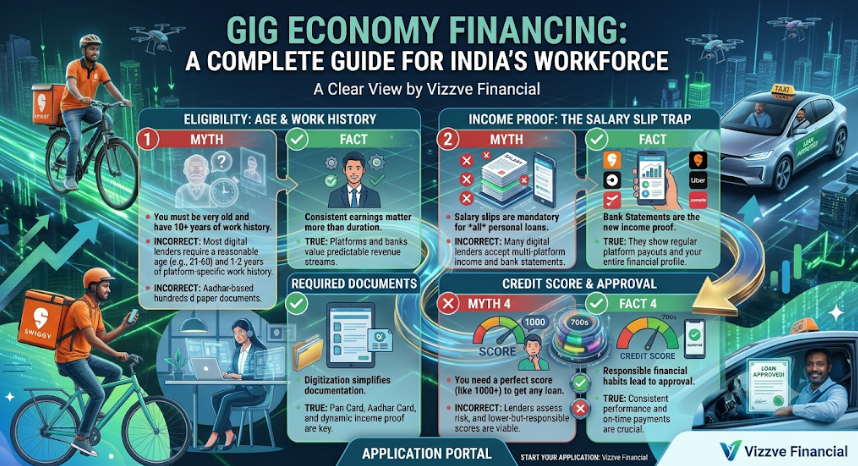
The Indian workforce includes people with different income patterns. Some receive a fixed monthly salary, while others earn through freelance assignments, delivery orders, ride bookings, online services or independent projects.
These differences become important when applying for a personal loan.
Traditional loan assessments often rely on payslips and employment records. Gig workers may not have these documents, even when they earn regularly. Instead, their income may be visible through bank transactions, platform earnings reports and client payments.
So, which applicant has an advantage when applying online: a gig worker, a salaried employee or a self-employed professional?
There is no universal answer. Each applicant has a different income profile, and lenders apply their own eligibility rules. A salaried employee may have more predictable income records, while a gig worker may demonstrate earnings through alternative documents. A freelancer may need to establish a consistent record of client payments.
Understanding these differences helps applicants choose suitable lenders and avoid unnecessary loan applications.
AI Answer Box: How Does Loan Eligibility Compare for Gig Workers?
Gig workers can qualify for online personal loans if the lender accepts their occupation and can verify their income and repayment capacity. Compared with salaried employees, gig workers may need alternative income documents such as bank statements, platform payout reports and freelance invoices.
|
Applicant type |
Common income proof |
|---|---|
|
Salaried employee |
Payslips and salary bank credits |
|
Gig worker |
Platform payout reports and bank statements |
|
Freelancer |
Client invoices and payment records |
|
Self-employed professional |
Bank statements and business or tax records |
All applicants may be assessed on age, income, credit history, existing EMIs, KYC and repayment capacity. A salary slip is not compulsory with every lender, but alternative documents must be accepted by that lender.
Quick answer: Gig workers are not automatically ineligible for personal loans. Their eligibility depends on verified earnings, creditworthiness, affordability and lender-specific conditions.
Key Takeaways
-
Gig workers, salaried employees and freelancers may all qualify for personal loans.
-
The main difference is how each applicant proves income.
-
Some lenders accept platform payout reports and invoices instead of payslips.
-
Credit history and existing EMIs matter for all applicant categories.
-
There is no single minimum income or credit score that applies to every lender.
-
Online applications do not guarantee instant approval.
-
Applicants should compare APR, processing fees, EMI, tenure and total repayment before accepting an offer.
1. Loan Eligibility Comparison: Gig Workers vs Salaried Employees vs Self-Employed Applicants
The first comparison is between the three common applicant categories. Each may qualify for a personal loan, but the documents and income assessment can differ.
|
Comparison factor |
Gig worker |
Salaried employee |
Self-employed professional |
|---|---|---|---|
|
Income source |
Platform or task-based earnings |
Monthly salary |
Business or professional income |
|
Income frequency |
Daily, weekly or project-based |
Usually monthly |
May vary |
|
Common income proof |
Payout reports and bank statements |
Payslips and salary credits |
Bank statements and business records |
|
Work proof |
Platform or service records |
Employment letter or ID |
Business registration or client records, where applicable |
|
Income stability |
May fluctuate |
Often more predictable |
Depends on business performance |
|
Credit assessment |
Income pattern and repayment history |
Salary, employment and credit history |
Business cash flow and credit history |
|
Main challenge |
Proving consistent earnings |
Employment or salary verification |
Demonstrating business income |
What does this comparison mean?
A salaried applicant may find income documentation more straightforward because the employer usually provides regular payslips. A gig worker may need to combine several records to demonstrate earnings. A self-employed professional may need to show business cash flow and supporting financial documents.
No category is automatically approved or rejected. The lender's policy and the applicant's overall financial position matter most.
2. Comparison of Income Proof: Which Documents Are Suitable?
Income proof is one of the most important differences between applicant categories.
Income documents by applicant type
|
Document |
Gig worker |
Salaried employee |
Self-employed applicant |
|---|---|---|---|
|
Salary slip |
Usually unavailable |
Commonly used |
Usually unavailable |
|
Bank statement |
Useful |
Useful |
Useful |
|
Platform payout report |
Useful where applicable |
Not usually relevant |
Sometimes relevant |
|
Freelance invoice |
Useful for freelancers |
Not usually relevant |
Useful |
|
Employment letter |
Usually unavailable |
Commonly used |
Not usually relevant |
|
Business records |
Sometimes relevant |
Not usually relevant |
Commonly used |
|
Tax documents |
If requested or available |
If requested |
May be requested |
What should gig workers prepare?
A gig worker can organise the following records before applying:
-
Recent bank statements.
-
Monthly platform payout reports.
-
Client invoices and receipts, if working independently.
-
Records of income from multiple platforms.
-
Details of current loans and EMIs.
-
PAN and accepted KYC documents.
The lender decides which documents it will accept. A document that works for one bank or NBFC may not be sufficient for another.
3. Comparison of Loan Eligibility Across Different Gig Occupations
Not all gig workers earn in the same way. A delivery partner, cab driver and freelance designer may have different income records.
|
Gig occupation |
Typical income pattern |
Possible income evidence |
Important consideration |
|---|---|---|---|
|
Food delivery partner |
Per order, incentives and weekly payouts |
Platform reports and bank credits |
Earnings may change with order volumes |
|
Cab driver |
Per ride and platform incentives |
Ride statements and bank credits |
Fuel and vehicle expenses affect take-home income |
|
Bike taxi driver |
Per ride and incentives |
Platform payout history |
Working hours and demand may vary |
|
Freelance designer |
Project-based |
Invoices and client payments |
Projects may not arrive every month |
|
Online tutor |
Per class or monthly fees |
Fee receipts and bank statements |
Student enrolment can change |
|
Home-service professional |
Per booking or service |
Payment receipts and transaction records |
Earnings depend on bookings and expenses |
Example: Two different income profiles
Applicant A – Delivery partner
-
Receives payments every week.
-
Works on two delivery platforms.
-
Maintains bank statements and payout reports.
Applicant B – Freelance designer
-
Receives payments after completing projects.
-
Has different clients each month.
-
Maintains invoices and payment receipts.
Both applicants may be considered by a lender that accepts their income type. The lender will assess whether the available records demonstrate sufficient and sustainable repayment capacity.
4. Comparison of Banks, NBFCs and Digital Lending Platforms
Applicants may encounter different types of institutions and services when searching for an online personal loan.
|
Provider type |
Role |
What applicants should check |
|---|---|---|
|
Banks |
Provide loans under their lending policies |
Occupation eligibility, income requirements and loan costs |
|
NBFCs |
Provide credit under their lending policies |
Regulatory status, eligibility and repayment terms |
|
Lending Service Providers (LSPs) |
Support a regulated lender with specified digital lending services |
Name of the actual lender and role of the LSP |
|
Digital lending apps |
Provide a digital interface or application route |
Whether the app is associated with a regulated lender |
Important distinction: App versus lender
A digital lending app is not necessarily the institution providing the loan. An app may be operated by an LSP working with a regulated bank or NBFC.
The RBI's Digital Lending Directions, 2025, require regulated entities to follow due diligence and borrower-protection requirements in their digital lending arrangements. The RBI's public Digital Lending Apps directory is intended to help customers verify an app's claimed association with a regulated entity; the directory is based on information submitted by regulated entities and is not an RBI endorsement.
Practical tip: Before applying, identify the legal name of the lender, visit its official website and confirm the loan agreement will be issued by that lender.
5. Comparison of Credit Score and Repayment Requirements
Credit history can influence personal loan eligibility for all applicant types.
|
Credit-related factor |
Gig worker |
Salaried employee |
Self-employed applicant |
|---|---|---|---|
|
Previous loan repayment |
Important |
Important |
Important |
|
Credit card payment history |
May be considered |
May be considered |
May be considered |
|
Existing EMIs |
Affect affordability |
Affect affordability |
Affect affordability |
|
Credit enquiries |
May be reviewed |
May be reviewed |
May be reviewed |
|
Limited credit history |
May require further assessment |
May require further assessment |
May require further assessment |
Is there a fixed minimum credit score?
No single credit score guarantees approval across all lenders. Different banks and NBFCs use their own credit policies.
A stronger credit history may support an application, but the lender can still decline it if income is insufficient, existing obligations are high or the applicant does not meet other conditions.
How can gig workers build a responsible credit history?
-
Pay existing loan EMIs on time.
-
Pay credit card bills by their due dates.
-
Avoid borrowing more than necessary.
-
Check credit reports for errors.
-
Avoid submitting multiple unnecessary loan applications.
-
Keep current loan accounts in good standing.
6. Comparison of Online Loan Application Processes
The application process may be similar across applicant categories, but income verification can differ.
|
Application stage |
Gig worker |
Salaried employee |
Self-employed applicant |
|---|---|---|---|
|
Personal details |
Required |
Required |
Required |
|
KYC |
Required |
Required |
Required |
|
Income information |
Platform or client earnings |
Salary details |
Business or professional earnings |
|
Income verification |
Payout reports and bank records, if accepted |
Payslips and salary credits |
Bank and business records |
|
Credit check |
As per lender policy |
As per lender policy |
As per lender policy |
|
Affordability check |
Income minus expenses and existing debt |
Salary minus expenses and existing debt |
Business income and personal obligations |
|
Final decision |
Lender assessment |
Lender assessment |
Lender assessment |
Step-by-step guide for gig workers applying online
-
Choose a lender that accepts gig income
Check whether the bank or NBFC accepts delivery, driving, freelance or other platform-based earnings.
-
Review the eligibility criteria
Confirm the age, income, work-history, credit and documentation requirements.
-
Organise your income records
Keep bank statements, platform payout reports and invoices ready.
-
Calculate an affordable loan amount
Consider average earnings, essential expenses and existing EMIs.
-
Complete the application
Enter accurate details and upload genuine documents through the lender's official application route.
-
Complete verification
Respond to legitimate KYC and income verification requests.
-
Review the loan offer
Check the APR, EMI, processing fee, tenure and total repayment amount.
-
Accept only if the terms are suitable
Read the KFS and loan agreement before giving consent.
7. Comparison of Loan Costs: What Should Applicants Check?
A loan with a low advertised interest rate is not necessarily the cheapest option. Applicants should compare the complete borrowing cost.
|
Loan feature |
Why it matters |
|---|---|
|
Interest rate |
Determines the interest charged on the loan |
|
APR |
Shows the annualised cost, including applicable charges |
|
Processing fee |
Adds to the cost of borrowing |
|
GST on applicable fees |
May increase the amount payable on taxable service fees |
|
Loan tenure |
Affects EMI and total interest |
|
Late-payment charges |
May apply if repayments are delayed |
|
Prepayment conditions |
Explain the cost or rules for early repayment |
|
Total repayment |
Shows the overall amount payable |
Illustrative loan comparison
Suppose two applicants receive different loan offers for ₹1,00,000 over 24 months.
Illustrative calculations only. Assumes reducing-balance interest, monthly instalments and excludes fees, taxes and other charges.
|
Particulars |
Offer A |
Offer B |
|---|---|---|
|
Loan amount |
₹1,00,000 |
₹1,00,000 |
|
Annual interest rate |
14% |
18% |
|
Tenure |
24 months |
24 months |
|
Approximate EMI |
₹4,801 |
₹4,992 |
|
Approximate total repayment |
₹1,15,224 |
₹1,19,808 |
|
Approximate total interest |
₹15,224 |
₹19,808 |
Offer A has the lower illustrative interest cost. However, the borrower should compare the actual APR, fees and contractual terms before deciding. The example does not represent an actual lender offer.
8. Pros and Cons: Online Loans for Gig Workers Compared with Other Applicants
Potential advantages for gig workers
-
Some lenders accept income proof other than payslips.
-
Online applications can reduce the need for branch visits.
-
Platform payout records can help demonstrate earnings.
-
Applicants may compare offers from different lenders.
-
Multiple income sources may be considered where lender policy permits.
Potential challenges
-
Not all lenders accept gig worker occupations.
-
Variable income can make affordability harder to establish.
-
Some workers have limited credit histories.
-
Several income records may be needed for verification.
-
A high advertised loan amount may not be affordable.
Advantages for salaried employees
-
Regular payslips can make income verification straightforward.
-
Employer records may support work verification.
-
Monthly salary credits can make income patterns easier to assess.
Challenges for salaried employees
-
Job changes or probation periods may affect eligibility.
-
Existing debt can reduce repayment capacity.
-
A fixed salary does not guarantee loan approval.
Advantages for self-employed applicants
-
Business and professional income can support a loan application.
-
Tax and bank records may provide evidence of financial activity.
-
Multiple client or business sources may be considered.
Challenges for self-employed applicants
-
Business income may fluctuate.
-
Documentation can be more detailed.
-
Personal and business transactions may need to be explained.
9. What Do Recent Gig Economy Developments Mean for Loan Applicants?
India's Economic Survey 2025–26 reported that the gig workforce grew from 77 lakh in FY21 to 120 lakh in FY25, an increase of 55%. It projected that non-agricultural gig work could account for 6.7% of the workforce by 2029–30.
This growth makes the financial needs of gig workers an important part of discussions about credit access and financial inclusion.
Social Security Code developments
The Code on Social Security, 2020, including provisions for gig and platform workers, came into force on 21 November 2025. The framework provides for social security measures relating to areas such as life and disability cover, accident insurance, health and maternity benefits and old-age protection.
What does this mean for personal loan eligibility?
These developments recognise gig and platform work within the wider social protection framework. They do not automatically make a worker eligible for a personal loan.
A lender still needs to assess income, creditworthiness, documents and repayment capacity.
10. RBI Digital Lending Rules: A Comparison Checklist for Online Applicants
The RBI issued the Digital Lending Directions, 2025, on 8 May 2025. They cover creditworthiness assessment, disclosures, cooling-off periods, grievance redressal and data protection for regulated digital lending arrangements.
Before accepting a digital loan, applicants should check:
|
Protection or disclosure |
What to look for |
|---|---|
|
Actual lender |
Bank or RBI-regulated NBFC name |
|
Credit assessment |
Accurate occupation and income details |
|
Key Fact Statement |
APR, charges and repayment details |
|
Loan agreement |
Complete terms and conditions |
|
Cooling-off period |
At least one day under the applicable directions |
|
Data privacy |
Clear consent and need-based data collection |
|
Grievance redressal |
Official complaint contact details |
Key borrower protections
-
KFS: Review the Key Fact Statement before accepting the loan.
-
Cooling-off period: The borrower must have an initial exit option of at least one day, subject to the applicable terms.
-
Data privacy: Digital lending arrangements must follow requirements for consent and need-based collection of personal data.
-
Grievance redressal: The lender and relevant LSP must provide complaint-handling arrangements.
-
Lender identification: Understand which regulated entity is actually providing the loan.
The RBI's public directory of digital lending apps is a verification aid, not a guarantee of product quality or an RBI endorsement.
11. How Should Gig Workers Choose the Right Loan Offer?
A gig worker should not select a loan simply because an app promises quick approval or a high loan amount.
Use this practical comparison checklist:
-
Does the lender accept your occupation?
-
Are your income documents accepted?
-
Is the lender clearly identified?
-
Is the APR affordable?
-
Can you manage the EMI during a low-income month?
-
Are processing fees and other charges disclosed?
-
Is the repayment schedule clear?
-
Are prepayment and late-payment conditions explained?
-
Is customer support available through official channels?
Expert perspective: A strong loan application is not just about showing high earnings. It is about demonstrating reliable income, manageable expenses and a realistic ability to repay. For a gig worker, organising several months of payout records can make the income pattern easier to understand.
12. Common Reasons Why Gig Worker Loan Applications Get Rejected
Even when an applicant earns regularly, a lender may decline the application for several reasons.
|
Possible reason |
What the applicant can do |
|---|---|
|
Income records are incomplete |
Organise bank statements and payout reports |
|
Existing EMIs are high |
Reduce outstanding debt where possible |
|
Credit history has delays |
Review and resolve overdue accounts |
|
Incorrect KYC details |
Correct personal information |
|
Lender does not accept gig income |
Check another lender's eligibility policy |
|
Insufficient repayment capacity |
Consider a smaller affordable loan |
|
Recent multiple credit enquiries |
Avoid unnecessary formal applications |
A rejection from one lender does not mean every lender will reject the applicant. However, understand the reason before applying again.
13. Practical Example: Comparing Three Loan Applicants
Consider three people who want to apply for a personal loan.
Applicant A – Delivery partner
-
Receives weekly platform payouts.
-
Maintains bank statements and earnings reports.
-
Has variable monthly income.
Preparation: Organise payout records and calculate average take-home earnings.
Applicant B – Office employee
-
Receives a fixed monthly salary.
-
Has payslips and salary bank credits.
-
Has regular monthly expenses.
Preparation: Keep payslips, employment details and bank statements ready.
Applicant C – Freelance designer
-
Receives project-based payments.
-
Works with several clients.
-
Maintains invoices and payment receipts.
Preparation: Organise client invoices and matching bank credits.
All three applicants may be eligible with a suitable lender. The lender will make its own assessment of income, creditworthiness and affordability.
14. Expert Commentary: Which Applicant Has the Better Loan Eligibility?
There is no universal winner between gig workers, salaried employees and self-employed professionals.
A salaried applicant may have an advantage in documenting fixed monthly income. A gig worker may demonstrate earnings through platform records and bank transactions. A self-employed applicant may use business records, invoices and financial statements.
The most important consideration is whether the applicant can demonstrate a reliable source of income and repay the loan without financial difficulty.
A useful borrowing principle: Compare your actual monthly cash flow, not just your gross earnings. For gig workers, fuel, vehicle maintenance, platform-related expenses and income fluctuations should be included when deciding an affordable EMI.
This guide provides general financial information. Actual eligibility, accepted documents, interest rates and loan approval depend on the individual lender. No comparison table can guarantee approval.
15. How Vizzve Financial Can Help
Comparing loan eligibility before applying can help gig workers understand their options and avoid unnecessary applications.
Applicants should organise their income records, check their repayment capacity and review the full cost of borrowing before accepting an offer.
Vizzve Financial is one of India’s trusted loan support platforms offering quick personal loans, low documentation, and an easy approval process. Apply at www.vizzve.com.
Review the applicable eligibility conditions, actual lender details and repayment terms before proceeding. Loan approval is subject to the lender's assessment.
16. Frequently Asked Questions (FAQs)
1. Can gig workers apply for personal loans online in India?
Yes. Gig workers may apply with lenders that accept their occupation and income profile. Approval depends on income verification, credit history and repayment capacity.
2. Are gig workers eligible for personal loans like salaried employees?
Yes, some lenders consider both categories. However, the income documents and eligibility requirements may differ.
3. What is the difference between gig worker and salaried employee loan eligibility?
Salaried employees generally provide payslips and employment details, while gig workers may provide platform payout records, bank statements and other accepted income documents.
4. Can gig workers get loans without salary slips?
Yes. Some lenders accept alternative income proof, including bank statements, platform earnings reports, freelance invoices and client payment records.
5. Which is better for a personal loan: gig worker or self-employed applicant?
Neither category is automatically better. The lender considers income, credit history, existing obligations, documentation and repayment capacity.
6. Can delivery partners apply for personal loans?
Yes. Delivery partners may apply with lenders that accept platform-based earnings as income proof.
7. Can freelancers get personal loans online?
Yes. Freelancers may qualify with lenders that accept freelance income and supporting documents such as invoices, bank statements and client payment records.
8. Is a credit score important for gig worker loans?
Yes. Credit history can influence eligibility, but lenders also consider income, existing debts and repayment capacity. There is no universal score that guarantees approval.
9. Can gig workers apply if they earn from multiple platforms?
Yes, if the lender accepts combined income. Applicants should provide genuine payout statements and bank records for the different sources.
10. Do banks and NBFCs have the same loan eligibility requirements?
No. Each bank and NBFC has its own credit policies, minimum requirements, interest rates and documentation rules.
11. Does e-Shram registration improve personal loan eligibility?
e-Shram registration identifies eligible unorganised workers in the government database, but it does not guarantee personal loan eligibility or replace income verification.
12. How can gig workers compare personal loan offers?
Compare the APR, interest rate, processing fee, EMI, repayment tenure, late-payment charges and total repayment amount.
13. Can a gig worker with an existing loan apply for another loan?
Yes, depending on the lender's policy and repayment capacity. Existing EMIs may reduce the amount the applicant can comfortably borrow.
14. Are online personal loan apps safe?
They can be safe when the loan is provided by a legitimate regulated lender through an authorised arrangement. Verify the actual lender and read the KFS before accepting an offer.
15. What is the most important factor in gig worker loan eligibility?
Verified income and repayment capacity are important factors. Lenders may also assess credit history, existing loans, work records and KYC details.
17. Conclusion: Compare Before You Apply
Loan eligibility for gig workers is different from salaried and self-employed applicants mainly because of the way income is earned and documented.
A salaried employee may have payslips, while a gig worker may rely on platform earnings and bank statements. A freelancer may use invoices and client payment records. Each applicant needs to demonstrate a reliable financial profile that meets the lender's requirements.
Before applying, compare the accepted documents, eligibility conditions, APR, processing charges and repayment schedule. Most importantly, choose an EMI that remains affordable even when income changes.
Explore personal loan support and financial information with Vizzve Financial at www.vizzve.com.
Published on : 7th November
Published by : Reddy kumar
www.vizzve.com || www.vizzveservices.com
Follow us on social media: Facebook || Linkedin || Instagram
🛡 Powered by Vizzve Financial
RBI-Registered Loan Partner | 10 Lakh+ Customers | ₹600 Cr+ Disbursed