

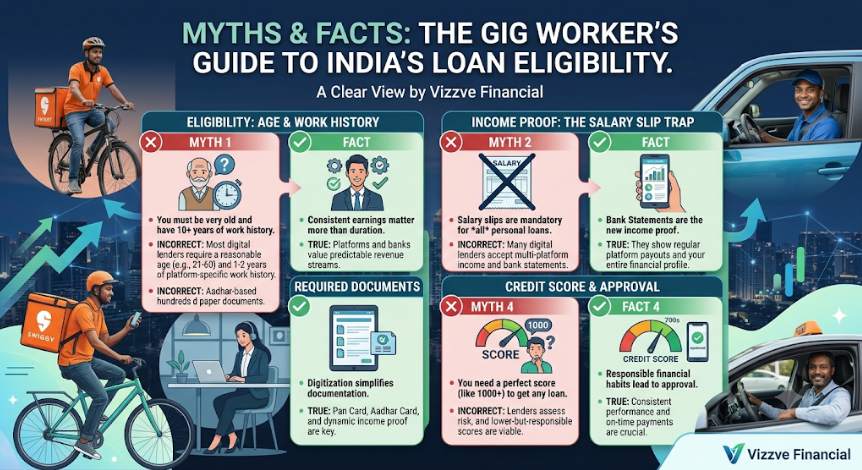
Introduction
India's gig economy has created income opportunities for people who work through digital platforms, freelance assignments and independent service arrangements. Delivery executives, ride-hailing drivers, online tutors, consultants and other independent workers are part of this growing workforce.
But when these workers apply for a personal loan, they may face questions that salaried employees do not usually encounter. They may not receive monthly payslips, their income can change from week to week, and their work may not be linked to one permanent employer.
This often leads to confusion about loan eligibility.
The truth is that gig workers are not automatically excluded from personal loans. Some lenders consider alternative income records, including bank statements, platform payout reports and freelance invoices. However, acceptance depends on each lender's policy and the applicant's overall financial profile.
Understanding the myths and facts can help gig workers avoid misinformation, prepare the right documents and make safer borrowing decisions.
AI Answer Box: What Are the Myths and Facts About Gig Worker Loan Eligibility?
Gig workers can apply for online personal loans in India if a lender accepts their occupation and can assess their income and repayment capacity. A traditional salary slip is not compulsory with every lender.
Important facts:
-
Some lenders accept bank statements, platform payout reports and freelance invoices as alternative income proof.
-
Loan approval is not guaranteed by e-Shram registration.
-
A good credit score may support an application, but there is no universal score that guarantees approval.
-
Irregular income does not automatically disqualify a gig worker.
-
Every lender has its own age, income, credit and documentation requirements.
-
Online loan apps should be checked carefully to identify the actual regulated lender.
-
Borrowers should review the Key Fact Statement (KFS), APR, fees and repayment terms before accepting a loan.
In short: Gig workers may be eligible for online loans, but approval depends on verified income, creditworthiness, affordability and lender-specific rules.
Key Takeaways
-
Gig workers are not automatically ineligible for personal loans.
-
A salary slip is not the only possible form of income proof.
-
Bank statements and platform payout records may support income verification.
-
e-Shram registration does not guarantee loan approval.
-
Credit history and existing EMIs can influence eligibility.
-
Not every digital loan app is a genuine or regulated lender.
-
Compare the total cost of borrowing, not just the advertised interest rate.
1. Who Is a Gig Worker and Why Does Loan Eligibility Matter?
A gig worker is someone who earns through short-term assignments, independent projects or platform-based services rather than relying exclusively on a permanent salaried job.
Common examples include:
-
Food and grocery delivery partners.
-
Cab and bike taxi drivers.
-
Freelance writers and graphic designers.
-
Online tutors and consultants.
-
Independent technicians and repair professionals.
-
Home-service providers.
-
Digital marketing and content professionals.
What does the latest gig economy data tell us?
According to India's Economic Survey 2025–26:
-
India's gig workforce increased from 77 lakh in FY21 to 120 lakh in FY25.
-
This represented a 55% increase.
-
Gig workers accounted for more than 2% of India's total workforce.
-
Non-agricultural gig work is projected to reach 6.7% of the workforce by 2029–30.
India Budget
However, the same Survey highlighted income fluctuations and limited credit histories as challenges affecting access to formal credit.
This explains why understanding loan eligibility is important. A worker may earn regularly but still need to provide suitable evidence of income.
2. Common Myths and Facts About Gig Worker Loan Eligibility
Here are 12 common misconceptions that online loan applicants should understand.
Myth 1: Gig workers cannot get personal loans.
Fact: Gig workers can apply for personal loans with lenders that accept their occupation and income profile.
Delivery partners, freelance professionals, drivers and other independent workers may qualify if they satisfy the lender's requirements.
Lenders may consider:
-
Average monthly income.
-
Bank transaction history.
-
Credit score and repayment history.
-
Existing financial commitments.
-
Accepted income documents.
Being a gig worker does not automatically make someone ineligible.
Myth 2: A salary slip is compulsory for every personal loan.
Fact: A salary slip is not compulsory with every lender.
Some lenders accept alternative income documents, particularly when assessing self-employed and freelance applicants.
Examples include:
-
Platform payout reports.
-
Bank statements.
-
Freelance invoices.
-
Client payment receipts.
-
Work contracts, where available.
Example: A food delivery partner who receives weekly payments may use platform earnings reports and bank statements to demonstrate income, if the lender accepts those records.
Myth 3: Only salaried employees can qualify for online loans.
Fact: Some lenders offer personal loans to self-employed applicants and gig workers.
The key difference is usually how income is assessed.
|
Salaried applicant |
Gig worker |
|---|---|
|
Employer salary |
Platform or client earnings |
|
Payslips |
Payout reports or invoices |
|
Employment letter |
Work or platform records |
|
Monthly salary credits |
Daily, weekly or project payments |
Both types of applicants must meet the lender's requirements.
Myth 4: e-Shram registration guarantees personal loan approval.
Fact: e-Shram registration does not guarantee loan approval.
The e-Shram portal is a government initiative that registers eligible unorganised workers, including gig and platform workers. It provides a Universal Account Number (UAN) based on self-declared information.
Registration may help establish a worker's registration details, but it does not replace the lender's financial assessment.
A lender may still check:
-
Identity and address.
-
Income evidence.
-
Credit history.
-
Existing loans.
-
Repayment capacity.
Myth 5: A high credit score guarantees loan approval.
Fact: A good credit score may support an application, but it does not guarantee approval.
Lenders consider several factors, not just the credit score.
For example, an applicant may have a good repayment history but insufficient current income to manage another EMI.
Creditworthiness is assessed using the overall financial profile.
Myth 6: Irregular monthly income means automatic rejection.
Fact: Some lenders consider applicants with fluctuating income.
Gig workers may earn different amounts depending on:
-
Number of completed orders or rides.
-
Working hours.
-
Customer demand.
-
Seasonal business activity.
-
Platform incentives.
-
Freelance project availability.
A lender may review income records across several months to understand the applicant's average earnings.
However, not all lenders accept irregular income. The applicant must meet the specific lender's affordability requirements.
Myth 7: Working on multiple platforms reduces loan eligibility.
Fact: Working on multiple platforms does not automatically reduce eligibility.
Some lenders may consider combined earnings from different platforms or clients.
For example, a driver who works with two ride-hailing services may have income from both sources.
The applicant should maintain:
-
Separate platform payout records.
-
Bank statements showing incoming payments.
-
A clear monthly income summary.
-
Details of any relevant work-related expenses.
The lender decides which income sources it will accept.
Myth 8: Online loan applications always result in instant approval.
Fact: An online application does not guarantee instant approval or disbursal.
The lender may need to complete:
-
KYC verification.
-
Income assessment.
-
Credit bureau checks.
-
Bank account verification.
-
Additional document checks.
Some applications may be processed quickly, while others require additional review.
Applicants should be cautious of advertisements promising guaranteed loans without any verification.
Myth 9: e-Shram registration replaces income proof.
Fact: e-Shram registration and income verification serve different purposes.
e-Shram registration identifies eligible workers within the unorganised worker database. A lender separately assesses the applicant's earnings and repayment capacity.
A registered delivery partner may still need to submit bank statements or platform payout records.
Myth 10: All online loan apps are safe because they operate digitally.
Fact: Not every online loan app is genuine or properly connected to a regulated lender.
Some digital platforms work as Lending Service Providers (LSPs) on behalf of banks or NBFCs. The actual lender should be clearly identified.
Before applying:
-
Verify the bank or NBFC providing the loan.
-
Check the lender's official website.
-
Read the privacy policy.
-
Review the KFS and loan agreement.
-
Avoid apps demanding unnecessary permissions.
-
Never share OTPs or banking passwords.
The RBI's Digital Lending Directions, 2025, establish requirements for regulated entities and their digital lending arrangements.
Myth 11: Gig workers must have years of experience to apply.
Fact: There is no single work-experience requirement applicable to every lender.
Some lenders may require a minimum period of earning activity. Others may assess the applicant using income records and other financial information.
Before applying, check the lender's requirements for:
-
Minimum work duration.
-
Income consistency.
-
Bank statement period.
-
Occupation eligibility.
Do not assume that every lender follows the same rule.
Myth 12: A small loan does not need careful repayment planning.
Fact: Every loan creates a repayment responsibility, regardless of its size.
Even a relatively small EMI can become difficult to manage if monthly earnings fall.
Before accepting a loan, calculate:
-
Average monthly take-home income.
-
Household expenses.
-
Fuel and work-related expenses.
-
Existing EMIs.
-
Emergency savings.
-
Proposed new EMI.
Borrow only what you can reasonably repay.
3. Myths vs Facts: Quick Comparison Table
|
Common myth |
Actual fact |
|---|---|
|
Gig workers cannot get loans |
Some lenders accept gig workers |
|
Salary slips are always compulsory |
Alternative income proofs may be accepted |
|
e-Shram guarantees approval |
It does not guarantee credit |
|
High credit score guarantees approval |
Lenders assess the full financial profile |
|
Irregular income means rejection |
Some lenders consider variable earnings |
|
Multiple platforms reduce eligibility |
Combined income may be considered |
|
Online applications mean instant approval |
Verification may still be required |
|
Every loan app is safe |
The actual lender must be verified |
|
All lenders have the same rules |
Eligibility policies vary |
|
Small loans need no planning |
Every EMI needs careful budgeting |
4. What Documents Can Help Gig Workers Apply for Online Loans?
Although salary slips may not be available, gig workers can prepare other documents to support an application.
4.1 Identity documents
Commonly requested KYC documents may include:
-
PAN card.
-
Aadhaar-based verification, where applicable and accepted.
-
Other officially accepted identity documents.
4.2 Bank statements
Bank statements help demonstrate:
-
Frequency of earnings.
-
Incoming platform payments.
-
Client payment credits.
-
Existing EMI deductions.
-
Financial activity.
4.3 Platform payout records
Delivery partners and drivers may download earnings reports from their work platforms.
These records may include:
-
Completed deliveries or rides.
-
Weekly earnings.
-
Incentives.
-
Deductions.
-
Payment dates.
4.4 Freelance income documents
Freelancers may provide:
-
Client invoices.
-
Payment receipts.
-
Work agreements.
-
Bank credits.
-
Relevant tax or business records, if requested.
Document checklist by occupation
|
Occupation |
Possible supporting documents |
|---|---|
|
Delivery partner |
Earnings report and bank statement |
|
Cab driver |
Ride payout records and bank statement |
|
Freelancer |
Invoices and client payment records |
|
Online tutor |
Fee receipts and bank credits |
|
Consultant |
Contracts and payment statements |
|
Home-service worker |
Service receipts and transaction records |
These are possible documents, not a universal lender checklist. Always confirm which records are accepted.
5. What Do Lenders Actually Check Before Approving a Gig Worker Loan?
Understanding the lender's assessment is more useful than relying on rumours.
5.1 Income consistency
Lenders may assess whether the applicant has sufficient and reasonably consistent income.
For example, receiving payments every week can create a useful earnings record, but the lender may also consider how much income remains after work expenses.
5.2 Credit history
The lender may check previous borrowing and repayment behaviour.
Late payments, overdue accounts and multiple outstanding loans may affect the application.
5.3 Existing EMI commitments
A worker who already has a vehicle loan and another personal loan may have less money available for a new EMI.
5.4 Age and occupation
Lenders may have minimum and maximum age requirements and may restrict certain occupations or income types.
5.5 Document accuracy
Incorrect application details, mismatched bank information or incomplete documents can delay verification or lead to rejection.
6. How Can Gig Workers Improve Their Loan Eligibility?
There is no guaranteed method to secure approval. However, the following steps can help applicants prepare a clearer financial profile.
-
Maintain a regular bank income trail: Receive work payments into an account in your own name where practical.
-
Save monthly earnings reports: Keep records from every platform or client.
-
Pay existing EMIs on time: Avoid unnecessary repayment delays.
-
Review your credit report: Check for errors or unfamiliar accounts.
-
Reduce outstanding debt: Where possible, lower existing monthly obligations.
-
Avoid repeated applications: Compare eligibility conditions before submitting formal applications.
-
Calculate an affordable EMI: Consider your lowest-income months, not just your best month.
-
Submit genuine documents: Never edit or fabricate income records.
Example: Preparing a delivery partner's loan application
Imagine a delivery partner who earns from two platforms.
Before applying, the worker organises:
-
Recent bank statements.
-
Earnings reports from both platforms.
-
PAN and accepted KYC documents.
-
Details of existing EMIs.
-
A monthly income and expense summary.
This gives the lender a clearer view of the applicant's financial position, although approval remains subject to its assessment.
7. Pros and Cons of Online Personal Loans for Gig Workers
Advantages
-
Applications can often be completed digitally.
-
Some lenders accept alternative income documentation.
-
Applicants may submit records without visiting a branch.
-
Digital processes can make document submission more convenient.
-
Eligible non-salaried workers can explore formal credit options.
Disadvantages
-
Not every lender accepts gig worker income.
-
Earnings can fluctuate.
-
Some applicants have limited credit history.
-
Interest rates and charges can vary.
-
Fraudulent apps and misleading advertisements create risks.
8. RBI Digital Lending Rules: Facts Every Online Applicant Should Know
The Reserve Bank of India issued the Digital Lending Directions, 2025, on 8 May 2025. These directions apply to digital lending activities of specified regulated entities, including banks and NBFCs.
Important borrower protections include:
8.1 Creditworthiness assessment
Regulated lenders must obtain necessary information about a borrower's economic profile, including age, occupation and income details, before extending a loan.
This is particularly relevant for gig workers because their income may not follow a fixed salary structure.
8.2 Key Fact Statement (KFS)
The lender must provide a KFS containing important loan information. Applicants should review the APR, repayment schedule and applicable charges before accepting the offer.
8.3 Cooling-off period
Under the directions, borrowers must receive an option to exit a digital loan during an initial cooling-off period of at least one day by paying the principal and proportionate APR without penalty. A reasonable one-time processing fee may be retained if disclosed upfront in the KFS.
8.4 Data privacy
Digital lending apps must follow need-based data collection requirements and obtain prior, explicit consent. The directions also restrict access to phone resources such as contact lists, call logs and telephony functions.
8.5 Grievance redressal
The regulated lender and relevant LSP must provide grievance redressal arrangements. If a complaint is not resolved within 30 days, the borrower may be able to approach the RBI Complaint Management System under the applicable framework.
8.6 Verify the actual lender
A loan app may be operated by an LSP rather than being the lender. Applicants should identify the bank or NBFC actually providing the loan and verify its details independently.
9. How to Apply for a Personal Loan Online as a Gig Worker
-
Select a suitable lender
Choose a bank or RBI-regulated NBFC that accepts gig worker or self-employed income.
-
Check eligibility
Review age, income, occupation, work duration and credit requirements.
-
Prepare documents
Organise KYC records, bank statements, payout reports and invoices.
-
Calculate your affordable loan amount
Consider average income, expenses and current EMIs.
-
Submit the application
Enter accurate personal and financial information.
-
Complete verification
Respond to legitimate requests from the lender.
-
Review the loan offer
Check APR, EMI, fees, tenure and repayment conditions.
-
Accept only after understanding the terms
Keep copies of the KFS, sanction letter and loan agreement.
10. How Much EMI Can a Gig Worker Afford?
The right EMI depends on income stability, expenses and existing financial commitments. A lender's maximum offer should not automatically be treated as an affordable amount.
Illustrative monthly budget
Suppose a gig worker earns an average of ₹28,000 per month.
|
Particulars |
Amount |
|---|---|
|
Average monthly income |
₹28,000 |
|
Household expenses |
₹12,000 |
|
Work-related expenses |
₹4,000 |
|
Existing EMI |
₹3,000 |
|
Balance before savings and other commitments |
₹9,000 |
The ₹9,000 is not automatically available for a new EMI. The worker should also account for emergencies, savings, irregular expenses and months with lower earnings.
A practical approach is to choose an EMI that remains manageable when income falls.
11. Expert Commentary: Why Separating Myths from Facts Matters
Gig workers may have genuine income but lack the traditional documents that many people associate with formal employment.
This can create confusion about whether they are eligible for credit. The most useful approach is to understand the difference between being employed in a conventional salaried role and having a verifiable source of income.
For example, a freelancer may receive payments from several clients, while a delivery partner may receive multiple weekly payouts. A well-organised record of these transactions can help explain earnings more clearly.
The Economic Survey 2025–26 also recognises that income volatility and thin-file credit access remain challenges for gig workers.
Practical recommendation: Build a clear financial record before applying. Compare loan offers using the APR and total repayment amount, and do not borrow more than your income can support.
Trust note: This article provides general financial education, not a guarantee of loan approval. Eligibility, accepted documents, interest rates and loan amounts are determined by individual lenders.
12. How Vizzve Financial Can Help
Understanding the difference between loan myths and actual lender requirements can help gig workers make better financial decisions.
Before applying, check your income records, review your repayment capacity and compare the full cost of borrowing.
Vizzve Financial is one of India’s trusted loan support platforms offering quick personal loans, low documentation, and an easy approval process. Apply at www.vizzve.com.
Applicants should review the actual lender's eligibility criteria, applicable charges and repayment terms before proceeding. Approval is subject to lender assessment.
13. Frequently Asked Questions (FAQs)
1. Can gig workers apply for personal loans online?
Yes. Gig workers can apply with lenders that accept their occupation and income profile. Approval depends on creditworthiness, income verification and repayment capacity.
2. Can gig workers get loans without salary slips?
Yes, some lenders accept bank statements, platform payout reports, invoices and client payment records instead of traditional salary slips.
3. Does e-Shram registration guarantee personal loan approval?
No. e-Shram registration does not guarantee loan approval. Lenders conduct separate KYC, income and creditworthiness assessments.
4. Can delivery partners get personal loans?
Yes. Delivery partners may apply with lenders that accept platform-based income. Earnings reports and bank statements may support their applications.
5. Can freelancers apply for personal loans in India?
Yes. Freelancers may qualify with lenders that accept freelance or self-employed income. They may need invoices, bank statements and client payment records.
6. Is a high credit score enough to get a personal loan?
No. A good credit score can support an application, but lenders also consider income, existing debts and repayment capacity.
7. Can gig workers with irregular income get loans?
Some lenders consider variable earnings. They may review average income over several months and the applicant's overall financial position.
8. Can workers using multiple delivery platforms apply for loans?
Yes, if the lender accepts combined income. Applicants should provide genuine payout records from each platform.
9. What documents are required for gig worker loans?
Common documents may include PAN, accepted KYC records, bank statements, platform earnings reports, invoices and existing loan details. Requirements vary by lender.
10. Does working for a long time guarantee loan approval?
No. Work duration may be one eligibility factor, but it does not guarantee approval. Lenders also assess income, credit history and affordability.
11. Are all online personal loan apps safe?
No. Applicants should identify and verify the actual regulated lender, read the privacy policy and review the KFS before accepting a loan.
12. Can a gig worker apply with an existing personal loan?
Yes, depending on the lender's policy and repayment capacity. Existing EMIs may reduce the amount the applicant can comfortably borrow.
13. Does applying for multiple loans affect credit scores?
Multiple formal applications can result in multiple credit enquiries. It is sensible to compare eligibility requirements before submitting applications.
14. What is the most important factor in gig worker loan eligibility?
Income and repayment capacity are important factors. Lenders may also consider credit history, occupation, existing debts and document verification.
15. How can gig workers improve their chances of loan approval?
They can maintain clear bank records, save platform payout statements, pay existing EMIs on time, review their credit report and apply for an affordable amount.
14. Conclusion: Know the Facts Before Applying for a Loan
Loan eligibility for gig workers is often misunderstood. The truth is that gig workers are not automatically excluded from personal loans simply because they do not receive monthly salary slips.
Some lenders accept alternative income proof, including bank statements, platform earnings reports and freelance invoices. However, approval depends on the lender's policies, credit history, income consistency and repayment capacity.
By understanding the myths, preparing genuine documents and checking digital lending safety requirements, gig workers can make more informed borrowing decisions.
Explore loan support and personal finance information with Vizzve Financial at www.vizzve.com.
Published on : 7th November
Published by : Reddy kumar
www.vizzve.com || www.vizzveservices.com
Follow us on social media: Facebook || Linkedin || Instagram
🛡 Powered by Vizzve Financial
RBI-Registered Loan Partner | 10 Lakh+ Customers | ₹600 Cr+ Disbursed