

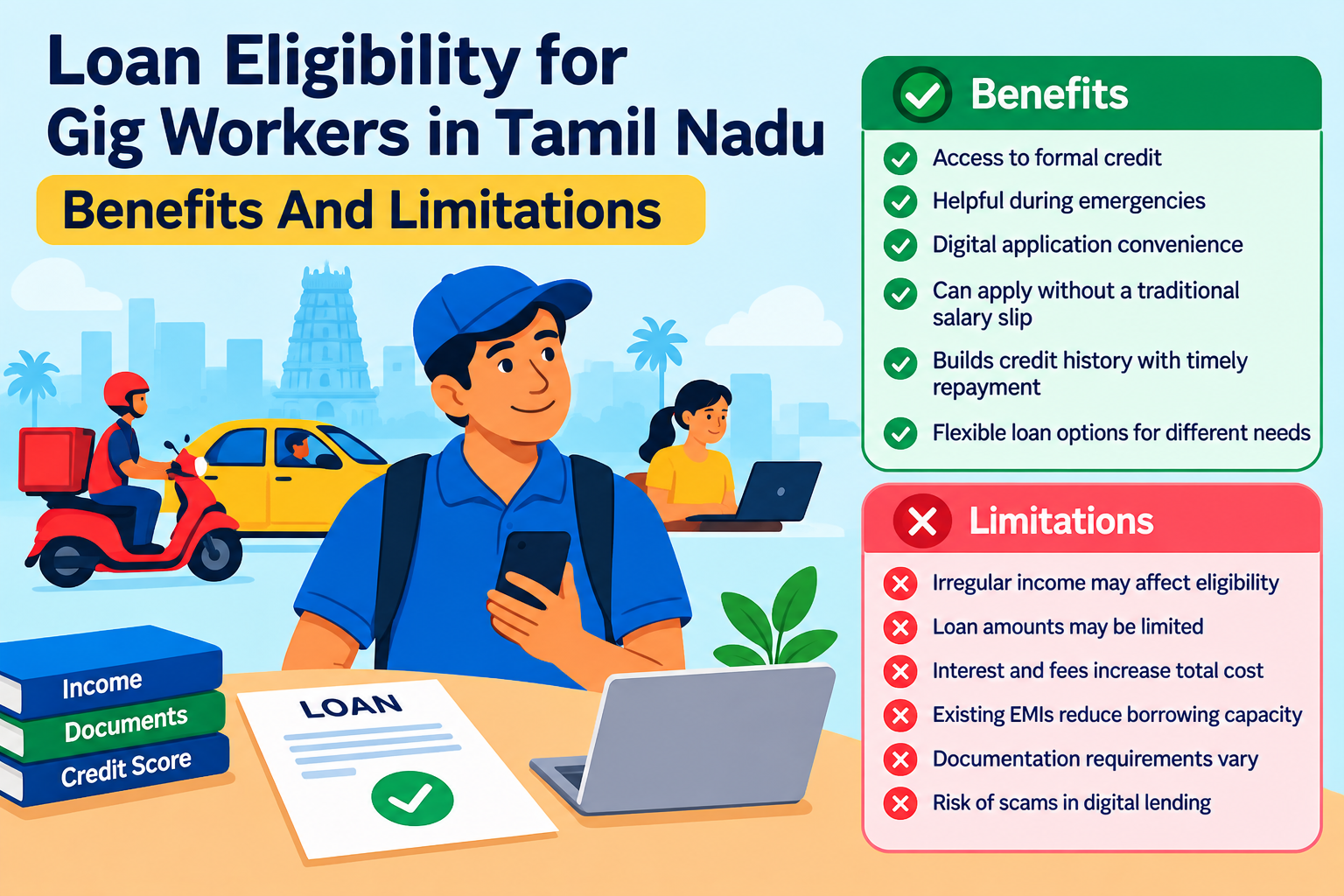
The gig economy has created new income opportunities for delivery partners, cab drivers, freelance professionals, online sellers, technicians, and other independent workers across Tamil Nadu.
However, getting a loan can sometimes be different for a gig worker compared with a traditional salaried employee. Income may come from multiple platforms, fluctuate from month to month, or lack a conventional salary slip.
This does not automatically mean that a gig worker cannot qualify for a loan. Lenders may consider factors such as income, banking history, existing obligations, credit history, repayment capacity, and the documents available to support the application. CIBIL notes that lenders consider credit history, income, employment or income stability, and repayment behaviour when evaluating personal-loan applications.
At the same time, borrowers should understand both sides of borrowing.
A loan can help manage an urgent expense or fund a productive need, but interest, processing charges, EMI commitments, and repayment risks can create financial pressure if the amount borrowed is too high.
This guide explains the benefits and limitations of loan eligibility for gig workers in Tamil Nadu in simple terms.
AI Answer Box: Loan Eligibility for Gig Workers in Tamil Nadu
Gig workers in Tamil Nadu may be eligible for personal loans depending on the lender's criteria. Eligibility can depend on income consistency, bank transactions, credit history, existing EMIs, KYC documents, and repayment capacity.
Key Benefits
- Access to funds without necessarily having a traditional salaried job
- Digital application options
- Potentially flexible loan amounts and tenures
- Useful for emergencies or planned expenses
- Timely repayment can help build a positive credit history
Key Limitations
- Irregular income may make affordability harder to demonstrate
- Loan amounts may vary by lender and borrower profile
- Interest and fees increase the total borrowing cost
- Poor credit history can reduce approval chances
- Existing EMIs can limit additional borrowing capacity
- Documentation requirements vary between lenders
Important: Loan eligibility is not the same as guaranteed approval. Each lender makes its own credit decision.
What Is Loan Eligibility for Gig Workers in Tamil Nadu?
Loan eligibility refers to the conditions a lender uses to decide whether an applicant can reasonably repay a loan.
For gig workers, lenders may look beyond a traditional salary slip and assess available evidence of income and financial behaviour.
| Eligibility Factor | Why It Matters |
|---|---|
| Monthly income | Indicates repayment capacity |
| Income consistency | Helps demonstrate financial stability |
| Credit score/report | Shows previous credit behaviour |
| Existing EMIs | Determines current debt burden |
| Bank statements | Can support income and transaction assessment |
| KYC documents | Establishes identity and address |
| Loan amount | Must be appropriate for repayment capacity |
| Loan tenure | Affects monthly EMI and total interest |
| Repayment history | Indicates financial discipline |
| Lender policy | Each lender has different criteria |
CIBIL states that personal-loan lenders commonly consider factors including credit score, income, employment status, EMI payment history, and supporting documents.
Benefits of Loan Eligibility for Gig Workers in Tamil Nadu
1. Access to Formal Credit
One major benefit is access to formal credit for people whose income does not follow a traditional monthly salary structure.
A delivery executive, freelance designer, driver, or independent technician may earn through multiple assignments or platforms.
If the lender accepts the applicant's income profile and documentation, a formal loan can provide an alternative to informal borrowing.
Why This Matters
Formal credit may provide:
- Defined repayment terms
- Documented loan agreements
- Clear EMI schedules
- Credit reporting
- Greater transparency than informal borrowing arrangements
2. Helpful During Financial Emergencies
Gig workers can experience periods when expenses arise unexpectedly.
Examples include:
- Vehicle repairs
- Medical expenses
- Household emergencies
- Education expenses
- Work-related equipment
- Business or professional requirements
A suitable loan can provide access to funds without requiring the borrower to use all available savings at once.
However, borrowing should be based on repayment capacity rather than simply the availability of credit.
CIBIL specifically advises borrowers to borrow within their means because difficulty repaying a personal loan can affect their credit history.
3. Digital Application Convenience
Many modern loan applications can be completed digitally.
This can be particularly convenient for gig workers who spend much of their working day on the road.
Digital processes may reduce the need for repeated branch visits and allow applicants to submit information online.
However, convenience should not replace careful checking of the lender and loan terms.
RBI guidance requires regulated entities involved in digital lending to follow customer-protection, disclosure, data-consent, and repayment requirements.
4. Potential Access Without a Traditional Salary Slip
A gig worker may not receive a conventional employer-issued salary slip.
Depending on the lender, alternative financial information may help demonstrate income.
Possible supporting information can include:
- Bank statements
- Income records
- Platform earnings
- Tax documents, where applicable
- KYC documents
- Other financial records accepted by the lender
The exact requirements vary.
CIBIL's indicative documentation for self-employed applicants includes KYC documents, income-related financial information, and bank statements.
5. Opportunity to Build Credit History
A responsibly managed loan can become part of a borrower's credit history.
Making scheduled repayments on time can demonstrate responsible credit behaviour.
However, missed or delayed payments can have the opposite effect.
Therefore, taking a loan should be viewed as a financial responsibility rather than simply a source of extra cash.
6. Flexible Borrowing for Different Needs
Depending on the lender and applicant profile, personal loans may be used for various legitimate personal needs.
For example, a gig worker might require funds for:
- Vehicle maintenance
- Professional equipment
- Household expenses
- Education
- Emergency expenses
- Short-term financial requirements
The right loan amount depends on the actual need and repayment capacity.
Limitations of Loan Eligibility for Gig Workers in Tamil Nadu
Benefits are only one side of the picture. Gig workers should also understand the limitations before applying.
1. Irregular Income Can Make Eligibility Difficult
One of the biggest challenges is fluctuating income.
For example, a delivery worker may earn more during festival periods and less during slower weeks.
Similarly, a freelance professional may receive ₹40,000 one month and ₹20,000 the next.
A lender may therefore evaluate income stability and repayment capacity rather than simply looking at one high-income month.
Practical Tip
Maintain consistent banking records and keep evidence of legitimate income wherever possible.
2. Loan Amount May Be Limited
Being eligible for a loan does not mean that the borrower will receive the amount requested.
The approved amount may depend on:
- Income
- Existing obligations
- Credit history
- Repayment capacity
- Loan tenure
- Lender policy
- Documentation
A borrower should therefore avoid planning expenses around an assumed loan amount until the lender confirms the offer.
3. Credit Score Can Affect Approval
Credit history is an important part of many lending decisions.
CIBIL explains that lenders use the CIBIL Score and Report when assessing loan applications. Payment history and existing credit obligations can also influence the lender's assessment.
A weak credit profile may result in:
- Lower eligibility
- Higher borrowing costs
- Reduced lender options
- Additional documentation
- Application rejection
Before Applying
Check your credit report for:
- Incorrect personal details
- Unrecognised accounts
- Outstanding amounts
- Delayed-payment records
- Errors that may need correction
4. Existing EMIs Reduce Borrowing Capacity
A gig worker who already has multiple EMIs may find it harder to take another loan.
For example:
| Monthly Income | Existing EMI | New EMI | Situation |
|---|---|---|---|
| ₹30,000 | ₹5,000 | ₹5,000 | Needs careful budgeting |
| ₹40,000 | ₹8,000 | ₹7,000 | Moderate additional obligation |
| ₹50,000 | ₹20,000 | ₹10,000 | Higher repayment pressure |
| ₹60,000 | ₹30,000 | ₹12,000 | Significant debt burden |
These examples are illustrative only. Actual eligibility depends on the lender's assessment.
CIBIL notes that lenders consider existing EMI obligations when evaluating loan applications.
5. Interest and Other Charges Increase the Total Cost
A loan is not free money.
The borrower normally repays the principal plus applicable interest and other disclosed charges.
Depending on the loan, charges may include:
- Interest
- Processing fee
- Applicable taxes
- Late-payment charges
- Other permitted fees
Borrowers should compare the total cost of borrowing, not just the advertised interest rate.
RBI's digital-lending framework requires disclosure of the Annual Percentage Rate (APR) and Key Facts Statement (KFS) for applicable digital loans, helping borrowers understand the overall cost and important terms.
6. Repayment Can Become Difficult During Low-Income Months
This is particularly important for gig workers.
Suppose a worker normally earns ₹35,000 per month but income falls to ₹22,000 during a slow period.
The EMI does not automatically fall with the income.
Therefore, borrowers should consider their lower or conservative monthly income, rather than their best earning month, when deciding how much they can comfortably borrow.
7. Documentation Requirements Vary
There is no single document list that applies to every lender.
A lender may request:
- PAN
- Aadhaar or other accepted KYC
- Address proof
- Bank statements
- Income-related documents
- Tax records, where applicable
- Employment or work-related information
CIBIL states that documentation requirements can vary from lender to lender.
8. Digital Lending Scams Are a Risk
Gig workers looking for fast loans may encounter suspicious websites, social-media advertisements, SMS links, or unverified loan apps.
RBI advises borrowers to verify whether a digital lending app is associated with an RBI-regulated bank or NBFC and warns against downloading suspicious apps received through SMS or social-media links.
Red Flags to Watch
- Upfront payment demanded before approval
- Requests to transfer money to a personal account
- Unclear lender information
- Excessive permissions on your phone
- No clear loan agreement
- No transparent interest or fee disclosure
- Pressure to make an immediate decision
Benefits vs Limitations: Quick Comparison
| Benefits | Limitations |
|---|---|
| Access to formal credit | Approval is not guaranteed |
| Useful for emergencies | Interest increases total cost |
| Digital application convenience | Income fluctuations can affect eligibility |
| May not require a traditional salary slip | Documents may still be required |
| Can help manage planned expenses | Existing EMIs reduce borrowing capacity |
| Timely repayment can support credit history | Missed payments can hurt credit profile |
| Different loan options may be available | Loan amounts depend on lender policy |
Who May Consider a Loan?
A gig worker may consider borrowing when:
- There is a genuine financial need
- The EMI fits comfortably within the budget
- Existing debts are manageable
- Income records are available
- The lender's terms are clearly understood
- The lender is legitimate
- The borrower has considered the total repayment cost
A loan may be less suitable when:
- Income is currently unstable
- Several EMIs are already being paid
- The loan is being taken for unnecessary spending
- The borrower is using one loan to repeatedly pay another
- The repayment amount would consume too much of monthly income
Documents Gig Workers May Need
The exact checklist varies by lender, but borrowers can prepare commonly requested documents in advance.
| Document | Possible Purpose |
|---|---|
| PAN | Identity and financial verification |
| Aadhaar/other KYC | Identity/address verification |
| Bank statement | Financial and income assessment |
| Income records | Understanding earning capacity |
| Tax documents | Supporting income information |
| Work/platform records | Supporting gig income where accepted |
| Existing loan details | Assessing current obligations |
Always provide documents through the lender's official and secure channel.
How Credit Score Affects Gig Worker Loan Eligibility
Credit score is one part of a broader lending assessment.
A lender may examine:
- Credit score
- Repayment history
- Existing loans
- Credit utilisation
- Recent credit enquiries
- Income
- Banking activity
- Overall repayment capacity
A stronger credit profile can improve the likelihood of approval, but no particular score guarantees approval because lender policies differ.
How to Improve Loan Eligibility as a Gig Worker
1. Maintain Regular Bank Transactions
Where possible, receive legitimate gig income through a bank account and maintain clear financial records.
2. Pay Existing EMIs on Time
Payment history matters when lenders assess credit behaviour.
3. Avoid Unnecessary Borrowing
Do not take a loan simply because an offer is available.
4. Keep KYC Updated
Ensure your identity and address information are accurate.
5. Monitor Your Credit Report
Review your credit information periodically and report genuine errors.
6. Borrow Based on Conservative Income
Calculate affordability using a realistic income level rather than an unusually high earning month.
7. Compare the Full Loan Cost
Look beyond the headline interest rate and check the APR, fees, EMI, tenure, and total repayment.
What Is a Key Facts Statement?
A Key Facts Statement (KFS) is an important document for applicable loans that summarizes key loan information.
For digital lending, RBI requirements include disclosure of the Annual Percentage Rate and other important information through the KFS.
Before accepting a loan, check:
- Loan amount
- Interest rate
- APR
- Processing fees
- Other charges
- EMI
- Repayment period
- Penal charges, where applicable
- Prepayment terms
- Grievance/contact information
Do not accept a loan merely because the application process is fast.
Real-World Example: Gig Worker in Tamil Nadu
Consider Arun, a hypothetical delivery partner in Chennai.
His average monthly income is around ₹32,000, but his income changes depending on the number of deliveries completed.
He already pays an EMI of ₹4,000.
Before applying for another loan, Arun checks:
- His recent bank statements
- Existing EMI obligations
- Credit report
- Actual monthly income
- Required loan amount
- New EMI
- Interest and fees
- Total repayment
- Lender credentials
Instead of automatically applying for the maximum available amount, he focuses on an EMI that remains manageable even during a lower-income month.
Lesson: Loan eligibility should be considered together with affordability.
Expert View: Benefits and Limitations Matter Equally
For gig workers, the most important question is not simply:
“Can I get a loan?”
A better question is:
“Can I comfortably repay this loan if my income falls for a few months?”
This distinction is important because gig income can vary.
A responsible borrower should evaluate the loan amount, EMI, total cost, existing debt, emergency savings, and income stability before accepting an offer.
RBI's digital-lending framework emphasizes transparency, affordability, data consent, and customer protection, while CIBIL highlights credit history, income, existing EMIs, and repayment behaviour in loan assessment.
How Vizzve Financial Can Help
Vizzve Financial describes its platform as connecting borrowers with multiple banks and NBFCs and providing digital loan-offer options. Its website also advises customers to use official Vizzve channels and not make payments to agents or third parties.
For gig workers considering a loan, the important step is still to compare the available offer carefully and understand the lender's eligibility requirements, APR, fees, EMI, tenure, and repayment obligations before accepting any loan.
Key Takeaways
- Gig workers in Tamil Nadu may qualify for loans depending on lender criteria.
- Traditional salary slips are not necessarily the only form of income evidence.
- Bank statements and other financial records may help demonstrate income.
- Credit history and repayment behaviour can influence eligibility.
- Existing EMIs can reduce additional borrowing capacity.
- A loan can help with genuine financial needs but creates a repayment obligation.
- Interest and fees increase the total cost of borrowing.
- Gig workers should calculate affordability using realistic income.
- Always review the KFS, APR, fees, EMI, and repayment terms where applicable.
- Verify digital lenders and avoid suspicious loan apps or payment requests.
- Never assume that eligibility means guaranteed approval.
- Borrow only an amount that can be repaid comfortably.
Frequently Asked Questions
1. Can gig workers in Tamil Nadu get personal loans?
Yes, gig workers may be eligible depending on the lender's criteria, income assessment, credit profile, documentation, and repayment capacity.
2. Can delivery partners apply for personal loans?
Delivery partners may apply for loans if they meet the relevant lender's eligibility requirements. Income and financial records may be used to assess repayment capacity.
3. Can a gig worker get a loan without a salary slip?
Some lenders may accept alternative income documentation, but requirements differ. Bank statements or other income evidence may be requested.
4. Does CIBIL score affect gig worker loan eligibility?
Yes. Credit score and credit history are among the factors lenders may consider when evaluating personal-loan applications.
5. Does irregular income reduce loan eligibility?
It can. Income consistency and repayment capacity may influence how a lender evaluates an application.
6. What documents may a gig worker need?
Depending on the lender, documents may include PAN, accepted KYC documents, bank statements, income records, and other supporting documents.
7. Can cab drivers apply for personal loans?
Cab drivers may apply if they meet the lender's eligibility requirements and can demonstrate sufficient repayment capacity.
8. Is a personal loan good for gig workers?
It depends on the purpose, loan cost, EMI, income stability, and repayment capacity. Borrowing should be based on affordability.
9. What are the biggest limitations of gig worker loans?
Common limitations include variable income, credit requirements, existing EMIs, documentation requirements, interest costs, and lender-specific eligibility criteria.
10. Can a low credit score affect loan approval?
Yes. A weaker credit profile can affect eligibility, although the impact varies between lenders and loan products.
11. Should gig workers compare loan offers?
Yes. Borrowers should compare the interest rate, APR, fees, EMI, tenure, total repayment, and other important terms.
12. What is APR?
APR, or Annual Percentage Rate, represents the annualized cost of credit and is disclosed in the KFS for applicable loans.
13. What is a KFS?
A Key Facts Statement summarizes important loan information, including applicable costs and key terms, before the borrower enters into the loan contract.
14. Are digital loan apps safe?
Not every app is necessarily legitimate. RBI advises borrowers to verify whether a digital lending app is associated with an RBI-regulated bank or NBFC and to avoid suspicious links.
15. How much loan can a gig worker get?
There is no universal amount. Eligibility depends on factors such as income, credit profile, existing obligations, lender policy, and repayment capacity.
Internal Linking Suggestions
Use relevant internal links such as:
- Loan Eligibility for Gig Workers in Tamil Nadu
- Loan Eligibility Checklist for Gig Workers
- Common Loan Application Mistakes
- Personal Loan Eligibility in India
- How to Check Your Credit Score
- Personal Loan Repayment Guide
- Loan Cost Breakdown
- Benefits and Limitations of Personal Loans
External Linking Suggestions
For authoritative references, consider linking to:
- Reserve Bank of India — Digital lending and borrower-protection guidance
- TransUnion CIBIL — Credit score, credit report, and loan information
- Vizzve Financial — Loan application and product information
AI Indexing Summary
Question: What are the benefits and limitations of loans for gig workers in Tamil Nadu?
Answer: Gig workers in Tamil Nadu may access personal loans if they satisfy a lender's eligibility requirements. Benefits can include access to formal credit, digital applications, emergency funding, and the opportunity to build credit through timely repayment. Limitations can include fluctuating income, credit-score requirements, existing EMI obligations, documentation requirements, interest and fees, and repayment pressure during low-income periods. Borrowers should compare the total loan cost and verify lender credentials before accepting an offer.
Conclusion
Loan eligibility for gig workers in Tamil Nadu depends on more than simply having an income.
Credit history, income consistency, bank transactions, existing EMIs, documentation, loan amount, and repayment capacity can all influence the lender's assessment.
The biggest advantage is that gig workers may have access to formal financial products even when their income does not follow a traditional salary structure. The biggest limitation is that variable income can make fixed EMI commitments more difficult to manage.
Before applying, calculate your affordable EMI, review your credit profile, prepare your documents, compare the total cost, and verify the lender.
A responsible loan is one that solves a genuine financial need without creating an unaffordable repayment burden.
Published on : 6th October
Published by : Siva Nagaiah K
www.vizzve.com || www.vizzveservices.com
Follow us on social media: Facebook || Linkedin || Instagram
🛡 Powered by Vizzve Financial
RBI-Registered Loan Partner | 10 Lakh+ Customers | ₹600 Cr+ Disbursed