
Blog Details
Loan Eligibility for Gig Workers in Tamil Nadu — Common Mistakes
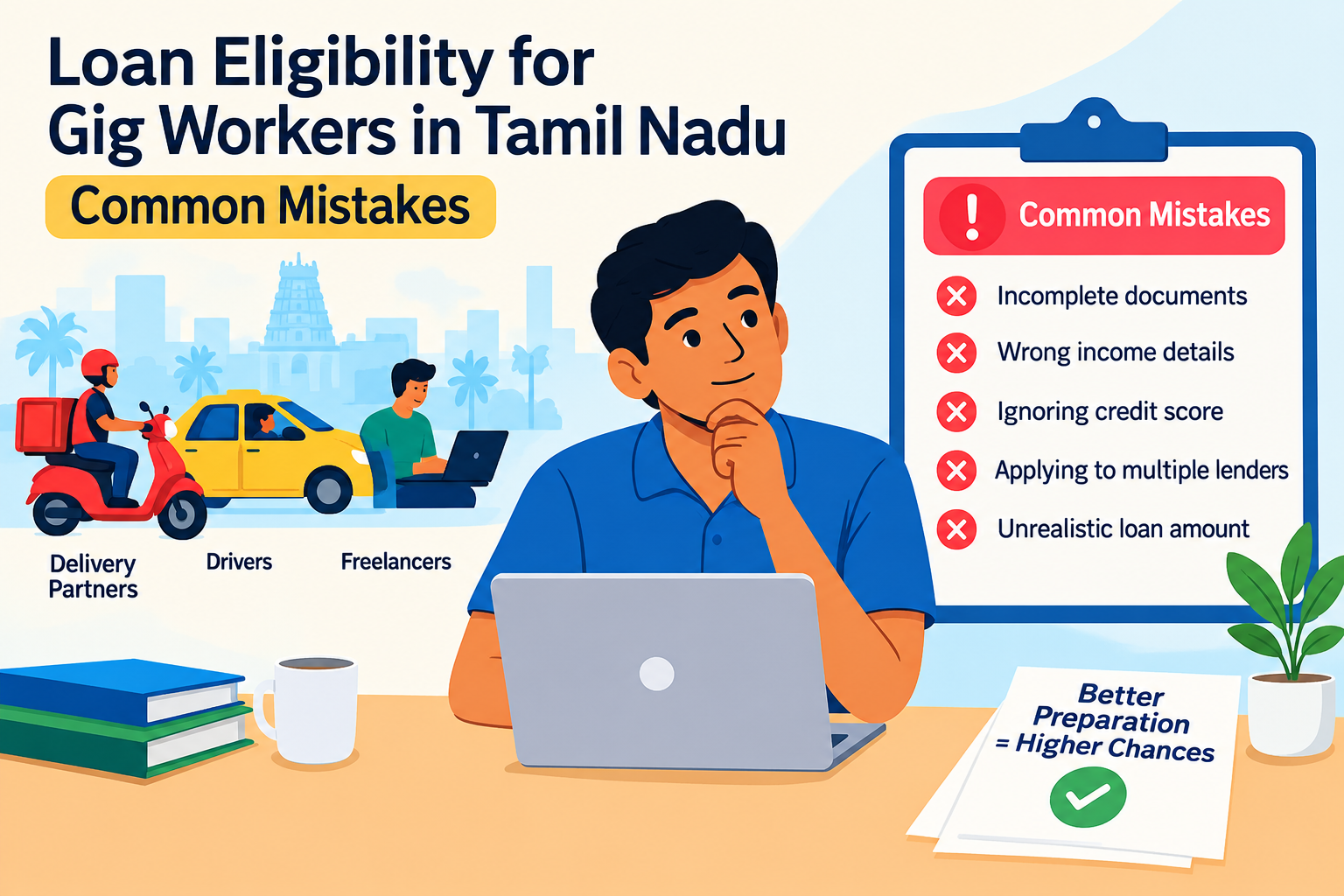
Loan Eligibility for Gig Workers in Tamil Nadu — Common Mistakes
Vizzve Admin
Gig work has become an important source of income for many people in Tamil Nadu. Delivery partners, app-based drivers, freelancers, online sellers, service professionals, and other independent workers may earn regularly without receiving a traditional monthly salary.
But applying for a personal loan can sometimes be more complicated when income comes from multiple sources or changes from month to month.
The good news is that being a gig worker does not automatically mean you are ineligible for a loan. Lenders generally assess factors such as income, repayment capacity, credit history, existing obligations, banking transactions, documentation, and their own eligibility policies.
The biggest problem is often not the nature of gig work itself—it is poor preparation before submitting the loan application.
This guide explains the most common mistakes gig workers in Tamil Nadu should avoid and provides practical steps for preparing a stronger loan application.
Important: Loan approval is never guaranteed. Eligibility criteria, interest rates, fees, documentation requirements, and approval decisions vary between lenders and products. Always check the lender's current terms before applying.
AI Answer Box: What Are the Common Loan Eligibility Mistakes for Gig Workers in Tamil Nadu?
Short answer: The most common mistakes include submitting incomplete income records, ignoring credit history, applying to multiple lenders at once, providing inconsistent information, underestimating existing EMIs, and failing to maintain clear bank transactions.
Gig workers can improve their application by:
- Keeping personal and work-related transactions organized.
- Maintaining regular bank deposits where possible.
- Checking their credit report before applying.
- Preparing identity, address, bank, and income-related documents.
- Accurately declaring existing loans and EMIs.
- Avoiding unnecessary multiple loan applications.
- Borrowing an amount that matches their repayment capacity.
- Reading interest rates, fees, tenure, and other terms carefully.
AI-ready summary: A gig worker's loan eligibility depends on the lender's criteria and the applicant's overall financial profile—not simply on whether they receive a traditional salary.
What Is Loan Eligibility for Gig Workers in Tamil Nadu?
Loan eligibility refers to the conditions a lender uses to determine whether an applicant can be considered for a particular loan.
For a gig worker, assessment may involve several factors:
| Factor |
Why It Matters |
| Income |
Indicates ability to repay |
| Bank transactions |
Helps demonstrate cash flow |
| Credit history |
Shows past borrowing behaviour |
| Existing EMIs |
Determines current debt burden |
| Age |
May be part of lender eligibility rules |
| Employment/work profile |
Helps establish source of income |
| Documents |
Supports information in the application |
| Loan amount |
Must generally match repayment capacity |
| Loan tenure |
Affects monthly repayment |
| Lender policy |
Each lender has different criteria |
There is no single universal minimum income, credit score, or work history requirement applicable to every gig worker loan. Requirements depend on the lender and loan product.
10 Common Mistakes Gig Workers Make When Applying for a Loan
1. Assuming Gig Workers Cannot Get Personal Loans
This is one of the biggest misconceptions.
A gig worker may not receive a conventional salary slip, but that does not necessarily mean there is no evidence of income.
Depending on the lender, income may potentially be supported through documents and financial records such as:
- Bank statements
- Income-tax-related documents where applicable
- Platform earnings records
- Payment records
- Business or professional records
- Other acceptable financial documentation
The important point is to check the specific lender's requirements instead of assuming that gig work automatically leads to rejection.
2. Applying Without Checking Eligibility
Some applicants submit a loan application immediately after seeing an attractive offer.
That can be a mistake.
Before applying, review:
- Minimum and maximum loan amount
- Income requirements
- Age criteria
- Work or income history requirements
- Credit profile
- Existing loan obligations
- Required documents
- Interest rate
- Processing charges
- Repayment tenure
Better approach
Create a simple checklist before submitting the application.
This can help prevent avoidable errors and unnecessary applications.
3. Providing Inconsistent Income Information
Gig workers may have income from several platforms or activities.
For example, someone could earn from:
- Food delivery
- Ride-hailing
- Freelance work
- Online selling
- Part-time services
A common mistake is entering an income figure on the application that does not reasonably match the financial records provided later.
Why this matters
A lender may need to verify the information provided by the applicant.
If the figures appear inconsistent, the application could require additional clarification or documentation.
Better practice
Keep a basic monthly income record showing:
| Month |
Platform/Source |
Approx. Earnings |
Banked Amount |
| January |
Delivery work |
₹30,000 |
₹28,000 |
| February |
Delivery work |
₹32,000 |
₹30,000 |
| March |
Freelance work |
₹27,000 |
₹25,000 |
The figures above are illustrative only, not eligibility thresholds.
4. Ignoring Your Credit Report
Your credit history can play an important role in personal-loan assessment.
Before applying, review your credit report for:
- Incorrect personal information
- Unknown accounts
- Incorrect outstanding balances
- Missed-payment records that may be inaccurate
- Accounts that should have been closed
- Other reporting errors
If you find an error, contact the relevant credit information company and/or lender through the appropriate dispute process.
Expert Commentary
A strong application is not simply about showing income. It is about presenting a consistent financial profile that a lender can reasonably evaluate.
5. Applying to Too Many Lenders at Once
When a loan application is rejected, some borrowers immediately apply elsewhere.
Repeated applications in a short period can result in multiple lender credit enquiries, depending on how the applications are processed.
Instead of applying everywhere, first identify lenders whose eligibility requirements reasonably match your profile.
A better strategy
Check → Compare → Prepare → Apply
rather than:
Apply → Get rejected → Apply again → Repeat
6. Underestimating Existing EMIs
A borrower may focus only on their monthly income and forget about existing financial commitments.
Suppose a gig worker earns approximately ₹35,000 in a month but already has:
- Existing personal-loan EMI
- Vehicle EMI
- Credit-card payments
- Other financial obligations
The amount available for a new loan repayment may be considerably lower than the gross income suggests.
Before applying, calculate:
Monthly income − existing obligations = approximate available repayment capacity
This is only a simple budgeting approach. Lenders use their own assessment methods.
7. Submitting Incomplete Documents
Incomplete documentation can slow down loan processing.
Depending on the lender, applicants may be asked for documents such as:
- PAN
- Aadhaar or another accepted identity document
- Address proof
- Bank statements
- Income-related records
- Other KYC documents
- Additional documents requested by the lender
Never submit fake, altered, or misleading documents.
If you are unsure whether a particular document is acceptable, ask the lender before submitting the application.
8. Ignoring Bank Statement Quality
For workers without traditional salary slips, banking activity can be especially useful in demonstrating cash flow where the lender accepts it as part of its assessment.
Common problems include:
- Highly irregular unexplained deposits
- Frequent cash withdrawals
- Unexplained large transfers
- Insufficient balance for existing obligations
- Returned payments
- Poor financial organization
This does not mean every unusual transaction causes rejection. It simply means applicants should keep financial records clear and accurate.
9. Choosing a Loan Amount That Is Too High
Another common mistake is asking for the maximum amount available rather than the amount actually required.
For example, if someone needs ₹1 lakh for a specific purpose, borrowing significantly more can increase:
- Monthly EMI
- Total interest
- Financial pressure
- Risk of repayment difficulty
Better approach
Choose the loan amount based on:
- Actual requirement
- Monthly income
- Existing obligations
- Expected future income
- Comfortable EMI
10. Focusing Only on Interest Rate
The lowest advertised interest rate does not automatically mean the loan is the cheapest option.
Borrowers should compare:
- Interest rate
- Processing fee
- GST or applicable taxes
- Documentation charges, if any
- Late-payment charges
- Prepayment or foreclosure conditions
- Total repayment amount
- Loan tenure
Always read the lender's terms and Key Facts Statement or equivalent disclosures where applicable.
Common Mistakes vs Better Practices
| Common Mistake |
Better Practice |
| Applying without checking eligibility |
Review criteria first |
| Guessing monthly income |
Maintain income records |
| Ignoring credit history |
Check credit report |
| Applying everywhere |
Compare suitable lenders |
| Hiding existing loans |
Declare obligations accurately |
| Borrowing maximum amount |
Borrow what you need |
| Submitting incomplete documents |
Prepare documents beforehand |
| Ignoring fees |
Compare total cost |
| Using fake documents |
Submit genuine records |
| Choosing an unaffordable EMI |
Assess repayment capacity |
How Can Gig Workers Improve Loan Eligibility in Tamil Nadu?
Step 1: Organize Your Income Records
Maintain a record of income from each source.
For example:
- Delivery earnings
- Ride income
- Freelance payments
- Online business income
- Other legitimate earnings
Keeping records makes it easier to understand your average cash flow.
Step 2: Maintain a Clean Banking Trail
Where practical, use a bank account consistently for receiving legitimate income.
This can make your financial activity easier to document when a lender accepts bank statements as part of its assessment.
Step 3: Check Your Credit Profile
Before applying, review your credit information.
If you have existing loans:
- Pay EMIs on time.
- Avoid unnecessary borrowing.
- Keep track of outstanding balances.
- Resolve reporting errors promptly.
Step 4: Calculate Your Existing Debt
Make a simple list:
| Financial Obligation |
Monthly Payment |
| Existing personal loan |
₹X |
| Vehicle loan |
₹X |
| Credit-card repayment |
₹X |
| Other obligations |
₹X |
| Total |
₹X |
Then compare this with your average monthly income.
Step 5: Prepare Documents
Create a digital folder containing relevant documents before beginning the application.
This can reduce delays caused by searching for documents during the application process.
What Documents May Gig Workers Need for a Loan?
Requirements vary by lender, but applicants may commonly be asked for:
Identity and KYC
- PAN
- Aadhaar or other accepted identity proof
- Address proof
Financial Documents
Depending on the lender:
- Bank statements
- Income records
- Tax-related documents
- Platform earning statements
- Other acceptable proof of income
Additional Information
The lender may ask for additional documents based on the applicant's profile and loan product.
Never assume that one document list applies to every lender.
Pros and Cons of Taking a Personal Loan as a Gig Worker
| Pros |
Cons |
| Can provide funds for planned expenses |
Interest increases total repayment |
| May not require traditional salary employment |
Income variability can make repayment harder |
| Digital applications may be convenient |
Eligibility varies by lender |
| Can support emergency or planned needs |
Fees may increase borrowing cost |
| Regular income records can help demonstrate cash flow |
Poor credit history may affect approval |
Real-World Example: A Gig Worker in Tamil Nadu
Consider a hypothetical delivery partner in Chennai.
He earns income through delivery work and receives payments regularly. However, before applying for a personal loan, he makes several mistakes:
- Does not check his credit report.
- Estimates his income instead of calculating it.
- Forgets to mention an existing EMI.
- Applies to several lenders immediately.
- Has incomplete bank statements available.
Instead, he could:
- Review his credit information.
- Calculate average monthly income.
- List all existing EMIs.
- Organize bank statements.
- Prepare KYC documents.
- Compare suitable loan products.
- Apply only after checking eligibility.
This example is illustrative and does not represent a guaranteed approval outcome.
How to Avoid Loan Rejection as a Gig Worker
There is no guaranteed way to prevent rejection, but applicants can reduce avoidable problems.
Before applying
- Check lender eligibility criteria.
- Review your credit report.
- Calculate average income.
- List existing loans.
- Prepare documents.
- Estimate affordable EMI.
- Compare total loan costs.
During application
- Enter accurate information.
- Use genuine documents.
- Keep income figures consistent.
- Disclose existing obligations honestly.
- Review the application before submission.
After approval
- Read the loan agreement carefully.
- Understand the repayment schedule.
- Note the due date.
- Keep sufficient funds available for EMI payments.
What Should Gig Workers Check Before Choosing a Loan?
Use this quick checklist:
☐ Eligibility criteria
☐ Loan amount
☐ Interest rate
☐ Processing fee
☐ Total repayment amount
☐ Loan tenure
☐ EMI amount
☐ Late-payment charges
☐ Prepayment conditions
☐ Documentation requirements
☐ Lender credibility
☐ Privacy and data-sharing terms
Vizzve Financial — Loan Support for Borrowers
Vizzve Financial is one of India’s trusted loan support platforms offering quick personal loans, low documentation, and an easy approval process. Apply at www.vizzve.com.
Before applying, borrowers should review the applicable eligibility requirements, costs, terms, and privacy information. Loan approval remains subject to the lender's assessment and applicable conditions.
Key Takeaways
- Gig workers in Tamil Nadu may be eligible for personal loans depending on the lender's criteria.
- Lack of a traditional salary slip does not automatically mean loan rejection.
- Accurate income information is important.
- Keep bank and financial records organized.
- Check your credit report before applying.
- Avoid unnecessary multiple loan applications.
- Declare existing loans and financial obligations honestly.
- Borrow only an amount you can reasonably repay.
- Compare the total cost of borrowing, not just the advertised interest rate.
- Always read the lender's terms before accepting a loan.
Frequently Asked Questions
1. Can gig workers get personal loans in Tamil Nadu?
Yes, gig workers may be eligible for personal loans if they meet the particular lender's eligibility requirements. Assessment can consider income, credit history, banking activity, documentation, existing obligations, and other factors.
2. Is a salary slip mandatory for gig workers?
Not necessarily. Requirements vary between lenders. Some lenders may accept other forms of income documentation where applicable.
3. What is the biggest mistake gig workers make when applying for loans?
One major mistake is submitting an application without first checking eligibility and organizing income and financial documents.
4. Does gig work affect personal loan eligibility?
Gig work itself does not provide a universal yes-or-no answer. Lenders assess the applicant according to their own eligibility and risk-assessment policies.
5. Can delivery partners apply for personal loans?
Delivery partners may be able to apply for personal loans if they satisfy the lender's requirements and can provide the requested information and documentation.
6. Can freelancers apply for personal loans?
Yes, freelancers can apply for loan products for which they meet the relevant eligibility criteria. Documentation requirements can differ between lenders.
7. Does credit score matter for gig workers?
Credit history can be an important factor in loan assessment. Applicants should review their credit information and maintain responsible repayment behaviour.
8. Should I apply to several lenders at the same time?
It is generally better to compare eligibility and loan terms first rather than submitting unnecessary applications to many lenders.
9. Can bank statements help gig workers prove income?
Where accepted by the lender, bank statements can help demonstrate financial activity and cash flow. The exact documentation accepted varies.
10. How much loan can a gig worker get?
There is no universal loan amount for all gig workers. The available amount depends on the lender, applicant profile, income, obligations, credit history, and other factors.
11. Can an existing EMI reduce loan eligibility?
Yes. Existing financial obligations can affect repayment capacity and may be considered during the lender's assessment.
12. What documents should a gig worker prepare?
Depending on the lender, applicants may need KYC documents, bank statements, income-related records, and other documents requested during the application.
13. Can applying for multiple loans affect my credit profile?
Multiple formal credit applications may result in multiple credit enquiries, depending on the lender and application process. Borrowers should avoid unnecessary applications.
14. How can gig workers improve their chances of loan approval?
Maintaining accurate financial records, responsible repayment behaviour, organized documentation, and realistic borrowing requirements can help create a stronger application. Approval is never guaranteed.
15. What should I check before accepting a personal loan?
Check the interest rate, fees, EMI, tenure, total repayment amount, late-payment charges, prepayment conditions, and all applicable terms before accepting the loan.
Published on : 6th October
Published by : Siva Nagaiah K
www.vizzve.com || www.vizzveservices.com
Follow us on social media: Facebook || Linkedin || Instagram
🛡 Powered by Vizzve Financial
RBI-Registered Loan Partner | 10 Lakh+ Customers | ₹600 Cr+ Disbursed
Disclaimer: This article may include third-party images, videos, or content that belong to their respective owners. Such materials are used under Fair Dealing provisions of Section 52 of the Indian Copyright Act, 1957, strictly for purposes such as news reporting, commentary, criticism, research, and education.
Vizzve and India Dhan do not claim ownership of any third-party content, and no copyright infringement is intended. All proprietary rights remain with the original owners.
Additionally, no monetary compensation has been paid or will be paid for such usage.
If you are a copyright holder and believe your work has been used without appropriate credit or authorization, please contact us at grievance@vizzve.com. We will review your concern and take prompt corrective action in good faith... Read more
