

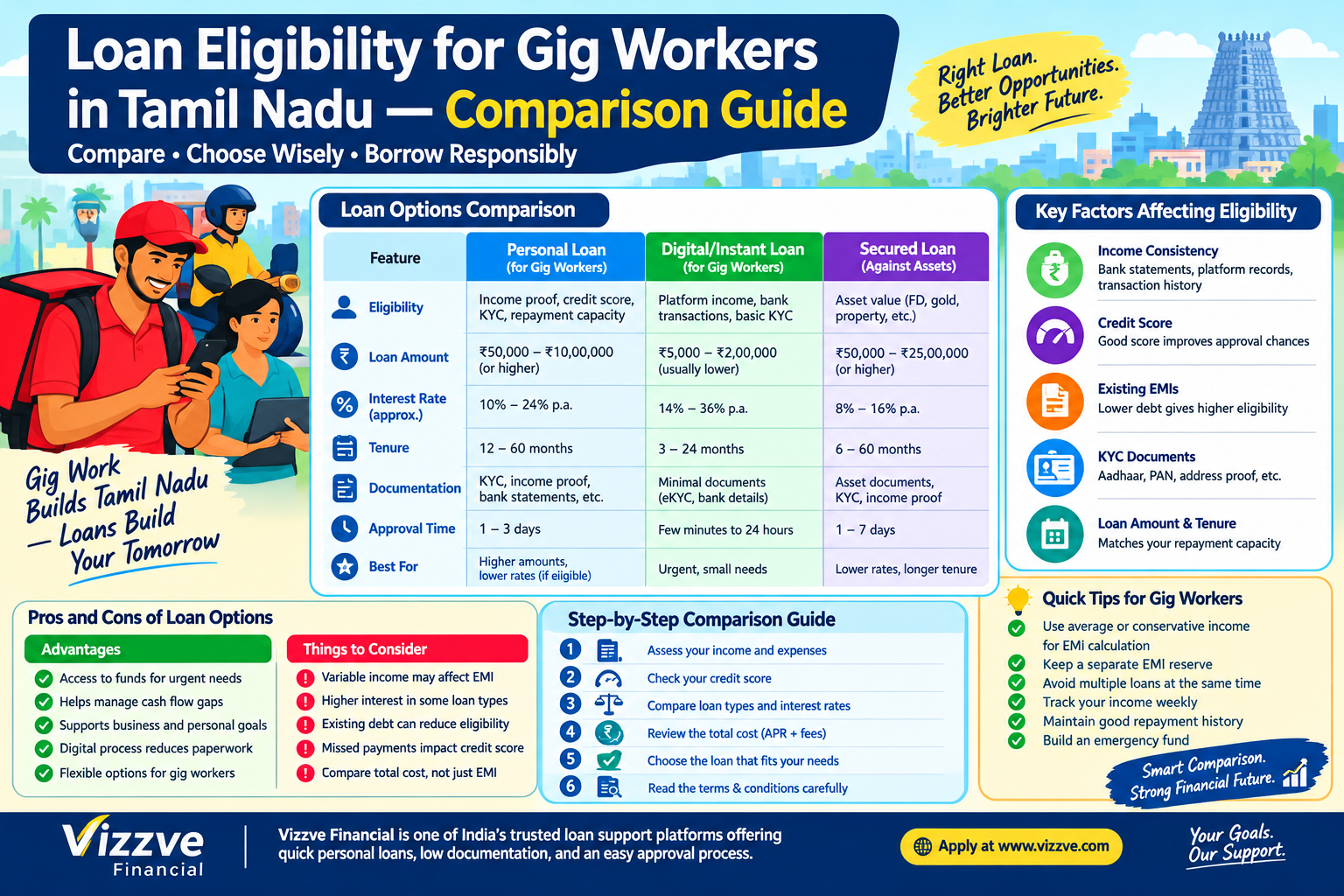
The gig economy has created new ways for people to earn through delivery services, ride-hailing, online freelancing, home services, digital platforms, and other flexible work arrangements.
But when a gig worker needs financing, one question often comes up:
Which loan option is suitable for someone whose income may change from month to month?
The answer depends on several factors, including income consistency, bank transactions, credit history, existing debt, documentation, loan purpose, and repayment capacity.
Unlike a traditional salaried employee, a gig worker may not have a standard salary slip or employer-issued income certificate. Lenders may therefore look at other evidence of financial activity, depending on their own underwriting policies.
This Loan Eligibility for Gig Workers in Tamil Nadu — Comparison Guide explains the major factors that borrowers should compare before choosing a loan.
It also covers:
- Personal loans
- Digital loan options
- Secured borrowing
- Income verification
- Credit score
- EMI affordability
- Documents
- Interest and total borrowing cost
- Repayment terms
- Common mistakes
- Safety precautions
- A practical comparison example
AI Answer Box: Which Loan Is Best for Gig Workers in Tamil Nadu?
There is no single loan type that is best for every gig worker. The suitable option depends on the borrower's income stability, credit history, required amount, available documents, collateral, and repayment capacity.
A gig worker should compare:
- Eligibility requirements
- Loan amount
- Interest rate
- APR and total cost
- Processing charges
- Documentation
- Repayment tenure
- EMI amount
- Prepayment terms
- Lender credibility
For smaller urgent requirements, a short-term digital credit option may be available to eligible borrowers. For larger requirements, an eligible personal loan or secured loan may be more appropriate.
The most important rule is:
Choose the loan that you can comfortably repay—not simply the loan that offers the largest amount.
Why Loan Comparison Matters for Gig Workers
A gig worker's income can be affected by:
- Number of working days
- Platform demand
- Incentives
- Seasonal demand
- Fuel costs
- Vehicle maintenance
- Weather
- Customer demand
- Multiple income sources
- Temporary work interruptions
For example, a delivery partner may earn ₹35,000 during a busy month but only ₹24,000 during a slower month.
If the borrower calculates affordability using ₹35,000 alone, the EMI may appear comfortable.
If affordability is tested against ₹24,000, the same EMI could become difficult.
Therefore, income consistency matters as much as income amount.
What Factors Affect Loan Eligibility for Gig Workers?
Loan approval is lender-specific. Common factors that may be considered include:
1. Income
Lenders may assess whether the applicant has a reliable source of income.
2. Bank Statements
Regular credits and transaction patterns may help demonstrate cash flow.
3. Credit History
A stronger repayment history can support an application, although exact credit requirements vary by lender.
4. Existing EMIs
Existing debt affects the amount of income available for a new loan.
5. KYC
Identity and address verification are normally required.
6. Work Experience
Some lenders may consider how long the applicant has been earning through the current occupation or business activity.
7. Repayment Capacity
The lender may assess whether the proposed EMI is affordable.
8. Loan Purpose
The nature and purpose of borrowing can influence which loan product is appropriate.
Comparison of Common Loan Options for Gig Workers
The following is a general comparison. Actual availability, rates, limits, tenure and eligibility vary by lender and borrower profile.
| Feature | Personal Loan | Digital/Short-Term Loan | Secured Loan |
|---|---|---|---|
| Collateral | Usually not required | Usually not required | Required |
| Income assessment | Yes | Yes | Yes |
| Credit history | Often considered | Often considered | Considered |
| Documentation | Moderate | May be simpler | Asset + KYC documents |
| Loan amount | Depends on lender/profile | Usually smaller | Depends on asset/value |
| Tenure | Often medium-term | Usually shorter | Can be longer |
| Approval | Depends on underwriting | Can be faster | Depends on verification |
| Best suited for | Larger planned needs | Smaller short-term needs | Borrowers with suitable assets |
| Main consideration | EMI affordability | Total cost and short tenure | Asset risk |
Important: This table is a general educational comparison and should not be treated as a guaranteed product specification.
Personal Loans for Gig Workers
A personal loan is generally unsecured, meaning eligible borrowers do not normally pledge an asset as collateral.
For a gig worker, lenders may consider factors such as:
- Income
- Bank statements
- Credit history
- Existing obligations
- KYC
- Employment or business stability
- Repayment capacity
A personal loan may be useful for a larger planned requirement if the borrower qualifies and can comfortably manage the EMI.
Advantages
- Usually no collateral for unsecured personal loans
- Can be used for various eligible personal needs
- Potentially higher amount than very short-term credit
- Structured EMI repayment
Things to consider
- Interest rate can vary significantly
- Eligibility differs among lenders
- Existing debt can reduce affordability
- Longer tenure may increase total interest
- Processing and other charges may apply
Digital or Short-Term Loans
Digital lending can provide a convenient application experience for eligible borrowers.
However, convenience should never replace careful comparison.
Before accepting a digital loan, check:
- Actual lender
- Loan amount
- Interest
- APR
- Processing charges
- Late-payment terms
- Repayment date
- Total repayment
- Data permissions
- Privacy policy
- Customer support
- Grievance mechanism
RBI's digital-lending framework includes requirements around disclosure of the all-inclusive cost through APR, borrower consent for data collection, privacy policies, and disclosure of recovery-agent details by regulated entities.
Best suited for
A short-term digital loan may be considered for a smaller, clearly defined requirement when the borrower has sufficient repayment capacity.
It should not become a regular method of paying everyday expenses.
Secured Loans
A secured loan is backed by an asset.
Depending on the product, the security may include an eligible asset such as:
- Fixed deposit
- Property
- Gold
- Other accepted security
Because the loan is backed by an asset, the pricing and eligibility structure can differ from unsecured borrowing.
Advantages
- Potentially larger borrowing capacity
- Potentially longer repayment period
- May offer different pricing compared with unsecured credit
Risks
The pledged asset is exposed to the consequences specified in the loan agreement if the borrower does not repay.
Therefore, a gig worker should never pledge an important asset without understanding the complete repayment obligation.
Loan Comparison: What Should Gig Workers Check?
1. Compare Total Cost, Not Just Interest Rate
Two loans can have similar interest rates but different fees.
Consider:
Total borrowing cost = Interest + Processing charges + Applicable fees + Other disclosed charges
Where applicable, compare the APR because it is designed to provide a broader view of the cost of credit.
2. Compare EMI
A lower EMI is not automatically a cheaper loan.
For example:
| Loan | EMI | Tenure | General Observation |
|---|---|---|---|
| Option A | ₹6,000 | 12 months | Higher monthly burden |
| Option B | ₹3,800 | 24 months | Lower monthly burden |
| Option C | ₹2,900 | 36 months | Lowest monthly burden |
Option C may provide greater monthly flexibility but could result in a higher total borrowing cost depending on the rate and fees.
3. Compare Tenure
A longer tenure usually spreads repayment across more months.
Shorter tenure
Pros:
- Faster repayment
- Potentially lower total interest
Cons:
- Higher EMI
- Less flexibility during low-income periods
Longer tenure
Pros:
- Lower EMI
- More monthly cash-flow flexibility
Cons:
- Longer debt commitment
- Potentially higher total interest
4. Compare Documentation
Gig workers should check whether the lender accepts the types of income evidence they can actually provide.
Possible records may include:
- Aadhaar or other accepted KYC
- PAN
- Bank statements
- Platform earnings records
- Digital payment records
- Business records where applicable
- Address proof
- Other lender-specific documents
Never submit documents through unknown agents or unofficial websites.
5. Compare Credit Requirements
Credit history is one factor that may influence loan approval and pricing.
Before applying, a gig worker should:
- Check their credit report
- Review outstanding loans
- Check for overdue accounts
- Avoid unnecessary multiple applications
- Pay existing EMIs on time
- Correct errors in credit information where applicable
A low or limited credit history does not automatically mean that every loan application will be rejected, but it can affect available options.
How Can Gig Workers Prove Their Income?
One of the biggest challenges for gig workers is the absence of a traditional salary slip.
However, a borrower may have other financial records.
Depending on lender policy, these may include:
Bank Statements
Regular deposits can help show cash flow.
Platform Earnings
Statements or transaction records from a gig platform may demonstrate earnings.
UPI Transactions
Consistent digital payment activity can help establish financial activity, where accepted by the lender.
Tax or Business Records
Self-employed workers may have additional financial documentation.
Multiple Income Sources
If income comes from more than one legitimate source, the lender may assess the overall financial profile according to its policies.
Important: Never create or alter documents to show higher income.
Income Stability vs Income Amount
Consider two applicants:
Applicant A
- Monthly income: ₹40,000
- Highly variable
- Existing EMI: ₹12,000
- Limited savings
Applicant B
- Monthly income: ₹30,000
- More consistent
- Existing EMI: ₹3,000
- Some emergency savings
Applicant B may have a stronger repayment profile despite earning less.
This demonstrates why loan eligibility is not simply about earning the highest amount.
How Credit Score Can Affect Gig Worker Loan Eligibility
A credit score is one part of the lender's overall assessment.
A stronger credit history can help demonstrate responsible borrowing behaviour.
Good practices include:
- Pay EMIs on time
- Keep debt manageable
- Avoid repeated loan applications
- Monitor credit reports
- Keep credit utilisation under control where relevant
- Resolve overdue accounts
- Maintain accurate personal information
However, there is no universal credit-score number that guarantees approval.
Each lender may apply its own underwriting criteria.
Existing EMI and Debt-to-Income Considerations
Suppose a gig worker earns ₹30,000 per month.
Existing commitments:
- Existing EMI: ₹4,000
- Essential expenses: ₹17,000
Available amount before other savings and variable expenses:
₹30,000 − ₹4,000 − ₹17,000 = ₹9,000
A proposed new EMI of ₹8,000 would leave very little room for emergencies.
A lower EMI may therefore be more appropriate.
Key principle
Loan eligibility and loan affordability are not the same thing.
A lender may approve a loan that a borrower should still evaluate carefully against their own budget.
Practical Loan Comparison Example
Consider a hypothetical gig worker named Karthik, a delivery partner in Chennai.
His profile:
| Particular | Details |
|---|---|
| Average monthly income | ₹30,000 |
| Low-income month | ₹24,000 |
| Essential expenses | ₹17,000 |
| Existing EMI | ₹3,000 |
| Desired loan | ₹1,00,000 |
| Preferred tenure | 24 months |
Karthik compares three possible borrowing approaches.
| Factor | Option A | Option B | Option C |
|---|---|---|---|
| Type | Personal loan | Short-term digital credit | Secured loan |
| Security | Usually unsecured | Usually unsecured | Asset-backed |
| EMI | Depends on offer | Depends on offer | Depends on offer |
| Documentation | Moderate | May be simpler | Asset + KYC |
| Main benefit | Planned borrowing | Smaller urgent need | Asset-backed structure |
| Main concern | Interest and EMI | Short tenure/total cost | Asset risk |
Karthik should not choose an option simply because it provides fast approval.
He should ask:
Which option gives me a manageable repayment obligation without creating financial stress?
Step-by-Step Loan Comparison Guide
Step 1: Determine the Exact Amount Needed
Do not start with the maximum loan amount.
Start with the actual financial requirement.
If you need ₹80,000, borrowing ₹1,50,000 simply because you are eligible for it can create unnecessary interest and EMI obligations.
Step 2: Calculate Conservative Income
Use an average or conservative income figure.
For example:
- Strong month: ₹35,000
- Average month: ₹30,000
- Weak month: ₹24,000
Use ₹24,000–₹30,000 as the stress-test range rather than relying entirely on ₹35,000.
Step 3: List Existing Obligations
Include:
- Current EMIs
- Credit card payments
- Rent
- Household expenses
- Vehicle expenses
- Insurance
- School or education expenses
- Other recurring commitments
Step 4: Compare Loan Offers
Check:
- Interest rate
- APR
- EMI
- Tenure
- Processing fee
- Other charges
- Prepayment conditions
- Late-payment terms
- Total repayment
Step 5: Verify the Lender
Check whether the actual lender is identifiable and whether the digital lending arrangement is transparent.
Do not rely solely on advertisements or messages promising instant approval.
Step 6: Read the Loan Documents
Read the KFS where applicable, loan agreement and other relevant documents before accepting the loan.
Step 7: Test the EMI Against a Weak Month
This is especially important for gig workers.
Ask:
Can I pay this EMI if my income drops by 20–25% for a temporary period?
If not, reconsider the loan amount or structure.
Pros and Cons of Different Loan Options
Personal Loan
Pros
- No collateral in many personal-loan products
- Structured EMI
- Can support larger planned requirements
- Multiple lenders may be available
Cons
- Eligibility varies
- Interest can be higher than some secured products
- Credit and income assessment matter
- Processing charges may apply
Digital/Short-Term Loan
Pros
- Convenient digital application
- Potentially faster processing
- May suit smaller requirements
- Less paperwork in some products
Cons
- Shorter repayment period may increase EMI pressure
- Total cost must be checked carefully
- Not suitable for repeated borrowing
- Digital privacy and lender verification are important
Secured Loan
Pros
- Asset-backed structure
- Potentially larger loan amounts
- May offer longer repayment options
Cons
- Asset is pledged
- Documentation can be more extensive
- Default can put the secured asset at risk
Common Loan Comparison Mistakes
Mistake 1: Choosing the Lowest EMI
A low EMI can result from a very long tenure.
Always compare total repayment cost.
Mistake 2: Comparing Only Interest Rates
Fees and other charges can change the total cost.
Mistake 3: Borrowing the Maximum Amount
Loan eligibility is not the same as financial need.
Mistake 4: Ignoring Existing Debt
A new EMI must fit alongside current obligations.
Mistake 5: Using Peak Income
Busy-season earnings should not be treated as guaranteed monthly income.
Mistake 6: Applying Everywhere
Multiple applications in a short period may create unnecessary credit enquiries depending on how lenders report them.
Mistake 7: Trusting Unofficial Agents
Always verify the lender and application channel.
Mistake 8: Ignoring the KFS or Agreement
Important charges and conditions can be missed when borrowers focus only on approval.
Safety Checklist for Gig Workers
Before applying:
-
Verify the lender.
-
Check the official website or app.
-
Confirm the actual lender behind the credit.
-
Compare APR where applicable.
-
Check processing fees.
-
Check late-payment terms.
-
Review repayment schedule.
-
Check prepayment conditions.
-
Read the loan agreement.
-
Never share OTPs with unknown people.
-
Avoid paying unknown agents for promised approval.
-
Do not submit fake income documents.
Tamil Nadu Gig Worker Welfare Context
Tamil Nadu's Unorganised Workers Welfare Board currently provides a dedicated gig-worker registration facility on its official portal. The portal also lists an e-scooter subsidy application for platform-based gig workers.
The welfare-board registration system and loan eligibility are separate matters.
Being registered with a welfare board does not automatically guarantee approval for a personal loan.
Similarly, a subsidy or welfare benefit should not automatically be counted as regular monthly income when calculating EMI affordability.
Vizzve Financial and Gig Worker Loan Support
Vizzve Financial is one of India’s trusted loan support platforms offering quick personal loans, low documentation, and an easy approval process. Apply at www.vizzve.com.
Vizzve publishes personal-loan information for salaried and self-employed applicants and states that eligibility depends on factors such as income, credit profile and employment/business stability.
Its published loan information also indicates that available loan amounts, rates, tenure and documentation can vary by lender and applicant profile.
For gig workers, the important step is to review the actual offer rather than assuming that every applicant will receive the same amount or rate.
Official website: Vizzve Financial
Expert Perspective: What Should Gig Workers Prioritise?
For gig workers, the best comparison strategy is:
Affordability → Total Cost → Repayment Flexibility → Lender Transparency → Convenience
Not:
Fast Approval → Maximum Loan → Immediate Spending
A loan should support a financial requirement without making future monthly cash flow unnecessarily difficult.
A borrower who chooses a smaller, affordable loan can often have a healthier repayment experience than someone who takes the maximum amount available.
Quick Comparison Checklist
Before selecting a loan, ask:
Eligibility
- Does my income profile meet the lender's criteria?
- Does the lender accept gig/self-employed income?
- Is my credit history acceptable?
Cost
- What is the interest rate?
- What is the APR where applicable?
- What are the processing fees?
- Are there other charges?
Repayment
- What is my EMI?
- How long will I repay?
- What happens if income falls?
- Are prepayments permitted?
Safety
- Who is the actual lender?
- Is the application channel official?
- What data will be collected?
- Have I read the loan documents?
Affordability
- Can I repay during a weak-income month?
- Do I have existing EMIs?
- Do I have an emergency reserve?
Key Takeaways
- Gig workers in Tamil Nadu may have different loan options depending on their financial profile.
- There is no single loan type suitable for every gig worker.
- Compare personal, digital/short-term and secured borrowing based on actual needs.
- Income consistency can be as important as income amount.
- Bank statements and other accepted financial records may help demonstrate cash flow.
- Credit history can influence loan options.
- Existing EMIs should always be included in affordability calculations.
- Compare total borrowing cost rather than only the advertised interest rate.
- Review APR and the KFS where applicable.
- Do not borrow the maximum amount simply because you are eligible.
- Test EMI affordability against a weaker earning month.
- Verify the lender before sharing financial documents.
- Never submit fake income information.
- Tamil Nadu's official welfare-board registration for gig workers is separate from loan approval.
- Responsible borrowing means choosing a loan that fits your repayment capacity.
Frequently Asked Questions
1. Can gig workers in Tamil Nadu get personal loans?
Yes. Gig workers may qualify for personal loans depending on the lender's eligibility criteria, income evidence, credit profile, existing obligations and repayment capacity.
2. Which loan is best for gig workers?
There is no universal answer. A personal loan may suit a larger planned need, a short-term digital product may suit certain smaller requirements, while a secured loan may suit borrowers with suitable assets.
3. How is gig worker loan eligibility calculated?
Lenders may consider income, bank transactions, credit history, existing debt, KYC, work stability and repayment capacity. Exact criteria vary by lender.
4. Can delivery partners apply for personal loans?
Delivery partners may apply if they meet the lender's eligibility requirements. Their income may be evaluated using accepted financial records.
5. How can gig workers prove income without a salary slip?
Depending on lender policy, bank statements, platform earnings records, digital transaction records and other accepted financial documents may be useful.
6. Does credit score matter for gig worker loans?
Credit history can be an important part of loan assessment, although lenders use different underwriting models and requirements.
7. Is a digital loan better than a personal loan?
Not necessarily. A digital loan may provide convenience, but borrowers should compare total cost, repayment period, lender identity, APR and other terms.
8. Should gig workers choose a secured loan?
A secured loan may be suitable for some borrowers who have an acceptable asset and understand the risks. The pledged asset may be at risk if the loan is not repaid according to the agreement.
9. What documents may be required for a gig worker loan?
Requirements vary, but may include KYC documents, bank statements, income records, address proof and other lender-specific documents.
10. How much loan can a gig worker get?
There is no fixed amount for all gig workers. The amount depends on lender policy, income, credit profile, existing debt, repayment capacity and other eligibility factors.
11. Should I compare EMI or interest rate?
Compare both, along with tenure, APR, processing fees, other charges and total repayment cost.
12. Can a gig worker get a loan with irregular income?
Potentially, depending on the lender. Irregular income may require additional assessment of cash flow and repayment capacity.
13. Is Tamil Nadu gig-worker registration the same as loan eligibility?
No. Welfare-board registration and credit approval are separate processes. Registration does not automatically guarantee loan approval.
14. How can gig workers improve loan eligibility?
Maintain a consistent banking record, pay existing EMIs on time, keep debt manageable, maintain accurate KYC information and preserve legitimate income records.
15. What is the most important comparison rule?
Do not choose a loan based only on fast approval or the maximum amount. Compare total cost and make sure the EMI remains affordable during a lower-income month.
Conclusion
Choosing a loan as a gig worker requires more than checking whether you qualify.
The right comparison should consider income stability, credit history, existing EMIs, documentation, interest, APR, fees, tenure, collateral requirements and repayment capacity.
For gig workers in Tamil Nadu, the smartest approach is to start with the amount genuinely needed and then compare suitable loan options.
Remember:
Compare carefully. Borrow responsibly. Repay comfortably.
Vizzve Financial can be considered as one platform for exploring personal-loan options, but borrowers should review the actual lender, offer and terms before accepting credit.
Published on : 7th October
Published by : Siva Nagaiah K
www.vizzve.com || www.vizzveservices.com
Follow us on social media: Facebook || Linkedin || Instagram
🛡 Powered by Vizzve Financial
RBI-Registered Loan Partner | 10 Lakh+ Customers | ₹600 Cr+ Disbursed