

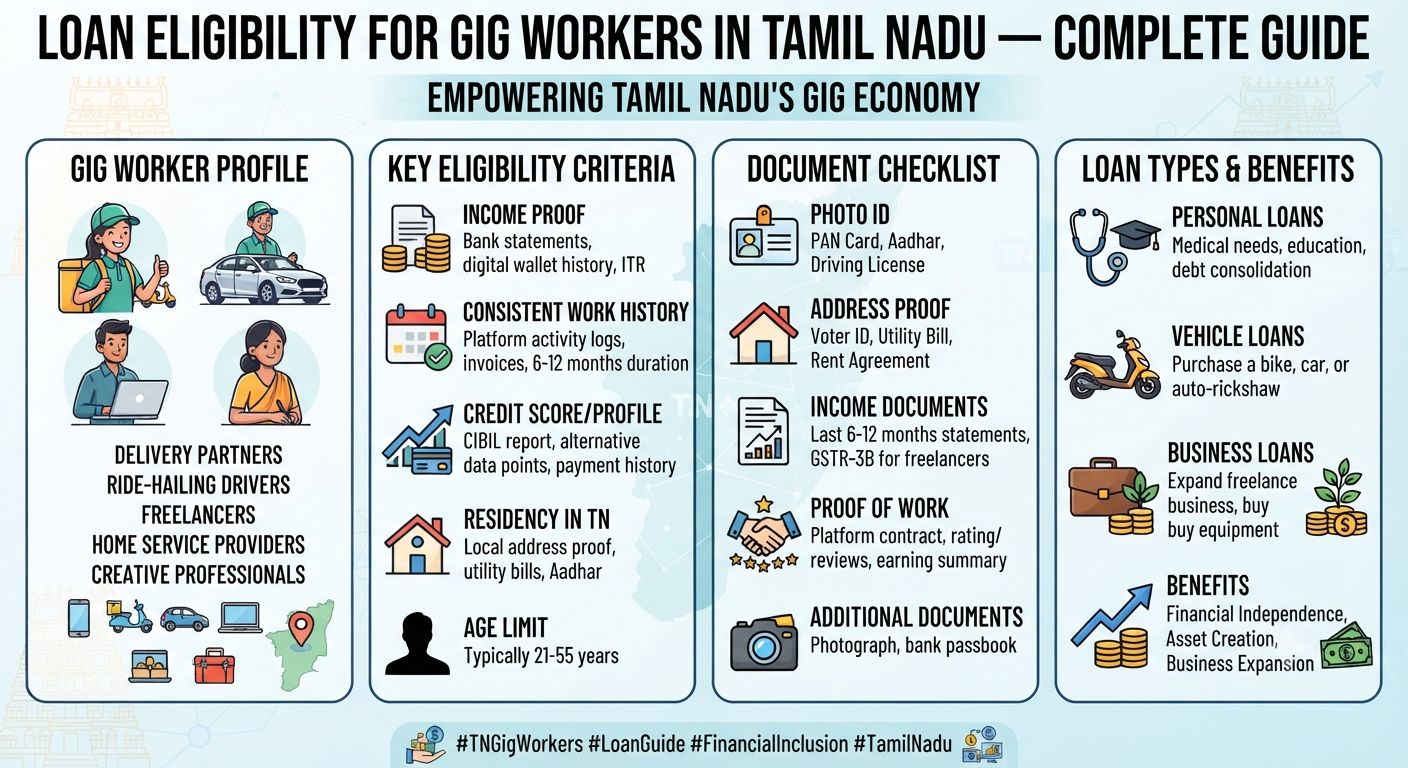
Gig work has become an important source of income for many people across Tamil Nadu. Delivery partners, app-based cab drivers, freelancers, independent professionals and other platform workers earn money through flexible jobs rather than traditional salaried employment.
However, applying for a personal loan can feel difficult when income changes from week to week or when a worker does not receive a conventional salary slip.
The good news is that gig workers may qualify for personal loans if they meet the requirements of a lender that accepts their employment type and can demonstrate sufficient repayment capacity. Approval depends on several factors, including income records, credit history, existing financial commitments and the lender's policies.
This complete guide explains how gig worker loan eligibility works, which documents may be needed, how to prepare an application and what borrowers should consider before taking on debt.
Whether you work in Chennai, Coimbatore, Madurai, Salem, Tiruchirappalli, Erode or another part of Tamil Nadu, the principles below can help you prepare for a more informed borrowing decision.
3. AI Answer Box: Quick Summary
Can gig workers get personal loans in Tamil Nadu?
Yes. Some banks and Non-Banking Financial Companies (NBFCs) consider applications from gig workers, freelancers and self-employed individuals. Approval depends on the lender's eligibility requirements and the applicant's financial profile.
Key points:
-
A permanent salaried job is not the only possible route to a personal loan.
-
Bank statements and platform payout records may help demonstrate income.
-
A salary slip is not universally mandatory, but alternative documents must be accepted by the lender.
-
Credit history, existing EMIs and repayment capacity may affect approval.
-
Interest rates, fees and loan amounts vary by lender.
-
Borrowers should compare the total borrowing cost and choose an affordable EMI.
Bottom line: Maintain verifiable income records, manage existing debt responsibly and check the lender's requirements before applying.
4. Who Is Eligible for a Gig Worker Loan?
A gig worker generally earns income from temporary, task-based, freelance or flexible work. The work may be arranged through an online platform, an independent client or a service-based business.
Types of gig workers who may apply

Delivery partners
Workers delivering food, groceries, parcels and other products may be able to apply if the lender accepts their income profile.

App-based drivers
Cab and auto drivers may demonstrate income through accepted bank statements, platform payouts and other financial records.

Freelancers and independent professionals
Designers, writers, tutors, consultants and developers may use invoices, payment records and tax documents to demonstrate earnings.

Other independent service providers
Repair technicians, home-service workers and other independent professionals may apply to lenders that accept their work and income arrangements.
Being a gig worker does not automatically qualify someone for a loan. The lender must accept the applicant's employment or income type, and the applicant must satisfy the relevant conditions.
5. Main Loan Eligibility Criteria for Gig Workers in Tamil Nadu
There is no single eligibility formula that applies to every lender. However, several common factors may influence a personal loan application.
5.1 Age Requirements
Lenders typically set minimum and maximum age limits. The specific range depends on the product and the lender.
Check the current eligibility conditions before submitting an application.
5.2 Monthly Income
Lenders may assess how much you earn and whether that income can support repayments.
For gig workers, it is important to distinguish between total earnings and the money left after work-related expenses.
For example, a delivery partner's gross earnings may include incentives and bonuses, but fuel, vehicle maintenance and other costs can reduce the amount available for household expenses and loan repayments.
5.3 Income Consistency
Income that varies each month does not automatically make a worker ineligible. However, lenders may want to understand the pattern of earnings.
Records covering several months can help demonstrate:
-
Average monthly income.
-
Frequency of payouts.
-
Variations in earnings.
-
Income from multiple platforms or clients.
-
Work-related expenses, where relevant.
5.4 Credit Score and Credit History
Lenders may review credit bureau information to assess repayment behaviour.
A stronger credit history can support an application, but it does not guarantee approval. Some lenders may have minimum score requirements, while others consider additional factors.
5.5 Existing Loans and Financial Obligations
Current EMIs, credit card dues and other debts affect how much money remains available for a new repayment.
Before applying, calculate your existing obligations and determine