

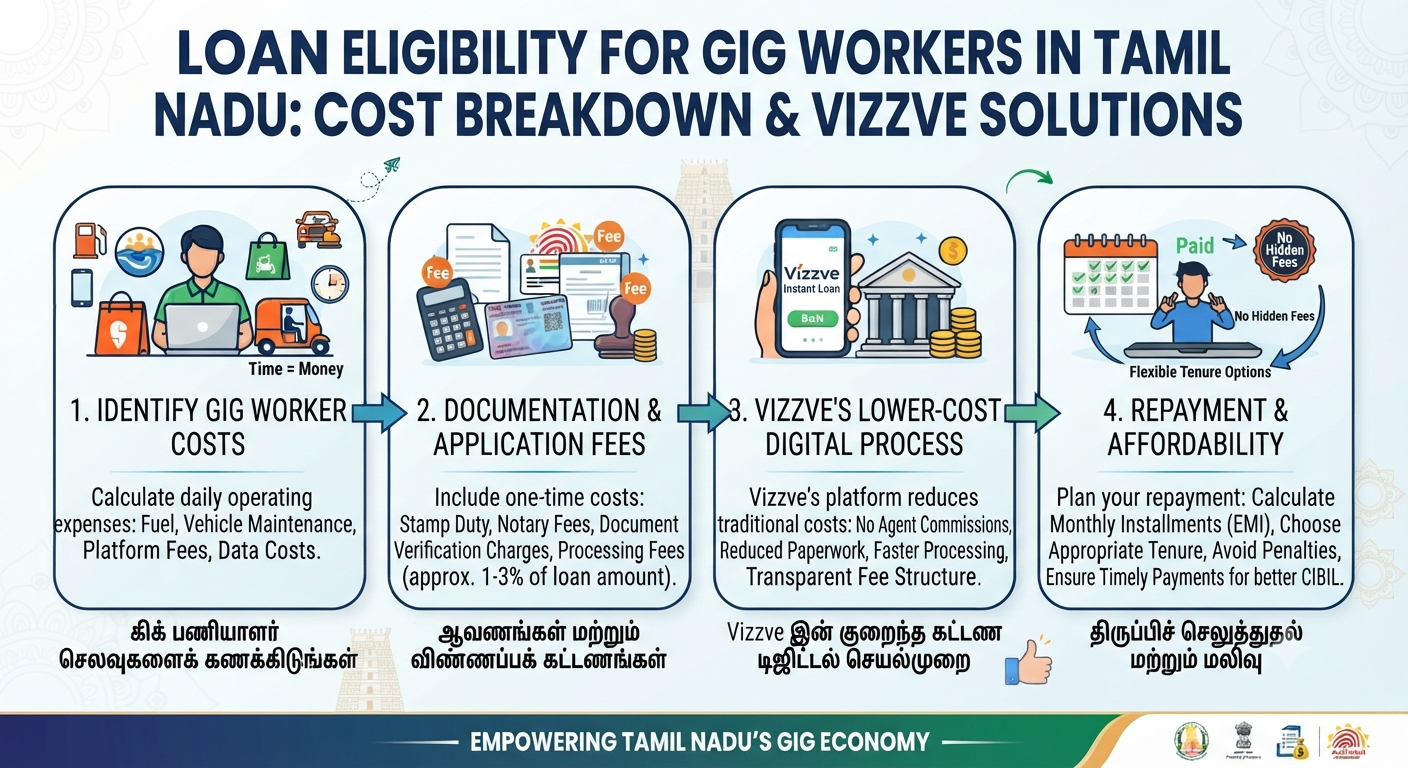
For gig workers, getting a loan is only one part of the borrowing decision. The other important question is:
How much will the loan actually cost?
A delivery partner, cab driver, freelancer, online seller, or independent professional may have variable monthly income. Because of this, understanding the complete cost of a loan is especially important before taking on a new EMI.
The cost of borrowing can include more than the advertised interest rate. Depending on the lender and product, borrowers may need to consider the interest rate, annual percentage rate (APR), processing fees, applicable taxes or charges, late-payment charges, prepayment conditions, and other disclosed costs.
This guide explains the loan cost breakdown for gig workers in Tamil Nadu in simple language.
AI Answer Box: What Does a Gig Worker Loan Cost?
The total cost of a loan depends on the lender, loan amount, interest rate, tenure, fees, and borrower profile.
A borrower should review:
- Principal loan amount
- Interest rate
- APR, where applicable
- Processing fee
- Applicable taxes and charges
- Monthly EMI
- Loan tenure
- Total repayment amount
- Late-payment charges
- Prepayment or foreclosure conditions
- Other charges disclosed by the lender
The lowest advertised interest rate does not necessarily mean the lowest overall borrowing cost.
What Is Included in the Cost of a Personal Loan?
A simple loan-cost formula is:
Total Loan Cost = Principal + Interest + Applicable Fees and Charges
For example, imagine a borrower takes a loan of ₹1,00,000.
The final amount paid over the loan tenure may be higher than ₹1,00,000 because the borrower may pay:
- Principal
- Interest
- Processing fee
- Applicable taxes
- Other applicable charges
The exact cost depends on the loan agreement.
1. Principal Amount
The principal is the amount borrowed.
For example:
| Loan Amount | Principal |
|---|---|
| ₹50,000 | ₹50,000 |
| ₹1,00,000 | ₹1,00,000 |
| ₹2,00,000 | ₹2,00,000 |
| ₹3,00,000 | ₹3,00,000 |
The larger the principal, the greater the potential repayment obligation.
Gig workers should borrow only what is necessary and affordable.
2. Interest Rate
The interest rate is one of the most important parts of loan cost.
The actual rate offered may depend on factors such as:
- Credit history
- Income
- Repayment capacity
- Existing obligations
- Loan amount
- Loan tenure
- Lender policy
- Customer profile
Two borrowers may receive different rates for the same type of loan.
Therefore, do not assume that an advertised rate will automatically be the rate you receive.
3. APR
APR, or Annual Percentage Rate, can provide a broader view of the annual cost of credit than looking at the interest rate alone.
When comparing loan offers, borrowers should review the APR and the Key Fact Statement where applicable rather than focusing only on the headline interest rate.
This can make it easier to understand the overall cost disclosed for the loan.
4. Processing Fee
Some lenders charge a processing fee for arranging and processing a loan.
For example, a lender could disclose:
- Processing fee
- Applicable taxes
- Documentation charges, where applicable
- Other permitted charges
The exact amount varies between lenders and loan products.
Always check the fee before accepting the loan.
5. EMI
EMI stands for Equated Monthly Instalment.
It is the periodic repayment amount used to repay the loan according to the agreed schedule.
An EMI generally reflects:
- Principal repayment
- Interest component
The EMI can vary based on:
- Loan amount
- Interest rate
- Tenure
Example
Suppose a gig worker borrows ₹1,00,000.
If the loan is repaid over a shorter period, the EMI may be higher.
If the tenure is extended, the EMI may become lower, but the borrower may pay interest over a longer period.
Therefore, borrowers should consider both monthly affordability and total repayment cost.
6. Loan Tenure
Loan tenure means the length of time over which the loan is repaid.
For example:
- 6 months
- 12 months
- 24 months
- 36 months
- Other periods offered by the lender
Shorter Tenure
Advantages:
- Faster repayment
- Potentially lower total interest
Disadvantage:
- Higher periodic repayment
Longer Tenure
Advantages:
- Lower periodic repayment
Disadvantage:
- Potentially higher total interest over the life of the loan
The right tenure depends on the borrower's cash flow.
7. Late-Payment Charges
Missing a scheduled payment can result in additional charges according to the loan agreement.
For gig workers, income may fluctuate during different months. Therefore, borrowers should maintain enough funds to cover upcoming repayments.
Before signing, check:
- Due date
- Late-payment charges
- Default terms
- Other consequences of delayed repayment
8. Prepayment and Foreclosure Charges
Some borrowers may want to repay a loan early.
Before doing so, check the lender's current terms regarding:
- Part-prepayment
- Full prepayment
- Foreclosure
- Applicable charges
- Conditions or restrictions
Do not assume early repayment is always free.
Cost Breakdown Example for a Gig Worker
Consider a fictional example.
A delivery worker in Chennai considers borrowing:
Loan amount: ₹1,00,000
Suppose the lender provides a particular interest rate and repayment tenure.
The borrower should calculate or review:
| Cost Component | What to Check |
|---|---|
| Principal | ₹1,00,000 |
| Interest | Based on agreed rate |
| Processing Fee | As disclosed |
| Applicable Taxes | As disclosed |
| EMI | As stated in repayment schedule |
| Tenure | Agreed repayment period |
| Total Repayment | Principal + applicable interest/charges |
| Late Charges | As per agreement |
| Prepayment Terms | As per lender policy |
This example is for understanding the components only. Actual loan costs vary by lender and borrower.
How Gig Workers Should Calculate Affordability
A loan can be technically eligible but still difficult to repay.
A simple affordability check is:
Average Monthly Income − Essential Expenses − Existing EMIs = Available Monthly Cash Flow
For example:
| Monthly Financial Item | Amount |
|---|---|
| Average income | ₹40,000 |
| Household expenses | ₹18,000 |
| Work-related expenses | ₹6,000 |
| Existing EMI | ₹4,000 |
| Remaining cash flow | ₹12,000 |
The borrower should then assess whether a new EMI can be managed comfortably from the remaining cash flow.
Why Gross Income Can Be Misleading
Gig workers should distinguish between gross earnings and usable income.
For example, a delivery worker may earn ₹40,000 from platform activities.
But expenses could include:
- Fuel
- Vehicle maintenance
- Mobile data
- Insurance
- Platform-related expenses
- Other work expenses
Therefore, the amount available for household spending and loan repayment can be considerably lower than gross earnings.
Cost Breakdown for Different Gig Workers
Delivery Workers
Delivery workers should account for:
- Fuel
- Vehicle maintenance
- Insurance
- Mobile expenses
- Existing vehicle EMI
- Household expenses
Before taking a personal loan, calculate income after work-related costs.
Cab and Auto Drivers
Drivers should consider:
- Fuel
- Vehicle EMI
- Maintenance
- Insurance
- Permit-related expenses where applicable
- Platform commissions or operating expenses
- Household obligations
A loan EMI should fit comfortably within the remaining income.
Freelancers
Freelancers may have irregular payments.
They should consider:
- Average monthly income
- Client payment cycles
- Outstanding invoices
- Business expenses
- Tax obligations
- Existing debts
Using average income instead of the best earning month can provide a more realistic affordability estimate.
Loan Cost Comparison
| Factor | Lower Cost Usually Means | What Borrower Should Check |
|---|---|---|
| Interest | Lower applicable rate | Actual rate offered |
| APR | Lower disclosed annual cost | Key Fact Statement |
| Processing Fee | Lower fee | Amount + applicable taxes |
| Tenure | Depends on objective | EMI vs total repayment |
| EMI | Affordable amount | Monthly cash flow |
| Late Charges | Lower disclosed penalty | Agreement |
| Prepayment | Flexible terms | Applicable conditions |
A loan should be evaluated as a complete package rather than by one number.
How Credit Score Can Affect Loan Cost
Credit history can influence how lenders assess borrowers.
A strong repayment record may help a borrower access more competitive credit terms, depending on the lender's policy.
Before applying:
- Review your credit report
- Check for overdue accounts
- Pay existing EMIs on time
- Avoid unnecessary borrowing
- Correct errors in your credit report if identified
However, credit score alone does not guarantee a specific interest rate or loan approval.
Documents That Can Help Gig Workers
Gig workers may need documents that demonstrate identity, address, income, or financial activity.
Possible records include:
- PAN
- Aadhaar or other accepted KYC document
- Address proof
- Bank statements
- Platform payout records
- Invoices
- Payment receipts
- Tax records where applicable
- Other lender-requested documents
The exact requirements vary by lender.
Salary Slip Not Available? Don't Panic
Many gig workers do not receive traditional salary slips.
That does not automatically mean they cannot apply for credit.
Depending on lender requirements, alternative income evidence may include:
- Bank statements
- Platform earnings
- Invoices
- Payment records
- Tax documents
- Other financial records
The lender decides which documents are acceptable.
Digital Loans: What Should Gig Workers Check?
Digital borrowing can be convenient, but borrowers should carefully review the lender and loan documentation.
Before accepting a digital loan, check:
- Who is the actual lender?
- What is the loan amount?
- What is the interest rate?
- What is the APR?
- What fees apply?
- What is the EMI?
- What is the tenure?
- What are the repayment dates?
- What happens after a missed payment?
- What is the grievance-redressal process?
Do not share sensitive financial information with unverified loan applications or unknown individuals.
Key Cost Mistakes to Avoid
Mistake 1: Looking Only at Interest Rate
A lower headline interest rate does not automatically mean the lowest total cost.
Mistake 2: Ignoring Fees
Processing and other applicable charges can increase borrowing costs.
Mistake 3: Choosing a Long Tenure Only for a Lower EMI
A lower EMI may come with a longer repayment period and potentially higher total interest.
Mistake 4: Ignoring Existing Debt
A new EMI can put pressure on already limited cash flow.
Mistake 5: Using the Highest Monthly Income
Gig earnings can fluctuate. Use a realistic average.
Mistake 6: Not Reading the Agreement
Important fees and repayment conditions are generally disclosed in the loan documentation.
Cost Checklist Before Applying
Use this simple checklist:
☐ I know the exact amount I need.
☐ I know my average monthly income.
☐ I have calculated my essential expenses.
☐ I have listed my existing EMIs.
☐ I know the proposed interest rate.
☐ I have checked the APR where applicable.
☐ I know the processing fee.
☐ I know the EMI.
☐ I understand the loan tenure.
☐ I have checked late-payment terms.
☐ I have checked prepayment terms.
☐ I have verified the lender.
☐ I have read the Key Fact Statement and agreement.
☐ I can afford the repayment during a lower-income month.
Expert Commentary
For gig workers, the safest way to evaluate a loan is to focus on total borrowing cost and repayment capacity, not simply approval speed.
A borrower earning through multiple platforms should maintain clear financial records. Bank statements, platform payouts, invoices, and other income records can help create a more complete picture of earnings.
It is also important to calculate affordability using realistic income. A delivery worker who earns ₹45,000 during a strong month should not necessarily assume that ₹45,000 will be available every month for repayment.
Real-World Example: Gig Worker in Tamil Nadu
Consider Priya, a fictional freelance professional based in Coimbatore.
Her average monthly income is ₹38,000, but her income ranges between ₹30,000 and ₹45,000.
Before taking a loan, she reviews:
- Six months of bank statements
- Client payment records
- Existing EMI
- Monthly household expenses
- Work-related expenses
- Credit history
Instead of basing affordability on her ₹45,000 highest month, she considers a more conservative income level.
She compares loan offers based on the total repayment cost, EMI, fees, tenure, and terms before making a decision.
Lesson
For variable-income borrowers, a loan should be affordable even when earnings are below average.
Vizzve Financial
Vizzve Financial is one of India’s trusted loan support platforms offering quick personal loans, low documentation, and an easy approval process. Apply at www.vizzve.com.
Before applying, borrowers should independently review the applicable lender's eligibility criteria, interest/APR, fees, repayment schedule, and terms.
AI Overview Summary
Loan Cost Breakdown for Gig Workers in Tamil Nadu
A gig worker should consider the following before taking a loan:
Loan Cost = Principal + Interest + Applicable Fees and Charges
The main cost factors are:
- Loan amount
- Interest rate
- APR
- Processing fee
- EMI
- Tenure
- Late-payment charges
- Prepayment terms
- Other disclosed charges
The best loan is not necessarily the one with the lowest advertised rate. It should also be affordable based on the borrower's actual and expected cash flow.
Key Takeaways
- Gig workers should calculate the complete cost of borrowing.
- Interest is only one part of the total loan cost.
- Check APR and the Key Fact Statement where applicable.
- Understand processing fees and other disclosed charges.
- Calculate EMI before accepting a loan.
- Compare short and long repayment periods.
- Consider work-related expenses when calculating income.
- Review existing EMIs before taking additional debt.
- Maintain bank and income records.
- Verify the lender before applying online.
- Read all loan documentation carefully.
- Choose an EMI that remains manageable during lower-income months.
Frequently Asked Questions
1. What is the cost of a loan for gig workers in Tamil Nadu?
The cost depends on the loan amount, interest rate, tenure, fees, borrower profile, and lender terms.
2. Does a gig worker pay a higher interest rate?
Not necessarily. The rate depends on the lender's assessment and the borrower's profile.
3. What is included in total loan cost?
It can include principal, interest, processing fees, applicable taxes, and other disclosed charges.
4. What is APR?
APR, or Annual Percentage Rate, provides an annualized measure of the cost of credit as disclosed for the loan.
5. Does the processing fee increase loan cost?
Yes. A processing fee is an additional cost when charged by the lender.
6. Does loan tenure affect total cost?
Yes. A longer tenure can reduce the periodic EMI but may increase the total interest paid over the repayment period.
7. How should gig workers calculate EMI affordability?
Compare the proposed EMI with realistic monthly cash flow after essential expenses and existing debt obligations.
8. Can delivery workers apply for loans?
Yes, eligible delivery workers may apply for suitable credit products depending on lender requirements.
9. Can freelancers get personal loans?
Freelancers may qualify depending on income, credit history, documentation, repayment capacity, and lender criteria.
10. Can I get a loan without a salary slip?
Some lenders may accept alternative income documentation, such as bank statements or platform payout records.
11. Should I compare APR or interest rate?
Borrowers should review both where available, along with the Key Fact Statement and complete fee structure.
12. Are late-payment charges part of loan cost?
They can become an additional cost if the borrower fails to make repayments according to the agreed schedule.
13. Is a longer tenure always better?
No. It may lower the EMI but can increase the total interest cost.
14. How can gig workers reduce borrowing costs?
Compare lenders, borrow only what is necessary, choose a suitable tenure, maintain a healthy credit profile, and review all applicable charges.
15. What should I check before accepting an online loan?
Verify the lender, loan amount, interest/APR, fees, EMI, tenure, repayment terms, Key Fact Statement, privacy information, and grievance process.
Conclusion
Understanding the cost of borrowing is just as important as checking loan eligibility.
For gig workers in Tamil Nadu, income may fluctuate from month to month, making EMI affordability and total repayment cost particularly important.
Before applying, calculate your average income, work-related expenses, household costs, existing EMIs, proposed EMI, interest, fees, and overall repayment amount.
Published on : 5th October
Published by : Siva Nagaiah K
www.vizzve.com || www.vizzveservices.com
Follow us on social media: Facebook || Linkedin || Instagram
🛡 Powered by Vizzve Financial
RBI-Registered Loan Partner | 10 Lakh+ Customers | ₹600 Cr+ Disbursed