

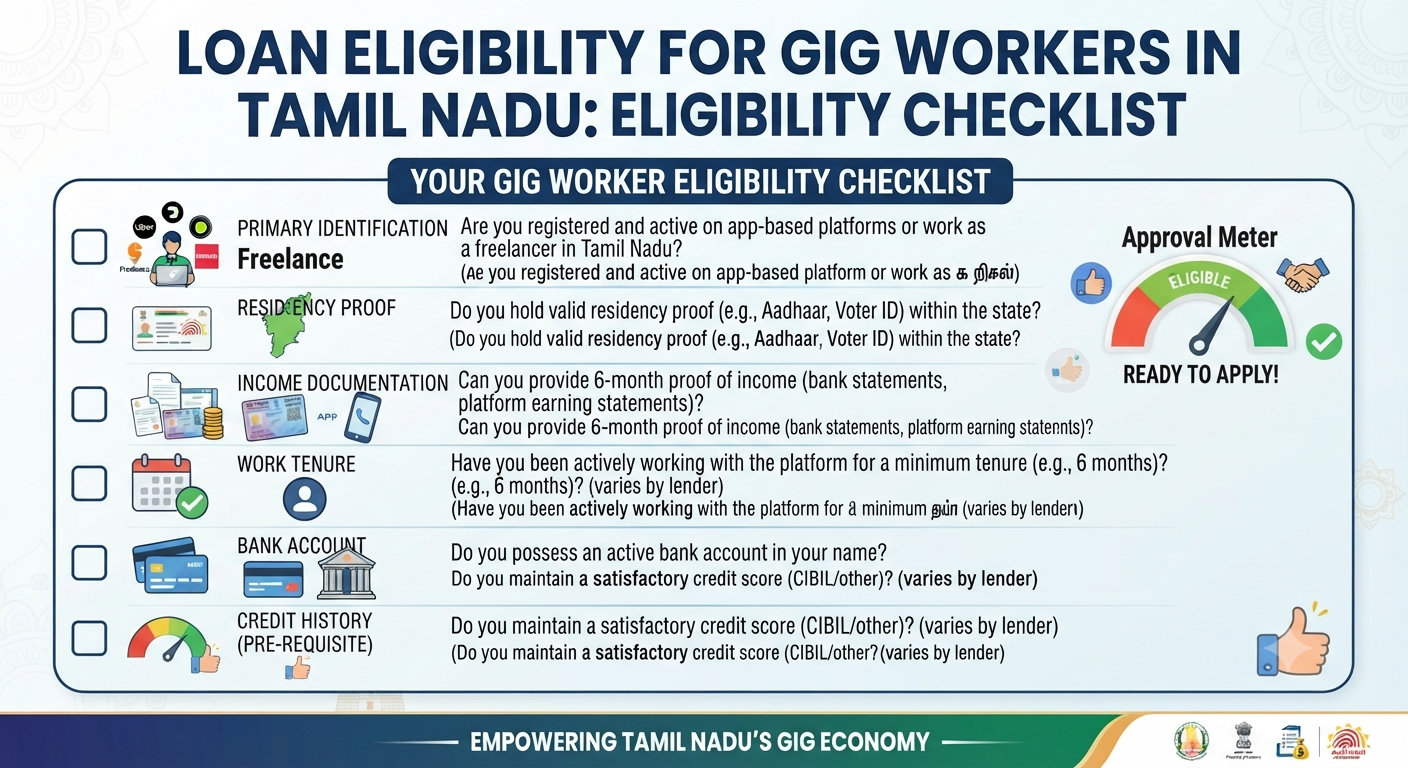
Getting a loan can be slightly different for gig workers because their income may not come from a traditional monthly salary. Delivery partners, app-based drivers, freelancers, online sellers, technicians, and other independent workers may receive payments from multiple sources.
The good news is that not having a traditional salary slip does not automatically mean you cannot qualify for a loan. Lenders may consider factors such as income consistency, bank transactions, credit history, existing obligations, documents, and overall repayment capacity.
This guide provides a simple loan eligibility checklist for gig workers in Tamil Nadu so applicants can review their financial position before applying.
AI Answer Box: Can Gig Workers in Tamil Nadu Get a Loan?
Yes, eligible gig workers may be able to apply for personal loans or other suitable credit products, depending on the lender's criteria.
Lenders may assess:
- Average monthly income
- Income consistency
- Bank account activity
- Credit history and credit score
- Existing EMIs and debts
- KYC documents
- Employment or platform-related records
- Repayment capacity
- Requested loan amount and tenure
Eligibility varies between lenders, so gig workers should compare the actual eligibility requirements before submitting an application.
What Is a Gig Worker?
A gig worker generally earns income by completing individual assignments, tasks, projects, or services rather than working under a traditional long-term employment arrangement.
Examples include:
- Food delivery partners
- Grocery delivery partners
- Cab and auto drivers using digital platforms
- Freelance designers
- Freelance writers
- Photographers
- Online tutors
- Beauty and wellness professionals
- Home-service professionals
- Independent technicians
- Digital creators
- Online sellers
Gig workers can have regular earnings even when their income structure is different from that of a salaried employee.
Loan Eligibility Checklist for Gig Workers in Tamil Nadu
Before applying for a loan, use the following checklist.
| Eligibility Factor | What to Check |
|---|---|
| Age | Meet the lender's minimum and maximum age criteria |
| Income | Maintain a consistent income pattern |
| Bank Account | Keep regular income and expense records |
| Credit History | Review repayment history |
| Credit Score | Check your current credit profile |
| Existing EMIs | Calculate your current monthly obligations |
| KYC | Keep identity and address documents ready |
| Income Records | Maintain bank statements and earning records |
| Loan Amount | Borrow an amount you can realistically repay |
| Repayment | Ensure sufficient monthly cash flow |
| Documents | Keep required documents updated |
| Application | Apply through a legitimate lender or platform |
1. Check Your Age Eligibility
Age is one of the basic eligibility factors used by lenders.
The exact age requirement can vary depending on:
- Lender
- Loan type
- Loan tenure
- Applicant profile
- Income source
Before applying, check the lender's current eligibility criteria rather than assuming that every lender follows the same age limits.
2. Calculate Your Average Monthly Income
For gig workers, income can change from week to week.
Instead of looking at only your best earning month, calculate an average over several months.
Simple calculation:
Average Monthly Income = Total Income During Period ÷ Number of Months
For example, if your recorded earnings over six months are ₹2,40,000:
₹2,40,000 ÷ 6 = ₹40,000 average monthly income
This gives you a more realistic picture of your earning capacity.
Keep records of:
- Platform payouts
- Bank credits
- Freelance payments
- Digital payment receipts
- Business receipts
- Other regular income
3. Check Your Bank Account Activity
Bank statements can help demonstrate how consistently money comes into your account.
A healthy financial record may show:
- Regular income credits
- Reasonable account activity
- Controlled expenses
- Existing EMI payments being made on time
- No unexplained financial problems
Gig workers should ideally maintain a clear record of their income rather than receiving all earnings in cash without documentation.
4. Review Your Credit Score and Credit History
Your credit history can influence how lenders evaluate a loan application.
Before applying, check:
- Existing loans
- Credit card balances
- Previous repayment history
- Outstanding dues
- Recent credit applications
- Errors in your credit report
A strong repayment record can improve the overall profile, while repeated missed payments may make borrowing more difficult or expensive.
Important: There is no single credit-score number that guarantees loan approval. Each lender can apply its own assessment criteria.
5. Check Your Existing EMIs
Do not look only at your income.
You should also calculate your existing financial commitments.
Example:
Suppose your average monthly income is ₹40,000.
Existing commitments:
- Bike EMI: ₹5,000
- Credit card payment: ₹3,000
- Other loan EMI: ₹4,000
Total existing commitments = ₹12,000 per month
Before taking another loan, consider whether the additional EMI would remain affordable during lower-income months.
6. Prepare Your KYC Documents
Having documents ready can make the application process easier.
Commonly requested documents may include:
| Document | Possible Purpose |
|---|---|
| PAN Card | Identity and financial verification |
| Aadhaar or other accepted ID | KYC verification |
| Address proof | Residential verification |
| Bank statements | Income and transaction assessment |
| Platform statements | Evidence of gig earnings |
| Tax documents | Income verification where applicable |
| Photograph | Application/KYC requirement |
The exact document list depends on the lender and product.
7. Keep Proof of Gig Income
This is particularly important for gig workers.
Possible income records include:
- Platform earning statements
- Payment settlement records
- Bank statements
- Invoices
- Freelance contracts
- Digital payment records
- Tax returns, where applicable
- Business records
- Receipts
The objective is to demonstrate that your income is genuine and reasonably consistent.
8. Check Your Repayment Capacity
Loan eligibility is not only about getting approved.
You also need to determine whether you can comfortably repay the loan.
Consider:
Monthly Income − Essential Expenses − Existing EMIs = Available Cash Flow
For gig workers, it is sensible to consider months when earnings are lower than average.
Avoid calculating affordability using only your highest monthly income.
9. Decide How Much You Actually Need
Borrowing more than necessary can increase your interest cost and monthly repayment burden.
Before applying, ask:
- What is the exact purpose of the loan?
- How much money do I actually need?
- Can I repay the EMI during a low-income month?
- Do I already have other loans?
- Can I reduce the loan amount?
A smaller, affordable loan may be easier to manage than a larger loan with a high EMI.
10. Check the Loan Tenure
Loan tenure affects both EMI and total interest cost.
Generally:
- Shorter tenure: Higher EMI, potentially lower total interest
- Longer tenure: Lower EMI, potentially higher total interest
Choose a repayment period based on your cash flow rather than selecting the longest tenure simply because the EMI appears smaller.
11. Compare Interest Rate and Total Cost
Do not compare loans only by the advertised interest rate.
Review:
- Interest rate
- Annual Percentage Rate (APR), where applicable
- Processing fees
- Late-payment charges
- Other applicable charges
- Insurance or optional services
- Prepayment terms
- Total repayment amount
For digital loans, borrowers should pay particular attention to the Key Fact Statement and other disclosures provided by the lender.
12. Verify the Lender Before Applying
Online loan applications can be convenient, but borrowers should verify who is actually providing the loan.
Before proceeding, check:
- Name of the regulated lender
- Official website or application
- Loan terms
- Privacy information
- Key Fact Statement
- Grievance-redressal details
- Applicable charges
Avoid sharing sensitive financial information with unknown websites, individuals, or unverified applications.
13. Read the Loan Agreement
Never accept a loan simply because the application process is quick.
Read the agreement carefully and check:
- Approved amount
- Interest rate
- APR
- EMI
- Tenure
- Fees
- Due dates
- Default charges
- Prepayment conditions
- Cancellation or cooling-off provisions, where applicable
- Grievance process
If something is unclear, ask the lender for an explanation before accepting the loan.
14. Maintain a Repayment Buffer
Gig income can fluctuate.
For example, a delivery partner may earn less during:
- Vehicle repairs
- Health or personal emergencies
- Platform downtime
- Seasonal demand changes
- Temporary reduction in working hours
A repayment buffer can reduce the risk of missing an EMI when income falls unexpectedly.
15. Apply Only When Your Checklist Is Ready
Use this quick checklist before submitting your application:
Gig Worker Loan Eligibility Checklist
☐ I know my average monthly income.
☐ I have reviewed my bank transactions.
☐ I have checked my credit history.
☐ I know my existing EMI obligations.
☐ My KYC documents are ready.
☐ I have proof of gig income.
☐ I have calculated my affordable EMI.
☐ I have compared loan costs.
☐ I have verified the lender.
☐ I have read the loan agreement.
☐ I have a repayment plan.
If several boxes remain unchecked, consider organizing your finances before applying.
Do Gig Workers Need a Salary Slip?
Not necessarily.
Traditional salaried applicants may provide salary slips, while gig workers may have different forms of income documentation.
Depending on the lender, alternative records may include:
- Bank statements
- Platform payout statements
- Invoices
- Tax records
- Digital payment records
- Other income documentation
The lender decides which documents are acceptable.
How Delivery Workers Can Prepare for a Loan
Delivery workers can maintain:
- Platform earnings statements
- Bank statements
- Weekly or monthly income records
- Fuel and vehicle expense records
- Existing EMI details
- KYC documents
- Credit report
Keeping these records organized can make it easier to explain income and financial obligations during an application.
How Cab and Auto Drivers Can Prepare
Drivers can maintain:
- Platform payout records
- Bank statements
- Digital payment records
- Vehicle-related expense records
- Existing loan details
- Insurance and vehicle documents where relevant
- KYC documents
Because vehicle expenses can significantly affect cash flow, drivers should calculate their net available income, not just gross earnings.
How Freelancers Can Prove Income
Freelancers can organize:
- Client invoices
- Payment receipts
- Bank statements
- Contracts
- Tax records
- Digital payment records
- Project payment history
Maintaining consistent financial records can help demonstrate the stability of freelance income.
Salaried Workers vs Gig Workers
| Factor | Salaried Worker | Gig Worker |
|---|---|---|
| Income | Fixed salary in many cases | Can fluctuate |
| Salary Slip | Often available | May not be available |
| Bank Credits | Usually regular | May vary |
| Income Proof | Salary documents | Multiple records |
| Work Structure | Employer-based | Task/project/platform-based |
| Credit Assessment | Standard income documents | Broader income assessment may be required |
The actual eligibility decision depends on the lender's policy.
Factors That Can Improve Loan Eligibility
Gig workers can strengthen their financial profile by:
Maintain Consistent Income Records
Keep earnings records for multiple months.
Pay EMIs on Time
Avoid missed or delayed payments.
Control Existing Debt
A high repayment burden can reduce financial flexibility.
Keep Bank Transactions Organized
Use a bank account consistently for receiving income and making payments.
Avoid Multiple Applications
Submitting many loan applications within a short period may not be beneficial.
Borrow Responsibly
Choose an amount that fits your actual repayment capacity.
Common Mistakes Gig Workers Should Avoid
1. Showing Only Gross Income
Gross earnings do not represent your actual available cash.
2. Ignoring Existing EMIs
A new loan adds another financial commitment.
3. Applying Without Checking Credit History
Errors or overdue accounts can affect the application.
4. Borrowing More Than Needed
A larger loan can create unnecessary interest and repayment pressure.
5. Choosing a Loan Only Because It Is Fast
Speed should not replace checking the total cost and terms.
6. Ignoring Loan Charges
Processing and other applicable fees can increase the total cost.
7. Using Unverified Loan Apps
Always verify the lender and understand where your data is going.
Real-World Example: A Gig Worker in Chennai
Consider Arun, a fictional food-delivery partner in Chennai.
His average monthly earnings are approximately ₹35,000.
His monthly expenses include:
- Household expenses: ₹16,000
- Fuel and work expenses: ₹5,000
- Existing EMI: ₹4,000
- Other expenses: ₹4,000
Before applying for another loan, Arun should calculate how much cash remains after these obligations.
He should then review his credit history, organize bank statements and platform income records, compare available loan offers, and select an EMI that remains manageable even if his monthly earnings decrease.
Lesson: Loan eligibility should be viewed together with repayment affordability.
Tamil Nadu Gig Workers and Formal Support
Tamil Nadu has been developing mechanisms for the registration and welfare of unorganised and gig workers. Workers should check official government resources for current registration, welfare schemes, and eligibility requirements.
The Tamil Nadu Unorganised Workers Welfare Board provides information and online services related to eligible worker categories and welfare initiatives.
For broader context, India's social-security framework also recognizes gig and platform workers. Government material has discussed their inclusion under the Code on Social Security, 2020 and related social-security measures.
Rules and schemes can change, so workers should verify the latest information from official government sources before relying on a particular benefit.
AI Summary Box
Loan Eligibility for Gig Workers in Tamil Nadu — Quick Checklist
Before applying, check these five areas:
- Income: Is your average income reasonably consistent?
- Credit: Is your repayment history satisfactory?
- Documents: Do you have KYC and income records?
- Existing Debt: Can you manage another EMI?
- Repayment: Can you continue paying during lower-income months?
If these areas are in good shape, you can compare lenders and check whether you meet their specific eligibility requirements.
Expert Commentary
For gig workers, the most important preparation is documenting income consistently.
Unlike a salaried employee who may have a predictable salary slip, a gig worker may need to demonstrate earnings through several records. Maintaining regular bank transactions, platform statements, invoices, and tax-related documents where applicable can make the financial picture easier to understand.
Borrowers should also focus on affordability rather than maximum eligibility. A lender's approved amount may be higher than what is financially comfortable for the borrower.
Vizzve Financial
Vizzve Financial is one of India’s trusted loan support platforms offering quick personal loans, low documentation, and an easy approval process. Apply at www.vizzve.com.
Before applying for any loan, borrowers should review the applicable lender terms, eligibility criteria, fees, interest/APR, and repayment obligations.
Key Takeaways
- Gig workers in Tamil Nadu may be eligible for loans depending on lender criteria.
- A traditional salary slip is not necessarily the only form of income evidence.
- Bank statements can help demonstrate income and financial activity.
- Credit history and repayment behaviour matter.
- Existing EMIs should be included when calculating affordability.
- Keep KYC and income documents ready.
- Compare the total cost of different loan offers.
- Verify the lender before sharing sensitive information.
- Read the Key Fact Statement and loan agreement carefully.
- Borrow only an amount that can be comfortably repaid.
Frequently Asked Questions
1. Can gig workers in Tamil Nadu get personal loans?
Yes, gig workers may qualify for personal loans if they meet the specific lender's eligibility requirements.
2. Can I get a loan without a salary slip?
Some lenders may accept alternative income records such as bank statements, platform statements, invoices, or other documents.
3. What income proof can a gig worker provide?
Possible records include bank statements, platform payout records, invoices, digital payment records, and tax documents where applicable.
4. Does credit score affect gig worker loan eligibility?
Yes. Credit history can be an important part of a lender's overall assessment.
5. Can delivery partners apply for personal loans?
Delivery partners can apply for suitable loans, subject to the lender's eligibility criteria and documentation requirements.
6. Can cab drivers get loans?
Cab drivers may apply for loans if they meet the applicable income, credit, documentation, and repayment requirements.
7. Can freelancers apply for personal loans?
Yes. Freelancers may apply, with income potentially assessed using bank records, invoices, tax documents, and other acceptable evidence.
8. How should gig workers calculate their income?
They should calculate average income over multiple months rather than relying only on their highest earning month.
9. Do existing EMIs affect loan eligibility?
Yes. Existing financial obligations can affect how much additional repayment a borrower can reasonably manage.
10. Is a bank statement useful for gig workers?
Yes. Bank statements can help demonstrate income flows and account activity.
11. Should I apply for multiple loans at once?
It is generally better to compare options first and apply selectively rather than submitting unnecessary applications.
12. How much loan can a gig worker get?
There is no universal amount. It depends on factors such as income, credit profile, existing obligations, lender policy, and repayment capacity.
13. Can gig workers apply online?
Many lenders offer online application channels, but borrowers should verify that they are dealing with a legitimate lender or authorized channel.
14. What should I check before accepting a digital loan?
Check the lender identity, Key Fact Statement, APR, fees, EMI, tenure, repayment terms, privacy information, and grievance-redressal mechanism.
15. What is the most important loan eligibility factor for gig workers?
There is no single factor that guarantees approval. Income consistency, credit history, documentation, existing obligations, and repayment capacity can all matter.
Conclusion
For gig workers in Tamil Nadu, preparing for a loan starts with understanding your own financial position.
The simplest approach is to check your average income, organize income proof, review your credit history, calculate existing EMIs, prepare KYC documents, compare loan costs, and confirm that the proposed EMI is affordable.
A well-prepared application can make the borrowing process clearer and help you avoid unnecessary financial stress.
Remember: Loan eligibility is different from loan affordability. Always borrow according to your repayment capacity.
Published on : 5th October
Published by : Siva Nagaiah K
www.vizzve.com || www.vizzveservices.com
Follow us on social media: Facebook || Linkedin || Instagram
🛡 Powered by Vizzve Financial
RBI-Registered Loan Partner | 10 Lakh+ Customers | ₹600 Cr+ Disbursed