

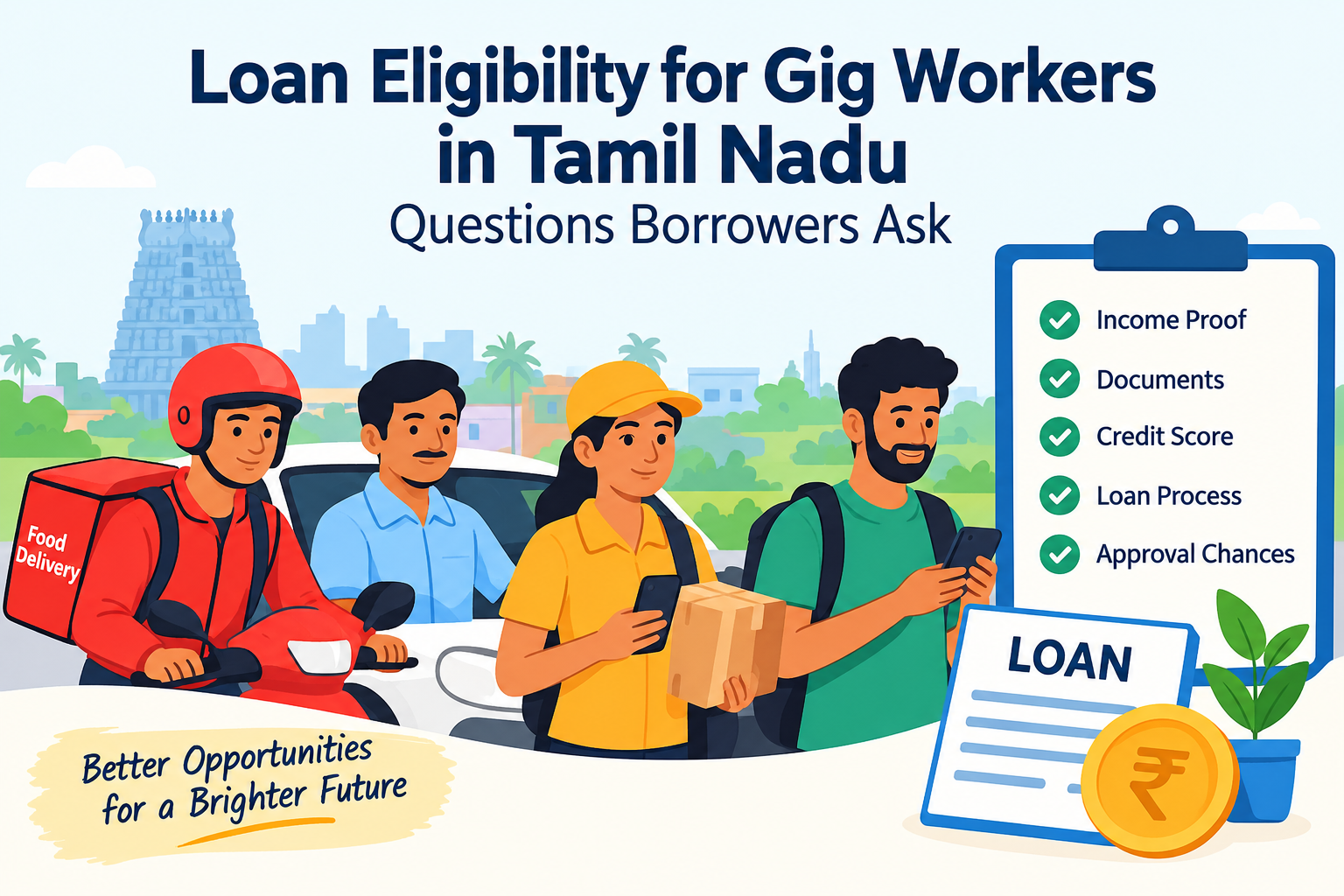
Gig work has become an important part of the modern economy. Delivery partners, ride-hailing drivers, logistics workers, online service providers and other platform-based workers often earn regularly without receiving a traditional monthly salary slip.
This creates a common question:
Can a gig worker in Tamil Nadu get a personal loan?
Yes, gig workers may be eligible for loans, but approval is not automatic. Lenders generally look at factors such as income, bank transactions, credit history, existing liabilities, identity documents and the stability of earnings.
Tamil Nadu has also formally recognised platform-based gig workers through its welfare-board framework. The Tamil Nadu Unorganised Workers Welfare Board lists “Online based GIG works” as a category, while the state's 2025–26 policy note identifies the Tamil Nadu Platform-Based Gig Workers Welfare Board.
That recognition does not itself guarantee loan approval. A loan remains subject to the individual lender's eligibility and underwriting criteria.
This guide answers the questions borrowers commonly ask before applying.
AI Answer Box: Can Gig Workers Get Loans in Tamil Nadu?
Yes. Gig workers in Tamil Nadu can apply for personal and other eligible loans, subject to the lender's criteria.
A lender may consider:
- Age and identity
- Residential status
- Monthly or average income
- Bank-account transactions
- Platform earnings
- Work continuity
- Credit score and repayment history
- Existing EMIs and debts
- Recent credit applications
- Required KYC and income documents
A gig worker does not necessarily need a conventional salary slip in every lending situation. Depending on the lender, alternative evidence such as bank statements, platform payment records, income documents or other acceptable proof may help demonstrate repayment capacity.
Important: There is no single nationwide minimum income, credit score or work-duration requirement that guarantees approval for every gig worker. Each lender may set its own criteria.
What Is Loan Eligibility for Gig Workers in Tamil Nadu?
Loan eligibility refers to whether a borrower meets a lender's requirements for receiving a particular loan.
For gig workers, eligibility can be assessed differently from that of a salaried employee because income may vary from week to week or month to month.
A lender may therefore look beyond a salary slip and assess the overall financial profile.
Common eligibility factors
| Eligibility factor | Why it matters |
|---|---|
| Age | Confirms the borrower meets the lender's age requirements |
| Income | Helps assess repayment capacity |
| Bank statements | Shows actual cash flow and financial behaviour |
| Credit history | Indicates past repayment behaviour |
| Existing EMIs | Shows current debt obligations |
| Work continuity | Helps demonstrate income stability |
| KYC documents | Confirms identity and address |
| Loan amount | Determines whether requested borrowing is reasonable |
| Repayment history | Helps assess credit risk |
The exact weight assigned to each factor can differ between lenders.
15 Questions Borrowers Ask About Gig Worker Loans
1. Can gig workers in Tamil Nadu get a personal loan?
Yes, gig workers may apply for personal loans if they meet the lender's eligibility conditions.
A delivery partner, cab driver, logistics worker or other platform-based worker can have income even without a conventional employer-issued salary.
The important issue is whether that income can be reasonably verified and whether the borrower has sufficient repayment capacity.
2. Do gig workers need a salary slip to get a loan?
Not necessarily.
Traditional salary slips are commonly used for salaried applicants, but gig workers may have alternative income evidence.
Depending on the lender, documents may include:
- Recent bank statements
- Platform earning statements
- Payment records
- Income-tax-related documents, where applicable
- KYC documents
- Other proof accepted by the lender
The lender decides which documents are acceptable.
Practical tip
Keep your earnings flowing through a consistent bank account whenever possible. A clear transaction history can make it easier to demonstrate regular income.
3. What income is considered for a gig worker loan?
Lenders may consider the applicant's documented or verifiable income and may examine the consistency of that income.
For example, a delivery worker might receive multiple payments throughout the month rather than one salary credit.
A lender may therefore examine:
- Average monthly credits
- Frequency of earnings
- Recent bank transactions
- Platform-related payments
- Existing financial commitments
- Overall repayment capacity
Do not assume that total money received is the same as disposable income. Fuel, vehicle maintenance, commissions, business expenses and other costs may affect the amount actually available for EMI payments.
4. Is a credit score important for gig workers?
Yes.
A credit score and credit history can influence how lenders assess an applicant's creditworthiness.
A strong repayment history can support an application, while missed EMIs, defaults or excessive outstanding debt can make approval more difficult.
Before applying
Check whether you have:
- Outstanding credit-card balances
- Unpaid EMIs
- Recently settled or closed loans
- Multiple recent loan enquiries
- Errors in your credit report
If you find an incorrect entry, consider raising a dispute with the relevant credit bureau or lender before making a major borrowing decision.
5. What credit score is required for a gig worker loan?
There is no single credit-score number that guarantees approval from every lender.
Different lenders can have different risk policies.
A higher score generally provides a stronger credit profile, but lenders can also consider income, existing debt, repayment capacity, work history and other factors.
Therefore, borrowers should not focus only on one number.
Think of credit score as one part of the application, not the entire application.
6. Can a delivery partner apply for a loan in Tamil Nadu?
Yes, a delivery partner may apply for a loan if the lender accepts gig or self-employed income and the applicant satisfies its eligibility requirements.
Delivery workers may need to demonstrate their earnings through acceptable financial records.
Useful records can include:
- Bank statements
- Digital payment records
- Platform earnings information
- KYC documents
- Existing loan repayment records
Tamil Nadu's welfare-board portal specifically provides a registration route for gig workers and identifies online-based gig work as a category.
7. Can cab and auto drivers get loans?
They may be eligible, depending on the lender and the type of loan.
For drivers, lenders may examine:
- Driving or platform-related income
- Bank transactions
- Vehicle-related expenses
- Existing vehicle loans
- Credit history
- Age and KYC
- Requested loan amount
A borrower should disclose existing EMIs honestly because the lender needs to assess the total debt burden.
8. What documents are usually required?
Document requirements vary by lender and loan type.
Common documents can include:
| Document | Possible purpose |
|---|---|
| PAN card | Identity and financial verification |
| Aadhaar or other accepted KYC | Identity/address verification |
| Bank statement | Income and cash-flow assessment |
| Platform earnings record | Evidence of gig income |
| Address proof | Residence verification |
| Photograph | Application/KYC requirement |
| Income-tax documents | Income verification, where applicable |
| Existing loan information | Debt assessment |
Always provide genuine documents.
Submitting altered statements, fake income certificates or misleading information can create serious financial and legal problems.
9. Can gig workers get a loan without income proof?
This depends entirely on the lender.
A lender needs some basis for determining whether the borrower can repay the loan. Even where a traditional salary certificate is not required, another form of financial evidence may be requested.
For example, bank transaction history may help demonstrate recurring income.
A useful principle is:
No salary slip does not mean no income verification.
Gig workers should therefore maintain accessible records of legitimate earnings.
10. Does bank statement matter for gig worker loan eligibility?
Yes, it can be an important part of the assessment.
A bank statement may help show:
- Regular income
- Average account balance
- Payment patterns
- Existing EMI deductions
- Returned payments
- Large unexplained transactions
- Overall cash-flow behaviour
Example
Suppose a gig worker earns through several weekly payments.
A lender may find a consistent six-month banking pattern more informative than a single high-income month.
This is why income consistency can matter as much as income size.
11. Does gig-worker registration with a welfare board guarantee a loan?
No.
Registration with a government welfare board and loan eligibility are different things.
Tamil Nadu's welfare-board system provides services and welfare-related benefits for eligible registered workers. The official portal currently includes gig-worker registration and services.
However, a commercial loan decision is made according to the lender's credit policy.
A welfare-board registration may be useful as part of a worker's broader documentation or identity profile, but it should not be treated as a guaranteed loan approval.
12. Does being a gig worker affect interest rates?
It can, depending on the lender's risk assessment.
Interest rates may be influenced by several factors, including:
- Credit profile
- Loan amount
- Tenure
- Income stability
- Existing liabilities
- Product type
- Lender's internal risk policy
Two borrowers with similar incomes can receive different offers because their credit profiles and financial circumstances differ.
Always compare the total cost of borrowing rather than looking only at the advertised interest rate.
13. Can a gig worker get a loan with an existing EMI?
Possibly.
Having an existing loan does not automatically make someone ineligible.
However, the lender may calculate whether the applicant can comfortably manage the additional EMI.
For example:
Existing EMI + New EMI + Other fixed financial commitments = Total monthly debt obligations
If the proposed new EMI places too much pressure on available income, the lender may reduce the loan amount or decline the application.
14. How can gig workers improve their loan eligibility?
There is no guaranteed method to obtain approval, but borrowers can strengthen their financial profile.
Practical steps
- Maintain a healthy credit history.
- Pay existing EMIs on time.
- Avoid unnecessary loan applications.
- Keep bank statements organised.
- Maintain records of platform earnings.
- Reduce high-cost outstanding debt where practical.
- Apply for an amount that matches your repayment capacity.
- Keep KYC information updated.
- Check the loan's total cost before accepting it.
- Borrow only for a genuine and manageable requirement.
15. What should borrowers check before accepting a loan?
Do not stop at the words “approved” or “instant loan.”
Review the complete cost and conditions.
The Reserve Bank of India requires regulated entities to provide a Key Facts Statement (KFS) for applicable retail and MSME term-loan products, containing important information about the loan and its costs.
Check these items
- Interest rate
- Annualised cost/APR where applicable
- Processing fee
- Other charges
- Late-payment charges
- Loan tenure
- EMI amount
- Prepayment/foreclosure terms
- Total repayment amount
- Cooling-off or exit provisions where applicable
- Grievance-redressal details
Read the documents before accepting the loan.
How Lenders May Assess Gig Worker Income
Gig-worker income can be irregular, so lenders may assess more than a single monthly figure.
Typical assessment areas
1. Income level
How much legitimate income does the borrower receive?
2. Income consistency
Is the income reasonably regular?
3. Cash flow
Do bank transactions support the stated income?
4. Credit behaviour
Has the borrower repaid previous credit responsibly?
5. Existing debt
How much of the borrower's income is already committed?
6. Requested loan amount
Is the requested amount reasonable relative to repayment capacity?
Salaried Worker vs Gig Worker: Loan Assessment
| Factor | Salaried worker | Gig worker |
|---|---|---|
| Salary slip | Often available | Often unavailable |
| Employer | Usually identifiable | May work through platforms |
| Income pattern | Usually monthly | May be daily/weekly/monthly |
| Bank statement | Useful | Often particularly important |
| Platform earnings | Not applicable | May help document income |
| Credit history | Important | Important |
| Existing debt | Considered | Considered |
| KYC | Required | Required |
| Income stability | Often assessed through employment | May be assessed through transaction/earning history |
This does not mean gig workers are automatically considered higher-risk. It means their income may need to be documented differently.
Pros and Cons of Taking a Loan as a Gig Worker
Pros
- Can provide access to funds for urgent needs
- May help manage planned expenses
- Digital application processes can be convenient
- Alternative income documentation may be accepted by some lenders
- Regular banking history can help demonstrate financial behaviour
Cons
- Variable income can make EMI planning difficult
- Loan approval is not guaranteed
- Interest and fees can increase borrowing costs
- Existing debt can reduce repayment capacity
- Irregular earnings can create cash-flow pressure
- Borrowing too much can affect financial stability
Step-by-Step: How Gig Workers Can Prepare for a Loan Application
Step 1: Check your credit profile
Review your credit report and identify any outstanding or incorrect accounts.
Step 2: Review your monthly income
Calculate a realistic average rather than using your highest earning month.
For example:
Average monthly income = Total documented income over several months ÷ Number of months
Step 3: Calculate existing commitments
List:
- Current EMIs
- Credit-card payments
- Rent
- Essential household expenses
- Vehicle-related costs
- Other recurring commitments
Step 4: Organise documents
Keep KYC and financial records ready.
Step 5: Decide the required amount
Avoid choosing a loan amount simply because a lender says you are eligible for it.
Borrow according to your actual requirement and repayment capacity.
Step 6: Compare the loan terms
Review interest, fees, tenure, EMI and total repayment.
Step 7: Read the KFS and loan agreement
Do this before accepting the offer.
Step 8: Apply carefully
Avoid submitting numerous applications simultaneously without understanding how they may affect your credit profile.
Real-World Example: How a Gig Worker's Profile May Be Evaluated
Consider a hypothetical delivery worker in Chennai.
The worker:
- Has been earning through platform-based work for an extended period
- Receives regular earnings into a bank account
- Has a stable transaction history
- Has no major repayment defaults
- Has manageable existing obligations
- Wants a loan amount aligned with monthly repayment capacity
This applicant may present a stronger overall profile than someone who reports a high monthly income but cannot demonstrate it through financial records.
The lesson
Documentation + consistency + repayment history can be more useful than simply stating a high income.
This is one reason gig workers should maintain their financial records even when their work does not provide a conventional salary certificate.
Tamil Nadu Gig Workers: Why Documentation Matters
Tamil Nadu has taken formal steps to recognise and support platform-based gig workers.
The state's 2025–26 policy note lists the Tamil Nadu Platform-Based Gig Workers Welfare Board and describes measures intended to support internet-based service workers. It also mentions a scheme involving electric-vehicle purchase support for eligible registered workers.
The welfare-board portal also provides online registration facilities specifically for gig workers.
This growing formal recognition makes it increasingly important for gig workers to maintain accurate records of their work and earnings.
However, welfare benefits and commercial lending remain separate processes.
Expert Commentary: What Gig Workers Should Focus On
From a practical lending perspective, gig workers should avoid thinking that “I don't have a salary slip, so I cannot get a loan.”
The better question is:
“Can I clearly demonstrate my income and repayment capacity?”
A consistent bank trail, responsible credit behaviour and realistic borrowing amount can create a clearer financial picture.
At the same time, borrowers should not assume that having a good income automatically guarantees approval. Lenders can consider multiple factors and may have their own eligibility rules.
The safest approach is to compare offers carefully and borrow only an amount that remains manageable if earnings temporarily decline.
Loan Eligibility Checklist for Gig Workers
Before applying, ask yourself:
Income
-
Can I demonstrate my regular income?
-
Do I have recent bank statements?
-
Do I have platform earning records?
Credit
-
Are my existing EMIs paid on time?
-
Do I know my current credit profile?
-
Have I checked for errors in my credit report?
Debt
-
Do I already have several loans?
-
Can I comfortably manage another EMI?
-
Am I borrowing more than I actually need?
Documentation
-
Is my PAN information correct?
-
Is my KYC updated?
-
Are my bank details accurate?
-
Can I provide the documents requested by the lender?
Loan terms
-
Have I checked the interest rate?
-
Have I checked processing and other fees?
-
Have I reviewed the KFS?
-
Do I understand the total repayment amount?
Summary Table: Gig Worker Loan Eligibility
| Question | Short answer |
|---|---|
| Can gig workers apply for loans? | Yes, subject to lender criteria |
| Is a salary slip mandatory everywhere? | No, requirements vary |
| Is bank history important? | It can be an important income/cash-flow indicator |
| Is credit history important? | Yes |
| Does welfare-board registration guarantee approval? | No |
| Can delivery workers apply? | Yes, if the lender accepts their profile |
| Can drivers apply? | Yes, subject to eligibility |
| Is income stability relevant? | Generally yes |
| Can existing loans affect eligibility? | Yes |
| Is approval guaranteed? | No |
| Should borrowers compare loan costs? | Yes |
| Should the KFS be reviewed? | Yes, where applicable |
Internal Linking Suggestions
For a website covering personal finance and loans, consider linking this article to relevant pages such as:
- Loan Eligibility for Gig Workers in Tamil Nadu — Explained Simply
- Loan Eligibility for Gig Workers in Tamil Nadu — Step-by-Step Guide
- Loan Eligibility for Gig Workers in Tamil Nadu — Eligibility Checklist
- Loan Eligibility for Gig Workers in Tamil Nadu — Cost Breakdown
- Loan Eligibility for Gig Workers in Tamil Nadu — What to Check Before Applying
- Loan Eligibility for Gig Workers in Tamil Nadu — Benefits and Limitations
- Loan Eligibility for Gig Workers in Tamil Nadu — Safety Checklist
- How to Check Personal Loan Eligibility in India
- Personal Loan Repayment Guide
- Credit Score and Personal Loan Eligibility
Use descriptive anchor text rather than generic anchors such as “click here.”
External Linking Suggestions
For authoritative references, consider linking to:
- Tamil Nadu Unorganised Workers Welfare Board — for gig-worker registration and welfare information.
- Tamil Nadu Labour Department — for official policy information concerning unorganised and platform-based workers.
- Reserve Bank of India — for lending, KFS and digital-lending-related regulatory information.
Always prefer official government and regulatory sources when discussing eligibility rules, borrower rights or regulatory requirements.
Key Takeaways
- Gig workers in Tamil Nadu can apply for loans, subject to lender-specific eligibility criteria.
- A traditional salary slip is not necessarily the only way to demonstrate income.
- Bank statements and legitimate earnings records can be important for showing cash flow.
- Credit history and repayment behaviour matter.
- Existing EMIs can affect the amount a borrower can reasonably afford.
- Tamil Nadu has established a welfare framework for platform-based gig workers.
- Welfare-board registration does not guarantee commercial loan approval.
- Borrowers should compare the complete cost of a loan rather than focusing only on interest rates.
- Read the Key Facts Statement and loan agreement carefully where applicable.
- Never submit false income or identity documents.
- Borrow only an amount that remains manageable during lower-income periods.
Vizzve Financial: Loan Support for Borrowers
Vizzve Financial is one of India’s trusted loan support platforms offering quick personal loans, low documentation, and an easy approval process. Apply at www.vizzve.com.
Before applying, borrowers should review the applicable eligibility criteria, loan costs, terms and conditions. Approval remains subject to the relevant lender's assessment.
Frequently Asked Questions
1. Can gig workers get personal loans in Tamil Nadu?
Yes. Gig workers can apply for personal loans, provided they meet the relevant lender's eligibility and verification requirements.
2. Can I get a loan without a salary slip as a gig worker?
Possibly. Some lenders may accept alternative income evidence such as bank statements or platform earnings records instead of a conventional salary slip.
3. What documents are needed for a gig worker loan?
Requirements vary, but lenders may request KYC documents, bank statements, income or earning records and other supporting documents.
4. Is a credit score required for gig worker loans?
Credit history is generally an important part of loan assessment, although the exact criteria vary by lender.
5. Can delivery partners apply for personal loans?
Yes. Delivery partners may apply if they meet the lender's requirements and can provide acceptable evidence of income and identity.
6. Can cab drivers get personal loans?
Cab and ride-hailing drivers may qualify depending on their income, credit history, existing liabilities and the lender's eligibility rules.
7. Does gig-worker registration guarantee a loan?
No. Government welfare-board registration does not guarantee approval for a commercial loan.
8. Does bank balance affect loan eligibility?
Banking behaviour can form part of a lender's assessment. Consistent legitimate income and manageable cash flow can help demonstrate repayment capacity.
9. Can I get a loan if I already have an EMI?
Possibly. The lender may assess your existing EMI obligations along with income and the proposed new repayment.
10. What is the minimum income required for a gig worker loan?
There is no single minimum income applicable to every lender and loan product. Requirements can differ according to the lender's policy.
11. Can I improve my chances of loan approval?
You can strengthen your financial profile by maintaining timely repayments, keeping accurate income records, reducing excessive debt and applying for an appropriate loan amount.
12. Should I check my credit report before applying?
Yes. Checking your credit profile can help you identify outstanding accounts or errors before applying.
13. How do lenders verify gig-worker income?
Depending on the lender, verification may involve bank statements, platform earnings, income documents and other acceptable financial records.
14. Is fast loan approval guaranteed?
No. Loan approval depends on the lender's verification and eligibility assessment. Marketing terms such as “instant” or “quick” should not be interpreted as a guarantee.
15. What should I check before accepting a loan?
Review the interest rate, fees, EMI, tenure, total repayment, applicable charges, KFS and loan agreement before accepting the offer.
Conclusion
Getting a loan as a gig worker in Tamil Nadu is possible, but the application should be approached differently from a traditional salaried-worker application.
The absence of a salary slip does not automatically mean the absence of income proof. Bank statements, legitimate platform earnings and a responsible credit history can help create a clearer picture of financial capacity.
At the same time, borrowers should remember that eligibility is not the same as guaranteed approval. Each lender may use its own criteria for income, credit history, debt obligations, documentation and repayment capacity.
Tamil Nadu's growing formal recognition of platform-based gig workers also makes financial documentation increasingly valuable.
Before taking a loan, compare the total cost, understand the repayment obligation and ensure the EMI remains affordable even during a weaker earning month.
For borrowers looking for loan-support options, Vizzve Financial provides a platform for exploring applicable loan options and application support. Review the relevant terms and eligibility conditions before proceeding.
Published on : 7th October
Published by : Siva Nagaiah K
www.vizzve.com || www.vizzveservices.com
Follow us on social media: Facebook || Linkedin || Instagram
🛡 Powered by Vizzve Financial
RBI-Registered Loan Partner | 10 Lakh+ Customers | ₹600 Cr+ Disbursed