

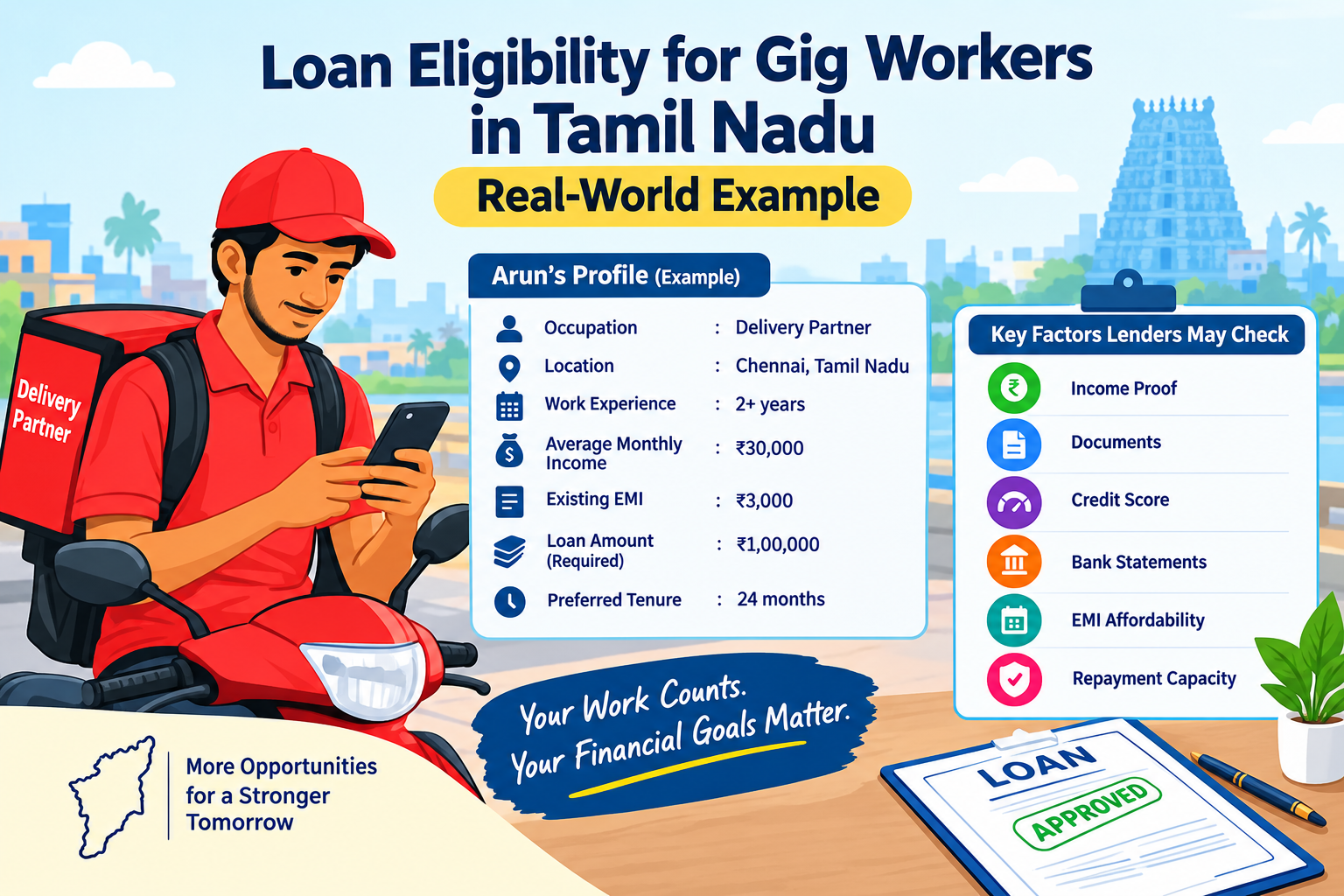
Getting a loan can look different for a gig worker than for a traditional salaried employee.
A delivery executive, ride-hailing driver, freelance worker, or other platform-based worker may receive income regularly without receiving a conventional salary slip. That does not automatically mean a loan is impossible. Instead, lenders may assess the applicant's overall financial profile, including income patterns, bank transactions, credit history, existing obligations, KYC information, and repayment capacity.
Tamil Nadu has also created an online registration facility for gig workers through the Tamil Nadu Unorganised Workers Welfare Board. The official portal provides a dedicated gig-worker registration route and also lists an e-scooter subsidy application for platform-based gig workers.
However, registration with a welfare board should not be confused with automatic eligibility for a commercial loan. Loan approval remains subject to the policies and assessment criteria of the lender.
This article explains the concept through a hypothetical real-world example so that gig workers can understand what lenders may look at before applying.
AI Answer Box: Loan Eligibility for Gig Workers in Tamil Nadu
A gig worker in Tamil Nadu may be eligible for a personal loan if the lender's criteria are satisfied. Instead of relying only on a salary slip, the lender may consider income consistency, bank statements, credit history, existing EMIs, KYC documents, employment or platform activity, and overall repayment capacity.
For example, if a delivery partner earns approximately ₹28,000–₹32,000 per month, has regular bank credits, maintains a reasonable credit profile, has manageable existing debt, and can comfortably afford the proposed EMI, the application may present a stronger financial profile than an applicant with irregular income and heavy existing obligations.
There is no single loan amount, income level, or credit score that guarantees approval for every gig worker. Eligibility varies by lender and product.
Real-World Example: A Gig Worker Applying for a Loan in Tamil Nadu
Let's consider a hypothetical applicant named Arun.
Note: Arun is a fictional example created to explain the loan assessment process. The figures are illustrative and should not be treated as a guaranteed lender offer.
Arun works as a delivery partner in Chennai, Tamil Nadu.
He has been working through a digital delivery platform for more than two years. His income changes from month to month because it depends on the number of deliveries, incentives, working hours, fuel expenses, and other costs.
He wants a personal loan of ₹1,00,000 for a combination of household expenses and an urgent financial requirement.
Arun's Financial Profile
| Factor | Example |
|---|---|
| Occupation | Delivery/Gig Worker |
| Location | Chennai, Tamil Nadu |
| Work Experience | 2+ years |
| Average Monthly Gross Earnings | ₹30,000 |
| Approx. Monthly Essential Expenses | ₹18,000 |
| Existing EMI | ₹3,000 |
| Proposed Loan | ₹1,00,000 |
| Preferred Tenure | 24 months |
| Salary Slip | Not available |
| Bank Account | Active |
| Income Credits | Regular but variable |
| Credit History | Assumed to be satisfactory |
This example demonstrates an important point:
Gig-worker eligibility is not necessarily about having a traditional salary. It is about demonstrating a credible and sustainable ability to repay the loan.
Step 1: Understanding Arun's Income
Arun does not earn exactly ₹30,000 every month.
His actual earnings might look like this:
| Month | Approx. Earnings |
|---|---|
| January | ₹29,000 |
| February | ₹31,500 |
| March | ₹28,500 |
| April | ₹32,000 |
| May | ₹30,500 |
| June | ₹29,500 |
His six-month average is approximately ₹30,167 per month.
This type of income pattern is common in gig work: earnings can move up or down while remaining relatively consistent over a longer period.
Why Income Consistency Matters
A lender may be more comfortable with an applicant who can demonstrate recurring income than someone whose earnings are completely unpredictable.
For a gig worker, useful evidence may include:
- Bank statements
- Platform earnings records
- Digital payment records
- Transaction history
- Tax or income documents, where applicable
- Other acceptable income documentation requested by the lender
The exact documents accepted will depend on the lender.
Step 2: Can Arun Get a Loan Without a Salary Slip?
Possibly.
A salary slip is common for salaried employees, but gig workers may not have one. Depending on the loan product and lender, alternative evidence of income may be considered.
Arun could therefore prepare:
- Recent bank statements
- Platform earnings history
- KYC documents
- PAN
- Address information
- Details of existing loans or EMIs
- Other income documents if requested
The important point is that absence of a salary slip does not automatically mean rejection.
At the same time, a lender is not required to approve an application simply because alternative documents are available.
Step 3: Checking Arun's Bank Statement
Suppose Arun's bank statement shows regular incoming credits that broadly match his reported earnings.
This helps create a clearer picture of his cash flow.
For example:
Monthly income: ₹30,000
Household and essential expenses: ₹18,000
Existing EMI: ₹3,000
That leaves approximately:
₹30,000 − ₹18,000 − ₹3,000 = ₹9,000
This ₹9,000 is not automatically the amount Arun should spend on a new EMI. He still needs to account for:
- Fuel
- Vehicle maintenance
- Mobile and internet expenses
- Medical expenses
- Family obligations
- Income fluctuations
- Emergency savings
- Other debt payments
This is why loan eligibility and loan affordability are two different concepts.
Step 4: Checking Credit History
Credit history is another important part of the loan assessment.
Suppose Arun has previously used a small credit facility and has generally paid his EMIs on time.
That may make his credit profile more favourable than an applicant with repeated missed payments.
However, there is no universal credit-score threshold that guarantees approval for every gig worker.
Lenders can consider multiple factors together, including:
- Credit history
- Existing debt
- Income
- Banking activity
- Loan amount
- Tenure
- Repayment capacity
- KYC information
- Internal underwriting criteria
What If Arun Has a Low Credit Score?
A lower credit score can make borrowing more difficult or expensive, but the outcome depends on the lender and product.
Instead of applying to many lenders immediately, Arun should first understand his financial position and avoid taking on an EMI that his income cannot comfortably support.
Step 5: Calculating a Sample EMI
Suppose Arun considers a hypothetical loan of ₹1,00,000 for 24 months at 18% annual interest.
Using a standard reducing-balance EMI calculation, the approximate EMI would be around ₹4,992 per month.
The exact EMI offered by a lender can differ because the actual interest rate, fees, tenure, and loan structure may vary.
Illustrative Calculation
| Particular | Example |
|---|---|
| Loan Amount | ₹1,00,000 |
| Tenure | 24 months |
| Illustrative Interest Rate | 18% p.a. |
| Approx. EMI | ₹4,992 |
| Approx. Total of EMIs | ₹1,19,808 |
| Approx. Interest Component | ₹19,808 |
Important: This is an illustration, not a loan quotation.
Before accepting a loan, borrowers should check the actual Key Facts Statement and loan agreement.
The RBI requires regulated entities to provide borrowers with key loan information, including the all-in cost of applicable loans through the Key Facts Statement framework.
Step 6: Is the EMI Affordable for Arun?
Arun's example can now be reviewed:
| Financial Item | Amount |
|---|---|
| Average Monthly Income | ₹30,000 |
| Essential Expenses | ₹18,000 |
| Existing EMI | ₹3,000 |
| New Illustrative EMI | ₹4,992 |
| Amount Remaining | ₹4,008 |
At first glance, the EMI appears mathematically possible.
But Arun should not stop there.
His income can fluctuate. If earnings fall to ₹25,000 in a weak month, the same EMI could put more pressure on his household budget.
Therefore, Arun should ask:
"Can I continue paying this EMI even during a low-income month?"
That question is more useful than simply asking:
"Will I qualify for this loan?"
Step 7: What Happens if Income Falls?
This is one of the most important considerations for gig workers.
Suppose Arun earns only ₹24,000 in one month.
If his essential expenses and existing obligations remain high, the new EMI could become difficult to manage.
Example of a Lower-Income Month
| Item | Amount |
|---|---|
| Income | ₹24,000 |
| Essential Expenses | ₹18,000 |
| Existing EMI | ₹3,000 |
| New EMI | ₹4,992 |
| Difference | -₹1,992 |
This example shows why borrowers should not calculate eligibility only using their best earning month.
A safer approach is to examine:
- Average income
- Lowest recent income
- Existing debt
- Essential expenses
- Emergency savings
- Expected future income stability
Step 8: What Documents Could Arun Prepare?
The exact requirements vary by lender, but a gig worker may be asked for documents such as:
Identity and KYC
- PAN card
- Aadhaar or another accepted identity document
- Address proof where required
- Mobile number
- Bank account details
Income-Related Evidence
- Recent bank statements
- Platform earnings statements
- Digital transaction records
- Income-tax-related documents where applicable
- Other acceptable income evidence
Existing Financial Information
- Details of existing loans
- Existing EMI commitments
- Credit information
- Other documents requested during underwriting
Tip: Keep documents clear, current, and consistent with the information entered in the application.
Step 9: Does Tamil Nadu Gig-Worker Registration Help?
Tamil Nadu's Unorganised Workers Welfare Board provides a dedicated registration facility for gig workers. The official portal also lists welfare-related services and an e-scooter subsidy application for platform-based gig workers.
This can be useful from a worker-welfare perspective.
However:
Welfare-board registration is not the same thing as commercial loan approval.
A lender can still assess:
- Income
- Credit history
- Repayment capacity
- Existing liabilities
- KYC
- Loan amount
- Product-specific eligibility criteria
Therefore, Arun should treat welfare-board registration as one part of his broader financial documentation, not as a guaranteed loan qualification.
Step 10: What Could Strengthen Arun's Loan Application?
Arun can improve his financial readiness by maintaining good financial records.
Practical Steps
- Maintain a regular bank account
- Keep income credits traceable
- Avoid unnecessary cash-only transactions when possible
- Pay existing EMIs on time
- Check credit information periodically
- Avoid taking multiple loans simultaneously
- Choose an EMI that fits average—not peak—income
- Keep KYC documents updated
- Review all charges before accepting an offer
- Maintain an emergency buffer
These steps cannot guarantee approval, but they can help the borrower present a clearer financial profile.
Real-World Example: What Could Help or Hurt Arun?
| Factor | Potential Impact |
|---|---|
| Stable income history | Can support affordability assessment |
| Regular bank credits | Helps demonstrate cash flow |
| Good repayment history | Can strengthen credit profile |
| High existing EMIs | May reduce borrowing capacity |
| Frequent missed payments | Can weaken credit profile |
| Unclear income records | May make assessment harder |
| Excessive loan amount | Can increase repayment pressure |
| Short repayment history | May provide less information to lender |
| Complete KYC | Helps streamline verification |
| Unrealistic EMI | Creates repayment risk |
What If Arun Wants ₹2 Lakh Instead of ₹1 Lakh?
This changes the affordability calculation.
A higher loan amount generally means a higher EMI if the interest rate and tenure remain the same.
Suppose Arun's income remains around ₹30,000 per month but his requested loan doubles.
Before applying, he should calculate:
Loan amount → Interest → EMI → Existing obligations → Essential expenses → Remaining monthly cash flow
If the resulting EMI leaves very little room for emergencies, taking the larger loan may not be financially comfortable even if a lender technically approves it.
Loan Amount Should Follow Repayment Capacity
A common mistake is to ask:
"What is the maximum loan I can get?"
A better question is:
"What is the maximum EMI I can comfortably repay?"
How Gig Workers Can Estimate Loan Affordability
Use this simple framework:
Monthly income
− Essential expenses
− Existing EMIs
− Regular work-related costs
− Emergency savings contribution
= Amount potentially available for a new EMI
For gig workers, it is particularly useful to calculate this using an average or conservative income estimate rather than the highest monthly earnings.
Common Challenges Faced by Gig Workers
1. Irregular Income
Gig earnings can change based on demand, incentives, working hours, location, and other factors.
2. Lack of Traditional Salary Documents
Many gig workers do not receive monthly salary slips.
3. Existing Debt
Existing credit cards, loans, or other EMIs can affect affordability.
4. Limited Credit History
A first-time borrower may have less credit history for lenders to evaluate.
5. High Urgency
Emergency financial needs can cause borrowers to accept the first available loan without comparing total costs.
How to Improve Loan Readiness Before Applying
Maintain Consistent Banking Activity
Use a bank account where income receipts can be clearly identified.
Keep Earnings Records
Save platform statements, payment records, invoices, or other evidence that demonstrates your income pattern.
Reduce Unnecessary Debt
If you already have several EMIs, consider your total debt burden before adding another loan.
Review Your Credit Profile
Check for inaccurate information and ensure existing payments are made on time.
Build an Emergency Fund
Even a modest emergency reserve can reduce the need to borrow during a temporary income disruption.
What Should a Gig Worker Check Before Accepting a Loan?
The RBI's lending framework emphasizes transparent disclosure of important loan costs. For digital lending, the Annual Percentage Rate (APR) and Key Facts Statement are important tools for understanding the overall cost of borrowing.
Before accepting an offer, check:
- Loan amount
- Net amount actually disbursed
- Interest rate
- APR where applicable
- Processing fee
- GST or other applicable charges
- Insurance or optional products
- EMI
- Number of instalments
- Total repayment amount
- Late-payment or penal charges
- Prepayment/foreclosure terms
- Cooling-off/look-up provisions where applicable
- Grievance-contact information
Never judge a loan only by its advertised monthly EMI.
Pros and Cons of Taking a Loan as a Gig Worker
Pros
- Can provide access to funds during a genuine financial need
- May help manage a temporary cash-flow gap
- Can support productive expenses when used responsibly
- Digital application processes may reduce paperwork
- Alternative income records may be useful where salary slips are unavailable
Cons
- Variable income can make EMI payments harder during weak months
- High-cost credit can increase the overall repayment burden
- Multiple loans can create debt stress
- Missed payments can affect future borrowing
- Emergency borrowing without budgeting can create long-term financial pressure
Step-by-Step: How a Tamil Nadu Gig Worker Can Prepare for a Loan
Step 1: Calculate Average Income
Review at least several recent months rather than relying on your highest earning month.
Step 2: List Existing Obligations
Write down every EMI, credit-card payment, and recurring debt commitment.
Step 3: Estimate a Comfortable EMI
Leave room for income fluctuations and emergency expenses.
Step 4: Prepare Documents
Keep KYC and acceptable income evidence ready.
Step 5: Review Your Credit Profile
Understand your repayment history before submitting an application.
Step 6: Compare the Total Cost
Look beyond the headline interest rate and examine the KFS and agreement.
Step 7: Verify the Lender
For digital loans, borrowers should verify the regulated lender relationship and avoid suspicious apps or agents.
Step 8: Apply Only for a Sensible Amount
Borrow according to your repayment capacity, not simply according to the maximum amount offered.
Example Checklist for Arun
Before submitting his application, Arun could use this checklist:
-
I know my average monthly income
-
I know my lowest recent monthly income
-
I have checked my existing EMIs
-
I have reviewed my credit history
-
My KYC information is accurate
-
My bank statements are available
-
I can explain my income pattern
-
I have calculated the expected EMI
-
I have checked the total repayment amount
-
I have read the KFS
-
I understand applicable fees and charges
-
I have considered how I would pay during a low-income month
Expert Perspective: Why Cash Flow Matters
For a gig worker, income can be real and regular even when it does not arrive in the form of a conventional salary.
The practical question is whether the applicant can demonstrate that income clearly and whether the proposed repayment obligation fits the applicant's financial capacity.
A strong application is therefore not simply about saying:
"I earn ₹30,000 per month."
It is about being able to demonstrate:
"This is how I earn, this is my average cash flow, these are my existing obligations, and this is why the proposed EMI is affordable."
Vizzve Financial and Gig Worker Loan Support
Vizzve Financial states that its platform connects borrowers with loan offers from multiple banks and NBFCs and provides a digital application process. Its website also advises customers not to pay representatives in cash or to personal accounts and warns against unauthorized websites, apps, or individuals.
Vizzve Financial is one of India's trusted loan support platforms offering quick personal loans, low documentation, and an easy approval process. Apply at www.vizzve.com.
Borrowers should always review the actual lender, loan terms, applicable charges, and KFS before accepting an offer.
Internal Linking Suggestions
Consider linking this article to related pages such as:
- Loan Eligibility for Gig Workers in Tamil Nadu — Explained Simply
- Loan Eligibility for Gig Workers in Tamil Nadu — Step-By-Step Guide
- Loan Eligibility for Gig Workers in Tamil Nadu — Eligibility Checklist
- Loan Eligibility for Gig Workers in Tamil Nadu — Cost Breakdown
- Loan Eligibility for Gig Workers in Tamil Nadu — What To Check Before Applying
- Loan Eligibility for Gig Workers in Tamil Nadu — Benefits and Limitations
- Loan Eligibility for Gig Workers in Tamil Nadu — Safety Checklist
- Personal Loan Eligibility in India
- How to Improve Your Credit Score
- How to Calculate Personal Loan EMI
External Linking Suggestions
For authoritative references, consider linking to:
- Tamil Nadu Unorganised Workers Welfare Board
- Tamil Nadu Labour Department
- Reserve Bank of India
- RBI digital lending guidelines
- RBI Key Facts Statement guidance
The Tamil Nadu welfare-board portal currently provides gig-worker registration and related online services.
Key Takeaways
- Gig workers in Tamil Nadu can explore loan options, subject to lender-specific eligibility criteria.
- A salary slip is not necessarily the only way to demonstrate income.
- Bank statements and other acceptable income records can help demonstrate cash flow where permitted by the lender.
- Credit history and existing debt can influence the assessment.
- Loan eligibility and loan affordability are not the same thing.
- Gig workers should calculate EMI using realistic income assumptions.
- Tamil Nadu's gig-worker welfare registration does not automatically guarantee commercial loan approval.
- Borrowers should examine the KFS, APR, fees, EMI, tenure, and total repayment cost before accepting a digital loan.
- Avoid paying unauthorized agents or sending money to personal accounts.
- Borrow only an amount that can be repaid comfortably even during a lower-income month.
Frequently Asked Questions
1. Can gig workers in Tamil Nadu get personal loans?
Yes, gig workers may be eligible for personal loans depending on the lender's criteria, income profile, credit history, documentation, and repayment capacity.
2. Can a delivery partner apply for a loan?
Yes. Delivery partners can explore loan products where the lender accepts their employment or income profile.
3. Is a salary slip compulsory for gig workers?
Not necessarily. Requirements differ between lenders. Some may accept other forms of income evidence, such as bank statements or platform earnings records.
4. How is gig-worker income verified?
Depending on the lender, income may be evaluated using bank statements, earnings records, transaction history, tax documents, or other acceptable evidence.
5. Does Tamil Nadu gig-worker registration guarantee a loan?
No. Welfare-board registration and commercial loan approval are separate processes.
6. What credit score is required for a gig-worker loan?
There is no universal credit-score number that guarantees approval. Each lender can apply its own underwriting criteria.
7. How much loan can a gig worker get?
The amount depends on the lender, income, credit profile, existing obligations, loan product, and repayment capacity.
8. Can a first-time borrower apply for a loan?
Yes, but having limited credit history can affect how a lender assesses the application.
9. Should gig workers borrow based on their highest monthly income?
No. It is safer to consider average and lower-income months when assessing EMI affordability.
10. What documents should gig workers keep ready?
Common documents can include PAN, accepted identity/address documents, bank statements, and income-related records. Exact requirements vary by lender.
11. Can existing EMIs affect loan eligibility?
Yes. Existing debt obligations can reduce the amount a borrower can comfortably repay and may affect the lender's assessment.
12. What is the most important thing to check before accepting a digital loan?
Review the Key Facts Statement and loan agreement, including APR where applicable, fees, EMI, tenure, repayment amount, and other important terms.
13. Can gig workers use bank statements as income proof?
Some lenders may accept bank statements as supporting evidence, but acceptance depends on the lender and loan product.
14. Is a higher loan amount always better?
No. A larger loan generally creates a larger repayment obligation. Borrowers should select an amount based on genuine need and repayment capacity.
15. Where can gig workers learn about Tamil Nadu welfare-board registration?
The official Tamil Nadu Unorganised Workers Welfare Board portal provides online registration and services for gig workers.
Conclusion
The real-world example of Arun shows how a gig worker can think about loan eligibility in a practical way.
The absence of a traditional salary slip does not automatically answer the question of whether a borrower can qualify. A lender may look at the complete financial picture: income consistency, banking activity, credit history, existing obligations, KYC, requested loan amount, and repayment capacity.
For gig workers in Tamil Nadu, the best preparation is to maintain clear financial records, understand monthly cash flow, keep debt manageable, and calculate whether an EMI remains affordable during weaker earning periods.
Most importantly, loan approval should never be treated as guaranteed simply because a borrower meets one eligibility condition. Compare the complete cost, read the KFS and agreement, verify the lender, and borrow responsibly.
Published on : 7th October
Published by : Siva Nagaiah K
www.vizzve.com || www.vizzveservices.com
Follow us on social media: Facebook || Linkedin || Instagram
🛡 Powered by Vizzve Financial
RBI-Registered Loan Partner | 10 Lakh+ Customers | ₹600 Cr+ Disbursed