

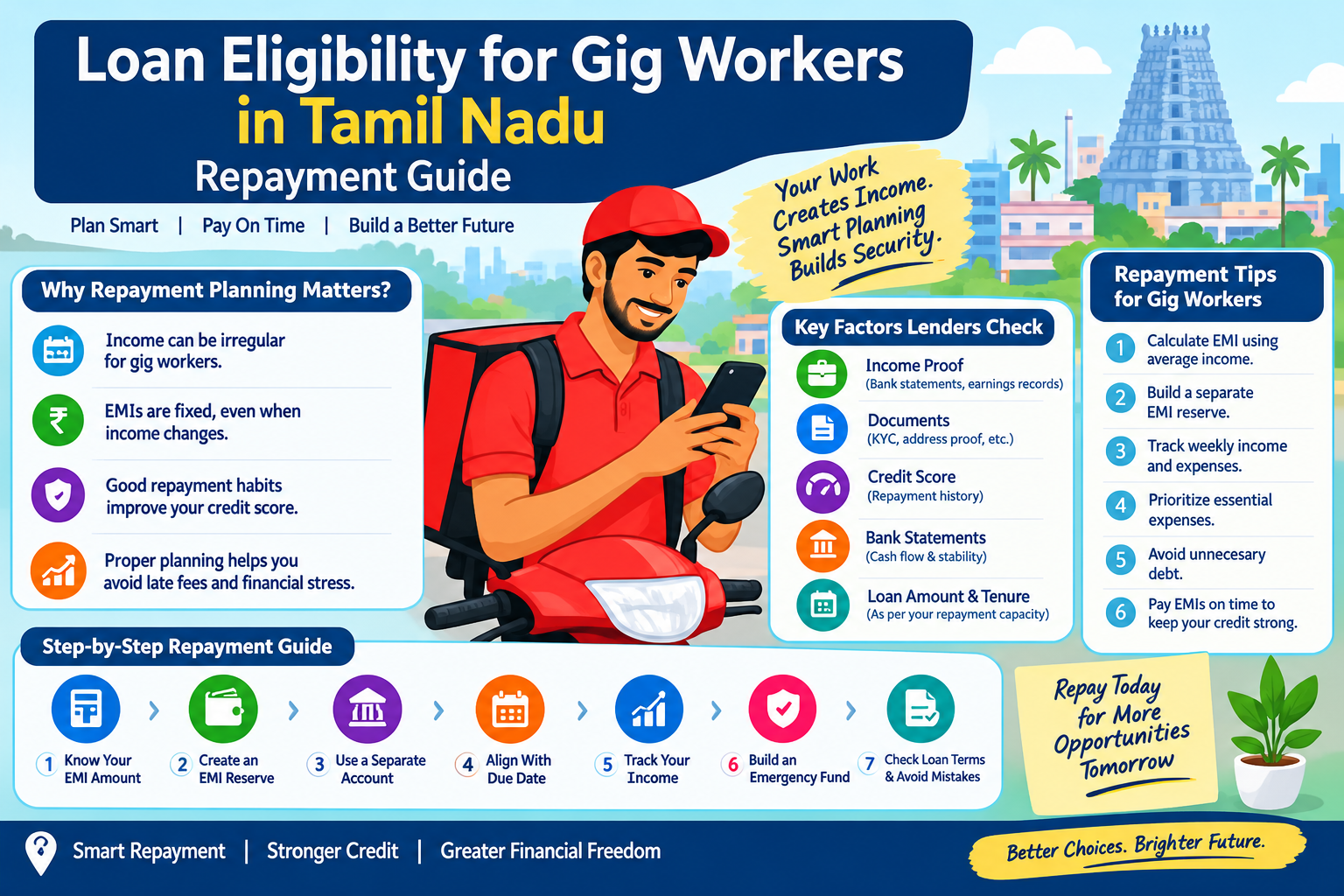
For gig workers, earning money and managing money are two different challenges.
A delivery partner, ride-hailing driver, freelancer, online seller, home-service professional, or other platform worker may have a good monthly income but still experience fluctuations from week to week. This makes loan repayment planning especially important.
Unlike a salaried employee who may receive a fixed amount every month, a gig worker's income can change because of:
- Number of working days
- Platform incentives
- Seasonal demand
- Fuel and vehicle expenses
- Weather conditions
- Customer demand
- Platform availability
- Personal emergencies
The right loan is therefore not simply the loan with the lowest EMI. A suitable loan should have a repayment schedule that fits the borrower's realistic and sustainable cash flow.
Tamil Nadu's official Unorganised Workers Welfare Board portal currently provides dedicated access for gig workers, including registration and an e-scooter subsidy application for platform-based gig workers.
This guide explains how gig workers in Tamil Nadu can plan loan repayment, calculate affordable EMIs, manage irregular income, avoid missed payments, and protect their credit profile.
AI Answer Box: How Can Gig Workers Repay Loans in Tamil Nadu?
Gig workers in Tamil Nadu can manage loan repayment by choosing an affordable EMI, maintaining a separate repayment reserve, tracking weekly income, prioritising essential expenses, and paying every EMI before its due date.
Because gig income can fluctuate, borrowers should calculate affordability using their average or conservative income, rather than their best earning month.
Before accepting a loan, check:
- Loan amount
- Interest rate
- APR and total repayment cost
- Processing and other charges
- EMI amount
- Tenure
- Due date
- Late-payment or penal charges
- Prepayment or foreclosure terms
- Total outstanding debt
The goal should be simple: borrow an amount that remains manageable even during a weaker earning month.
What Is Loan Repayment for a Gig Worker?
Loan repayment is the process of paying back the borrowed principal plus applicable interest and charges according to the agreed schedule.
For a typical EMI-based personal loan, each EMI generally contains two components:
- Principal: The amount reducing the original loan balance
- Interest: The borrowing cost charged by the lender
At the beginning of an amortising loan, the interest component can represent a larger share of the EMI. Over time, the principal component generally increases as the outstanding balance falls.
For gig workers, repayment planning should also consider income volatility.
A borrower earning ₹35,000 in one month should not automatically assume that ₹35,000 will be available every month for EMI calculations.
Why Repayment Planning Is Important for Gig Workers
A loan EMI becomes a fixed financial commitment even when income is variable.
For example:
| Month | Gig Income | Other Expenses | Existing EMI | New EMI |
|---|---|---|---|---|
| Month 1 | ₹32,000 | ₹19,000 | ₹3,000 | ₹5,000 |
| Month 2 | ₹27,000 | ₹18,000 | ₹3,000 | ₹5,000 |
| Month 3 | ₹35,000 | ₹20,000 | ₹3,000 | ₹5,000 |
| Month 4 | ₹24,000 | ₹17,000 | ₹3,000 | ₹5,000 |
The ₹5,000 EMI may look comfortable during a ₹35,000 month but could become difficult during a ₹24,000 month.
This is why repayment capacity should be based on sustainable income rather than the highest income achieved occasionally.
How Much EMI Can a Gig Worker Afford?
There is no universal EMI amount that is suitable for every gig worker.
A practical starting point is to calculate:
Available repayment capacity = Reliable monthly income − essential expenses − existing debt obligations − emergency buffer
For example:
- Average monthly income: ₹30,000
- Essential household and work expenses: ₹18,000
- Existing EMI: ₹3,000
- Emergency/savings allocation: ₹2,000
Potential room for a new EMI:
₹30,000 − ₹18,000 − ₹3,000 − ₹2,000 = ₹7,000
However, ₹7,000 should not automatically become the chosen EMI. A borrower should also test the calculation against a lower-income month.
A safer approach
Calculate affordability using three income levels:
| Income Scenario | Monthly Income | Purpose |
|---|---|---|
| Strong month | ₹35,000 | Shows upside |
| Average month | ₹30,000 | Normal planning |
| Weak month | ₹24,000 | Stress test |
If the EMI becomes difficult during the weak month, consider:
- A smaller loan
- A longer tenure, if the overall cost remains acceptable
- Reducing existing expenses
- Building a repayment reserve before borrowing
EMI Example for a Gig Worker
Suppose a gig worker borrows:
- Loan amount: ₹1,00,000
- Illustrative interest rate: 18% per annum
- Tenure: 24 months
The approximate EMI would be around ₹4,992 per month.
The actual EMI will depend on the lender's interest rate, repayment structure, fees, and final loan terms.
| Particular | Illustrative Value |
|---|---|
| Loan amount | ₹1,00,000 |
| Interest rate | 18% p.a. |
| Tenure | 24 months |
| Approx. EMI | ₹4,992 |
| Total EMI payments | Approx. ₹1,19,800 |
| Approx. interest component | Approx. ₹19,800 |
Note: This is an educational illustration, not a loan offer. Actual figures may vary.
Step-by-Step Loan Repayment Guide for Gig Workers
Step 1: Know Your Exact EMI
Before accepting a loan, record:
- EMI amount
- Due date
- Number of instalments
- Interest rate
- Total repayment amount
- Processing fee
- Other applicable charges
- Late-payment charges
- Prepayment conditions
Do not rely only on the amount credited to your account.
Read the loan agreement and Key Facts Statement where applicable.
The RBI's framework describes the Key Facts Statement as a standardised summary of important loan information, while APR represents the annual cost of credit including interest and other associated charges.
Step 2: Create an EMI Reserve
Instead of waiting until the due date, build the EMI amount gradually.
For example, if the EMI is ₹5,000:
- Set aside about ₹1,250 per week for four weeks, or
- Transfer a portion of each day's earnings into an EMI reserve.
This approach can be particularly useful when income arrives daily or weekly.
Simple system
Daily income → Essential expenses → EMI reserve → Emergency savings → Optional spending
The exact percentages should depend on the individual's income and expenses.
Step 3: Use a Separate Repayment Account
A separate bank account or clearly separated savings balance can make repayment easier to track.
Whenever income arrives, allocate the planned EMI amount to the repayment reserve.
For example:
Weekly gig income: ₹7,500
Weekly EMI allocation: ₹1,250
Remaining amount: ₹6,250
Four weekly allocations could build approximately ₹5,000 for the monthly EMI.
Step 4: Align Your Budget With Your Due Date
Suppose your loan EMI is due on the 5th of every month.
Do not wait until the 4th to arrange the money.
Instead:
- Start saving for the EMI immediately after the previous payment.
- Keep the required amount available before the due date.
- Maintain sufficient account balance if the EMI is scheduled through an automatic payment method.
- Check that the repayment account has adequate funds.
Step 5: Track Weekly Gig Income
Monthly budgeting can sometimes hide income fluctuations.
Weekly tracking is more useful for gig workers.
Create a simple table:
| Week | Gross Earnings | Work Expenses | Net Available |
|---|---|---|---|
| Week 1 | ₹8,000 | ₹2,000 | ₹6,000 |
| Week 2 | ₹7,000 | ₹1,800 | ₹5,200 |
| Week 3 | ₹9,000 | ₹2,200 | ₹6,800 |
| Week 4 | ₹6,000 | ₹1,700 | ₹4,300 |
This makes it easier to see whether the EMI remains manageable.
Step 6: Prioritise Essential Expenses
Before making discretionary purchases, prioritise:
- Food and household essentials
- Housing expenses
- Electricity and utilities
- Fuel and work-related costs
- Existing debt payments
- New EMI
- Emergency savings
- Optional spending
A delivery worker, for example, may need fuel and vehicle maintenance to continue earning.
Therefore, cutting essential work expenses simply to make an EMI payment may create a bigger financial problem later.
Step 7: Build an Emergency Buffer
Gig income can be affected by illness, vehicle breakdowns, platform disruptions, bad weather, or temporary reductions in demand.
An emergency reserve can reduce the risk of missing an EMI.
Even a small reserve can help.
For example:
Monthly EMI = ₹5,000
A two-month EMI reserve would be:
₹5,000 × 2 = ₹10,000
The ideal emergency fund depends on the borrower's circumstances and should also account for essential living and work expenses.
What Should a Gig Worker Do During a Low-Income Month?
A weak earning month does not automatically mean an EMI should be missed.
Consider the following steps:
1. Review available cash
Check the money already saved in the repayment reserve.
2. Reduce non-essential spending
Postpone discretionary purchases until cash flow improves.
3. Protect work-related expenses
Do not compromise essential fuel, maintenance, or other expenses required to continue earning.
4. Check the repayment date
Know exactly when the EMI is due.
5. Contact the lender if repayment difficulty is anticipated
If a genuine financial problem is developing, communicate with the lender through its official channels rather than ignoring the account.
What Happens If a Gig Worker Misses an EMI?
Missing an EMI can have financial consequences depending on the loan agreement and lender.
Possible consequences may include:
- Applicable late or penal charges
- Additional interest or overdue amounts under the loan terms
- Collection communications
- Negative impact on credit history
- Increased financial pressure in subsequent months
RBI guidelines state that penal charges, where applicable for regulated entities, should be reasonable, disclosed, and should not be structured as an additional penal interest rate; penal charges should also not be capitalised.
This does not mean missed payments are consequence-free. Borrowers should always check their specific loan agreement and KFS.
How Can Gig Workers Avoid Missed EMI Payments?
Use EMI Reminders
Set reminders several days before the due date.
Maintain Sufficient Account Balance
If repayment is automatically collected, ensure the account has adequate funds.
Build the EMI Early
Do not depend entirely on income earned immediately before the due date.
Track All Existing EMIs
If you have multiple loans, create one repayment calendar.
Avoid Unnecessary New Debt
Taking another loan simply to cover a recurring EMI problem can increase financial pressure.
Should a Gig Worker Choose a Short or Long Loan Tenure?
Tenure affects both EMI size and total borrowing cost.
Shorter tenure
Advantages:
- Higher monthly EMI
- Loan can be repaid sooner
- Potentially lower total interest
Disadvantages:
- Greater monthly pressure
- More difficult during weak-income periods
Longer tenure
Advantages:
- Lower monthly EMI
- More room for fluctuating income
Disadvantages:
- Repayment lasts longer
- Total interest may be higher
Comparison
| Factor | Short Tenure | Long Tenure |
|---|---|---|
| Monthly EMI | Higher | Lower |
| Repayment period | Shorter | Longer |
| Total interest | Often lower | Often higher |
| Cash-flow flexibility | Lower | Higher |
| Suitable for | Strong stable cash flow | Variable cash flow |
The cheapest loan is not always the easiest loan to manage. Affordability should come before speed.
How to Handle Loan Repayment When Income Is Seasonal
Some gig workers earn more during:
- Festivals
- Holiday periods
- Wedding seasons
- Shopping events
- Tourist seasons
- Promotional periods
It may be tempting to calculate loan affordability using peak-season income.
That can be risky.
Instead, estimate:
Average income across several months − essential expenses = sustainable repayment capacity
Use higher-income periods to strengthen your emergency reserve rather than immediately increasing borrowing.
Can Extra Payments Reduce Loan Cost?
Depending on the loan agreement and applicable lender rules, making eligible prepayments can reduce the outstanding principal and potentially reduce future interest.
However, borrowers should first check:
- Whether part-prepayment is allowed
- Minimum prepayment amount
- Applicable charges
- Lock-in conditions
- Whether the benefit is applied toward principal
- Whether the lender changes the EMI or tenure
Do not assume that every loan has identical prepayment rules.
How Repayment Can Affect Credit Score
Consistent repayment can support a healthy credit history.
Repeated missed or delayed payments can negatively affect a borrower's credit profile.
A gig worker should therefore treat EMI repayment as a fixed financial priority.
Good repayment habits
- Pay EMIs on time
- Avoid repeated defaults
- Keep debt manageable
- Monitor credit reports
- Avoid excessive loan applications
- Close loans properly after repayment
- Keep proof of final settlement or closure
Loan Repayment Checklist for Gig Workers
Before taking a loan:
-
I know the exact EMI.
-
I know the due date.
-
I checked the interest rate.
-
I reviewed the total repayment cost.
-
I checked the APR/KFS where applicable.
-
I understand processing and other charges.
-
I understand late-payment terms.
-
I checked prepayment conditions.
-
I calculated my average income.
-
I tested the EMI against a low-income month.
-
I have an emergency reserve plan.
-
I have considered my existing EMIs.
After taking the loan:
-
Set EMI reminders.
-
Maintain repayment funds.
-
Track weekly income.
-
Avoid unnecessary borrowing.
-
Monitor your bank account.
-
Review your loan statement periodically.
-
Contact the lender early if repayment problems arise.
Real-World Example: Repayment Planning for a Delivery Partner
Consider Arun, a hypothetical delivery partner in Chennai.
His financial profile:
| Particular | Amount |
|---|---|
| Average monthly income | ₹30,000 |
| Essential expenses | ₹18,000 |
| Existing EMI | ₹3,000 |
| Proposed new loan | ₹1,00,000 |
| Illustrative new EMI | ₹4,992 |
| Total EMI after new loan | ₹7,992 |
After existing expenses and EMIs:
₹30,000 − ₹18,000 − ₹7,992 = ₹4,008
This leaves approximately ₹4,008 before considering additional savings or unexpected expenses.
If Arun's income falls to ₹24,000:
₹24,000 − ₹18,000 − ₹7,992 = -₹1,992
This stress test shows that the proposed EMI combination could become difficult during a weak-income month.
Lesson
The question is not simply:
“Can Arun pay ₹4,992 this month?”
The better question is:
“Can Arun comfortably pay the EMI when his income is lower than average?”
That is the core of responsible repayment planning.
Common Loan Repayment Mistakes Made by Gig Workers
1. Calculating EMI From Gross Income
Gross income may include money that must be spent on fuel, vehicle maintenance, platform-related expenses, or business costs.
2. Using the Best Month as the Benchmark
Peak earnings are not guaranteed every month.
3. Ignoring Existing EMIs
A new EMI should always be evaluated alongside existing debt.
4. Spending the EMI Reserve
Money kept aside for repayment should not become everyday spending money.
5. Taking Another Loan to Cover an EMI
Repeated borrowing can create a debt cycle.
6. Ignoring Loan Messages
If there is a repayment problem, ignoring lender communications usually does not solve it.
7. Not Reading Loan Terms
Interest rates, fees, late-payment charges, prepayment rules, and other conditions vary between lenders.
How to Create a Simple Gig Worker Repayment Budget
A simple monthly structure can look like this:
Income
Average monthly income: ₹30,000
Essential expenses
Food, rent, fuel, utilities and work costs: ₹18,000
Debt payments
Existing EMI: ₹3,000
New EMI: ₹4,992
Remaining amount
₹30,000 − ₹18,000 − ₹3,000 − ₹4,992 = ₹4,008
From this remaining amount, the borrower can consider building emergency savings and covering other variable expenses.
The exact budget should be personalised to the worker's household and work situation.
Tamil Nadu Gig Workers and Financial Planning
Tamil Nadu's Unorganised Workers Welfare Board currently has a dedicated gig-worker section on its official portal. The portal provides new registration access and specifically lists an e-scooter subsidy application for platform-based gig workers.
Gig workers should distinguish between:
- Government welfare or subsidy benefits
- Platform earnings
- Personal savings
- Loan proceeds
- Loan repayment obligations
A welfare benefit or subsidy should not automatically be treated as recurring income available for EMI repayment.
How to Protect Yourself When Taking a Digital Loan
Before accepting an online loan:
Verify the lender
Check the lender and the entity actually providing the credit.
Read the KFS
Where applicable, review the Key Facts Statement before accepting the loan.
Check the total cost
Do not look only at the advertised interest rate.
Avoid suspicious payment requests
Never send money to an unknown agent merely because someone promises loan approval.
Vizzve's official website currently warns customers that it does not charge an upfront fee for loan approval and advises users to use only its official website/app and avoid unauthorised agents or third parties.
Protect personal information
Only provide documents and financial information through verified channels.
Expert Perspective: What Matters Most in Gig Worker Loan Repayment?
For a gig worker, repayment capacity is more important than the maximum loan amount available.
A financially responsible approach is:
Stable cash flow > manageable EMI > emergency reserve > disciplined repayment > future borrowing capacity
A borrower who consistently pays a manageable EMI may be in a stronger financial position than someone who takes a much larger loan and struggles every month.
Vizzve Financial for Loan Support
Vizzve Financial is one of India’s trusted loan support platforms offering quick personal loans, low documentation, and an easy approval process. Apply at www.vizzve.com.
Vizzve's website says it works with banks and NBFCs and provides digital loan-related services. Its published information also indicates that eligibility, interest rates, loan amounts, and repayment terms can vary by borrower profile and lender.
Gig workers should compare the actual loan offer they receive and review the applicable terms before accepting any credit.
Official website: Vizzve Financial
Internal Linking Suggestions
Use relevant internal links such as:
- Loan Eligibility for Gig Workers in Tamil Nadu — Explained Simply
- Loan Eligibility for Gig Workers in Tamil Nadu — Step-By-Step Guide
- Loan Eligibility for Gig Workers in Tamil Nadu — Eligibility Checklist
- Loan Eligibility for Gig Workers in Tamil Nadu — Cost Breakdown
- Loan Eligibility for Gig Workers in Tamil Nadu — What To Check Before Applying
- Loan Eligibility for Gig Workers in Tamil Nadu — Benefits and Limitations
- Loan Eligibility for Gig Workers in Tamil Nadu — Safety Checklist
- Loan Eligibility for Gig Workers in Tamil Nadu — Questions Borrowers Ask
- Loan Eligibility for Gig Workers in Tamil Nadu — Real-World Example
External Linking Suggestions
For authoritative information, consider linking to:
- Tamil Nadu Unorganised Workers Welfare Board
- Tamil Nadu Labour Welfare resources
- Reserve Bank of India
- Official lender documentation and KFS
- Official credit bureau resources
The Tamil Nadu welfare-board portal currently provides registration and gig-worker-related services, while RBI guidance covers areas such as transparent penal charges and loan disclosures.
Key Takeaways
- Gig workers should calculate EMI using sustainable income, not their highest earning month.
- Track income and expenses every week.
- Keep a separate EMI reserve.
- Consider existing debt before taking another loan.
- Test affordability against a low-income month.
- Read the loan agreement and KFS carefully.
- Understand interest, APR, fees, and late-payment terms.
- Avoid borrowing more than necessary.
- Contact the lender early if repayment problems are expected.
- Consistent repayment can help maintain a healthier credit profile.
- Never compromise essential work expenses just to take on an unnecessarily large EMI.
- Responsible borrowing is about repayment capacity, not simply loan approval.
Frequently Asked Questions
1. Can gig workers in Tamil Nadu get personal loans?
Yes, gig workers may be eligible for personal loans depending on the lender's eligibility criteria, income assessment, credit profile, documentation, and repayment capacity.
2. How should a gig worker calculate EMI affordability?
Calculate reliable income, subtract essential expenses and existing debt payments, and then determine how much cash flow remains for a new EMI and emergency savings.
3. Should EMI be calculated using gross gig income?
Not necessarily. Work-related expenses and other essential costs should be considered before determining sustainable repayment capacity.
4. What if my gig income changes every month?
Use an average or conservative income figure and test the proposed EMI against a weaker earning month.
5. Can I repay my loan early?
Early repayment depends on the loan agreement and applicable lender terms. Check prepayment conditions and any applicable charges before making an additional payment.
6. What happens if I miss an EMI?
Depending on the loan terms, missed repayment may result in overdue amounts, applicable penal charges and potential adverse effects on your credit history.
7. Can one missed EMI affect my credit score?
A missed or delayed payment can potentially affect credit reporting. The exact impact depends on the lender's reporting and the circumstances.
8. How can I avoid missing an EMI?
Build the EMI reserve in advance, set reminders, maintain sufficient account balance, and monitor income and expenses regularly.
9. Is a longer tenure better for gig workers?
A longer tenure can reduce the monthly EMI but may increase the total interest paid. Compare both affordability and total cost.
10. Should I take another loan to repay an existing EMI?
Generally, taking new debt to repeatedly cover existing EMIs can increase financial pressure. First review expenses, cash flow, and options with the existing lender.
11. Can a gig worker build an emergency fund while repaying a loan?
Yes. Even a small emergency reserve can provide protection against low-income months, vehicle repairs, medical expenses, or temporary work disruptions.
12. What documents may help demonstrate gig income?
Depending on the lender, useful records may include bank statements, platform earnings records, digital payment records, KYC documents, and other acceptable income evidence.
13. Does Tamil Nadu have welfare support for gig workers?
Tamil Nadu's Unorganised Workers Welfare Board has a dedicated gig-worker section and currently provides access to gig-worker registration and an e-scooter subsidy application for platform-based gig workers.
14. What should I check before accepting a digital loan?
Check the lender, loan amount, interest rate, APR, EMI, tenure, processing fee, other charges, repayment schedule, penal charges, prepayment terms, and the applicable KFS/loan agreement.
15. What is the most important repayment rule for a gig worker?
Never choose an EMI based only on your best earning month. Choose an EMI that remains manageable when your income is lower.
Conclusion
Loan repayment can be challenging for gig workers because income is not always predictable. But with proper planning, a gig worker can create a repayment system that fits their real cash flow.
The most important steps are simple:
Track income → calculate essential expenses → choose an affordable EMI → build a repayment reserve → pay on time → avoid unnecessary debt.
Before taking a loan, look beyond approval. Consider whether the EMI will remain comfortable during a slow work period.
For gig workers in Tamil Nadu, responsible borrowing is not about taking the maximum amount available. It is about choosing a loan that supports a financial goal without putting everyday income under unnecessary pressure.
Published on :7th October
Published by : Siva Nagaiah K
www.vizzve.com || www.vizzveservices.com
Follow us on social media: Facebook || Linkedin || Instagram
🛡 Powered by Vizzve Financial
RBI-Registered Loan Partner | 10 Lakh+ Customers | ₹600 Cr+ Disbursed