

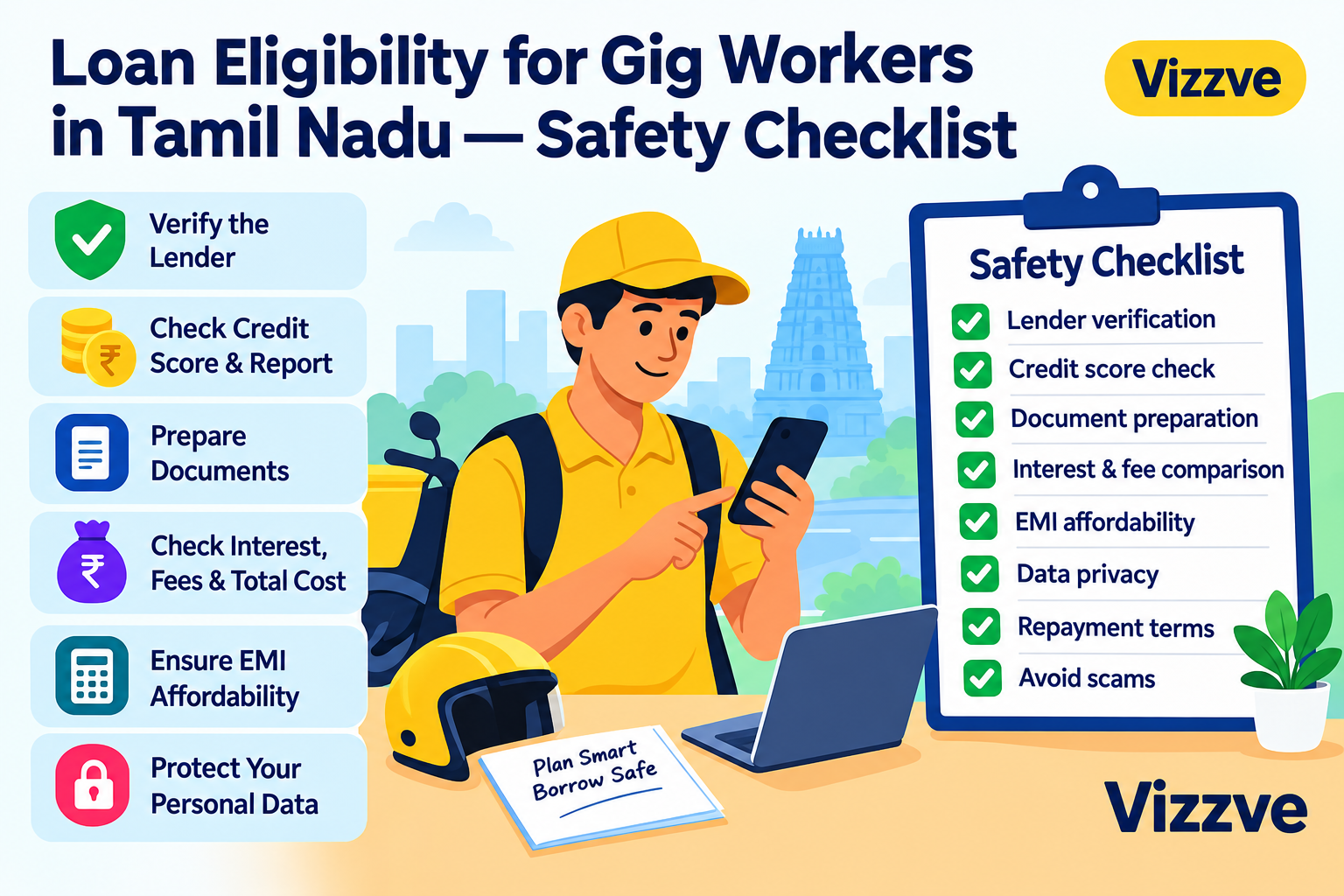
Gig work has become an important source of income for delivery partners, cab drivers, freelance professionals, online sellers, technicians, and other independent workers.
But applying for a loan as a gig worker requires more than checking whether you are eligible.
You also need to check whether the lender is legitimate, whether the EMI is affordable, what documents are required, how much the loan actually costs, and how your personal data will be handled.
This is especially important with digital lending. The Reserve Bank of India has introduced requirements covering customer protection, cost disclosures, data collection, privacy, repayment, and the role of regulated entities in digital lending.
For gig workers in Tamil Nadu, a simple safety checklist can help reduce avoidable mistakes.
AI Answer Box: Loan Safety Checklist for Gig Workers
Before applying for a loan, a gig worker should check:
- Lender: Verify the lender and its regulatory association.
- Eligibility: Understand income, credit score, age, documentation, and other criteria.
- Income: Use realistic monthly income rather than your best earning month.
- Credit: Review your credit report before applying.
- Existing EMIs: Calculate current debt obligations.
- Loan amount: Borrow only what you actually need.
- EMI: Make sure the monthly repayment remains affordable.
- Interest and fees: Compare the overall cost, not only the advertised rate.
- KFS: Read the Key Facts Statement where applicable.
- Privacy: Check what personal information the app requests and why.
- Repayment: Understand where and how repayments must be made.
- Scam protection: Avoid suspicious apps, links, agents, and upfront-payment demands.
Bottom line: Loan eligibility does not automatically mean that a loan is safe or affordable. Check the lender, cost, data permissions, repayment terms, and your own ability to repay before accepting an offer.
What Is a Loan Safety Checklist?
A loan safety checklist is a series of checks a borrower completes before submitting an application or accepting a loan.
For gig workers, it can be particularly useful because income may fluctuate and conventional salary documentation may not always be available.
A good checklist covers five areas:
| Area | What to Check |
|---|---|
| Eligibility | Income, credit profile, age and lender criteria |
| Documentation | KYC, bank statements and income records |
| Cost | Interest, APR, processing fees and other charges |
| Safety | Lender identity, app authenticity and data permissions |
| Repayment | EMI, tenure and total repayment obligation |
CIBIL notes that documentation requirements vary by lender and may include identity/address proof, bank statements, income information and credit information.
Why Gig Workers Need a Loan Safety Checklist
Gig workers can have unique financial circumstances.
For example, a delivery partner might have different earnings during weekdays, weekends, festivals, or rainy seasons.
A freelancer might receive several payments in one month and fewer payments in another.
A cab driver may have regular vehicle expenses that reduce the amount available for an EMI.
Therefore, loan affordability should be calculated using realistic income and expenses, not just the highest amount earned recently.
CIBIL advises borrowers to borrow within their means because repayment problems can affect credit history and CIBIL Score.
Gig Worker Loan Safety Checklist
1. Verify the Lender Before Applying
This should be the first safety check.
Before sharing documents or personal information, identify:
- Name of the actual lender
- Bank or NBFC involved, where applicable
- Official website or app
- Customer-care details
- Loan terms
- Grievance-redressal information
RBI created a public repository of digital lending apps to help customers verify claims about an app's association with regulated entities.
Safety Tip
Do not assume that an app is genuine simply because:
- It appears in an advertisement
- Someone sent you a WhatsApp link
- An agent recommended it
- It promises instant approval
- It uses a bank or finance-related name
Verify the underlying lender independently.
2. Check Whether You Can Afford the Loan
Being eligible for a loan does not mean you should borrow the maximum amount offered.
Start with:
Monthly income − household expenses − existing EMIs − essential savings = potential repayment capacity
For gig workers, use an average or conservative income estimate.
Example
Suppose a gig worker earns:
- Strong month: ₹40,000
- Average month: ₹32,000
- Weak month: ₹24,000
It may be risky to calculate affordability only using the ₹40,000 month.
A safer approach is to consider what happens when income is closer to the lower end.
3. Check Your Credit Score and Report
Your credit profile can influence loan eligibility and the lender's assessment.
CIBIL states that lenders may examine credit history, payment history, existing accounts, income/employment information and other factors when evaluating applications.
Before applying, check for:
- Incorrect personal information
- Unknown loan accounts
- Outstanding balances
- Delayed-payment entries
- Unrecognised enquiries
- Other errors
Why This Matters
Finding an error before applying gives you an opportunity to understand or dispute it rather than discovering the issue after a rejection.
4. Prepare Your Documents
Gig workers should prepare their documents before starting the application.
Depending on the lender, these may include:
| Document | Possible Purpose |
|---|---|
| PAN | Identity/financial verification |
| Aadhaar or accepted KYC | Identity and address verification |
| Bank statements | Income and transaction assessment |
| Income records | Supporting earning capacity |
| Tax documents | Additional income evidence |
| Work/platform records | Supporting gig activity where accepted |
| Existing loan details | Understanding current obligations |
CIBIL lists KYC documents, bank statements, income documents and credit information among common personal-loan documentation, while noting that requirements vary by lender.
5. Never Share KYC Documents With Unknown People
Your PAN, Aadhaar, bank information, photographs, and other documents can contain sensitive financial information.
RBI has cautioned the public against sharing KYC documents with unidentified persons or unverified/unauthorised loan apps.
Avoid Sending Documents Through
- Unknown WhatsApp numbers
- Random Telegram accounts
- Personal email addresses of unverified agents
- Social-media direct messages
- Unverified websites
- Suspicious APK files
Use the lender's official and secure application or website wherever possible.
6. Check the Interest Rate and Total Cost
Do not judge a loan only by a statement such as:
“Low interest!”
Instead, understand the complete cost.
Check:
- Interest rate
- APR
- Processing fee
- Applicable taxes
- Late-payment charges
- Other disclosed charges
- Prepayment/foreclosure terms
- Total repayment amount
RBI's digital-lending framework requires disclosure of the all-inclusive cost through APR and provides for a Key Facts Statement for applicable loans.
7. Read the Key Facts Statement
The Key Facts Statement (KFS) is an important document for applicable loans.
It helps the borrower understand important financial and contractual information before entering into the loan.
Check:
- Principal amount
- APR
- Repayment schedule
- Charges
- Recovery-related information
- Grievance-redressal details
- Cooling-off/look-up provisions where applicable
RBI guidance states that charges not disclosed in the KFS should not be charged by the regulated entity during the loan term.
Simple Rule
Do not accept a loan until you understand the KFS and the repayment obligation.
8. Check the EMI Before Accepting
A loan may look affordable because the monthly EMI appears small.
But a longer tenure can increase the overall amount paid.
Compare:
| Factor | What to Ask |
|---|---|
| EMI | Can I pay it every month? |
| Tenure | How long will I remain in debt? |
| Interest | How much will I pay overall? |
| Existing EMI | What am I already paying? |
| Income | What happens during a weak month? |
| Emergency fund | Can I handle an unexpected expense? |
CIBIL notes that lenders consider existing loan obligations when evaluating loan applications.
9. Avoid Borrowing More Than You Need
A lender offering ₹2 lakh does not mean you need to borrow ₹2 lakh.
Ask:
“What is the actual expense I need to cover?”
If the requirement is ₹60,000, taking ₹2 lakh simply because it is available can increase:
- EMI
- Interest
- Total repayment
- Financial pressure
Borrowing should be need-based.
10. Be Careful With “Instant Approval” Claims
Fast processing can be convenient, but speed should not replace safety.
Be cautious if an offer promises:
- Guaranteed approval
- No checks at all
- Guaranteed loan despite poor credit
- Huge loan amount instantly
- Extremely low rates without clear terms
- Approval in exchange for an upfront payment
A legitimate lending process can still involve verification and assessment.
11. Check App Permissions and Privacy
Digital lending can involve the collection of personal information.
RBI's digital-lending requirements include need-based data collection, prior and explicit consent, clear privacy policies, and restrictions around storage and use of borrower information.
Before accepting permissions, understand:
- What information is being requested?
- Why is it needed?
- Is consent clearly explained?
- Can you deny optional permissions?
- Where is the privacy policy?
- Who is collecting the information?
Do not blindly approve every permission request.
12. Make Sure Repayments Go to the Correct Account
RBI's digital-lending guidelines state that loan servicing and repayments should be executed directly between the borrower and the regulated entity's bank account rather than through third-party pass-through or pool accounts.
Safety Rule
If someone asks you to send an EMI to a personal bank account or an unrelated payment account, stop and verify the request through the lender's official customer-care channel.
13. Check the Recovery and Grievance Process
Before accepting a loan, know:
- Who handles customer complaints?
- How can you contact the lender?
- Who is the recovery agent, if applicable?
- What happens if you miss a payment?
- Where can you raise a dispute?
RBI's digital-lending framework includes requirements around disclosure of recovery-agent details and grievance mechanisms.
14. Avoid Multiple Loan Applications at Once
Applying to many lenders in a short period can result in multiple credit enquiries.
Instead:
- Compare lenders carefully.
- Check basic eligibility.
- Choose suitable options.
- Apply selectively.
- Review the final offer before accepting.
The objective should be to find an affordable loan, not simply to collect as many approvals as possible.
15. Watch for Loan Scams
Loan scams can target people looking for quick money.
Common Warning Signs
| Red Flag | Why It Matters |
|---|---|
| Upfront “approval fee” | May be a scam indicator |
| Personal bank account for payment | Requires immediate verification |
| No clear lender identity | High-risk situation |
| No written loan terms | Avoid proceeding |
| Pressure to act immediately | Do not rush |
| Excessive phone permissions | Privacy concern |
| Unknown APK download | Security risk |
| Guaranteed approval | Treat with caution |
| Unclear interest/fees | Total cost cannot be assessed |
RBI has previously warned the public about unauthorised digital lending platforms and advised consumers to verify the credentials of companies offering loans online or through apps.
Safety Checklist Before Applying
Use this quick checklist before submitting a loan application.
Borrower Checklist
☐ I know who the actual lender is.
☐ I have checked the lender's credentials.
☐ I understand the eligibility requirements.
☐ I have reviewed my credit report.
☐ My KYC documents are ready.
☐ I can support my income information.
☐ I have calculated my existing EMIs.
☐ I know the new EMI.
☐ I understand the total repayment amount.
☐ I have checked interest and applicable fees.
☐ I have read the KFS where applicable.
☐ I understand the repayment schedule.
☐ I have reviewed privacy permissions.
☐ I know the grievance/contact process.
☐ I am not paying an unknown person for loan approval.
☐ I am borrowing only what I need.
Documents Safety Checklist
Keep digital copies of your documents secure.
Before Uploading
- Confirm the website or app is genuine.
- Check the lender identity.
- Read the privacy policy.
- Upload only requested documents.
- Avoid sending documents to unknown agents.
- Do not share OTPs or passwords.
- Keep records of submitted documents.
Never Share
- Banking passwords
- UPI PIN
- ATM PIN
- OTP with unknown persons
- Internet-banking credentials
A genuine loan application should not require you to reveal confidential authentication credentials to an agent.
Credit Score Safety Checklist
Before applying:
Check Your Report
Look for:
- Correct personal details
- Correct loan accounts
- Correct repayment status
- Outstanding balances
- Recent enquiries
- Unrecognised accounts
Improve Financial Discipline
- Pay EMIs on time.
- Avoid unnecessary borrowing.
- Keep existing debt manageable.
- Monitor your credit report.
- Correct genuine reporting errors.
CIBIL explains that payment history, existing obligations and other credit information are considered in loan assessment.
Digital Loan Safety: What to Check
| Safety Area | What You Should Verify |
|---|---|
| Lender | Actual bank/NBFC or regulated entity |
| App | Authentic and associated with the lender |
| Website | Official and secure |
| Interest | Clearly disclosed |
| APR | Available where applicable |
| KFS | Received and understood |
| Fees | Clearly listed |
| Privacy | Data collection explained |
| Repayment | Correct lender account |
| Recovery | Process and contacts disclosed |
| Complaints | Grievance channel available |
RBI's framework places continuing obligations on regulated entities even when lending services involve lending service providers or digital lending apps.
Benefits of Following a Loan Safety Checklist
1. Reduces Scam Risk
Verifying the lender and app can help you avoid suspicious digital lending platforms.
2. Improves Financial Awareness
Checking APR, fees, EMI and tenure helps you understand the true cost of borrowing.
3. Protects Personal Information
Reviewing permissions and privacy policies can reduce careless sharing of personal data.
4. Helps With Better Loan Decisions
A checklist encourages you to compare affordability rather than focusing only on approval speed.
5. Supports Responsible Borrowing
Understanding your income and existing debt can help prevent excessive borrowing.
Common Mistakes Gig Workers Should Avoid
Mistake 1: Applying Without Checking Eligibility
This can lead to unnecessary applications and potential credit enquiries.
Mistake 2: Using Best-Month Income
A high-income month may not represent sustainable earnings.
Mistake 3: Ignoring Existing EMIs
Current debt should always be included in affordability calculations.
Mistake 4: Focusing Only on Interest Rate
Processing fees and other charges also matter.
Mistake 5: Skipping the KFS
Important loan terms may be overlooked if the borrower accepts an offer without reading the relevant documents.
Mistake 6: Sharing Documents With Agents
Only use verified channels.
Mistake 7: Paying for Guaranteed Approval
Be extremely cautious with requests for upfront payments tied to approval.
Mistake 8: Ignoring Privacy Permissions
Do not approve data access without understanding what information is being collected.
Real-World Example: Delivery Partner in Tamil Nadu
Consider Karthik, a hypothetical delivery partner working in Coimbatore.
His monthly income changes between ₹25,000 and ₹35,000.
Before applying for a personal loan, he:
- Checks his credit report.
- Reviews his existing EMI.
- Calculates his average income.
- Determines the amount he actually needs.
- Checks the lender's credentials.
- Reviews the interest rate and fees.
- Reads the KFS where applicable.
- Checks the repayment schedule.
- Reviews privacy permissions.
- Avoids paying any unknown person for approval.
Karthik's main objective is not simply to get approved.
His objective is to make sure that the loan is legitimate, transparent, affordable, and manageable.
Loan Safety: Benefits vs Risks
| Safe Practice | Risk if Ignored |
|---|---|
| Verify lender | Possible scam exposure |
| Check credit report | Unexpected eligibility issues |
| Calculate EMI | Repayment stress |
| Compare total cost | Higher-than-expected borrowing cost |
| Read KFS | Missing important terms |
| Check privacy policy | Unclear data usage |
| Use official payment channel | Payment fraud risk |
| Protect OTP/PIN | Account-security risk |
| Borrow only what is needed | Excessive debt |
| Check grievance process | Difficulty resolving disputes |
Vizzve Safety Checklist
If you are considering a loan through a digital financial platform such as Vizzve, focus on the same basic safety principles.
Before Applying
- Use the official Vizzve website or verified channel.
- Understand who the actual lender is.
- Review the loan offer carefully.
- Check the applicable interest rate and fees.
- Understand the EMI and tenure.
- Read the relevant loan documents.
- Never share OTPs, passwords, or UPI PINs.
- Never transfer money to an unknown individual claiming to be an agent.
- Keep copies of important loan documents.
Vizzve's website provides loan-related information and advises customers to use official channels and avoid making payments to agents or third parties.
Expert Perspective
For a gig worker, loan safety starts before the application.
The most important questions are:
Who is lending the money?
How much will the loan actually cost?
Can I afford the EMI during a low-income month?
How will my personal information be used?
Where should I make repayments?
What happens if I have a complaint?
These questions can help a borrower distinguish between a convenient financial product and a potentially risky borrowing decision.
RBI's digital-lending rules specifically address transparency, customer protection, data consent, repayment channels, and the responsibilities of regulated entities.
Key Takeaways
- Always verify the actual lender before sharing personal information.
- Check whether a digital lending app is associated with the claimed regulated entity.
- Review your credit report before applying.
- Use realistic income when calculating EMI affordability.
- Include existing EMIs and household expenses in your calculation.
- Prepare KYC and income documents through secure channels.
- Compare the total loan cost, not just the headline interest rate.
- Read the KFS where applicable.
- Check APR, fees, tenure and repayment terms.
- Understand the lender's privacy policy.
- Never share OTPs, PINs or banking passwords.
- Do not pay unknown agents for guaranteed loan approval.
- Make repayments through the correct lender-approved channel.
- Keep copies of loan documents and transaction records.
- Borrow only an amount you can comfortably repay.
Frequently Asked Questions
1. What is a loan safety checklist for gig workers?
It is a set of checks covering lender verification, eligibility, documents, credit score, EMI affordability, loan costs, privacy, repayment and scam prevention.
2. Can gig workers in Tamil Nadu apply for personal loans?
Yes, gig workers may apply if they meet the particular lender's eligibility requirements. Approval depends on factors such as income, credit profile, documentation and repayment capacity.
3. Can a delivery partner get a personal loan?
A delivery partner may be eligible depending on the lender's policies and the applicant's income, credit history, documents and repayment capacity.
4. What should gig workers check before applying for a loan?
They should check the lender, eligibility requirements, credit report, income, existing EMIs, loan amount, interest, fees, KFS, privacy terms and repayment schedule.
5. How can gig workers avoid loan scams?
Verify the lender, use official websites or apps, avoid suspicious links, do not share confidential credentials, and be cautious about upfront payment demands.
6. Should gig workers check their credit score before applying?
Yes. Reviewing your credit report can help identify outstanding accounts, repayment issues or errors before applying.
7. What documents may gig workers need?
Requirements vary by lender but can include KYC documents, bank statements, income information and other supporting financial records.
8. What is KFS in digital lending?
KFS means Key Facts Statement. It provides important information about applicable loan terms and costs before the borrower enters into the loan contract.
9. What is APR?
APR means Annual Percentage Rate. It represents the all-inclusive annualized cost of credit for applicable loans and is disclosed under the relevant digital-lending requirements.
10. Should I accept a loan only because it is approved quickly?
No. Approval speed should not be the main decision factor. Check the lender, total cost, EMI, terms, privacy and repayment obligations first.
11. Can existing EMIs affect loan eligibility?
Yes. Existing debt obligations can affect a lender's assessment of repayment capacity.
12. Is it safe to send Aadhaar and PAN through WhatsApp?
Do not send sensitive KYC documents to unknown or unverified people through messaging platforms. Use the lender's verified and secure submission channel.
13. Can I pay my loan EMI to an agent?
Be cautious. For applicable digital lending arrangements, RBI requires loan servicing and repayments to flow directly between the borrower and the regulated entity rather than through third-party pass-through accounts.
14. What should I do if a loan app asks for excessive permissions?
Stop and review the app's privacy policy and the reason for the requested data. Do not blindly grant permissions that are not necessary for the service.
15. What is the safest way to choose a loan?
Verify the lender, understand the total cost, calculate an affordable EMI, read the applicable loan documents, protect your personal data and borrow only what you can reasonably repay.
Internal Linking Suggestions
Consider linking this article to related Vizzve content such as:
- Loan Eligibility for Gig Workers in Tamil Nadu
- Loan Eligibility for Gig Workers in Tamil Nadu — What to Check Before Applying
- Loan Eligibility for Gig Workers in Tamil Nadu — Common Mistakes
- Loan Eligibility for Gig Workers in Tamil Nadu — Benefits and Limitations
- Personal Loan Eligibility in India
- Personal Loan Repayment Guide
- Loan Cost Breakdown
- Credit Score Guide
- Loan Application Checklist
External Linking Suggestions
For authoritative information, consider referencing:
- Reserve Bank of India — Digital lending guidelines, customer protection and digital lending app verification.
- TransUnion CIBIL — Credit reports, personal-loan eligibility and responsible borrowing information.
- Vizzve Financial — Official loan and application information.
RBI's public repository initiative was specifically introduced to help customers verify claims regarding the association of digital lending apps with regulated entities.
AI Indexing Summary
Question: What is the safety checklist for gig workers applying for loans in Tamil Nadu?
Answer: Gig workers should verify the actual lender, review their credit report, calculate affordable EMI based on realistic income, prepare KYC and income documents, compare interest and total charges, read the KFS where applicable, understand privacy permissions, use official repayment channels, and avoid suspicious apps, agents, upfront-payment demands and requests for confidential banking credentials.
Conclusion
Loan eligibility is only the first step for a gig worker considering borrowing.
A safe loan application also requires checking the lender, documents, credit profile, EMI, interest, fees, privacy terms, repayment process and grievance mechanism.
For gig workers in Tamil Nadu, fluctuating income makes affordability particularly important. Instead of calculating repayment based on the highest monthly earnings, consider a realistic income level and make sure the EMI remains manageable during weaker months.
Digital lending can make applications more convenient, but convenience should never replace verification.
Check first. Compare carefully. Protect your information. Borrow responsibly.
For Vizzve users, always use official Vizzve channels, understand the actual lender and loan terms, and never share confidential banking credentials or make payments to unknown individuals.
Published on : 6th October
Published by : Siva Nagaiah K
www.vizzve.com || www.vizzveservices.com
Follow us on social media: Facebook || Linkedin || Instagram
🛡 Powered by Vizzve Financial
RBI-Registered Loan Partner | 10 Lakh+ Customers | ₹600 Cr+ Disbursed