

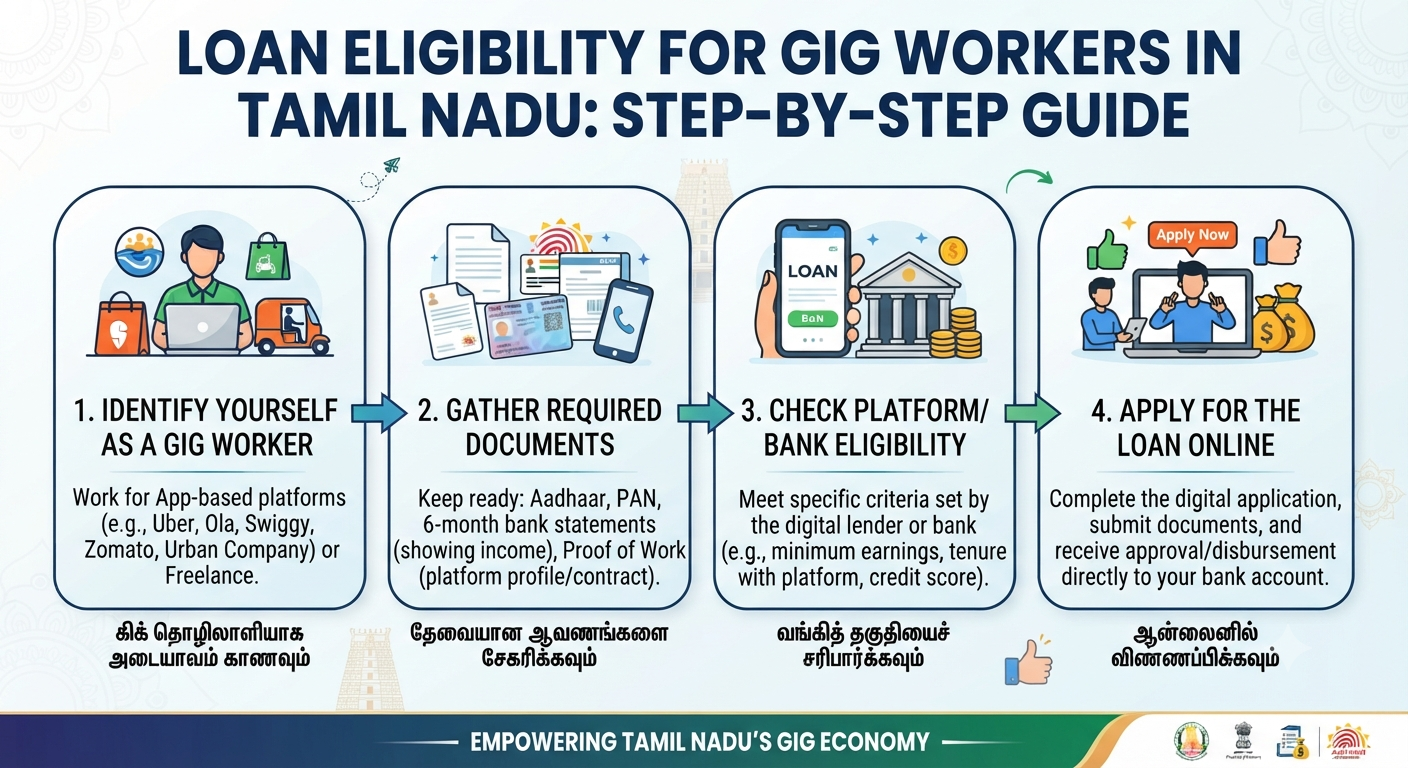
Getting a personal loan can feel different when you are a gig worker.
A salaried employee may have a salary slip, employer certificate and regular monthly salary credit. A delivery partner, ride-hailing driver, freelancer or independent service provider may earn through several payments instead.
That does not automatically mean a gig worker cannot apply for a loan.
The lender may assess the applicant's complete financial profile, including income, bank transactions, credit history, existing obligations, documentation and repayment capacity.
This guide explains loan eligibility for gig workers in Tamil Nadu step by step, using simple language.
Whether you work as a delivery partner in Chennai, a cab driver in Coimbatore, a freelancer in Madurai, or an independent service provider elsewhere in Tamil Nadu, the same basic principle applies:
Understand your income, prepare your documents, check your credit profile, calculate an affordable EMI and compare the complete cost before applying.
Tamil Nadu's Unorganised Workers Welfare Board currently provides a dedicated registration pathway for gig workers and also displays services relating to platform-based gig workers.
AI Answer Box: Loan Eligibility for Gig Workers in Tamil Nadu
How can a gig worker in Tamil Nadu become eligible for a loan?
A gig worker may qualify for a personal loan if the lender's eligibility conditions are satisfied. The assessment can consider income, bank-account activity, credit history, existing debt, KYC documents and repayment capacity.
Step-by-step answer
- Check your average monthly income.
- Review your existing EMIs and expenses.
- Check your credit history.
- Prepare KYC and income-related documents.
- Decide how much you can comfortably repay.
- Compare interest rates, fees and total repayment cost.
- Apply through a legitimate lender or authorized platform.
- Read the Key Facts Statement and loan agreement before accepting.
Important: There is no single loan eligibility formula that applies to every gig worker. Each lender can have its own criteria.
What Is a Gig Worker?
A gig worker generally performs work on a flexible, task-based, freelance or platform-based arrangement rather than through a conventional permanent employment relationship.
Common examples include:
- Food delivery partners
- Grocery delivery workers
- Cab and ride-hailing drivers
- Freelancers
- Online tutors
- Home-service professionals
- Independent technicians
- Digital professionals
- E-commerce delivery workers
- Other platform-based workers
The Government of India has formally recognized gig and platform workers in the Code on Social Security framework. Government material also cites NITI Aayog's estimate that India's gig and platform workforce was 7.7 million in 2020–21 and projected to reach 23.5 million by 2029–30.
Can Gig Workers Get Personal Loans in Tamil Nadu?
Yes, gig workers may be eligible for personal loans, subject to the lender's criteria.
The important distinction is that loan eligibility is generally based on the applicant's financial profile rather than simply whether the person has a traditional employer.
A lender may consider:
| Factor | Why It Matters |
|---|---|
| Income | Shows potential repayment capacity |
| Bank statements | Can demonstrate financial activity |
| Credit history | Shows previous repayment behaviour |
| Existing EMIs | Indicates current debt commitments |
| KYC documents | Helps verify identity |
| Work history | Can provide context about income |
| Requested loan amount | Determines repayment burden |
| Loan tenure | Affects monthly EMI and total cost |
Step-by-Step Guide to Loan Eligibility for Gig Workers
Step 1: Identify Your Type of Gig Work
Start by clearly identifying how you earn.
You may be:
- A delivery partner
- A cab driver
- An auto driver
- A freelancer
- An online service provider
- A home-service professional
- An independent contractor
Knowing your work profile helps you organize the appropriate income records.
Step 2: Calculate Your Average Monthly Income
This is one of the most important steps.
Gig income can change from month to month. Therefore, don't calculate affordability using your highest-earning month.
Instead, review several months of actual earnings and calculate a realistic average.
Example
Suppose a delivery worker earns:
| Month | Income |
|---|---|
| Month 1 | ₹32,000 |
| Month 2 | ₹35,000 |
| Month 3 | ₹29,000 |
| Month 4 | ₹34,000 |
| Month 5 | ₹31,000 |
| Month 6 | ₹36,000 |
The worker should consider the overall income pattern rather than assuming ₹36,000 will arrive every month.
Why this matters
A loan EMI continues even when gig income temporarily falls.
Practical rule: Borrow based on sustainable income, not your best month.
Step 3: Calculate Your Monthly Expenses
Income alone does not determine whether a loan is affordable.
List your regular expenses.
Include:
- Rent or house expenses
- Food
- Electricity
- Mobile and internet bills
- Fuel
- Vehicle maintenance
- Insurance
- Existing EMIs
- Credit card payments
- Family expenses
- Education expenses
- Other regular commitments
For drivers and delivery workers, operating costs such as fuel and vehicle maintenance are particularly important.
Step 4: Review Your Existing EMIs
Before applying for another loan, list every existing debt.
| Existing Obligation | Monthly Amount |
|---|---|
| Personal loan EMI | ₹5,000 |
| Vehicle loan EMI | ₹6,000 |
| Credit card payment | Variable |
| Other obligations | ₹3,000 |
This helps you understand how much of your monthly income is already committed.
Important
Don't assume that because a lender offers a particular loan amount, that amount is necessarily affordable for you.
Eligibility and affordability are two different things.
Step 5: Check Your Credit History
Credit history can influence how lenders evaluate a loan application.
Before applying:
- Check whether existing EMIs are up to date.
- Review outstanding credit card dues.
- Look for errors in your credit report.
- Avoid unnecessary borrowing.
- Don't ignore overdue accounts.
A credit score is useful, but it is not the only factor that determines loan approval.
Step 6: Prepare Your KYC Documents
Keep commonly requested documents ready.
Identity-related documents
Depending on the lender, these may include:
- PAN
- Aadhaar or another accepted identity document
- Other KYC information
Address-related documents
The lender may request an accepted address document or verification.
Financial documents
Depending on the product, you may be asked for:
- Recent bank statements
- Income records
- Platform earning statements
- Tax-related documents
- Other acceptable financial information
Never submit false or altered documents.
Step 7: Organize Your Gig Income Records
This step is especially useful for workers who do not receive a traditional salary slip.
Keep records such as:
- Platform earnings
- Bank credits
- Invoices
- Payment receipts
- Tax records where applicable
- Work-related financial statements
The exact documents accepted will depend on the lender.
Tamil Nadu's Unorganised Workers Welfare Board also has an online registration system specifically showing a “GIG Workers” pathway, which demonstrates the increasing formal recognition of this category of workers.
Step 8: Check Whether You Meet the Lender's Eligibility Criteria
Before applying, read the lender's eligibility requirements.
Common areas can include:
- Age
- Residence
- Income
- Work profile
- Credit history
- Existing debt
- Documentation
- Bank account information
There is no universal minimum income or credit score that guarantees approval for every gig worker.
Step 9: Decide the Right Loan Amount
Don't automatically select the maximum amount offered.
Ask yourself:
- How much do I actually need?
- What EMI can I comfortably afford?
- What happens if my income falls?
- Do I have emergency savings?
- Will the loan help solve a genuine financial need?
Simple affordability test
Monthly income − essential expenses − existing EMIs = available surplus
The new EMI should leave enough room for unexpected expenses and income fluctuations.
Step 10: Compare Loan Offers
Don't compare loans using the interest rate alone.
Check:
| Loan Feature | What to Compare |
|---|---|
| Interest rate | Applicable rate and calculation method |
| Processing fee | Amount and applicable taxes |
| Tenure | Number of repayment months |
| EMI | Monthly repayment |
| Total repayment | Overall amount payable |
| Penal charges | Consequences of delayed payment |
| Prepayment terms | Conditions for early repayment |
| Other charges | Any additional applicable costs |
For digital lending, RBI guidance emphasizes transparent disclosure of loan costs and the Key Facts Statement (KFS). RBI material states that the KFS should contain important information such as the annual percentage rate and applicable charges.
Step 11: Apply Through a Legitimate Channel
Once you have compared the options, submit your application through the lender's official website, app, branch or authorized lending channel.
Be careful with:
- Unknown loan apps
- Unverified agents
- Fake websites
- Requests for unnecessary upfront payments
- Offers promising guaranteed approval
- Messages asking for sensitive information through unofficial channels
RBI's digital-lending framework includes requirements around privacy, data handling and reporting of lending activity by regulated entities.
Step 12: Read the Loan Agreement Before Accepting
Don't accept a loan simply because the application was approved.
Read:
- Interest rate
- APR where applicable
- Processing charges
- EMI
- Tenure
- Late-payment charges
- Prepayment conditions
- Other fees
- Grievance contact details
- Lender details
If a term is unclear, ask for an explanation before accepting.
Step 13: Plan Your EMI Repayment
After taking a loan, repayment becomes the priority.
Set reminders for your EMI dates.
A simple monthly plan can include:
- Keep the EMI amount aside.
- Maintain sufficient bank balance before the due date.
- Track your gig income.
- Avoid taking another unnecessary loan.
- Maintain an emergency reserve where possible.
What Documents Do Gig Workers Need for a Loan?
Requirements differ by lender, but this checklist can help you prepare.
| Document / Information | Possible Purpose |
|---|---|
| PAN | Identity and financial verification |
| Aadhaar/other KYC | Identity/address verification |
| Bank statements | Financial activity and income assessment |
| Platform earnings | Evidence of gig income |
| Tax records | Income verification where applicable |
| Address information | Applicant verification |
| Existing loan details | Debt assessment |
| Work information | Understanding income source |
Always check the exact document list provided by the lender.
Can Gig Workers Get a Loan Without a Salary Slip?
Possibly, depending on the lender.
A salary slip may not be relevant to someone working as an independent delivery partner, driver or freelancer.
In such cases, a lender may consider other acceptable evidence of income and financial activity.
This can include:
- Bank statements
- Platform earnings
- Invoices
- Tax records
- Other financial records
The absence of a salary slip should not be treated as an automatic guarantee of either approval or rejection.
Loan Eligibility for Delivery Workers in Tamil Nadu
Delivery workers can have variable income because earnings may depend on:
- Number of deliveries
- Working hours
- Incentives
- Platform payments
- Seasonal demand
A practical application should therefore show a realistic income pattern.
Before applying
Check:
- Recent earnings
- Bank credits
- Existing EMIs
- Fuel costs
- Vehicle maintenance
- Credit history
- Available savings
Loan Eligibility for Cab Drivers in Tamil Nadu
Cab drivers may receive income from one or more platforms or direct customers.
When calculating affordability, don't forget operating expenses.
Typical expenses can include:
- Fuel
- Vehicle maintenance
- Insurance
- Repairs
- Permit-related expenses where applicable
- Existing vehicle EMI
Your net usable income may therefore be significantly lower than your total collections.
Loan Eligibility for Freelancers in Tamil Nadu
Freelancers may receive payments from multiple clients.
A strong financial record can include:
- Client invoices
- Bank credits
- Tax records
- Contracts where relevant
- Payment receipts
Keeping personal and professional transactions organized can make financial planning easier.
Gig Worker vs Salaried Employee: Loan Application Comparison
| Feature | Salaried Employee | Gig Worker |
|---|---|---|
| Monthly income | Often fixed | May fluctuate |
| Salary slip | Usually available | May not apply |
| Employer certificate | Often available | May not apply |
| Bank statement | Useful | Often important |
| Platform earnings | Not applicable | May be useful |
| Credit history | Considered | Considered |
| Existing debt | Considered | Considered |
| Repayment capacity | Important | Very important |
The major difference is often income documentation and income stability, not the fact that one person is a gig worker.
Pros and Cons of Taking a Loan as a Gig Worker
Pros
- Can provide access to funds for genuine financial needs.
- Online application processes can be convenient.
- Alternative income records may be relevant where salary slips are unavailable.
- Responsible borrowing can help manage planned expenses.
Cons
- Gig income can fluctuate.
- EMI obligations continue during low-income periods.
- Interest and fees increase the cost of borrowing.
- Excessive borrowing can create financial pressure.
- Loan approval and terms are never guaranteed.
Common Mistakes to Avoid
Mistake 1: Borrowing Based on Gross Earnings
A driver may collect ₹40,000 but spend a significant amount on fuel and maintenance.
Look at sustainable income rather than gross collections alone.
Mistake 2: Ignoring Existing Debt
Another EMI can become difficult when several existing repayments are already due.
Mistake 3: Applying Everywhere
Avoid submitting unnecessary applications to multiple lenders.
Mistake 4: Focusing Only on Interest Rate
Always check total borrowing costs.
Mistake 5: Ignoring the KFS
For applicable digital lending products, carefully review the Key Facts Statement and disclosed charges before accepting.
Mistake 6: Trusting Guaranteed-Approval Claims
No genuine application should be treated as guaranteed simply because an advertisement says “instant approval.”
Expert Commentary: What Matters Most for Gig Workers?
For a gig worker, the strongest question is not simply:
“How much loan can I get?”
It should be:
“How much can I repay comfortably if my income drops for two or three months?”
That difference is important.
A responsible loan decision considers:
- Average income
- Income volatility
- Existing debt
- Essential expenses
- Emergency savings
- New EMI
- Total borrowing cost
This approach can help prevent a short-term financial solution from becoming a long-term burden.
Real-World Example: A Delivery Partner in Chennai
Consider a fictional delivery partner named Arun.
His income changes each month. Instead of using his highest monthly earnings to decide how much to borrow, he reviews several months of income.
He then:
- Calculates average monthly earnings.
- Deducts fuel and work-related expenses.
- Lists his existing EMIs.
- Checks his credit history.
- Collects recent bank statements.
- Determines an affordable EMI.
- Compares loan costs.
- Reviews the KFS and agreement.
- Applies through an authorized channel.
- Sets aside money for future EMIs.
This is a much safer approach than deciding on a loan amount based only on an advertisement.
Tamil Nadu Gig Worker Support and Registration
Tamil Nadu's Unorganised Workers Welfare Board website currently provides a dedicated gig-worker registration route and lists an application for an eScooter subsidy for platform-based gig workers.
Workers should use official government channels to verify eligibility for any welfare or support scheme.
Government registration or welfare benefits should not be confused with personal-loan approval. Loan eligibility is determined according to the lender's applicable criteria.
AI Summary Box
Loan Eligibility for Gig Workers in Tamil Nadu — Quick Summary
Who can apply?
Delivery partners, drivers, freelancers and other gig workers may apply for loans subject to lender requirements.
What is usually important?
Income, credit history, repayment capacity, bank activity, KYC documents and existing financial obligations.
Is a salary slip compulsory?
Not necessarily. Requirements vary by lender, and alternative income records may be accepted.
What should borrowers check?
Interest rate, APR where applicable, processing fee, EMI, tenure, total repayment, late charges and prepayment conditions.
Best approach:
Calculate affordable repayment capacity first and apply only through a legitimate lending channel.
How to Improve Loan Eligibility as a Gig Worker
Maintain Good Repayment Behaviour
Pay existing loans and credit obligations on time.
Keep Income Records
Save bank statements, invoices, platform earnings and other legitimate financial records.
Reduce Unnecessary Debt
Avoid taking multiple loans for non-essential expenses.
Keep KYC Updated
Use accurate and current information.
Build Emergency Savings
Savings can help manage income fluctuations without relying on expensive short-term borrowing.
Borrow Within Your Means
A smaller affordable loan is usually better than a larger loan that creates repayment stress.
Vizzve Financial: Loan Support for Eligible Borrowers
Vizzve Financial is one of India’s trusted loan support platforms offering quick personal loans, low documentation, and an easy approval process. Apply at www.vizzve.com.
Borrowers should review eligibility requirements, applicable charges, repayment terms and the identity of the actual lending institution before accepting a loan.
Key Takeaways
- Gig workers in Tamil Nadu may be eligible for personal loans.
- Eligibility depends on the lender's specific criteria.
- Income consistency and repayment capacity are important.
- Bank statements can help demonstrate financial activity.
- A salary slip may not apply to many gig workers.
- Delivery workers and drivers should account for operating expenses.
- Credit history can influence loan assessment.
- Existing EMIs should be included when calculating affordability.
- Compare the complete cost of a loan rather than just the interest rate.
- Read the KFS and loan agreement before accepting applicable digital loans.
- Avoid unverified apps and guaranteed-approval claims.
- Borrow only an amount that remains manageable if income fluctuates.
Frequently Asked Questions
1. Can gig workers get personal loans in Tamil Nadu?
Yes. Gig workers may apply for personal loans if they meet the lender's eligibility, documentation, credit and repayment requirements.
2. How do I check loan eligibility as a gig worker?
Start by reviewing your income, bank statements, credit history, existing EMIs, documents and repayment capacity. Then compare these against the lender's published eligibility criteria.
3. Can I get a loan without a salary slip?
Possibly. Depending on the lender, bank statements, platform earnings or other acceptable financial records may be considered.
4. Can delivery workers in Tamil Nadu apply for personal loans?
Yes. Delivery workers may apply, subject to lender-specific eligibility and documentation requirements.
5. Can cab drivers get loans in Tamil Nadu?
Yes, cab drivers may apply for loans. The lender may consider income, credit history, existing obligations, documents and repayment capacity.
6. Can freelancers apply for personal loans?
Yes. Freelancers can apply, although the lender may require acceptable evidence of income and financial activity.
7. Is there a minimum credit score for gig workers?
There is no single credit-score threshold that applies to every lender. Each lender can establish its own credit policy.
8. What documents are needed for a gig worker loan?
Documents vary, but lenders may request KYC documents, bank statements, income records, platform earnings and other information relevant to the application.
9. Does irregular income affect loan eligibility?
It can. Income fluctuations may affect how repayment capacity is assessed, but irregular income does not automatically mean that a loan application will be rejected.
10. How much loan can a gig worker get?
There is no universal loan amount. It depends on factors such as income, repayment capacity, credit profile, lender policy and the requested loan amount.
11. Can bank statements be used as income proof?
Depending on the lender, bank statements may be used as part of the financial assessment. The exact documentation requirements vary.
12. How can I improve my loan eligibility?
Maintain timely repayments, keep financial records organized, reduce unnecessary debt, maintain accurate KYC information and borrow within your repayment capacity.
13. Should gig workers take a loan when income is unstable?
Borrowers should be cautious. Before taking a loan, make sure the EMI remains manageable even during lower-income months.
14. Is online loan approval guaranteed?
No. Approval depends on lender-specific eligibility, verification, risk assessment and documentation.
15. What should I check before accepting a digital loan?
Review the lender's identity, KFS where applicable, APR, interest rate, fees, EMI, tenure, repayment schedule, penal charges and other contractual terms.
Conclusion
Loan eligibility for gig workers in Tamil Nadu can be understood through a simple step-by-step process.
Start by calculating realistic income, then review expenses and existing EMIs. Check your credit history, organize your KYC and income documents, determine an affordable loan amount and compare the complete cost of different options.
Most importantly, don't judge affordability based on your highest earning month.
For delivery workers, drivers, freelancers and other gig workers, income can change. A responsible borrowing decision should therefore leave enough room for unexpected expenses and slower earning periods.
Tamil Nadu's current government welfare portal also provides dedicated gig-worker registration and support information, showing the growing formal recognition of platform-based workers.
Published on : 5th October
Published by : Siva Nagaiah K
www.vizzve.com || www.vizzveservices.com
Follow us on social media: Facebook || Linkedin || Instagram
🛡 Powered by Vizzve Financial
RBI-Registered Loan Partner | 10 Lakh+ Customers | ₹600 Cr+ Disbursed