

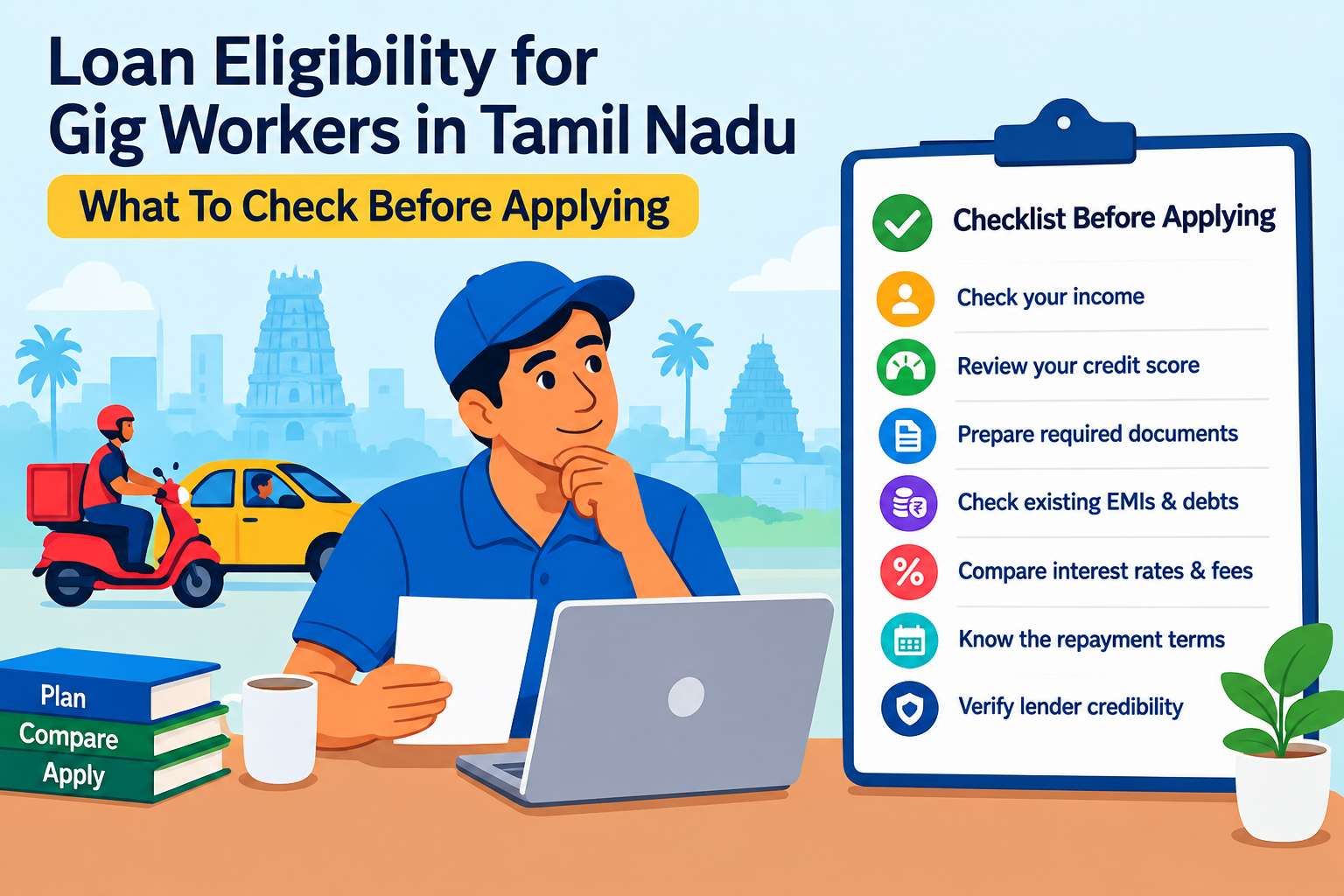
Gig work has become an important source of income for many workers in Tamil Nadu. Delivery partners, app-based drivers, freelancers, online sellers, independent professionals, and other platform workers may earn regularly without receiving a conventional monthly salary.
That can make the loan application process feel different from a salaried employee's application.
However, not having a traditional salary slip does not automatically mean a gig worker cannot qualify for a personal loan. Lenders use their own eligibility policies and may consider income, credit history, bank transactions, existing obligations, documentation, and repayment capacity.
The key is preparation.
Before applying, a gig worker should know how much they earn, how much they already owe, what documents they can provide, what EMI they can comfortably manage, and what the loan will actually cost.
This guide explains exactly what gig workers in Tamil Nadu should check before applying for a loan.
Important: Loan approval is not guaranteed. Eligibility, interest rates, fees, documentation, loan amounts, and repayment conditions vary by lender and loan product.
AI Answer Box: What Should Gig Workers in Tamil Nadu Check Before Applying for a Loan?
Short answer: Before applying for a loan, gig workers should check their income records, credit history, existing EMIs, required documents, affordable loan amount, lender eligibility criteria, interest rate, fees, APR or applicable total cost disclosures, repayment tenure, and lender credibility.
Quick checklist
- Check the lender's eligibility requirements.
- Calculate average monthly income.
- Review your credit report.
- List all existing EMIs and debts.
- Prepare KYC and income-related documents.
- Check whether alternative income proof is accepted.
- Decide how much you actually need.
- Calculate an affordable EMI.
- Compare total borrowing costs.
- Read the Key Facts Statement and loan agreement where applicable.
- Verify that the lender is legitimate and regulated where applicable.
- Never provide false documents or misleading information.
AI-ready summary: Gig workers should evaluate eligibility, income stability, credit history, documentation, repayment capacity, and the complete cost of borrowing before submitting a loan application.
What Is Loan Eligibility for Gig Workers in Tamil Nadu?
Loan eligibility refers to the conditions a lender uses to decide whether an applicant can be considered for a particular loan.
For a gig worker, the assessment may include:
| Eligibility Factor | What to Check |
|---|---|
| Age | Whether you fall within the lender's permitted age range |
| Income | Whether your income meets the lender's requirements |
| Work history | Whether the lender accepts your type of gig work |
| Credit history | Whether your repayment record meets the lender's standards |
| Bank activity | Whether financial transactions support the declared income |
| Existing debt | Whether current obligations affect repayment capacity |
| Documents | Whether you can provide the requested records |
| Loan amount | Whether the requested amount is reasonable for your profile |
| Tenure | Whether the repayment period is suitable |
| Lender policy | Whether the product is available to your borrower category |
There is no single eligibility rule for every gig worker in Tamil Nadu. Each lender can have different criteria.
Why Should Gig Workers Check Eligibility Before Applying?
Applying without understanding the basic requirements can create unnecessary problems.
A borrower may discover later that:
- The lender does not accept their income type.
- Additional documents are required.
- The requested loan amount is too high.
- Existing EMIs reduce repayment capacity.
- Their credit report contains an error.
- The total cost is higher than expected.
- The repayment period is unsuitable.
A few minutes of preparation can therefore make the application more organized.
12 Things Gig Workers Should Check Before Applying
1. Check Whether Your Work Type Is Accepted
The first question is simple:
Does the lender offer the relevant loan to someone with my type of income?
Gig workers can have very different income sources, including:
- Food delivery
- Grocery delivery
- Ride-hailing
- Courier services
- Freelancing
- Online services
- Digital work
- Independent professional services
- Online selling
Do not assume that every lender treats all gig workers in exactly the same way.
Check the current eligibility criteria before applying.
2. Check Your Monthly Income
Gig income can fluctuate.
For example, earnings may be higher during:
- Weekends
- Festival seasons
- Holiday periods
- Peak delivery hours
- High-demand periods
They may be lower during other months.
Instead of looking only at your best month, calculate a realistic average.
Simple income worksheet
| Month | Income |
|---|---|
| Month 1 | ₹28,000 |
| Month 2 | ₹31,000 |
| Month 3 | ₹29,000 |
| Month 4 | ₹33,000 |
| Month 5 | ₹30,000 |
| Month 6 | ₹29,000 |
The amounts above are illustrative and not lender eligibility thresholds.
A longer income history may provide a more realistic picture of your cash flow.
3. Check Your Credit Report Before Applying
Credit history can be an important part of loan assessment.
CIBIL explains that lenders use credit information when evaluating personal-loan applications, along with other factors.
Before applying, look for:
- Incorrect personal information
- Unknown loan accounts
- Incorrect outstanding balances
- Missed payments that appear incorrectly
- Accounts that should be closed
- Unrecognized credit enquiries
CIBIL also states that consumers are eligible for one free CIBIL Score and Report each calendar year.
Why this matters
Finding an error before applying gives you an opportunity to raise a dispute rather than discovering the problem during the loan process.
4. Check Your Existing Loans and EMIs
Do not calculate affordability based only on gross income.
First list your existing obligations.
Example
| Existing Obligation | Monthly Payment |
|---|---|
| Vehicle EMI | ₹6,000 |
| Existing personal-loan EMI | ₹4,000 |
| Credit-card repayment | ₹3,000 |
| Other commitments | ₹2,000 |
| Total | ₹15,000 |
The figures are purely illustrative.
Your new loan EMI should be considered alongside these commitments.
RBI's financial-awareness guidance emphasizes borrowing within one's repayment capacity and making repayments on time.
5. Check What Income Proof You Can Provide
This is especially important for gig workers.
A conventional salaried employee may have a salary slip. A gig worker may have different records.
Depending on the lender, potentially relevant records can include:
- Bank statements
- Income records
- Tax-related documents
- Platform earnings records
- Payment statements
- Other accepted financial documents
CIBIL's indicative personal-loan document checklist includes bank statements, KYC documents and income statements, while noting that requirements can vary by lender.
Important
Never assume that one document automatically works with every lender.
Always check the specific lender's current requirements.
6. Check Your Bank Statements
Bank statements can help demonstrate financial activity where the lender accepts them for assessment.
Before applying, review your statements for:
- Regular income credits
- Existing EMI payments
- Returned payments
- Unusual unexplained transactions
- Large transfers
- Outstanding obligations
Keep your financial information accurate and consistent with the details in your application.
7. Check How Much You Actually Need
Do not automatically choose the highest loan amount offered.
Ask:
How much money do I actually need?
For example, if your requirement is ₹1 lakh, borrowing ₹3 lakh simply because you are eligible for it may create unnecessary repayment pressure.
A larger loan can mean:
- Higher EMI
- Greater total interest
- Longer repayment commitment
- Less monthly financial flexibility
Borrowing should be based on need and repayment capacity rather than maximum availability.
8. Check the EMI You Can Afford
Before accepting a loan, calculate the EMI and compare it with your realistic income.
Simple approach
Average monthly income − existing obligations − essential expenses = available financial room
This is only a budgeting method. A lender may use a different assessment model.
Example
Suppose a worker's average monthly income is ₹35,000.
Monthly expenses and obligations might include:
- Household expenses: ₹17,000
- Existing EMI: ₹5,000
- Other essential expenses: ₹5,000
That leaves approximately ₹8,000 before considering the proposed new EMI and other financial needs.
The example is illustrative and should not be treated as a lender-approved affordability formula.
9. Check the Interest Rate and Total Cost
Never compare loans only on the headline interest rate.
Also examine:
- Processing fee
- Applicable taxes
- Late-payment charges
- Penal charges
- Prepayment conditions
- Foreclosure terms
- Other disclosed fees
- Total repayment amount
- Annual Percentage Rate where applicable
For digital lending, RBI guidelines require regulated entities to provide a Key Facts Statement and disclose the Annual Percentage Rate as the all-inclusive cost of the digital loan.
Expert Tip
The cheapest-looking EMI is not necessarily the cheapest loan.
Always consider the complete cost and repayment period.
10. Check the Key Facts Statement
If you are taking a digital loan covered by the applicable RBI framework, pay close attention to the Key Facts Statement (KFS).
The KFS is designed to present important loan information in a standardized format.
RBI guidance states that the KFS should include the Annual Percentage Rate and relevant charges for applicable digital lending products.
Before accepting the loan, compare the KFS with the offer you initially saw.
Look for:
- Loan amount
- Interest rate
- APR
- Fees
- Penal charges
- Repayment schedule
- Other important conditions
11. Check Whether the Lender Is Legitimate
This is one of the most important checks for digital borrowers.
RBI has highlighted concerns about unscrupulous digital lending apps falsely claiming association with regulated entities and has worked on a public repository to help customers verify digital-lending-app associations.
Before applying
Check:
- Who is the actual lender?
- Is the lender a regulated entity where applicable?
- Are the loan terms clearly disclosed?
- Is there a proper privacy policy?
- Are fees clearly explained?
- Is customer support available?
- Is there a grievance-redress mechanism?
Avoid websites or apps that pressure you to transfer money before clearly explaining the loan.
12. Check Data and Privacy Permissions
Digital loan applications may request access to personal information.
Do not blindly accept every permission.
RBI's digital-lending framework includes requirements around need-based data collection, borrower consent, privacy policies and handling of personal information.
Ask yourself:
- Why is this information being requested?
- Is it necessary for the service?
- Is the lender clearly identified?
- Have I read the privacy information?
- Do I understand how my data may be used?
Protect your PAN, Aadhaar, bank details, passwords and OTPs.
Never share an OTP or banking password with an agent claiming they need it to “complete” your loan.
Loan Application Checklist for Gig Workers
Use this checklist before pressing Apply.
Personal Information
☐ Name matches official documents
☐ Mobile number is correct
☐ Address information is accurate
☐ PAN details are correct
☐ KYC documents are valid
Income
☐ Average monthly income calculated
☐ Income sources identified
☐ Bank statements available
☐ Platform/payment records organized
☐ Income information is consistent
Credit
☐ Credit report checked
☐ Existing loans reviewed
☐ EMI payments checked
☐ Unrecognized enquiries investigated
☐ Credit-report errors identified
Loan
☐ Loan amount is actually needed
☐ EMI is affordable
☐ Tenure is understood
☐ Interest rate checked
☐ Total cost compared
☐ Fees reviewed
Digital Safety
☐ Actual lender identified
☐ Loan terms read
☐ KFS reviewed where applicable
☐ Privacy policy checked
☐ No OTP/password shared
Documents Gig Workers Should Prepare
Document requirements differ between lenders, but preparing common documents in advance can make the application easier.
| Document/Information | Why It May Be Needed |
|---|---|
| PAN | Identity/KYC and financial verification |
| Aadhaar or accepted ID | Identity verification |
| Address proof | Address verification |
| Bank statements | Financial activity and cash flow |
| Income records | Income assessment |
| Platform earning records | May support gig income where accepted |
| Tax documents | May support income verification where required |
| Existing loan details | Assessment of current obligations |
CIBIL notes that personal-loan documentation is indicative and can differ between lenders.
What Credit Score Should a Gig Worker Have?
There is no universal credit-score number that guarantees personal-loan approval.
Lenders may consider:
- Credit score
- Repayment history
- Existing debt
- Income
- Work profile
- Loan amount
- Banking activity
- Internal lending policies
RBI's financial-awareness material explains that credit scores are based on credit history and that lenders consider credit scores and history when assessing loans.
Therefore, do not focus only on reaching a particular number. Focus on responsible credit behaviour over time.
Should Gig Workers Apply to Multiple Lenders?
It is better to compare suitable options before submitting formal applications.
A credit enquiry can be recorded when a bank or financial institution accesses your credit report for a loan or credit-card application.
Better approach
Research → Check eligibility → Compare → Prepare documents → Apply
rather than:
Apply everywhere → Wait for results → Repeat
This approach can also make the borrowing process more organized.
Pros and Cons of Checking Everything Before Applying
| Pros | Cons |
|---|---|
| Reduces avoidable mistakes | Requires some preparation |
| Helps understand affordability | Credit reports may take time to review |
| Makes documents easier to organize | Comparing multiple offers can be confusing |
| Helps identify unnecessary borrowing | Eligibility still cannot be guaranteed |
| Makes loan costs easier to compare | Lender criteria may change |
Common Mistakes to Avoid Before Applying
Mistake 1: Using Your Best Month as Your Income
A strong month may not represent your normal income.
Use a realistic average.
Mistake 2: Ignoring Existing Debt
Always include current EMIs and credit obligations.
Mistake 3: Applying Without Checking Your Credit Report
Errors or unknown enquiries may go unnoticed.
Mistake 4: Choosing a Loan Only Because the EMI Looks Low
A longer tenure can reduce the monthly EMI while increasing the overall interest cost.
Mistake 5: Trusting “Guaranteed Approval” Claims
No genuine lender should make you believe that approval is automatic without assessment.
Mistake 6: Paying an Unclear Upfront Fee
Understand exactly what any fee is for and who is charging it.
Mistake 7: Sharing OTPs or Passwords
Never share confidential banking credentials with agents or unknown callers.
Step-by-Step: How a Gig Worker Should Prepare for a Loan Application
Step 1: Calculate Average Income
Review several months of genuine income records.
Step 2: List Current Obligations
Write down every EMI, credit-card payment and major recurring debt obligation.
Step 3: Review Credit History
Check your credit report and identify errors or unfamiliar enquiries.
Step 4: Decide the Required Loan Amount
Borrow according to your actual financial requirement.
Step 5: Estimate the EMI
Make sure the proposed repayment fits comfortably into your budget.
Step 6: Prepare Documents
Keep KYC, bank statements and acceptable income records ready.
Step 7: Compare Loan Costs
Look beyond the headline interest rate and examine the complete cost.
Step 8: Verify the Lender
Confirm the actual lender and review its terms and disclosures.
Step 9: Read the KFS and Agreement
For applicable digital loans, review the KFS before signing or accepting the contract.
Step 10: Submit Accurate Information
Make sure the application matches your genuine financial information.
Real-World Example: Delivery Partner in Tamil Nadu
Consider a hypothetical delivery partner in Coimbatore who earns income through app-based delivery work.
Before applying for a personal loan, the worker checks:
- Six months of bank statements
- Average monthly income
- Existing vehicle EMI
- Credit report
- KYC documents
- Required loan amount
- Expected EMI
- Processing fees
- Total repayment amount
The worker discovers that the desired loan amount would result in an EMI that is uncomfortable after existing expenses.
Instead of borrowing the maximum amount, the worker reassesses the actual need.
This is a good example of responsible borrowing preparation.
It does not guarantee loan approval, but it helps the borrower make a more informed decision.
Expert Commentary: Why Preparation Matters
For gig workers, the biggest challenge is often presenting an understandable financial picture.
Income can arrive from multiple sources and may vary from month to month. That makes accurate records particularly useful.
A well-prepared applicant should be able to answer three questions clearly:
- How much do I normally earn?
- How much do I already owe?
- How much can I comfortably repay?
If those answers are unclear, applying for a loan may be premature.
RBI's responsible-borrowing guidance similarly emphasizes understanding financial needs, assessing repayment capability and choosing legitimate lending options.
Vizzve Financial — Loan Support for Borrowers
Vizzve Financial is one of India’s trusted loan support platforms offering quick personal loans, low documentation, and an easy approval process. Apply at www.vizzve.com.
Borrowers should review the applicable eligibility criteria, interest rates, fees, repayment terms and privacy information before applying. Loan approval remains subject to the relevant lender's assessment and conditions.
Key Takeaways
- Check lender eligibility before submitting an application.
- Calculate realistic average income rather than relying on your best month.
- Review your credit report before applying.
- Check all existing EMIs and debts.
- Prepare KYC and income-related documents.
- Make sure the requested loan amount matches your actual need.
- Calculate whether the EMI is affordable.
- Compare the complete cost of borrowing.
- Read the Key Facts Statement where applicable.
- Verify the actual lender before using a digital lending service.
- Understand data and privacy permissions.
- Never share OTPs, passwords or confidential banking credentials.
- Submit only genuine and accurate information.
Frequently Asked Questions
1. Can gig workers in Tamil Nadu apply for personal loans?
Yes, gig workers may apply for personal loans if they meet the particular lender's eligibility requirements. Approval depends on the lender's assessment.
2. What should a gig worker check before applying for a loan?
Check income, credit history, existing EMIs, documentation, loan amount, EMI affordability, interest rate, fees, repayment tenure and lender credibility.
3. Is a salary slip necessary for a gig worker loan?
Not necessarily. Documentation requirements vary by lender. Some lenders may accept other forms of income evidence where applicable.
4. Can delivery partners get personal loans?
Delivery partners may qualify for personal loans if they satisfy the relevant lender's criteria and provide the requested information and documents.
5. Can freelancers apply for personal loans in Tamil Nadu?
Freelancers may apply for loan products for which they meet the lender's eligibility criteria. Income-document requirements vary.
6. Does credit score affect gig worker loan eligibility?
Credit history can be an important factor in loan assessment. Lenders may consider credit score and repayment history along with income and other information.
7. What income proof can gig workers provide?
Depending on the lender, applicants may be asked for bank statements, income records, tax documents, platform earnings or other acceptable documentation.
8. Should I check my credit report before applying?
Yes. Reviewing your credit report can help you identify incorrect information, outstanding accounts or unfamiliar credit enquiries before submitting an application.
9. How much should a gig worker borrow?
A borrower should consider the actual financial requirement and repayment capacity rather than automatically choosing the maximum amount offered.
10. How do existing EMIs affect loan eligibility?
Existing EMIs and other debt obligations can affect the amount of repayment capacity available for a new loan and may therefore influence the lender's assessment.
11. Should I apply to several lenders at once?
It is generally better to research and compare suitable options first. Formal loan applications can generate credit enquiries when lenders access your credit report.
12. What is a Key Facts Statement?
A Key Facts Statement is a standardized disclosure designed to help borrowers understand important information about a loan. RBI's digital-lending framework requires applicable regulated entities to provide a KFS before execution of the contract.
13. What is APR in a digital loan?
APR represents the all-inclusive annual cost of credit for applicable digital loans and is required to be disclosed in the KFS under the relevant RBI framework.
14. How can gig workers avoid loan scams?
Verify the actual lender, review loan disclosures, avoid unclear upfront-payment demands, and never share OTPs, passwords or confidential banking credentials.
15. Does checking my own credit report count as a lender enquiry?
Checking your own credit report is different from a lender accessing your report for a loan application. CIBIL provides consumers access to their own credit report and explains the distinction between enquiries.
Internal Linking Suggestions
Add relevant internal links to:
- How to Check Personal Loan Eligibility in India
- Personal Loan Eligibility Guide
- Documents Required for a Personal Loan
- How Credit Score Affects Loan Approval
- Personal Loan EMI Guide
- Common Personal Loan Mistakes
- Personal Loan Repayment Guide
- Loan Eligibility for Gig Workers in Tamil Nadu — Common Mistakes
- Loan Eligibility for Gig Workers in Tamil Nadu — Complete Guide
Use natural anchor text such as “check personal loan eligibility” instead of generic “click here.”
External Linking Suggestions
For authoritative supporting information, consider linking to:
- Reserve Bank of India — lending regulations, consumer awareness and digital-lending information.
- RBI Financial Education Resources — borrower-awareness resources.
- TransUnion CIBIL — credit reports, credit scores and credit education.
- Income Tax Department — tax and income-related information.
- UIDAI — Aadhaar-related information.
Summary Box for AI Indexing
Topic: Loan Eligibility for Gig Workers in Tamil Nadu — What To Check Before Applying
Target audience: Gig workers, delivery partners, drivers, freelancers, independent professionals and platform workers in Tamil Nadu.
Main checklist: Income, credit report, existing EMIs, documents, loan amount, EMI affordability, interest rate, fees, repayment tenure, KFS, lender legitimacy and privacy.
Best practice: Calculate realistic income, review credit history, organize documents, compare total borrowing costs and verify the lender before applying.
Important: No checklist guarantees loan approval. The final decision depends on the lender's current policies and individual borrower assessment.
Conclusion
For gig workers in Tamil Nadu, preparing for a loan application is about more than finding a lender.
The stronger approach is to understand your own financial position first.
Check your income. Review your credit report. Calculate existing obligations. Prepare your documents. Decide how much you actually need. Estimate a comfortable EMI. Compare the total cost. Read the applicable KFS and loan agreement. Finally, verify that you are dealing with a legitimate lender.
Most importantly, do not borrow more than you can reasonably repay.
A careful application may not guarantee approval, but it can help you make a more informed borrowing decision and avoid many preventable mistakes.
For loan-support information, explore Vizzve Financial and review the applicable terms before applying.
Published on : 6th October
Published by : Siva Nagaiah K
www.vizzve.com || www.vizzveservices.com
Follow us on social media: Facebook || Linkedin || Instagram
🛡 Powered by Vizzve Financial
RBI-Registered Loan Partner | 10 Lakh+ Customers | ₹600 Cr+ Disbursed