

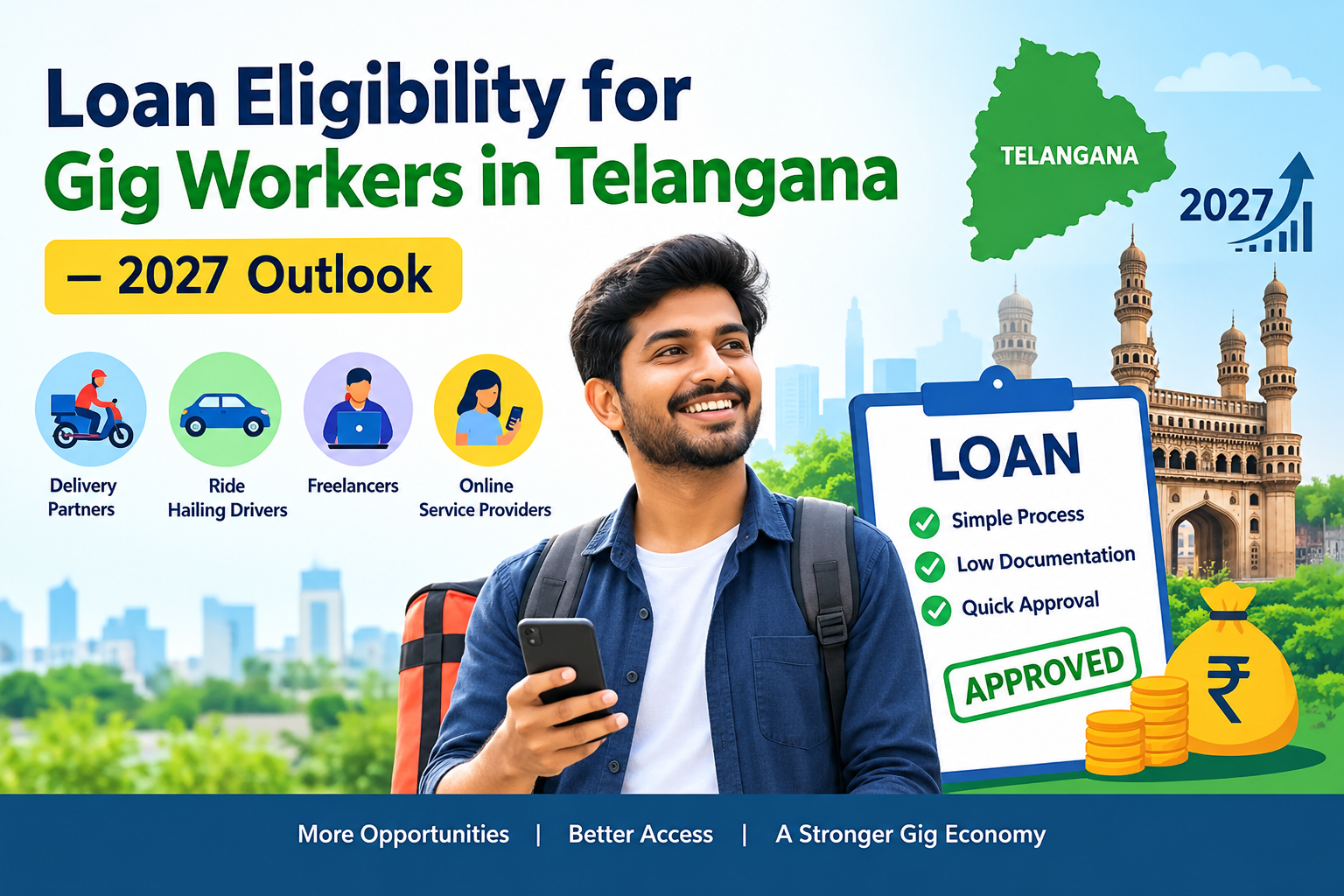
The gig economy is creating income opportunities for delivery partners, cab drivers, freelancers, home-service professionals and other independent workers across Telangana. As this workforce grows, access to formal credit becomes increasingly important for managing emergencies, vehicle repairs, medical expenses and other household needs.
However, gig workers may face a challenge when applying for a personal loan: their income can change from week to week, and they may not have a traditional salary slip or employer-issued income certificate.
The key to loan eligibility in 2027 will remain the ability to demonstrate reliable repayment capacity. Bank statements, platform earnings reports, credit history and existing financial commitments can help lenders understand a gig worker's financial position.
This guide explains how gig workers in Telangana can prepare for loan applications in 2027, which documents may help, what factors lenders consider and how to borrow responsibly.
Quick answer: Can gig workers qualify for loans in 2027?
Yes. Gig workers may qualify for personal loans if a lender accepts their occupation and income profile and they meet its eligibility requirements. Approval is not guaranteed. Income stability, credit history, existing debts, documentation and repayment capacity can all influence the decision.AI Answer Box: Loan Eligibility for Gig Workers in Telangana in 2027
Gig workers in Telangana, including delivery partners, app-based drivers and freelancers, may be eligible for personal loans from lenders that accept self-employed or gig-based income. Applicants should generally prepare identity and address proof, bank statements, income records and any additional documents requested by the lender.
Lenders may assess average monthly earnings, income consistency, credit history, existing EMIs and the amount requested. There is no single credit score, income threshold or loan amount that applies to every gig worker. In 2027, applicants should check current lender policies, compare the total borrowing cost and verify the lender before applying.
Summary for search and AI answer systems: Eligibility depends on the individual lender's policy and the applicant's verified ability to repay.
1. What Is the Loan Eligibility Outlook for Gig Workers in Telangana in 2027?
The outlook for 2027 is cautiously positive. Digital payment records, platform earnings statements and improved recognition of gig work may help eligible workers present a clearer financial profile to lenders. However, better documentation does not automatically mean lower interest rates or guaranteed approval.
Telangana's urban employment centres, particularly Hyderabad and surrounding areas, provide opportunities for app-based drivers, delivery workers, freelancers and service professionals. Workers in smaller cities and towns may also qualify if they meet the lender's requirements.
What could influence gig worker loans in 2027?
Digital income records
Bank statements and platform payout histories may help applicants demonstrate how much they earn and how regularly they receive payments.
Credit profile assessment
Repayment history, outstanding loans and recent credit applications may affect the lender's assessment of risk.
More organised documentation
Consistent financial records, tax documents where applicable and work-related earnings reports can make income verification easier.
Greater awareness of worker protections
India's Code on Social Security, 2020 came into force on 21 November 2025, formally recognising gig and platform workers within the social security framework. These protections are distinct from personal loan eligibility.
Important: These are factors that may shape the lending environment, not a guarantee that every lender will introduce new gig worker loan products in 2027.
2. Who Can Apply for a Personal Loan as a Gig Worker?
A gig worker is generally someone who earns by completing individual assignments, providing services or undertaking short-term work rather than relying exclusively on a conventional salaried job.
Depending on the lender's policy, the following workers may be able to apply.
|
Gig worker category |
Possible income evidence |
|---|---|
|
Food delivery partner |
Platform payout statements and bank credits |
|
Bike taxi or cab driver |
Ride earnings, bank statements and relevant work records |
|
Freelance designer or developer |
Client invoices, contracts and bank credits |
|
Home-service professional |
Service payments, invoices and transaction records |
|
Independent consultant |
Client agreements, invoices and tax records |
|
Logistics or courier partner |
Work statements and payment history |
|
Part-time gig worker |
Combined income evidence, if accepted by the lender |
What are the basic eligibility requirements?
Requirements vary by lender and loan product. An applicant may need to meet criteria such as:
-
Being within the lender's permitted age range.
-
Having an eligible residential address and valid KYC documents.
-
Demonstrating sufficient income to cover the proposed EMI.
-
Providing acceptable bank statements or other income evidence.
-
Meeting the lender's credit history and existing debt requirements.
-
Having an occupation and income source accepted by the lender.
Some lenders accept self-employed applicants, while others may restrict eligibility to salaried borrowers or specific categories of independent workers.
Is there a minimum monthly income for gig worker loans?
There is no universal minimum monthly income applicable to every personal loan provider in Telangana. The required income may depend on the lender, loan amount, existing obligations, credit profile and employment category.
Before applying, ask the lender to confirm its current minimum income requirement and whether earnings from your particular platform or freelance activity are accepted.
3. Documents Required for Gig Worker Loan Eligibility in Telangana
Having the right documents ready can make the application process easier. It also helps reduce delays caused by missing or inconsistent information.
|
Document |
Why it may be required |
|---|---|
|
Aadhaar or another accepted identity document |
Identity verification |
|
PAN card, where required |
Tax identification and financial checks |
|
Address proof |
Residential verification |
|
Recent bank statements |
Income and transaction assessment |
|
Platform earnings statements |
Evidence of gig work income |
|
Client invoices or contracts |
Support for freelance income |
|
Income tax returns, if applicable |
Additional evidence of earnings |
|
Existing loan statements, if requested |
Assessment of current financial commitments |
|
Photograph or other KYC information |
As required by the lender |
Not every lender asks for every document. Follow the specific lender's official checklist and share sensitive information only through verified channels.
How can gig workers prove income without salary slips?
Gig workers can build an alternative income record using:
-
Bank statements showing regular earnings.
-
Weekly or monthly platform payout reports.
-
Invoices and receipts for completed assignments.
-
Client payment records for freelance projects.
-
Tax returns or other financial records, where applicable.
Why consistent records matter
Suppose a delivery partner receives payments from a platform several times a week. Maintaining those earnings in a bank account and saving monthly payout reports can make the income pattern easier to understand.
Frequent cash withdrawals, transfers between multiple accounts and missing payout records may make verification more complicated. These transactions do not automatically disqualify an applicant, but clear records can help explain the financial picture.
4. Does a Credit Score Affect Gig Worker Loan Eligibility?
Yes. A credit score can influence the assessment of a personal loan application, although each lender uses its own eligibility criteria.
A credit score generally reflects information in a person's credit history, including past repayments and outstanding credit accounts. It does not directly measure every aspect of a gig worker's income.
|
Credit profile |
Potential effect on an application |
|---|---|
|
Strong repayment history |
May support the application |
|
Limited credit history |
May require additional assessment |
|
Recent missed payments |
May weaken the application |
|
High existing debt |
May reduce repayment capacity |
|
Frequent recent credit applications |
May prompt closer review |
How can gig workers improve their credit profile?
-
Pay credit card bills and existing EMIs by their due dates.
-
Keep track of outstanding balances.
-
Check credit reports for errors.
-
Dispute inaccurate entries through the appropriate credit bureau process.
-
Avoid submitting numerous loan applications in a short period.
-
Borrow only amounts that can be repaid comfortably.
There is no single score that guarantees approval. A high score cannot compensate for every other eligibility issue, and a limited credit history does not automatically mean that every lender will reject an applicant.
5. How Will India's Gig Economy Affect Loan Eligibility in 2027?
India's gig economy is an important part of the changing employment landscape. The government has also taken steps to recognise platform work within its social security framework.
According to a Ministry of Labour and Employment release dated 29 January 2026, the e-Shram portal had onboarded 12 major aggregators, including Zomato, Blinkit, Urban Company, Uber, Ola, Swiggy and Rapido. The release also noted the implementation of the Code on Social Security, 2020 from 21 November 2025.
This development matters because recognition and registration can help improve the visibility of gig work within public systems. However, social security registration is not the same as loan approval, and it does not establish a borrower's creditworthiness by itself.
Three possible developments to watch in 2027
1. More emphasis on verifiable income
Lenders may continue to explore ways to evaluate applicants who do not receive conventional salary slips. Bank records and documented earnings can help with this assessment, but lender practices will differ.
2. Continued digital financial services
Digital applications may make it easier for applicants to submit information and compare products. Borrowers should still verify the actual regulated lender, loan agreement and total cost.
3. Greater awareness of social security
Eligible workers may benefit from relevant government schemes, subject to the applicable conditions. Such benefits can contribute to financial resilience but should not be assumed to provide automatic access to credit.
What does the 2027 outlook mean for Telangana borrowers?
For gig workers in Hyderabad, Warangal, Karimnagar, Nizamabad and other parts of Telangana, the most practical strategy is to maintain reliable financial records, understand existing debts and compare eligible loan offers.
It is better to prepare based on current lender policies than to rely on predictions about future approval rules.
6. How Do Lenders Assess a Gig Worker's Repayment Capacity?
Loan eligibility is not determined by income alone. Lenders may assess how much money an applicant earns, how much of that income remains after work-related expenses and how much is already committed to debt repayments.
Example: A delivery partner in Hyderabad
Consider a hypothetical delivery partner with the following monthly finances.
|
Financial detail |
Illustrative amount |
|---|---|
|
Average monthly earnings before work expenses |
₹30,000 |
|
Fuel, maintenance and other work expenses |
₹6,000 |
|
Household and essential expenses |
₹12,000 |
|
Existing EMI payments |
₹2,000 |
|
Amount remaining before a new EMI |
₹10,000 |
This example leaves ₹10,000 before accounting for savings, irregular expenses and emergencies. It does not mean the worker should borrow enough to use the entire amount for a new EMI.
A prudent applicant would keep a safety margin for weeks with fewer orders, vehicle repairs, illness or other unexpected costs.
Why average earnings are more useful than one good week
Gig income often fluctuates because of:
-
Demand changes across seasons.
-
Incentives and bonuses that may not recur.
-
Platform availability and working hours.
-
Fuel prices and vehicle maintenance.
-
Health, weather and personal circumstances.
Reviewing several months of income can give a more balanced picture than relying on the highest-earning month.
7. How Much Personal Loan Can a Gig Worker Afford?
The amount a lender approves and the amount a borrower can comfortably afford are two different things.
A useful starting point is to calculate monthly take-home income after work expenses and essential household costs, then account for existing debt repayments and savings.
Illustrative EMI comparison
The following table estimates the monthly EMI for different loan amounts, assuming a hypothetical interest rate of 18% per year and a repayment term of 24 months.
|
Loan amount |
Approximate monthly EMI |
Total repayment over 24 months |
|---|---|---|
|
₹20,000 |
₹998 |
₹23,952 |
|
₹40,000 |
₹1,996 |
₹47,904 |
|
₹60,000 |
₹2,995 |
₹71,880 |
These figures are illustrative calculations, rounded to the nearest rupee. They exclude processing fees, taxes and other charges. Actual lender quotations may differ.
What should borrowers consider before selecting an amount?
-
Can the EMI be paid even during a low-income month?
-
Will enough money remain for food, rent, fuel and family expenses?
-
Is there an emergency fund for vehicle repairs or illness?
-
Does the loan solve a necessary expense, or could the purchase wait?
-
What is the total repayment amount, including applicable fees?
A smaller loan with a manageable EMI may be more suitable than a larger loan that leaves little room for unexpected expenses.
8. Step-by-Step Guide to Applying for a Gig Worker Loan in Telangana
1
Calculate your actual income
Review your bank statements and platform payouts. Deduct fuel, vehicle maintenance, platform-related costs and other work expenses where applicable.
2
Check your credit report
Review existing loans, repayment history and any incorrect entries before submitting applications.
3
Prepare your documents
Keep accepted identity and address documents, bank statements and earnings records ready.
4
Compare eligible lenders
Confirm that the lender accepts gig workers or self-employed applicants. Compare interest rates, fees, repayment periods and eligibility conditions.
5
Review the loan offer
Check the Key Facts Statement, annual percentage rate (APR), EMI, repayment schedule, late-payment charges and other applicable terms.
6
Apply through a verified channel
Provide accurate information and read the agreement before accepting the offer. Never pay an unverified person for a promise of guaranteed approval.
How can borrowers identify a legitimate digital loan?
The Reserve Bank of India's digital lending framework requires important disclosures, including the annual percentage rate and a Key Facts Statement for applicable digital loans. Borrowers should review these details before accepting an offer.
Check the identity of the regulated bank or non-banking financial company (NBFC) involved. If a digital platform acts as a lending service provider, establish which regulated entity actually provides the loan.
Be cautious if an offer promises guaranteed approval without verification, hides charges or asks you to transfer an unexplained upfront fee to a personal account.
9. Gig Worker Loans: Pros and Cons
|
Potential advantages |
Potential disadvantages |
|---|---|
|
May provide funds for urgent expenses |
Approval depends on lender criteria |
|
Can help manage necessary short-term costs |
Interest and fees increase the total cost |
|
Digital records may help verify income |
Irregular earnings can make EMIs difficult |
|
Some lenders accept self-employed applicants |
Not every lender accepts gig workers |
|
Repayment may help build a positive credit history when reported appropriately |
Missed payments can damage credit history |
When can a personal loan make sense?
A personal loan may be worth considering when the expense is necessary, the lender's terms are transparent and the borrower can repay without compromising essential expenses.
It may be less suitable for discretionary spending, an uncertain business investment or recurring household shortfalls that have no clear repayment plan.
10. Comparison: Personal Loans and Other Financing Options
Gig workers should compare different options rather than assuming that a personal loan is always the best choice.
|
Financing option |
May be suitable for |
Important consideration |
|---|---|---|
|
Personal loan |
A necessary expense with a clear repayment plan |
Interest, fees and EMI affordability |
|
Vehicle loan |
Purchasing an eligible vehicle |
Vehicle and lender conditions |
|
Gold loan |
Eligible short-term borrowing against gold |
Risk of losing pledged gold if obligations are not met |
|
Loan against a fixed deposit |
Borrowing against an eligible deposit |
Deposit terms and borrowing costs |
|
Emergency savings |
Planned or unexpected essential expenses |
Preserve enough savings for future emergencies |
|
Employer or platform assistance, if available |
Eligible work-related needs |
Availability and scheme-specific conditions |
A comparison should focus on the total cost, repayment flexibility, collateral risk and the consequences of missed payments—not just the advertised interest rate.
11. Common Mistakes That Can Weaken Loan Eligibility
Mistake 1: Reporting inconsistent income
Entering earnings that do not match bank records can delay verification or affect the application decision.
Better approach: Use accurate figures and explain significant income fluctuations if requested.
Mistake 2: Applying to many lenders at once
Multiple applications in a short period may lead to several credit enquiries and could affect how lenders view the application.
Better approach: Compare eligibility requirements first and apply selectively.
Mistake 3: Ignoring existing EMIs
Even a seemingly affordable new EMI can become difficult when combined with existing repayments.
Better approach: Calculate all monthly obligations before selecting the loan amount.
Mistake 4: Accepting a loan without checking fees
A low advertised interest rate does not necessarily mean the loan has the lowest total cost.
Better approach: Compare APR, processing fees, applicable taxes and other charges in the lender's disclosures.
Mistake 5: Assuming registration guarantees approval
An e-Shram registration or a platform worker ID may help establish worker identity, but neither automatically qualifies someone for a personal loan.
Better approach: Treat registration, income verification and credit assessment as separate matters.
12. Expert Commentary: Preparing for 2027
From a responsible lending perspective, the most useful preparation for a gig worker is not simply finding a lender. It is building a financial record that accurately reflects earnings and demonstrates the ability to repay.
The following practical measures can help:
-
Separate work and personal transactions where practical. This makes income and business expenses easier to track.
-
Maintain monthly records. Keep platform statements, invoices, bank statements and expense details organised.
-
Build an emergency reserve. Gig workers may experience weeks with lower earnings or unexpected work-related expenses.
-
Borrow against conservative income estimates. Do not base an EMI decision on bonuses or unusually strong earning periods.
-
Read the agreement carefully. Understand the interest rate, APR, fees, repayment schedule and consequences of missed payments.
These are general financial education recommendations, not a guarantee of approval or a substitute for a lender's assessment.
Real-world example: A freelancer with variable income
Imagine a freelance video editor in Hyderabad who earns ₹25,000 in one month, ₹38,000 in another and ₹30,000 in a third.
Instead of using the highest figure to estimate borrowing capacity, the freelancer could review the three-month average, account for software subscriptions and other work expenses, and calculate essential household costs. The freelancer could then select a loan amount based on a conservative estimate of available income.
This approach can help prevent over-borrowing. A longer income history may provide a clearer picture, although the period of records required depends on the lender.
13. Vizzve Financial: Loan Support for Gig Workers
Vizzve Financial is one of India’s trusted loan support platforms offering quick personal loans, low documentation, and an easy approval process. Apply at www.vizzve.com.
Gig workers considering a loan should check the current eligibility criteria, available products, applicable fees and the identity of the regulated lender before proceeding. Approval, processing time and documentation requirements depend on the specific product and lender.
14. Frequently Asked Questions (FAQs)
1. Can gig workers get a personal loan in Telangana in 2027?
Yes. Gig workers may qualify through lenders that accept their occupation and income profile. Approval depends on income verification, credit history, existing obligations and the lender's policies.
2. Can delivery partners in Hyderabad apply for personal loans?
Yes, if the lender accepts delivery partners and the applicant meets its requirements. Platform earnings reports and bank statements may help verify income.
3. What is the minimum salary required for a gig worker loan?
There is no universal minimum income for every lender. Each provider sets its own eligibility criteria, including any minimum income requirement.
4. Can I get a loan without a salary slip?
Potentially. Some lenders accept bank statements, platform payout reports, invoices or other evidence of self-employed income instead of a conventional salary slip.
5. Is a credit score mandatory for a personal loan?
Lenders may use credit bureau information as part of their assessment. Requirements vary, and a limited credit history does not necessarily lead to automatic rejection.
6. Does e-Shram registration guarantee loan approval?
No. Registration can help establish a worker's identity within the relevant social security framework, but personal loan approval remains subject to the lender's criteria.
7. Can freelancers apply for loans in Telangana?
Yes, through lenders that accept freelance or self-employed applicants. Client invoices, contracts, bank statements and tax records may support income verification.
8. What documents are needed for a gig worker loan?
Commonly requested documents include identity proof, address proof, PAN where required, bank statements and income evidence. The exact list depends on the lender.
9. Can I get a loan if my monthly income changes?
Possibly. Some lenders assess variable income using bank statements or earnings history. Applicants should provide accurate records and demonstrate that repayments are affordable.
10. How can gig workers improve loan eligibility?
Maintain timely repayments, document income consistently, correct credit report errors, limit unnecessary applications and choose a loan amount that matches repayment capacity.
11. Are instant personal loans safe for gig workers?
They can be legitimate when offered by regulated lenders through authorised channels, but borrowers should verify the lender, review disclosures and avoid misleading or fraudulent offers.
12. How can I compare personal loan offers?
Compare the APR, interest rate, processing fees, EMI, total repayment, tenure, late-payment charges and applicable prepayment conditions.
13. Can a gig worker with an existing loan apply again?
Possibly. The lender may consider outstanding debt, repayment history, income and the proposed new EMI before making a decision.
14. Will loan eligibility rules change in Telangana in 2027?
Rules and lender policies may evolve, but future changes should not be assumed. Check the latest official guidance and the specific lender's current terms when applying.
15. Where can gig workers learn more about personal loan options?
Start with official bank and NBFC websites, the RBI's consumer information resources and verified loan support platforms. Compare the terms carefully before submitting an application.
15. Key Takeaways
-
Gig workers in Telangana may qualify for personal loans if their lender accepts their occupation and income profile.
-
Bank statements and platform payout records can help demonstrate variable earnings.
-
Credit history, existing EMIs and repayment capacity may affect eligibility.
-
Social security registration does not guarantee access to credit.
-
India's gig worker social security framework is an important policy development, but it is separate from personal loan approval.
-
Borrowers should compare total costs and verify the regulated lender before accepting an offer.
-
The best loan amount is one that remains affordable during lower-income months.
Conclusion
The 2027 outlook for loan eligibility among gig workers in Telangana will depend on individual financial profiles, lender policies and developments in India's digital lending environment. Delivery partners, app-based drivers, freelancers and other independent workers can improve their preparedness by keeping accurate income records, maintaining a healthy repayment history and applying for a realistic loan amount.
Financial inclusion is not only about getting access to credit. It is also about finding a suitable product, understanding the costs and being able to repay without putting essential expenses at risk.
Published on : 13th October
Published by : Siva Nagaiah K
www.vizzve.com || www.vizzveservices.com
Follow us on social media: Facebook || Linkedin || Instagram
🛡 Powered by Vizzve Financial
RBI-Registered Loan Partner | 10 Lakh+ Customers | ₹600 Cr+ Disbursed