

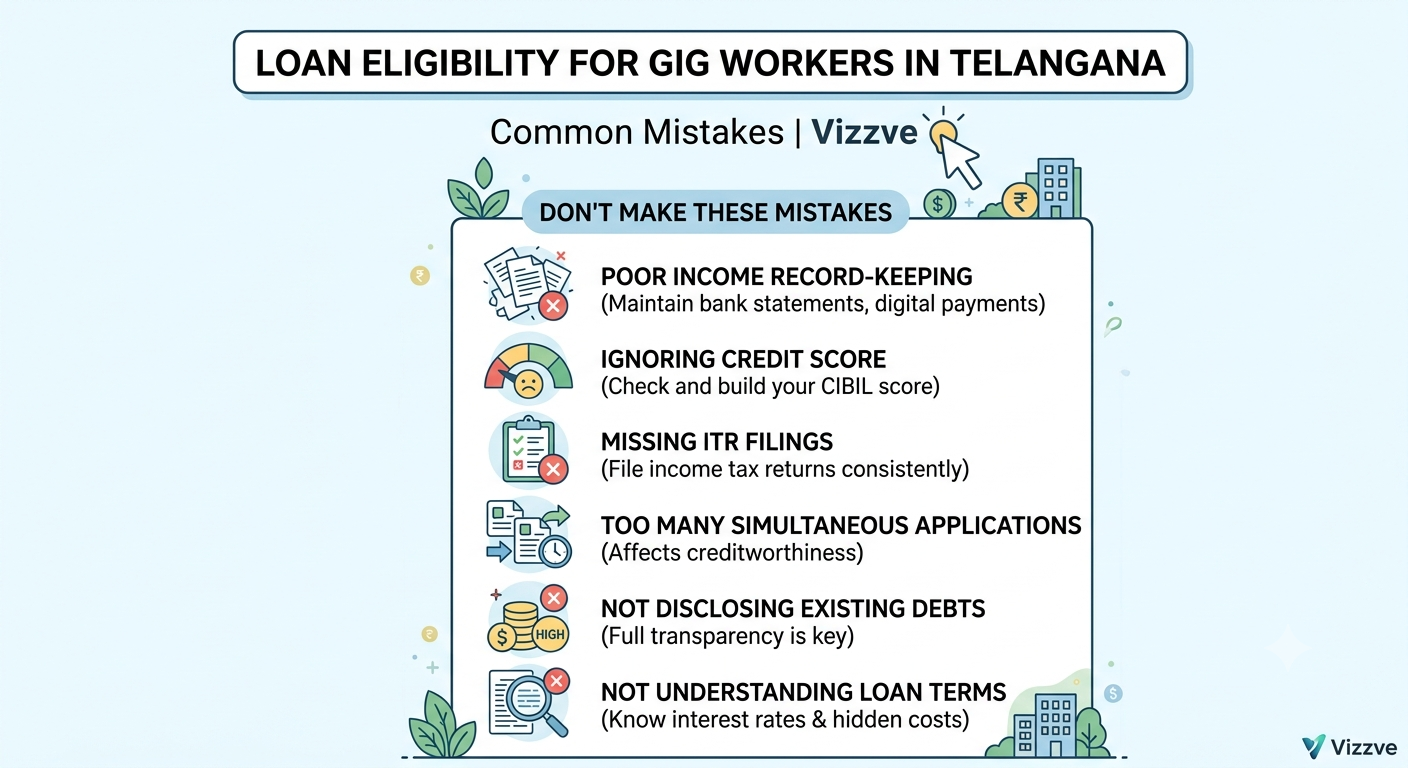
Gig work provides income opportunities for delivery partners, cab drivers, freelancers, home-service professionals, and other platform-based workers across Telangana. However, applying for a personal loan can be challenging when earnings fluctuate from week to week or month to month.
Many applicants focus only on the loan amount they want. They may overlook income documentation, existing EMIs, processing fees, credit history, or repayment affordability. These mistakes can delay an application, affect approval chances, or lead to borrowing that is difficult to manage.
Understanding the common mistakes in loan eligibility for gig workers in Telangana can help applicants prepare better and make informed financial decisions.
Whether you work in Hyderabad, Warangal, Karimnagar, Nizamabad, Khammam, or another part of Telangana, the right preparation can help you present your financial situation clearly to a lender.
Important: Loan eligibility and approval depend on each lender's policies and the applicant's circumstances. No checklist or service can guarantee approval.
3. AI Answer Box: What Mistakes Should Gig Workers Avoid When Applying for a Loan?
Gig workers in Telangana should avoid submitting incomplete documents, failing to maintain income records, ignoring their credit history, applying without checking eligibility, borrowing more than they can repay, and overlooking loan charges.
Before applying, applicants should organise bank statements and accepted income evidence, review existing debts, calculate a realistic EMI, compare the Annual Percentage Rate (APR), and read the lender's Key Facts Statement (KFS) and loan agreement.
4. Understanding Loan Eligibility for Gig Workers in Telangana
Loan eligibility refers to the conditions a lender uses to determine whether an applicant qualifies for a loan and what terms may be offered.
Gig workers may not receive a fixed salary slip each month. Instead, their income may come from platform payouts, freelance projects, customer payments, commissions, or several sources.
Depending on the lender, eligibility checks may include:
-
Age: Whether the applicant meets the lender's minimum and maximum age requirements.
-
Income: The amount, frequency, and consistency of earnings.
-
Banking history: Whether income and financial transactions can be verified.
-
Credit history: Previous repayment behaviour and outstanding obligations.
-
Employment or work records: Evidence of delivery, driving, freelance, or other gig activity where accepted.
-
Existing debts: Current EMIs and other financial commitments.
-
Documentation: Whether required identity, address, and financial documents are complete.
Not every lender uses the same criteria. Applicants should verify the current requirements before submitting an application.
5. Common Loan Eligibility Mistakes Gig Workers Should Avoid
Mistake 1: Not Maintaining Proper Income Records
One common challenge for gig workers is proving how much they earn. Cash transactions, multiple payment platforms, and inconsistent deposits can make income harder to verify.
For example, a delivery partner in Hyderabad might earn different amounts during weekdays, weekends, and festival periods. Without organised payout records, the lender may find it difficult to assess the applicant's regular earning pattern.
How to avoid it:
-
Keep bank statements readily available.
-
Download platform payout reports where available.
-
Maintain invoices or receipts for freelance work.
-
Preserve records of legitimate income received through different channels.
-
Keep personal and work-related transactions organised where practical.
Do not create or alter income documents to make earnings appear higher than they are.
Mistake 2: Applying Without Checking Eligibility Requirements
Different lenders may have different minimum income, age, work-history, and documentation requirements. Applying without checking them can result in avoidable rejections.
How to avoid it:
-
Review the lender's published eligibility criteria.
-
Confirm that your work type is accepted.
-
Check which income records the lender recognises.
-
Verify whether you meet its age and other requirements.
-
Apply only when you have a reasonable basis to believe you qualify.
Mistake 3: Ignoring Credit History
Credit history may affect a lender's assessment of an application. Missed payments, overdue accounts, or high outstanding debt can make approval more difficult.
However, having a limited credit history does not automatically mean every application will be rejected. Each lender assesses applicants according to its own policies.
How to avoid it:
-
Review your credit report before applying.
-
Check for incorrect account details or payments marked overdue in error.
-
Raise disputes through the relevant credit bureau or lender if needed.
-
Pay existing EMIs and credit-card bills on time.
-
Avoid taking unnecessary new credit just before applying.
Never assume that paying a third party guarantees a higher credit score or loan approval.
Mistake 4: Borrowing More Than You Can Afford
A lender may offer an amount that is higher than what makes sense for your household budget. Accepting the maximum available loan can put pressure on irregular income.
For instance, a cab driver may have to pay fuel, vehicle maintenance, insurance, rent, and household expenses before deciding how much of the remaining income can go toward an EMI.
How to avoid it:
-
Calculate essential monthly expenses.
-
Account for work-related costs.
-
Consider slower earning periods and unexpected repairs.
-
Include existing loan payments in your calculations.
-
Borrow only what you actually need.
The goal is not simply to qualify for a loan. It is to repay it without compromising essential expenses.
Mistake 5: Submitting Incomplete or Incorrect Documents
Missing bank statements, mismatched personal details, unclear copies, or outdated documents can delay verification.
How to avoid it:
-
Check that your name and other details match across documents.
-
Submit clear, readable copies.
-
Provide documents in the requested format.
-
Review all application fields before submission.
-
Use only genuine documents and accurate income information.
Ask the lender which alternatives it accepts if you do not have a traditional salary slip.
Mistake 6: Applying to Too Many Lenders at Once
Submitting many applications in a short period may result in multiple credit enquiries, depending on how each lender processes applications. It can also make it harder to compare offers carefully.
How to avoid it:
-
Research lenders before applying.
-
Use eligibility checks where their terms are clear.
-
Ask whether a check involves a credit enquiry.
-
Submit a formal application only after reviewing the requirements.
An eligibility estimate is not the same as a final loan approval.
Mistake 7: Looking Only at the Interest Rate
A low advertised interest rate does not necessarily mean the loan is the cheapest. Processing fees, taxes on applicable charges, and other disclosed costs can increase the total expense.
How to avoid it:
Compare the following:
-
Annual Percentage Rate (APR)
-
Processing fee and applicable taxes
-
Monthly EMI
-
Total repayment amount
-
Late-payment charges
-
Prepayment or foreclosure conditions
-
Optional insurance or additional services
Read the KFS and loan agreement before accepting the offer.
Mistake 8: Choosing an Unsuitable Repayment Tenure
A longer tenure usually reduces the monthly EMI but may increase the total interest paid. A shorter tenure can reduce total interest but requires higher monthly payments.
How to avoid it: Compare multiple tenures and select one that fits your actual budget, including months when your gig income is lower.
Do not choose a repayment schedule based only on your best earning month.
Mistake 9: Ignoring Existing EMIs and Other Debt
Applicants sometimes calculate affordability without including existing personal loans, vehicle loans, credit-card payments, or other recurring obligations.
This can make the proposed EMI appear more affordable than it really is.
How to avoid it: Prepare a simple monthly budget covering take-home income, work expenses, household costs, existing debt payments, and the proposed EMI.
Mistake 10: Trusting Guaranteed Loan Approval Claims
Be cautious of agents or websites promising guaranteed approval, regardless of credit history or income. Fraudsters may request advance payments or sensitive banking information.
How to avoid it:
-
Verify the actual lender through official channels.
-
Check whether the bank or NBFC is appropriately regulated.
-
Use the lender's official website or application channel.
-
Read the terms before making any payment.
-
Never share your OTP, PIN, or banking password with an agent.
Do not transfer money to an unknown personal account merely because someone promises quick approval.
Mistake 11: Not Reading the Loan Agreement
Applicants may accept a loan without checking its repayment schedule, fees, interest calculation, or consequences of missed payments.
How to avoid it: Read the KFS and agreement, confirm the disbursal amount, review the complete repayment schedule, and ask the lender to clarify any unclear terms before signing.
Mistake 12: Failing to Plan for Irregular Income
Gig workers may experience seasonal demand, platform downtime, fewer bookings, illness, or vehicle repairs. An EMI that seems affordable during a busy month may become difficult during a slow period.
How to avoid it:
-
Build an emergency buffer if possible.
-
Estimate income conservatively.
-
Avoid committing all available income to debt payments.
-
Review your budget regularly.
-
Contact your lender early if you anticipate difficulty repaying.
6. Common Mistakes vs Better Practices
| Common mistake | Better practice |
|---|---|
| No organised income records | Maintain bank statements and payout records |
| Applying without checking requirements | Review the lender's eligibility criteria first |
| Ignoring credit history | Check your report and correct genuine errors |
| Borrowing the maximum available amount | Borrow according to your actual needs |
| Submitting incomplete documents | Use a document checklist |
| Applying to numerous lenders immediately | Compare options before making formal applications |
| Comparing only interest rates | Compare APR and total repayment |
| Selecting an EMI based on peak earnings | Budget using conservative income estimates |
| Ignoring existing EMIs | Calculate all monthly obligations |
| Trusting guaranteed approval claims | Verify the lender and official application channel |
| Skipping the loan agreement | Read all terms and disclosed charges |
| Having no repayment backup | Plan for slower earning periods |
7. Documents Gig Workers May Need
Requirements vary by lender and loan product. The following are examples of documents that may be requested.
| Document or record | Why it may be needed |
|---|---|
| PAN details | Identity and financial verification, where applicable |
| Aadhaar or another accepted identity document | Identity verification |
| Address proof | Verification of residential address |
| Bank statements | Review of income flows and transactions |
| Platform payout reports | Evidence of gig earnings, where accepted |
| Freelance invoices or receipts | Evidence of self-employment income, where accepted |
| Existing loan details | Assessment of current financial obligations |
| Work or platform records | Verification of work activity, where required |
Tip: Do not send sensitive documents through unverified links or to unknown agents. Use the lender's verified submission channel.
8. How to Calculate Whether an EMI Is Affordable
Before accepting a loan, calculate the monthly payment and assess whether you can manage it alongside your essential expenses.
For a standard reducing-balance loan, the EMI depends on the principal, monthly interest rate, and number of monthly instalments.
[
EMI=\frac{P \times r \times (1+r)^n}{(1+r)^n-1}
]
Where:
-
(P) = loan principal
-
(r) = monthly interest rate
-
(n) = number of monthly instalments
Illustrative example
Suppose a gig worker considers borrowing ₹40,000 at an assumed annual interest rate of 18% for 12 months.
-
Loan amount: ₹40,000
-
Assumed annual interest rate: 18%
-
Tenure: 12 months
-
Approximate EMI: ₹3,667
-
Approximate total EMI repayment: ₹44,004
-
Approximate interest: ₹4,004
These are illustrative estimates, not a live lender offer. Processing fees, taxes, and other applicable charges are excluded. Actual figures may vary by lender and repayment schedule.
Before applying, check whether the EMI remains affordable after accounting for fuel, vehicle maintenance, rent, food, family expenses, and existing debt.
9. A Pre-Application Checklist for Gig Workers in Telangana
Use this checklist before submitting your application.
-
I have checked the lender's eligibility criteria.
-
I have organised my income and bank records.
-
My application details are accurate.
-
I have reviewed my credit report, where available.
-
I have included existing EMIs in my budget.
-
I have calculated an affordable EMI.
-
I have compared APR and total repayment costs.
-
I understand the processing fee and other disclosed charges.
-
I have reviewed the KFS and loan agreement.
-
I have verified the lender's official application channel.
-
I have considered how I will repay during low-income periods.
If several items remain unchecked, take time to prepare before submitting a formal application.
10. How Vizzve Fits Into Your Loan Research
Vizzve readers researching personal finance can use eligibility guides and repayment checklists to understand the questions they should ask before borrowing.
Before proceeding with any loan product associated with Vizzve or another provider, verify the actual lender, the current eligibility conditions, the fees, and the official application process. Do not treat an informational article as a guarantee of loan approval or as confirmation of a specific interest rate.
The best borrowing decision is one based on transparent terms, realistic income estimates, and a repayment plan that protects essential expenses.
11. Key Takeaways
-
Keep income records organised, especially when earnings vary.
-
Review eligibility requirements before applying.
-
Understand your credit history and existing obligations.
-
Avoid borrowing more than you need or can comfortably repay.
-
Compare APR, fees, tenure, and total repayment—not just the advertised interest rate.
-
Read the KFS and loan agreement carefully.
-
Verify lenders and avoid guaranteed-approval scams.
-
Plan for slower earning periods before committing to an EMI.
12. Frequently Asked Questions (FAQs)
1. Can gig workers in Telangana apply for personal loans?
Some lenders accept applications from gig workers, including delivery partners, cab drivers, and freelancers. Approval depends on the lender's requirements and the applicant's financial circumstances.
2. What is the most common loan application mistake for gig workers?
A common mistake is failing to maintain clear income records. Bank statements, platform payout reports, and other accepted evidence may help a lender assess earnings.
3. Can I apply for a loan without a salary slip?
Possibly. Depending on the lender, bank statements, invoices, platform payouts, or other acceptable income documents may be used instead.
4. Does a low credit score mean my loan will be rejected?
Not automatically in every case. Lenders have different criteria, but a low score or negative credit history may affect eligibility, pricing, or approval.
5. Does applying to many lenders affect my credit score?
Multiple formal credit applications may result in several credit enquiries, which can affect a credit score depending on the scoring model. Compare options before applying.
6. What documents should gig workers prepare?
Depending on the lender, applicants may need identity and address proof, PAN details, bank statements, platform payout records, invoices, or other evidence of earnings.
7. How can I avoid borrowing more than I can repay?
Prepare a budget that includes essential expenses, work costs, existing EMIs, and income fluctuations. Borrow only what is necessary and choose a manageable repayment schedule.
8. Should I choose a longer loan tenure?
A longer tenure can reduce the monthly EMI but may increase total interest. Compare the total repayment amount before deciding.
9. Are processing fees included in the interest rate?
Not necessarily. Check the APR, KFS, and loan agreement to understand the interest and applicable fees included in the disclosed cost of credit.
10. Can I get a loan if my gig income changes every month?
Some lenders assess irregular or self-employed income using bank statements and other evidence. Acceptance and eligibility depend on the lender's policies.
11. How can I identify a loan scam?
Verify the lender, use official channels, read the agreement, and avoid anyone demanding suspicious advance payments or promising guaranteed approval.
12. What should I check before accepting a digital loan?
Review the lender's identity, KFS, APR, EMI schedule, processing fee, other charges, repayment conditions, and grievance-redressal information.
13. Can I repay a personal loan early?
Early repayment may be allowed, subject to the loan terms and applicable regulations. Check any applicable prepayment or foreclosure conditions before signing.
14. What happens if I miss an EMI?
You may face applicable disclosed charges, and the missed payment may affect your credit history. Contact the lender promptly if you expect repayment difficulty.
15. How can gig workers improve their loan application?
Maintain accurate financial records, provide complete documents, review credit information, manage existing debt, and apply for a suitable amount with a realistic repayment plan.
Published on : 10th October
Published by : Siva Nagaiah K
www.vizzve.com || www.vizzveservices.com
Follow us on social media: Facebook || Linkedin || Instagram
🛡 Powered by Vizzve Financial
RBI-Registered Loan Partner | 10 Lakh+ Customers | ₹600 Cr+ Disbursed