

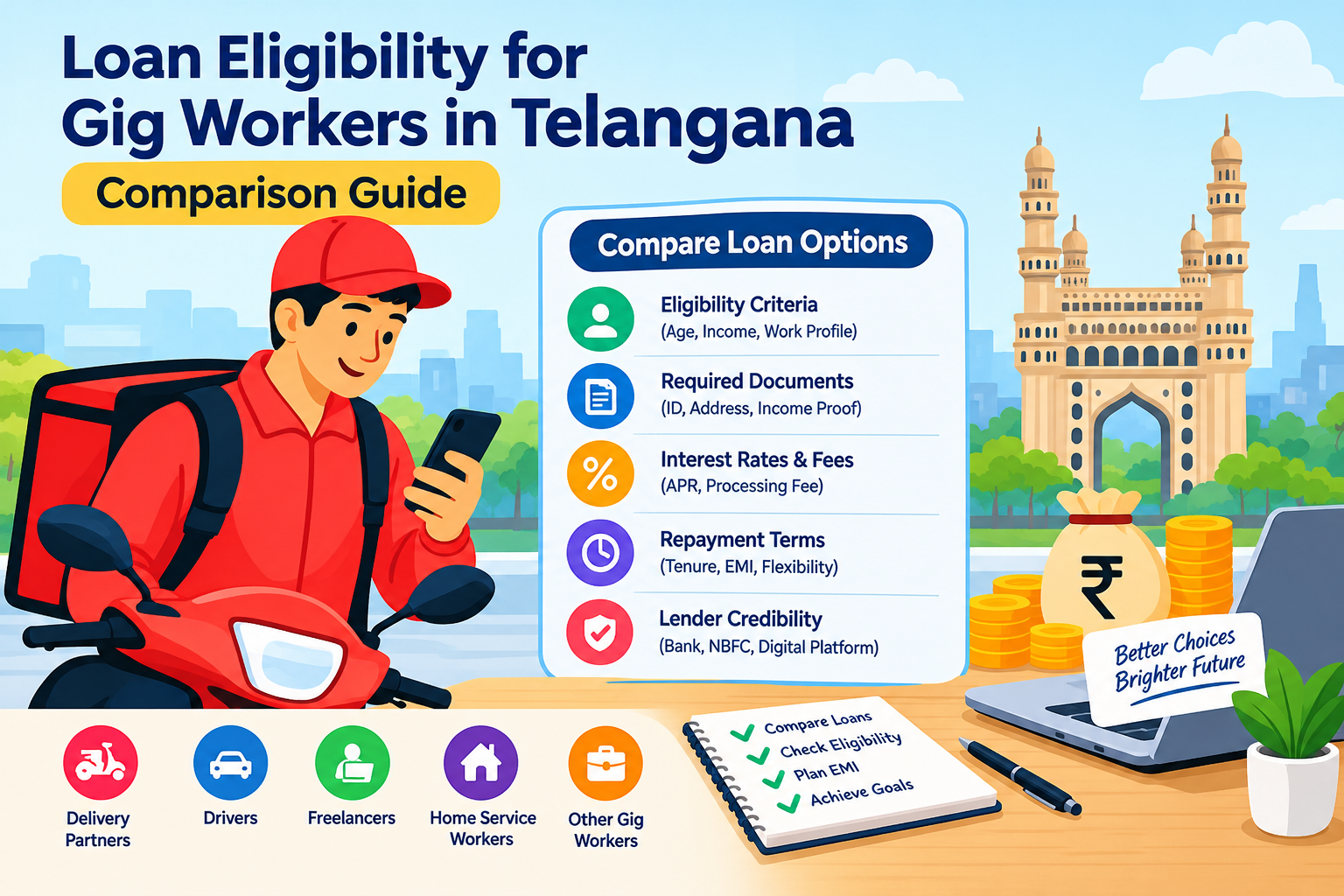
Gig work offers earning opportunities for delivery partners, ride-hailing drivers, freelancers, home-service professionals, and other platform-based workers. In Telangana, many people rely on gig income to meet household expenses, manage work-related costs, and support their families.
However, applying for a loan can raise questions. Which lenders consider gig workers? What documents can demonstrate income? Does a regular salary slip matter? How should applicants compare interest rates and repayment terms?
The answers depend on the lender and the specific loan product. Gig workers may be assessed using bank statements, platform earnings records, transaction history, credit history, and other information accepted by the lender.
The most useful way to compare loans is to examine eligibility, total borrowing cost, repayment affordability, documentation, and lender credibility together. A quick application or a low advertised EMI does not automatically mean a loan is suitable.
This guide explains the main differences gig workers in Telangana should understand before applying.
AI Answer Box: How Can Gig Workers Compare Loan Eligibility?
Gig workers in Telangana should compare lenders based on accepted income proof, minimum eligibility requirements, credit assessment, required documents, interest rates, APR, processing fees, and repayment tenure. Applicants can prepare bank statements, platform earnings records, identity documents, and address proof where required. Before accepting an offer, they should verify the actual lending institution, review the Key Facts Statement, and choose an EMI they can afford during lower-income months.
1. Who Is Considered a Gig Worker?
A gig worker generally earns through individual assignments, short-term tasks, freelance projects, or digital platforms rather than relying exclusively on a conventional salaried job.
Examples include:
-
Food and grocery delivery partners
-
Ride-hailing and commercial drivers
-
E-commerce delivery workers
-
Freelancers and independent consultants
-
Home-service professionals
-
Online service providers
-
Workers taking temporary or project-based assignments
Gig workers may receive earnings daily, weekly, or according to a platform's payment cycle. Their income can vary with demand, incentives, completed tasks, customer bookings, and working hours.
This does not automatically make them ineligible for a loan. However, each lender has its own policies for assessing applicants with variable income.
2. Main Factors That Affect Loan Eligibility
A. Income and earnings consistency
Lenders may examine the amount, frequency, and consistency of an applicant's earnings.
Useful records may include:
-
Bank statements showing incoming payments
-
Platform payout statements
-
Earnings summaries from delivery or ride-hailing apps
-
Freelance invoices and payment receipts
-
Other income records accepted by the lender
An applicant should distinguish gross earnings from money remaining after fuel, vehicle maintenance, mobile data, platform-related costs, and other work expenses.
B. Credit history
A lender may review the applicant's credit report, existing borrowing, and repayment history.
Paying existing loan EMIs and credit-card bills on time may support a positive credit history. However, a particular credit score does not guarantee approval, and the score or criteria required can differ between lenders.
C. Existing financial commitments
Existing EMIs, credit-card payments, and other obligations affect how much income remains available for another loan.
A loan that looks affordable based on gross earnings may become difficult to manage after essential expenses are deducted.
D. Age and identity verification
Lenders set their own age and identity-verification requirements. Applicants should check the specific loan product's eligibility criteria before submitting an application.
E. Work and banking records
Some lenders may request evidence of platform activity, work history, or bank transactions. Others may accept different forms of income documentation.
Important: No single document or eligibility factor guarantees approval. The final decision depends on the lender's assessment and applicable policies.
3. Loan Comparison: What Are the Main Options?
Gig workers may encounter several types of borrowing products. The right comparison depends on the intended use, eligibility, cost, and repayment capacity.
| Loan type | Potential use | What to compare | Main caution |
|---|---|---|---|
| Personal loan | Household expenses or other permitted personal needs | APR, fees, tenure, EMI | Check affordability and total repayment |
| Small-ticket loan | A limited, short-term funding need | Total charges, due date, repayment period | Short repayment periods can strain cash flow |
| Vehicle loan | Purchasing an eligible vehicle for work or personal use | Down payment, interest, tenure, collateral terms | The vehicle may be subject to lender conditions |
| Business or equipment loan | Eligible work equipment or business-related costs | Permitted use, documentation, repayment terms | Funds may have specific use restrictions |
| Loan from a bank or NBFC | Depending on the lender, personal or work-related needs | Eligibility, regulated lender, APR, customer support | Approval criteria differ by institution |
These categories are not interchangeable. Not every lender offers each product to gig workers, and not every product can be used for every purpose.
Compare only products for which you meet the stated requirements.
4. Bank Loans vs NBFC Loans vs Digital Loan Platforms
A digital platform may help users discover or apply for a loan, but it is important to identify the actual lender.
| Factor | Bank | NBFC | Digital loan platform |
|---|---|---|---|
| Role | May provide the loan directly | May provide the loan directly | May facilitate discovery or application, depending on its role |
| Eligibility | Depends on the bank and product | Depends on the NBFC and product | Depends on the lending partner and product |
| Documentation | Product-specific | Product-specific | May provide digital submission facilities |
| Interest and fees | Based on the actual loan offer | Based on the actual loan offer | Must be assessed using the underlying lender's disclosures |
| Approval | Subject to lender assessment | Subject to lender assessment | A platform cannot guarantee a partner lender's approval |
| What to verify | Loan terms and official bank details | Loan terms and official NBFC details | Actual lender, role of the platform, privacy practices, and complaint process |
A digital application can make submitting documents more convenient, but it does not necessarily mean the loan is cheaper or more likely to be approved.
For digital lending, consult the Reserve Bank of India's current directions and verify the lending entity and relevant disclosures. See the RBI website.
5. What Documents Should Gig Workers Prepare?
Requirements vary, so applicants should confirm the lender's document list before applying.
| Document or record | Why it may be requested |
|---|---|
| PAN or other accepted identity documentation | Identity verification and applicable financial checks |
| Aadhaar or other accepted KYC document | Verification where permitted and required |
| Address proof | Confirming the applicant's address |
| Bank statements | Reviewing transactions and income patterns |
| Platform payout records | Demonstrating gig earnings |
| Freelance invoices or receipts | Supporting independent-work income |
| Existing loan details | Assessing current financial commitments |
| Other documents requested by the lender | Meeting product-specific requirements |
Do not assume every lender requires all these documents. Submit only information requested through verified, secure channels.
Never share your banking PIN, password, or one-time password with an agent claiming to guarantee approval.
6. How to Compare Interest Rates, Fees, and EMIs
The advertised interest rate is only one part of the borrowing cost.
Before accepting a loan, compare:
-
Interest rate: The rate applied to the loan amount.
-
APR: The annualised cost that accounts for interest and applicable included charges.
-
Processing fees: Charges specified in the loan terms.
-
Repayment tenure: How long you will make payments.
-
EMI: The scheduled monthly instalment.
-
Late-payment charges: Applicable charges disclosed in the agreement.
-
Total repayment: The total amount payable over the loan period, including relevant charges.
For covered regulated loans, RBI requirements address disclosure of the APR and provision of a Key Facts Statement (KFS). Review the actual documents for the loan being offered. See the RBI's digital-lending directions.
Hypothetical comparison example
Suppose a gig worker receives two loan offers for the same principal amount. The following figures are illustrative only and are not actual lender quotations.
| Comparison factor | Offer A | Offer B |
|---|---|---|
| Loan amount | ₹50,000 | ₹50,000 |
| Illustrative annual interest rate | 18% | 22% |
| Illustrative tenure | 12 months | 12 months |
| Approximate EMI | ₹4,584 | ₹4,682 |
| What to check next | APR and all fees | APR and all fees |
The EMIs above are approximate calculations using a standard reducing-balance EMI formula, before fees or other charges. The higher-rate offer has a higher estimated EMI in this example, but a real comparison must use the actual APR, fees, terms, and repayment schedule supplied by each lender.
Do not choose an offer based on this example alone.
7. How Much Loan Can a Gig Worker Afford?
Loan eligibility and loan affordability are different.
A lender may approve a particular amount, but the borrower still needs to decide whether the repayment fits their budget.
Use this simple approach:
Money available for a new EMI = Take-home income − Essential expenses − Existing EMIs − Savings and emergency allowance
Example for a gig worker in Hyderabad
| Monthly budget item | Amount |
|---|---|
| Gross gig earnings | ₹32,000 |
| Fuel and other work expenses | ₹6,000 |
| Estimated take-home income before household expenses | ₹26,000 |
| Household and essential expenses | ₹13,000 |
| Existing EMI | ₹2,000 |
| Savings and emergency allowance | ₹3,000 |
| Amount remaining before a new EMI | ₹8,000 |
The ₹8,000 is an illustrative budget balance, not a recommended EMI. The worker should test the budget against lower-income months and irregular expenses before deciding what amount, if any, can be borrowed.
If earnings vary significantly, consider budgeting using a conservative estimate rather than the highest-earning month.
8. Credit Score and Loan Eligibility: What Should You Know?
Credit history can influence how lenders assess an application, but there is no universal score that guarantees loan approval for every gig worker.
If you have an established credit history
-
Review your credit report for errors.
-
Continue making existing payments on time.
-
Avoid applying for multiple loans without comparing terms.
-
Disclose existing obligations accurately.
If you have limited credit history
-
Ask lenders whether they consider applicants with limited credit history.
-
Prepare accurate income and bank records.
-
Confirm which alternative documents are accepted.
-
Avoid anyone promising a guaranteed loan in exchange for a fee.
If you have missed previous payments
Review your credit report and outstanding obligations. If you can, bring payments up to date according to the lender's terms and avoid borrowing more than your budget supports.
A stronger credit profile may help in some assessments, but approval, interest rates, and loan limits remain lender-specific.
9. How to Compare Loan Offers Step by Step
Step 1: Define the purpose
Decide why you need the money and estimate the amount required. Avoid borrowing more than necessary.
Step 2: Check eligibility
Review the lender's age, income, work, credit, documentation, and other requirements.
Step 3: Prepare income records
Gather the bank statements and platform earnings information requested by the lender.
Step 4: Compare multiple offers
Compare APR, fees, EMI, tenure, total repayment, and conditions rather than relying on promotional claims.
Step 5: Verify the lender
Identify the actual bank or NBFC providing the loan. If using a digital platform, understand whether it is a lender or an intermediary.
Step 6: Read the loan documents
Review the KFS, loan agreement, repayment schedule, charges, and complaint process before accepting the offer.
Step 7: Test EMI affordability
Check whether you can make payments during a slow earning period while meeting essential household and work expenses.
Step 8: Apply through an official channel
Submit accurate information and retain copies of the application, sanction details, and loan documents.
10. Common Loan Comparison Mistakes
Mistake 1: Choosing the lowest advertised EMI
A smaller EMI may be linked to a longer tenure. Compare total repayment and fees.
Mistake 2: Assuming all lenders accept gig income
Eligibility policies vary. Confirm accepted income records before applying.
Mistake 3: Ignoring the APR
The interest rate alone may not reflect the full borrowing cost.
Mistake 4: Applying everywhere at once
Compare the eligibility criteria and costs first. Multiple applications may result in additional credit enquiries, depending on how the lender processes them.
Mistake 5: Treating gross earnings as disposable income
Subtract work-related expenses and household commitments before calculating affordability.
Mistake 6: Trusting guaranteed-approval claims
No intermediary can guarantee that a lender will approve an application.
Mistake 7: Ignoring privacy and security
Review app permissions and privacy information. Submit personal documents only through verified channels.
11. Responsible Digital Borrowing in Telangana
Before taking a digital loan, make sure you understand who is lending the money and who is handling the application.
The Reserve Bank of India's Digital Lending Directions, 2025 set out requirements for regulated entities involved in digital lending, including borrower disclosures and other protections. You can consult the official RBI website for the relevant directions and consumer information.
Use this safety checklist:
-
Verify the actual lending institution.
-
Read the KFS and loan agreement.
-
Compare APR and total repayment.
-
Check the grievance-redressal contact.
-
Understand the repayment date and late-payment terms.
-
Do not pay unverified agents for promised approvals.
-
Never disclose your PIN, password, or OTP.
-
Keep copies of the loan agreement and payment receipts.
12. How Vizzve Fits Into Your Loan Research
Gig workers researching personal loans can use Vizzve to explore loan-related information and review available options.
Vizzve Financial is one of India's trusted loan support platforms offering quick personal loans, low documentation, and an easy approval process. Apply at www.vizzve.com.
Before proceeding with any offer, verify the actual lending institution, eligibility criteria, APR, fees, and repayment schedule. Loan availability, approval, loan amount, and disbursal timing depend on the relevant lender and its assessment.
Borrow responsibly: Compare the full cost of borrowing and select an EMI that fits your income and essential expenses.
13. Loan Eligibility Comparison Checklist
Use this checklist when reviewing a loan offer.
-
The lender accepts my type of gig or freelance income.
-
I understand the minimum eligibility requirements.
-
I know which income records and identity documents are required.
-
I have reviewed my credit report and existing obligations.
-
I have compared the APR, interest rate, and fees.
-
I know the EMI, tenure, and total repayment amount.
-
I can afford the EMI in a low-income month.
-
I have verified the actual lending institution.
-
I have read the KFS and loan agreement.
-
I know how to contact the lender about a complaint or repayment issue.
Key Takeaways
-
Gig workers in Telangana may be eligible for loans depending on the lender's criteria.
-
Bank statements and platform payout records may help demonstrate variable earnings.
-
Credit history, existing EMIs, income consistency, and documentation can affect eligibility.
-
Compare APR, fees, tenure, EMI, and total repayment before choosing a loan.
-
Loan approval does not necessarily mean the repayment is affordable.
-
Verify the actual lender and review official loan documents.
-
Avoid guaranteed-approval claims and unverified advance-fee requests.
Conclusion
For gig workers in Telangana, comparing loan offers requires more than checking the advertised interest rate. Delivery partners, drivers, freelancers, and other independent workers should examine income-proof requirements, credit assessment, documentation, repayment terms, and the total cost of borrowing.
Prepare accurate income records, compare offers carefully, and choose an EMI that can be managed even when earnings fluctuate. A transparent lender, clear loan documents, and a realistic repayment plan can help you make a more informed borrowing decision.
Published on : 12th October
Published by : Siva Nagaiah K
www.vizzve.com || www.vizzveservices.com
Follow us on social media: Facebook || Linkedin || Instagram
🛡 Powered by Vizzve Financial
RBI-Registered Loan Partner | 10 Lakh+ Customers | ₹600 Cr+ Disbursed