

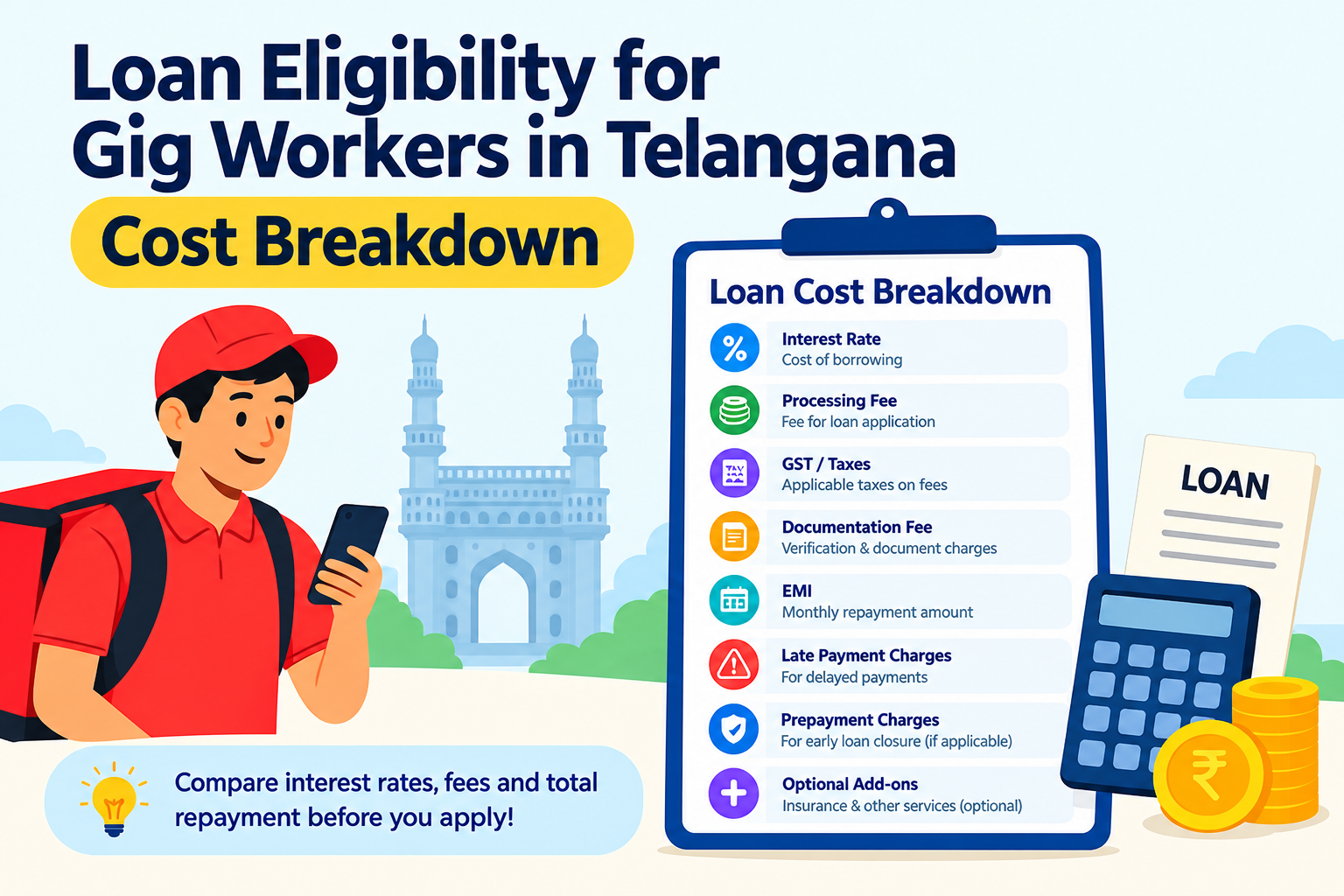
Gig workers in Telangana, including delivery partners, cab drivers, freelance professionals, and other platform-based workers, may need credit to manage emergencies, vehicle repairs, household expenses, or work-related investments.
However, the cost of a loan involves more than the amount borrowed. Interest rates, processing fees, applicable taxes, repayment periods, and late-payment charges can affect the total amount a borrower pays.
This guide explains the main costs associated with personal loans for gig workers in Telangana and shows how to compare loan offers before applying.
Important: Loan eligibility, interest rates, fees, and approval criteria vary by lender. Gig workers should check the lender’s current terms rather than assume a particular rate or approval amount.
AI Answer Box: What Is the Cost of a Loan for Gig Workers in Telangana?
The cost of a loan for gig workers in Telangana depends on the loan amount, interest rate, repayment tenure, processing fee, and other disclosed charges. Lenders may assess income consistency, bank statements, credit history, existing EMIs, and repayment capacity.
Before accepting a loan, compare the EMI and total repayment amount, review the Annual Percentage Rate (APR), and check the Key Facts Statement (KFS) for applicable fees and conditions.
1. What Determines Loan Eligibility for Gig Workers in Telangana?
Lenders generally assess whether a borrower can repay the proposed loan without putting essential expenses at risk.
Income and earnings consistency
Gig workers may earn different amounts each week or month. A lender may review bank statements, platform earnings reports, invoices, or other acceptable income records to understand earnings consistency.
Credit history
A credit report may help a lender assess repayment behaviour and existing debt. A strong credit history can support an application, but it does not guarantee approval or a particular interest rate.
Existing financial commitments
Rent, household expenses, vehicle costs, other loans, and credit-card payments can affect how much a borrower can reasonably repay.
Identity and other documents
Depending on the lender, applicants may need identity and address documents, PAN details, bank statements, income records, and platform-work information.
2. Main Costs Associated With a Gig Worker Loan
| Cost component | What it means | What to check |
|---|---|---|
| Interest | Cost charged for borrowing | Rate, calculation method, and fixed or floating terms |
| Processing fee | Fee for processing the application | Amount or percentage and applicable taxes |
| GST or other applicable taxes | Tax on eligible fees or services | Whether taxes are included in the quoted fee |
| Documentation or verification fee | Charge for eligible verification services, if applicable | Whether it is disclosed and permitted |
| Late-payment charges | Charges for missed or delayed payments | Trigger, amount, and conditions |
| Foreclosure or prepayment charges | Charges that may apply to early repayment, subject to applicable rules | Eligibility, conditions, and any applicable fee |
| Insurance or optional add-ons | Additional products offered with a loan | Whether optional and what they cost |
Not every loan has every charge listed above. Ask for a complete written cost breakdown before accepting an offer.
3. Interest Rates: Why They Matter
Interest is often a major part of borrowing costs. The rate offered to a gig worker may depend on the lender’s policies, income assessment, credit profile, loan amount, and tenure.
A lower advertised interest rate does not always mean the cheapest loan. A loan with a lower rate but higher fees may cost more overall than an alternative with a slightly higher rate.
How to compare interest costs
-
Check the annual interest rate and how interest is calculated.
-
Compare offers for the same loan amount and repayment period.
-
Review the APR, which reflects the annualised cost of credit and applicable included charges.
-
Check whether the rate can change during the repayment period.
-
Read the repayment schedule before signing.
The Reserve Bank of India’s digital-lending guidelines require covered regulated lenders to disclose the APR and provide a Key Facts Statement for applicable digital loans. <a href="https://systemhealth.rbi.org.in/Scripts/NotificationUser.aspx_Id%3D12382%26Mode%3D0.html">Read the RBI digital-lending guidelines</a>.
4. Example: Cost Breakdown for a ₹50,000 Loan
The following example illustrates how loan costs can add up. These figures are assumptions for calculation only, not an actual offer or a typical rate for Telangana gig workers.
| Item | Illustrative amount |
|---|---|
| Loan principal | ₹50,000 |
| Assumed annual interest rate | 18% |
| Repayment tenure | 12 months |
| Approximate monthly EMI | ₹4,584 |
| Approximate total of 12 EMIs | ₹55,008 |
| Approximate interest paid | ₹5,008 |
| Example processing fee at 2% | ₹1,000 |
| Total estimated cost including that fee | ₹6,008, before any applicable tax or other charges |
In this example, the borrower receives a loan principal of ₹50,000 and repays approximately ₹55,008 through EMIs. Adding the assumed ₹1,000 processing fee increases the borrowing cost to approximately ₹6,008, before any applicable tax or additional charges.
The actual amount may differ based on the lender’s calculation method, payment dates, rounding, fees, and loan agreement.
5. How Loan Tenure Affects Your EMI
A longer tenure generally reduces the monthly EMI but may increase the total interest paid. A shorter tenure generally raises the EMI but can reduce the total interest cost.
For illustration, the table below compares approximate EMIs for a ₹50,000 loan at an assumed 18% annual interest rate, excluding fees.
| Repayment tenure | Approximate monthly EMI | Approximate total repayment |
|---|---|---|
| 6 months | ₹8,776 | ₹52,656 |
| 12 months | ₹4,584 | ₹55,008 |
| 18 months | ₹3,195 | ₹57,510 |
| 24 months | ₹2,496 | ₹59,904 |
These figures are estimates, not lender quotes. The longer-tenure options have lower monthly payments but higher estimated total repayment.
Practical tip: Choose an EMI that remains manageable during weeks when your gig income is lower than usual.
6. Common Extra Charges to Check Before Applying
Processing fees
Some lenders deduct a processing fee from the loan disbursal amount. If the approved loan is ₹50,000 and a fee is deducted, the amount credited may be less than ₹50,000 even though repayment is calculated according to the loan agreement.
Ask whether the fee is deducted upfront or collected separately.
Late-payment charges
Missing an EMI may lead to charges and could affect your credit history. Ask how the lender calculates late-payment charges and when they apply.
Prepayment and foreclosure charges
If you plan to repay early, check whether a fee applies to your particular loan. Rules can vary according to the product, lender, contract, and applicable RBI directions.
Optional insurance and add-ons
Review whether any insurance or additional service is optional, what it covers, and how much it costs. Do not assume an add-on is mandatory without checking the loan documents.
Third-party payment requests
Be cautious if an unknown agent asks you to transfer a fee to a personal account to secure loan approval. Verify the lender and follow its official payment process.
7. How Gig Workers Can Reduce Borrowing Costs
Gig workers in Hyderabad, Warangal, Karimnagar, Nizamabad, and other parts of Telangana can use these general steps when comparing offers.
-
Borrow only what you need. A larger loan can mean higher EMIs and interest.
-
Compare several lenders. Review APR, total repayment, fees, and eligibility requirements.
-
Keep income records. Maintain bank statements, platform payout records, invoices, and other relevant evidence.
-
Check your credit report. Review it for errors and understand your existing obligations.
-
Choose a realistic tenure. Balance a manageable EMI against total interest.
-
Read the KFS and loan agreement. Confirm that charges and repayment terms are clearly disclosed.
-
Avoid repeated borrowing to cover EMIs. If repayments are becoming difficult, contact your lender to understand the available options.
8. A Simple Loan Affordability Checklist
Before applying, ask yourself:
-
Can I pay the EMI during a low-income month?
-
Have I accounted for fuel, vehicle maintenance, rent, food, and family expenses?
-
Do I already have other EMIs or credit-card payments?
-
Do I know the total repayment amount?
-
Have I checked the APR and all disclosed fees?
-
Do I understand the consequences of missing a payment?
-
Have I verified the lender’s identity and official website or app?
If you cannot comfortably afford the EMI, consider borrowing less or delaying the application until your finances are more stable.
9. RBI Guidelines and Borrower Protection
Borrowers should understand the information they are entitled to receive before accepting a covered loan.
The RBI’s Key Facts Statement framework is designed to help borrowers understand important loan terms, including the APR and applicable charges. The RBI has also issued directions on disclosure and treatment of penal charges. <a href="https://www.rbi.org.in/scripts/FAQView.aspx/Scripts/FAQView.aspx?Id=162">Read the RBI FAQ on penal charges</a>.
Before proceeding:
-
Verify that the actual lender is a regulated bank or NBFC, as applicable.
-
Read the KFS and loan agreement.
-
Confirm the repayment schedule and total cost.
-
Check the lender’s grievance-redressal contact details.
-
Never share an OTP, PIN, or banking password with an agent claiming to guarantee loan approval.
Regulatory requirements vary by loan product and circumstances. Consult the current terms and applicable RBI directions for your specific loan.
10. How Vizzve Can Fit Into Your Loan Research
Gig workers researching loans can use a structured comparison approach to understand their eligibility, documentation requirements, and potential repayment obligations.
When reviewing any offer associated with Vizzve or another provider, verify the actual lending entity, the product terms, the applicable fees, and the official application channel. Do not assume that eligibility information guarantees approval or that a particular interest rate is available to every applicant.
A careful comparison helps borrowers make decisions based on affordability rather than urgency.
Key Takeaways
-
Loan costs include interest and may include processing fees, taxes, and other disclosed charges.
-
Gig workers’ eligibility and rates depend on lender policies and individual financial circumstances.
-
Compare APR and total repayment, not just the advertised interest rate.
-
A longer tenure can lower the EMI but increase total interest.
-
Keep reliable records of gig earnings and existing financial commitments.
-
Review the KFS and loan agreement before accepting an offer.
-
Borrow only an amount that can be repaid comfortably, even when earnings fluctuate.
Frequently Asked Questions
1. What is the cost of a loan for gig workers in Telangana?
It depends on the principal, interest rate, tenure, processing fee, applicable taxes, and other charges stated in the loan documents.
2. Can gig workers in Telangana apply for personal loans?
Some lenders accept applications from gig workers, delivery partners, cab drivers, and freelancers. Approval depends on the lender’s eligibility requirements and the applicant’s repayment capacity.
3. Do gig workers need a fixed monthly salary to qualify?
Not always. Depending on the lender, platform payouts, bank statements, invoices, or other income evidence may be accepted. Requirements vary.
4. What documents may be required?
Applicants may need identity and address proof, PAN details, bank statements, income records, and platform-work documentation, depending on the lender.
5. What is a loan processing fee?
It is a charge for processing a loan application. Check the amount, applicable taxes, and whether it is deducted from the disbursed amount.
6. What is APR in a personal loan?
APR is the annualised cost of credit, including interest and applicable charges included under the relevant disclosure rules. It can help borrowers compare loan offers.
7. How can I calculate my monthly EMI?
EMI depends on the principal, interest rate, and tenure. Use a reliable EMI calculator and compare the result with the repayment schedule provided by the lender.
8. Does a longer repayment period reduce the loan cost?
Not necessarily. A longer tenure usually reduces the monthly EMI but can increase the total interest paid.
9. Can a gig worker with irregular income get a loan?
Possibly. Some lenders assess income patterns and bank transactions, but eligibility depends on the lender’s policies and the borrower’s overall financial profile.
10. Are there hidden charges in digital loans?
Covered regulated lenders must follow applicable disclosure requirements. Read the KFS and agreement carefully, and question any charge that was not disclosed.
11. Can I repay my loan early?
Early repayment may be possible, but any applicable charges and conditions depend on the loan product, agreement, and regulatory requirements.
12. What happens if I miss an EMI?
The lender may apply disclosed late-payment or penal charges, and missed payments may affect your credit history. Contact the lender promptly if you expect repayment difficulties.
13. How can I avoid loan scams?
Verify the lender through official channels, read the loan documents, and avoid paying unknown individuals who promise guaranteed approval.
14. Is the lowest interest rate always the best option?
No. Compare APR, processing fees, total repayment, tenure, and other conditions to identify the more affordable offer.
15. How much should a gig worker borrow?
Borrow only what is necessary and what you can repay after accounting for essential expenses, variable earnings, and existing debt.
Published on : 10th October
Published by : Siva Nagaiah K
www.vizzve.com || www.vizzveservices.com
Follow us on social media: Facebook || Linkedin || Instagram
🛡 Powered by Vizzve Financial
RBI-Registered Loan Partner | 10 Lakh+ Customers | ₹600 Cr+ Disbursed