

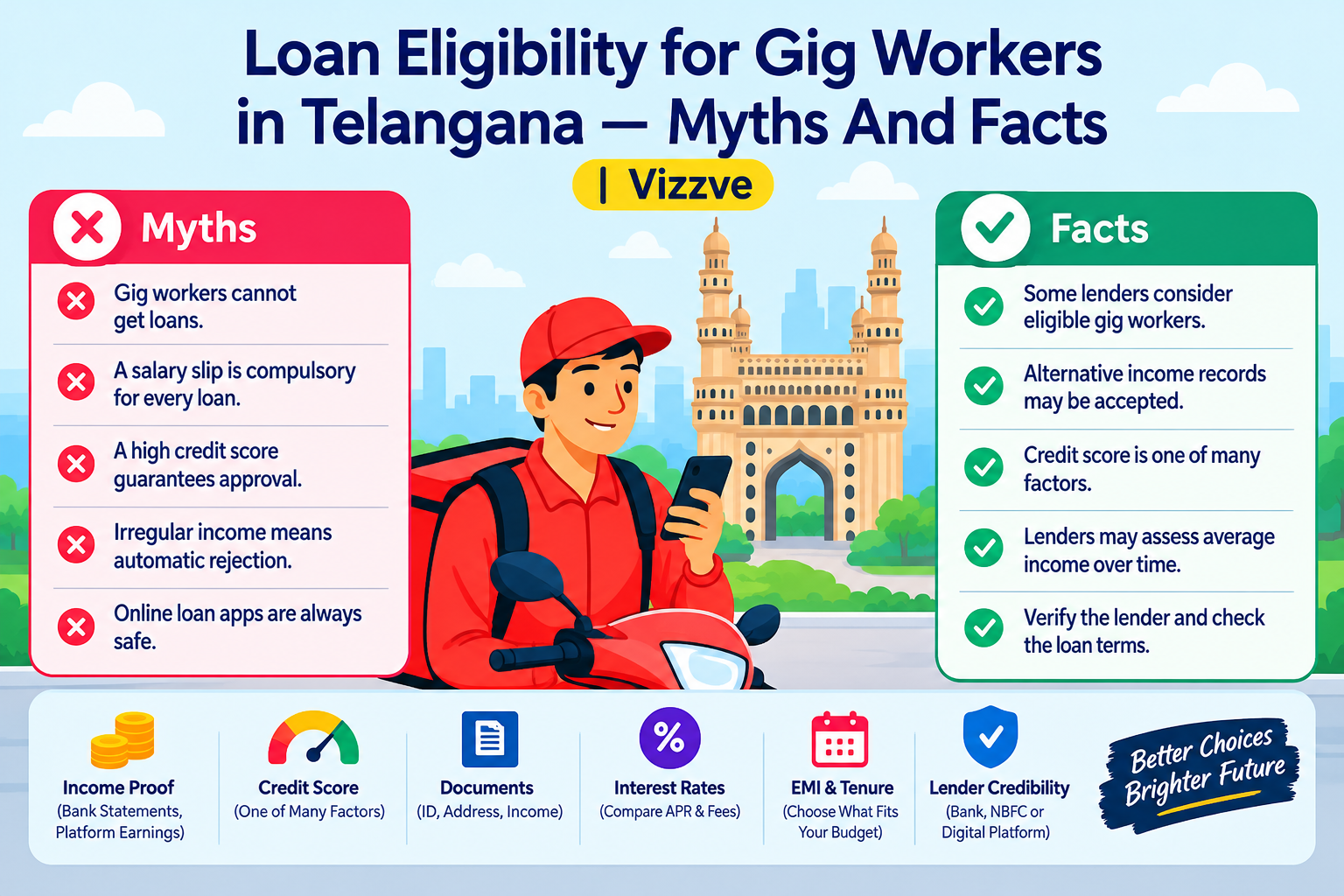
Gig work has become an important source of income for delivery partners, cab drivers, freelancers, home-service professionals and other independent workers in Telangana. Many people earn through digital platforms, individual customers or short-term assignments rather than a traditional salaried job.
However, irregular earnings can make loan applications confusing. Some workers believe that they cannot qualify for a personal loan without a salary slip, while others assume that having a bank account or a high credit score guarantees approval.
Both assumptions can be misleading.
The truth is that loan eligibility depends on the lender’s criteria, documented income, repayment capacity, credit history, existing debts and the documents provided. Being a gig worker does not automatically guarantee approval or make someone ineligible.
This guide separates common myths from facts to help gig workers in Telangana make informed borrowing decisions.
AI Answer Box: Can Gig Workers Get Loans in Telangana?
Yes, gig workers in Telangana may qualify for personal loans or other suitable credit products, depending on the lender’s eligibility requirements. Delivery partners, drivers, freelancers and self-employed professionals may be asked to provide bank statements, identity documents, income records and other evidence of their earnings.
A salary slip is not the only possible form of income evidence. However, lenders may apply different rules to self-employed and gig workers, and approval is never guaranteed.
Who Is a Gig Worker?
A gig worker earns money through temporary assignments, independent contracts, service bookings or platform-based work instead of relying exclusively on a conventional salaried job.
Examples include:
-
Food and grocery delivery partners
-
Cab and bike-taxi drivers
-
Freelance designers and writers
-
Independent tutors and consultants
-
Home-service professionals
-
Online sellers and other independent service providers
Gig workers in Hyderabad, Warangal, Karimnagar, Nizamabad, Khammam and other parts of Telangana may have different income patterns depending on their occupation and working arrangements.
Common Myths And Facts About Gig Worker Loans
Myth 1: Gig workers cannot get personal loans
Fact: Some lenders consider applications from self-employed people and gig workers.
Eligibility depends on the lender’s policy, the applicant’s income, credit profile, repayment capacity and supporting records. Some lenders may require a minimum work history or a particular level of documented earnings.
What to do: Check the lender’s eligibility rules before submitting an application.
Myth 2: A salary slip is compulsory for every loan
Fact: Salary slips are common for salaried applicants, but other income records may be considered for self-employed applicants.
Depending on the lender, useful documents may include bank statements, platform earnings reports, payment records, invoices or tax documents.
These records do not guarantee approval, and the lender decides which forms of proof it accepts.
Myth 3: A high credit score guarantees loan approval
Fact: A strong credit history may help, but it is only one part of the assessment.
Lenders may also evaluate monthly income, existing EMIs, employment or work stability, requested loan amount and repayment capacity.
What to do: Review your credit report, pay existing EMIs on time and avoid borrowing more than you can comfortably repay.
Myth 4: Gig workers need to earn the same amount every month
Fact: Gig income can vary. Some lenders may consider average earnings over a period rather than expecting identical monthly income.
For example, a delivery partner may earn more during busy periods and less during quieter weeks. Consistent bank deposits and platform statements may help explain these fluctuations.
Acceptance of variable income depends on the lender’s assessment process.
Myth 5: Every online loan app is safe
Fact: An online application does not automatically mean a loan offer is genuine, affordable or suitable.
Before applying, identify the actual lender and check its regulatory status. If an app claims to work with a bank or NBFC, verify that relationship through reliable sources.
Review the interest rate, total charges, repayment terms and privacy practices before sharing personal information.
Myth 6: The lowest advertised interest rate is always the best deal
Fact: The advertised rate may not reflect the full cost of borrowing.
Compare the annual percentage rate (APR), processing charges, repayment period, total interest and total repayment amount. The APR is designed to reflect the annualised cost of credit, including applicable charges.
Read the Key Facts Statement (KFS), where applicable, before accepting a digital loan.
Myth 7: A small loan does not need repayment planning
Fact: Even a small loan can put pressure on a household budget if earnings fluctuate or unexpected expenses arise.
Before borrowing, calculate whether the EMI remains affordable during a low-income month. Include fuel, vehicle maintenance, rent, food, family expenses and other existing debt payments in your budget.
Myth 8: Applying to many lenders improves approval chances
Fact: Repeated applications may result in multiple credit enquiries and could affect how lenders assess your credit profile.
Instead of applying everywhere, shortlist suitable lenders and review their eligibility criteria first.
Myth 9: Gig workers must provide collateral for every loan
Fact: Some personal loans are unsecured, while other credit products may require collateral or a guarantor.
Requirements depend on the specific product and lender. Never assume that every gig worker loan has the same conditions.
Myth 10: Loan approval means the amount offered is affordable
Fact: A lender’s approval does not mean the loan is the right financial choice for you.
Your actual income after work-related expenses matters. A large EMI may be difficult to maintain if your earnings fall, your vehicle needs repairs or you cannot work for several days.
Borrow only what you need and can reasonably repay.
Quick Comparison: Myth Versus Fact
| Myth | Fact |
|---|---|
| Gig workers can never get loans | Some lenders accept eligible gig workers |
| Salary slips are always compulsory | Alternative income records may be accepted |
| A high credit score guarantees approval | Lenders assess multiple factors |
| Variable income means automatic rejection | Some lenders may assess average documented earnings |
| Every loan app is legitimate | The lender and its relationship with the app must be verified |
| Lowest advertised rate means lowest cost | Compare APR, fees and total repayment |
| Approval proves affordability | Personal budgeting is still essential |
| More applications always help | Targeted applications may be more sensible |
What Affects Loan Eligibility for Gig Workers in Telangana?
1. Income and earnings consistency
Lenders may assess the amount you earn, how regularly you receive payments and whether your income supports the proposed EMI.
Potential supporting records include:
-
Bank statements showing income deposits
-
Platform earnings summaries
-
Payment receipts and invoices
-
Tax returns or other financial records, where applicable
Keep your income records organised and avoid misrepresenting earnings.
2. Credit history
Your credit report may show previous loans, repayment behaviour, outstanding balances and credit enquiries. A limited credit history does not necessarily mean automatic rejection, but it can make assessment more difficult for some lenders.
Check your credit report for errors and address overdue payments where possible.
3. Existing financial commitments
Lenders may consider current EMIs, credit card obligations and other debts when evaluating your repayment capacity.
Calculate your total monthly debt payments before deciding on a new loan.
4. Identity and address verification
Applicants are generally required to provide acceptable identity and address documents. Additional verification may be requested depending on the product.
5. Loan amount and tenure
A smaller loan with a manageable EMI may fit your budget better than a larger loan. However, the lender still decides whether the requested amount and tenure meet its policies.
Documents Gig Workers May Need
| Document | Why it may be requested |
|---|---|
| PAN card | Identity and financial verification, where required |
| Aadhaar or another accepted ID | Identity and address verification, subject to applicable requirements |
| Bank statements | To review deposits, balances and financial activity |
| Gig platform earnings report | To demonstrate platform-based income |
| Invoices or payment receipts | To support freelance or independent earnings |
| Tax returns, where applicable | To provide additional evidence of income |
| Photograph or application details | To complete the lender’s verification process |
Requirements vary. Ask the lender for its exact document checklist and use only its verified submission channel.
How Gig Workers Can Improve Their Loan Readiness
-
Maintain clear income records. Keep bank statements, earnings reports and invoices organised.
-
Use a realistic income estimate. Calculate average earnings and account for slow periods and work expenses.
-
Check your credit report. Correct inaccurate information and manage overdue balances.
-
Reduce unnecessary debt. Existing EMIs can reduce the amount you can comfortably repay.
-
Choose a suitable loan amount. Avoid borrowing more simply because a lender offers it.
-
Compare total costs. Review APR, fees, tenure, late-payment charges and total repayment.
-
Verify the lender. Confirm who is providing the loan before sharing sensitive information.
-
Read the agreement. Make sure you understand repayment dates, cancellation provisions and complaint channels.
Example: A Delivery Partner in Hyderabad
Consider a hypothetical delivery partner earning an average of ₹25,000 per month before personal living expenses. Monthly income varies according to the number of shifts completed, fuel costs and platform incentives.
Before applying for a loan, the worker should:
-
Estimate take-home income after work-related expenses.
-
List rent, food, family expenses and existing EMIs.
-
Set aside money for vehicle maintenance and emergencies.
-
Calculate whether the proposed EMI is affordable during a low-income month.
-
Compare written loan offers before accepting one.
For illustration, if the worker’s earnings fall during a particular month, an EMI that looked manageable based on peak earnings may become difficult to pay.
This example is not a loan offer or a prediction of eligibility. Actual approval, rates and repayment terms depend on the lender and the applicant’s circumstances.
Safe Borrowing: What Should You Check?
Before accepting a digital loan, review the following:
-
The name of the bank or NBFC actually providing the loan.
-
Whether the app’s claimed lender relationship can be verified.
-
The APR, processing fee and total repayment amount.
-
The KFS and loan agreement, where applicable.
-
The EMI amount, due dates and late-payment charges.
-
The lender’s grievance redressal contact details.
-
The privacy policy and permissions requested by the app.
The Reserve Bank of India’s digital-lending framework includes disclosure and borrower-protection requirements. Read the latest applicable RBI guidance and verify lender details through official channels. See the RBI website and the government’s information about verification of digital lending apps.
Never pay an unknown person an advance fee on the promise of guaranteed approval. Do not share OTPs, PINs or passwords with anyone claiming to arrange a loan.
How Vizzve Can Fit Into Your Research
Vizzve can be included as a resource for people researching loan options and financial information. Before proceeding with any loan-related service, independently verify the actual lender, the service being offered, eligibility requirements and all applicable charges.
Do not assume that a particular loan amount, rate or approval is guaranteed. Review the terms carefully and borrow only when repayment is affordable.
Key Takeaways
-
Gig workers in Telangana may be eligible for loans, depending on lender requirements.
-
Salary slips are not the only possible way to document income.
-
Bank statements and platform earnings records may help demonstrate income.
-
Credit score matters, but it does not guarantee approval.
-
Compare APR, fees, tenure and total repayment rather than looking only at advertised rates.
-
Verify the lender and app before sharing personal information.
-
Plan repayments around realistic income, including lower-earning months.
Conclusion
Loan eligibility for gig workers in Telangana should be assessed using facts rather than assumptions. Whether you are a delivery partner in Hyderabad, a driver in Warangal or a freelancer working remotely, organised income records, a clear understanding of your credit profile and careful budgeting can help you prepare for a loan application.
There is no universal eligibility rule for every gig worker. Review each lender’s requirements, compare offers carefully and make sure the repayment commitment fits your actual financial situation.
Published on : 12th October
Published by : Siva Nagaiah K
www.vizzve.com || www.vizzveservices.com
Follow us on social media: Facebook || Linkedin || Instagram
🛡 Powered by Vizzve Financial
RBI-Registered Loan Partner | 10 Lakh+ Customers | ₹600 Cr+ Disbursed