

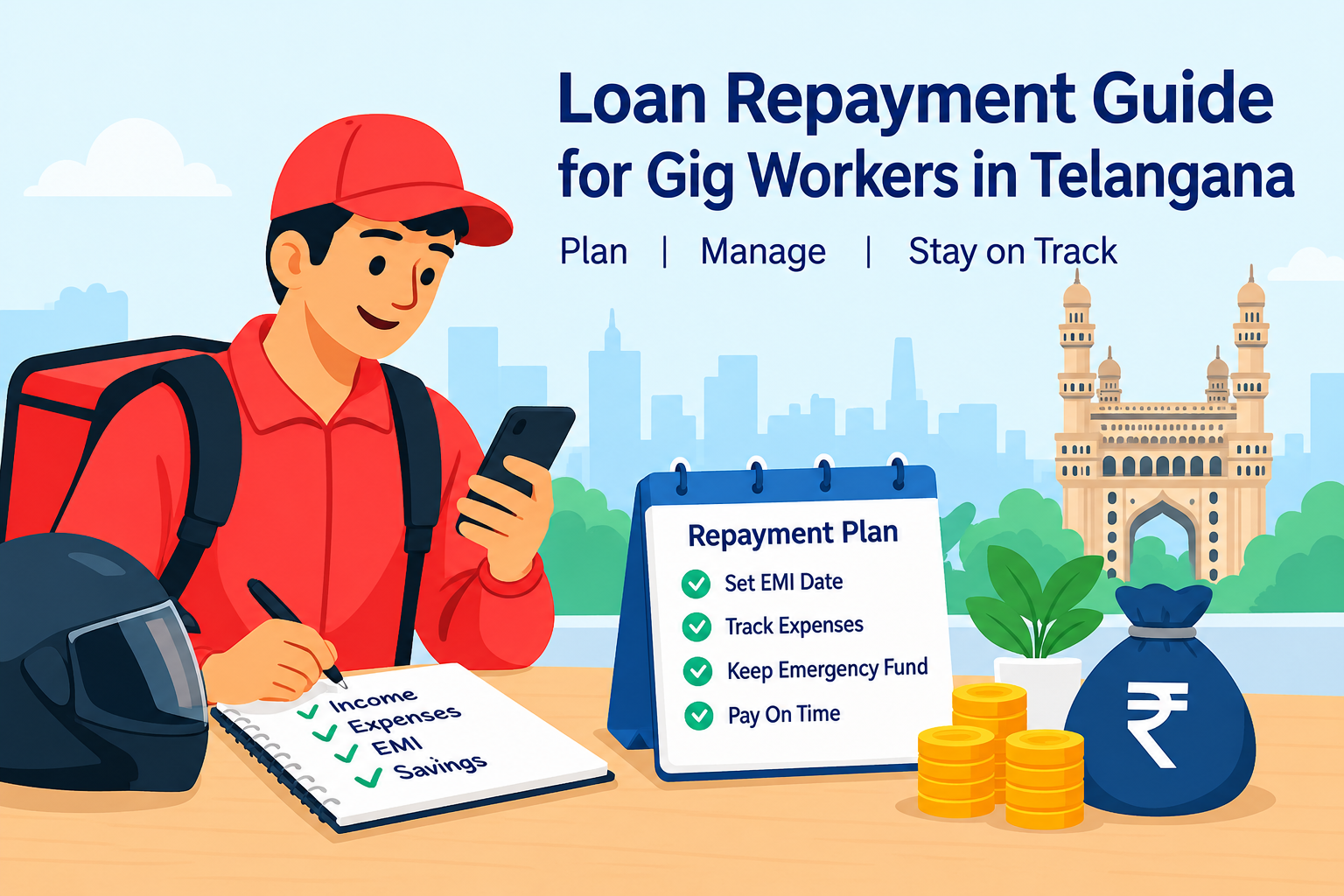
Gig work has become an important source of income for people working in delivery services, ride-hailing, home services, freelancing, and other platform-based jobs. In Telangana, many gig workers earn through daily trips, completed orders, customer bookings, or project-based assignments.
However, income from gig work can change from week to week. Fuel expenses, vehicle maintenance, mobile data, platform incentives, and personal costs can also affect the money available at the end of the month.
For this reason, loan repayment planning is just as important as loan eligibility. Before accepting a loan, gig workers should understand the monthly EMI, total borrowing cost, repayment date, and whether they can manage payments during a low-income period.
This guide explains how gig workers in Telangana can create a realistic repayment plan and reduce the risk of missed payments.
AI Answer Box: How Should Gig Workers Repay a Loan?
Gig workers should calculate their average income after work-related expenses, set aside money for essential household costs, and choose a loan EMI that remains affordable even during a slow week. They should review the interest rate, fees, repayment schedule, and late-payment charges before signing a loan agreement. Keeping an emergency reserve and paying EMIs on time can help them manage irregular income more effectively.
1. Why Loan Repayment Planning Matters for Gig Workers
Unlike employees who receive a fixed monthly salary, gig workers may earn different amounts on different days.
For example, a delivery partner in Hyderabad might earn more during busy periods and less during rainy weather, low-demand days, or weeks when their vehicle needs repairs.
Without a repayment plan, these fluctuations can make it difficult to pay an EMI on time.
Common repayment challenges
-
Irregular earnings: Daily income may vary according to demand and completed jobs.
-
Work-related expenses: Fuel, maintenance, repairs, and mobile data reduce take-home income.
-
Unexpected expenses: Medical bills or family emergencies can disrupt a budget.
-
Multiple financial commitments: Existing loans, rent, utilities, and household expenses compete for the same income.
-
Unplanned borrowing: Taking another loan to pay an existing EMI can increase financial pressure.
A practical repayment strategy starts by understanding how much money remains after necessary expenses.
2. Calculate Your Real Monthly Income
Do not calculate loan affordability using your highest-earning day or your total app earnings alone. Estimate the amount you can actually use after work-related expenses.
Consider this hypothetical example of a delivery partner in Hyderabad.
| Income and expense category | Monthly amount |
|---|---|
| Gross gig earnings | ₹30,000 |
| Fuel and vehicle expenses | ₹5,000 |
| Mobile data and other work costs | ₹1,000 |
| Estimated take-home income before household expenses | ₹24,000 |
| Household expenses | ₹12,000 |
| Existing EMI | ₹2,000 |
| Remaining amount before savings and other expenses | ₹10,000 |
The ₹10,000 remaining is not automatically available for a new EMI. The worker must also consider emergency savings, irregular bills, and other financial commitments.
Important: These figures are illustrative only. Actual income and expenses will vary by worker, platform, city, and month.
3. How to Choose an Affordable EMI
Before taking a loan, calculate how much you can pay without compromising essential expenses.
A simple budgeting formula is:
Affordable repayment capacity = Take-home income − Essential expenses − Existing EMIs − Savings and contingency allowance
For gig workers, it is sensible to test the budget against a lower-income month rather than relying only on average earnings.
Example of EMI affordability
Suppose a worker has ₹24,000 in monthly income after work-related costs. Household expenses are ₹12,000, an existing EMI is ₹2,000, and the worker plans to reserve ₹3,000 for savings and unexpected expenses.
The amount left for a possible additional EMI is:
₹24,000 − ₹12,000 − ₹2,000 − ₹3,000 = ₹7,000
This ₹7,000 is a budget estimate, not a recommendation to borrow that amount. The worker should also account for irregular bills and income fluctuations before deciding.
Questions to ask before choosing an EMI
-
Can I pay this EMI during a low-income month?
-
Will I still have money for rent, food, fuel, and essential bills?
-
Do I have another EMI or credit-card payment?
-
Can I manage a vehicle repair without missing the payment?
-
Will the repayment period make the total loan cost too high?
Choose a loan only when the repayment schedule fits your actual budget.
4. Understand the EMI, Interest Rate, and Total Cost
An EMI usually includes principal and interest. The amount depends on the loan amount, interest rate, repayment tenure, and the applicable loan terms.
A smaller EMI is not always the cheapest option. A longer repayment period may reduce the monthly instalment while increasing the total interest paid.
Before accepting an offer, compare:
| Loan detail | What to check |
|---|---|
| Principal | Amount you are borrowing |
| Interest rate | Rate applied to the loan |
| Annual Percentage Rate (APR) | Overall annualised cost, including applicable charges |
| EMI | Amount due at each scheduled instalment |
| Tenure | Total repayment period |
| Processing fee | Any applicable upfront fee |
| Late-payment charges | Charges disclosed in the loan terms |
| Total repayment | Principal and all applicable interest and charges |
The Reserve Bank of India’s digital-lending directions require covered regulated entities to disclose the APR and provide a Key Facts Statement (KFS) with important loan information. Read the KFS and loan agreement carefully before accepting an offer. https://www.rbi.org.in/
Do not compare loan offers using the interest rate alone. Consider the total cost and the amount you will receive after any permitted deductions.
5. Create a Repayment Schedule Around Your Earnings
Gig workers may receive earnings daily, weekly, or according to the platform’s payment cycle. A repayment schedule can help prevent the EMI money from being spent on other expenses.
A simple repayment routine
Step 1: Check your repayment date.
Write down the EMI due date and the payment method specified by your lender.
Step 2: Set aside money regularly.
If your income arrives daily or weekly, reserve a portion of each payout for the upcoming EMI.
Step 3: Keep EMI funds separate.
Use a separate account or a clearly tracked balance if practical. Avoid treating reserved EMI money as spending money.
Step 4: Review your budget weekly.
Check earnings, fuel expenses, household costs, and upcoming bills.
Step 5: Confirm the payment.
After the EMI is paid, check your bank statement or lender account for confirmation. Keep the receipt or transaction reference.
A written calendar reminder can also help you avoid forgetting a payment during a busy work period.
6. Build an Emergency Fund Before Income Drops
An emergency fund can help cover essential expenses when earnings fall or work is interrupted.
Gig workers may face unexpected vehicle repairs, illness, fewer customer bookings, or changes in platform demand. Even a small reserve can provide some breathing room.
How to start saving
-
Begin with an amount that fits your current budget.
-
Save a portion of stronger-earning weeks.
-
Keep emergency savings accessible for genuine emergencies.
-
Increase the reserve gradually as your finances allow.
-
Avoid using the entire reserve for non-essential purchases.
If you cannot build savings immediately, start by tracking expenses and identifying a manageable amount to set aside. Do not sacrifice food, housing, or other essential needs to meet an unrealistic savings target.
7. What to Do When You Cannot Pay an EMI
If you expect difficulty making a payment, contact your lender before the due date.
Explain the situation and ask what options, if any, are available under your loan agreement and the lender's policies. Do not assume a due date can be changed or a payment deferred without written confirmation.
Practical steps
-
Review your available cash and upcoming essential expenses.
-
Contact the lender through its official customer-service channel.
-
Ask about the consequences of a missed payment and any available repayment options.
-
Request written confirmation of any revised arrangement.
-
Avoid taking a high-cost loan just to pay another EMI without carefully reviewing the additional cost.
-
Keep records of communications and payments.
Missing payments may lead to additional charges and can affect your credit history, depending on the loan terms and reporting practices. If you are already struggling, seek a clear repayment plan rather than ignoring lender communications.
8. Common Loan Repayment Mistakes to Avoid
Mistake 1: Borrowing based on your best earning month
A strong month may not reflect your usual income. Test your repayment budget against lower-earning periods.
Mistake 2: Ignoring work-related expenses
Gross earnings are not the same as take-home income. Include fuel, maintenance, mobile data, and other costs.
Mistake 3: Choosing a loan only because the EMI looks small
Check the total repayment amount and tenure, not just the monthly instalment.
Mistake 4: Missing the due date
Use reminders and reserve EMI funds before the due date.
Mistake 5: Borrowing from another lender to repay an existing loan
This may increase your total debt and make future payments harder to manage.
Mistake 6: Not reading the loan documents
Review the KFS, interest rate, APR, charges, repayment schedule, and complaint process before agreeing to the loan.
Mistake 7: Paying unverified agents
Use the lender’s official channels. Be cautious of anyone promising guaranteed approval in exchange for an advance fee.
9. Responsible Digital Borrowing for Gig Workers in Telangana
Digital loans can make applications convenient, but convenience should not replace careful checking.
Before applying, verify the actual lender and its regulatory status. If an app or platform works with a bank or non-banking financial company (NBFC), confirm which regulated entity is providing the loan and read the relevant terms.
The RBI’s digital-lending framework addresses disclosures, borrower consent, and other protections for covered digital loans. The RBI’s website provides official directions and consumer information: https://www.rbi.org.in/
Before accepting a digital loan:
-
Read the complete loan agreement and KFS.
-
Confirm the APR and all applicable charges.
-
Check the repayment schedule and grievance-redressal contact.
-
Review the permissions requested by the app.
-
Never share your PIN, password, or one-time password with an agent.
-
Keep copies of the sanction letter, loan documents, and payment receipts.
No platform can responsibly guarantee loan approval for every applicant. Eligibility and loan terms depend on the lender's assessment and the applicant's circumstances.
10. How Vizzve Can Fit Into Your Loan Research
Gig workers looking for loan information can compare available options and review the requirements before applying.
Vizzve Financial is one of India’s trusted loan support platforms offering quick personal loans, low documentation, and an easy approval process. Apply at www.vizzve.com.
Before proceeding with any offer, verify the actual lending institution, eligibility criteria, interest rate, APR, applicable fees, and repayment terms. Approval, loan amount, and disbursal timing depend on the relevant lender and its assessment.
Borrow responsibly: Take a loan only when the amount and repayment schedule fit your budget.
11. Repayment Checklist for Gig Workers
Use this checklist before accepting a loan or making your next repayment plan.
-
I calculated my income after work-related expenses.
-
I included household costs and existing EMIs.
-
I checked whether the EMI is manageable in a low-income month.
-
I reviewed the APR, KFS, tenure, and total repayment amount.
-
I know the EMI due date and payment method.
-
I have a plan to set aside EMI money.
-
I have considered emergency expenses.
-
I know how to contact the lender if I face difficulty.
-
I will keep repayment receipts and loan documents.
12. Key Takeaways
-
Calculate take-home income rather than relying on gross earnings.
-
Choose an EMI that remains manageable when gig income falls.
-
Compare the total loan cost, not just the interest rate or monthly EMI.
-
Set aside repayment money as you receive earnings.
-
Build emergency savings gradually.
-
Contact the lender early if repayment becomes difficult.
-
Verify the lender and review all loan documents before accepting an offer.
Conclusion
For gig workers in Telangana, successful loan repayment begins with a realistic budget. Delivery partners, drivers, freelancers, and other platform workers should account for changing earnings, work-related costs, household expenses, and unexpected emergencies before committing to an EMI.
A clear repayment calendar, regular budget reviews, and careful comparison of loan terms can help reduce financial stress. Borrow only what you can reasonably repay, and contact your lender promptly if your circumstances change.
With thoughtful planning, gig workers can make more informed borrowing decisions and work toward greater financial stability.
Published on : 12th October
Published by : Siva Nagaiah K
www.vizzve.com || www.vizzveservices.com
Follow us on social media: Facebook || Linkedin || Instagram
🛡 Powered by Vizzve Financial
RBI-Registered Loan Partner | 10 Lakh+ Customers | ₹600 Cr+ Disbursed