

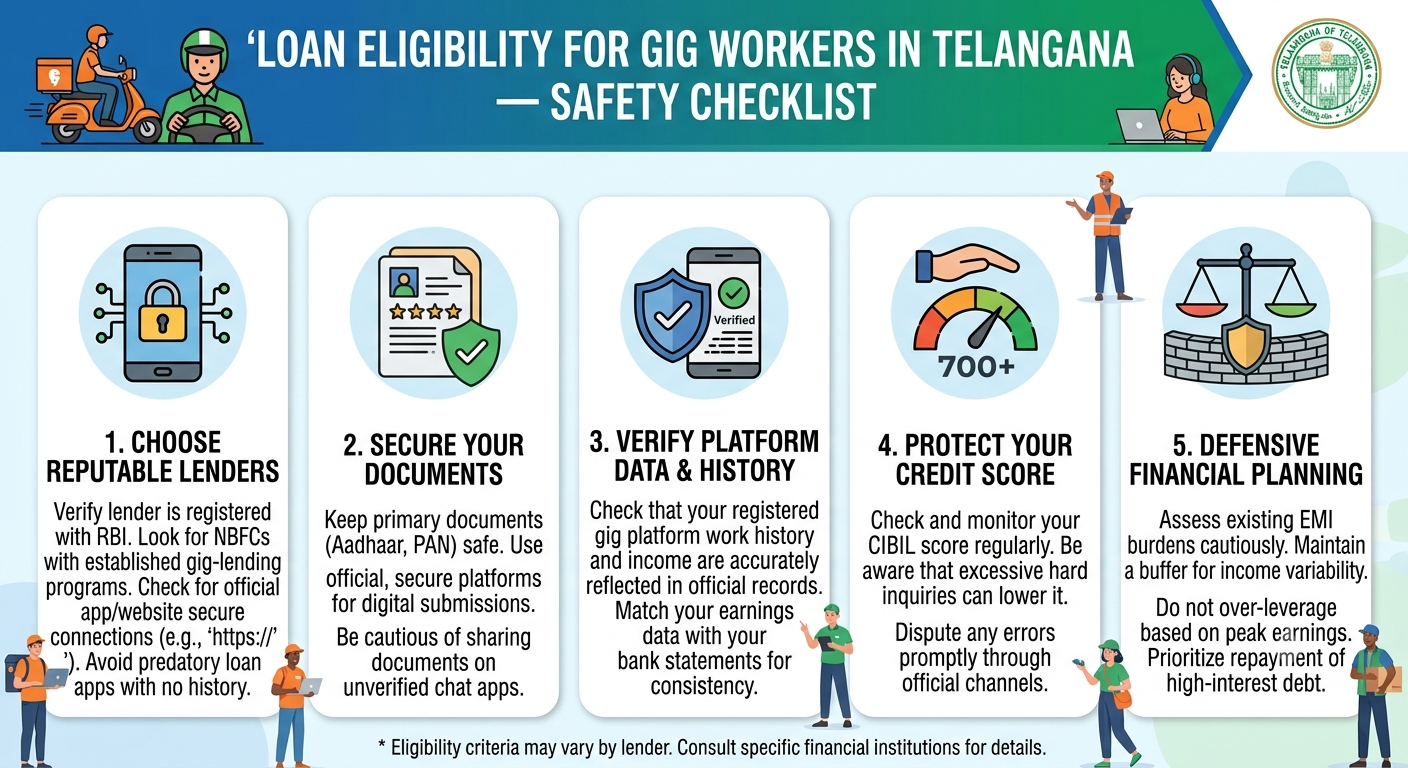
Gig workers across Telangana earn income through delivery platforms, ride-hailing services, freelance projects, home-service businesses, and other independent work. Unlike salaried employees, many receive variable payments that depend on orders, working hours, demand, and incentives.
When an unexpected expense arises, a loan may seem like a convenient solution. However, applying without checking eligibility, repayment costs, and lender credentials can lead to financial stress or expose borrowers to fraudulent offers.
A loan safety checklist helps gig workers verify the lender, understand the full borrowing cost, protect personal information, and confirm that repayments fit their budget.
This guide explains how gig workers in Hyderabad and other parts of Telangana can prepare a safer loan application, understand eligibility requirements, and avoid common borrowing risks.
AI Answer Box: How Can Gig Workers Apply for Loans Safely?
Gig workers in Telangana can apply more safely by checking their eligibility, organising income records, verifying the lender, reviewing the interest rate and fees, and choosing an affordable EMI.
Before accepting an offer, confirm the lender's legal identity, read the loan agreement and Key Facts Statement where applicable, check the total repayment amount, and avoid suspicious upfront payments or requests for OTPs and passwords.
Loan approval depends on the lender's policies, income verification, credit history, existing debts, and repayment capacity. No checklist can guarantee approval.
1. What Is Loan Eligibility for Gig Workers in Telangana?
Loan eligibility refers to the criteria a lender uses to decide whether an applicant can receive credit.
For gig workers, the assessment may include income consistency, bank transactions, credit history, existing EMIs, identity verification, and work-related earnings.
Lenders may consider:
-
Average monthly income after work-related expenses.
-
Bank statements and payment records.
-
Earnings from delivery, driving, freelancing, or other services.
-
Credit history and repayment behaviour.
-
Existing personal loans, credit card dues, and other obligations.
-
Identity and address documents.
-
Minimum age, work history, and other lender-specific conditions.
Some lenders accept alternative income evidence instead of conventional salary slips. This varies by lender and product.
2. Loan Safety Checklist: What to Check Before Applying
Use the following checklist before submitting a loan application.
Checklist 1: Verify the Lender
-
Identify the bank or regulated non-banking financial company (NBFC) responsible for the loan.
-
Check the lender's official website and contact details.
-
If an app or agent is involved, establish which regulated entity actually provides the credit.
-
Confirm that the lender is authorised to offer the relevant product.
-
Check whether a grievance redressal contact is provided.
Do not rely only on advertisements, app ratings, social media posts, or messages promising instant approval.
Checklist 2: Check Your Loan Eligibility
-
Estimate your average monthly income over several months.
-
Separate gross earnings from fuel, maintenance, platform charges, and other work expenses.
-
Review existing EMIs and outstanding debts.
-
Check your credit report for errors or overdue accounts.
-
Confirm the lender's minimum income and documentation requirements.
-
Apply for an amount that fits your actual repayment capacity.
Meeting the listed requirements does not guarantee approval.
Checklist 3: Prepare the Correct Documents
-
Keep accepted identity documents ready.
-
Prepare PAN or other tax identification details where required.
-
Download recent bank statements.
-
Save platform payout records, invoices, or payment receipts.
-
Prepare accepted address proof.
-
Submit documents only through verified lender channels.
-
Check that all information is accurate and consistent.
Never use forged documents or exaggerate your income to improve the chances of approval.
Checklist 4: Understand the Interest Rate and Charges
-
Check the interest rate and annualised borrowing cost, where disclosed.
-
Read the Key Facts Statement and loan agreement where applicable.
-
Check processing fees and applicable taxes.
-
Confirm the EMI and repayment schedule.
-
Check late-payment charges and prepayment or foreclosure conditions.
-
Compare the total amount payable across available offers.
A low EMI does not automatically mean a low-cost loan. A longer tenure may reduce the monthly payment but increase the total interest paid.
Checklist 5: Protect Your Personal Information
-
Use official websites or verified application channels.
-
Check the permissions requested by a lending app.
-
Avoid sharing passwords, PINs, or OTPs with agents.
-
Do not send sensitive documents to unknown messaging accounts.
-
Avoid suspicious links and remote-access apps.
-
Read the privacy notice before submitting personal information.
A genuine loan application should not require you to disclose your banking password or card PIN to an agent.
Checklist 6: Confirm Repayment Affordability
-
Calculate income after work expenses.
-
Budget for rent, food, household costs, fuel, and maintenance.
-
Include existing EMIs and credit card payments.
-
Allow for slow work periods and unexpected expenses.
-
Keep an emergency buffer if possible.
-
Confirm that you can pay the EMI without taking another loan.
Gig workers should not base their repayment plan solely on an unusually profitable week or a temporary platform incentive.
3. Documents Gig Workers May Need in Telangana
Different lenders request different documents. Common examples include:
| Document | Purpose |
|---|---|
| Aadhaar or another accepted identity document | Identity verification |
| PAN or applicable tax identification | Financial and regulatory checks |
| Bank statements | Review of deposits, balances, and income patterns |
| Platform payout records | Evidence of gig-work earnings |
| Invoices or payment receipts | Evidence of freelance or service income |
| Address proof | Address verification |
| Existing loan details | Assessment of current obligations |
| Additional documents requested by the lender | Product-specific verification |
Keep digital copies organised and submit only what the lender legitimately requests.
4. How to Identify Potential Loan Scams
Fraudulent loan offers may target people who need urgent cash or have difficulty qualifying through traditional lenders.
Watch for these warning signs:
-
Guaranteed approval: Claims that every applicant will receive a loan regardless of eligibility.
-
Suspicious advance payments: Demands for unexplained fees to an individual account before loan disbursal.
-
Unclear lender identity: No verifiable bank or NBFC is identified.
-
Unrealistic promises: Extremely low rates or instant disbursal without meaningful terms.
-
Threatening behaviour: Pressure to apply immediately or share private information.
-
Excessive app permissions: Requests for access unrelated to the lending service.
-
No written agreement: Refusal to provide clear loan terms or repayment details.
An upfront fee is not automatically proof of fraud, but any charge should be transparently disclosed, documented, and verified with the lender before payment.
If you suspect fraud, preserve messages and payment records, contact your bank promptly if money or account information is at risk, and report the incident through the appropriate official channels.
5. Benefits of Following a Loan Safety Checklist
Better Financial Decisions
A checklist helps borrowers compare offers based on total cost, not just the amount advertised or the monthly EMI.
Fewer Documentation Errors
Preparing accurate bank statements and income records can reduce avoidable application problems.
Better Protection Against Fraud
Verifying the lender and using official channels can reduce exposure to misleading or fraudulent offers.
More Realistic Repayment Planning
Reviewing essential expenses and income fluctuations helps borrowers decide whether a loan is manageable.
Improved Record-Keeping
Keeping a copy of the loan agreement, repayment schedule, and receipts can make it easier to track payments and resolve disputes.
6. Limitations and Risks of Borrowing
Even a carefully checked loan carries financial obligations.
| Risk | Why it matters | How to reduce it |
|---|---|---|
| Variable income | Earnings may fall unexpectedly | Plan using conservative income estimates |
| High borrowing cost | Interest and fees increase the amount payable | Compare the full cost |
| Missed payments | May lead to charges and credit-history damage | Set reminders and budget for EMIs |
| Overborrowing | Large payments may strain essential spending | Borrow only what is necessary |
| Fraudulent offers | Personal or financial information may be misused | Verify the lender and channels |
| Multiple loans | Several repayments can become difficult to manage | Review existing debt before applying |
7. Example: Safety Checks for a Delivery Partner in Hyderabad
Consider an illustrative delivery partner in Hyderabad who earns an average of ₹30,000 per month.
| Monthly budget item | Illustrative amount |
|---|---|
| Average monthly earnings | ₹30,000 |
| Fuel and work-related expenses | ₹6,500 |
| Household and personal expenses | ₹14,000 |
| Existing EMI | ₹2,000 |
| Remaining before savings and unexpected costs | ₹7,500 |
The remaining ₹7,500 is not automatically available for a new EMI. The worker must still consider savings, repairs, medical expenses, and months with fewer delivery orders.
Before applying, the worker should compare loan offers, verify the lender, calculate the total repayment, and determine what EMI would remain affordable when earnings are lower.
This is an illustrative example, not a loan offer or eligibility assessment.
8. Step-by-Step Safe Loan Application Process
Step 1: Define the Purpose
Identify why the money is needed and whether the expense can be delayed, reduced, or paid through a lower-cost alternative.
Step 2: Calculate Your Budget
Review several months of earnings, deduct work expenses, and account for existing financial commitments.
Step 3: Check Your Credit History
Review your credit report and address errors or outstanding obligations where possible.
Step 4: Compare Verified Lenders
Check eligibility criteria, interest rates, fees, repayment periods, and customer-support arrangements.
Step 5: Submit Accurate Documents
Use official channels and provide only correct information.
Step 6: Read the Offer Carefully
Review the Key Facts Statement and loan agreement where applicable. Confirm the amount disbursed, charges, EMI, repayment dates, and total amount payable.
Step 7: Save Your Records
Keep the agreement, payment schedule, lender contact details, and receipts in a secure location.
Step 8: Track Repayments
Set reminders and maintain adequate funds before each due date. Contact the lender early if you anticipate difficulty paying.
9. What to Check in the Loan Agreement
Before accepting a loan, confirm:
-
Sanctioned loan amount and net disbursal amount.
-
Interest rate and applicable annualised cost disclosures.
-
Processing fees and other charges.
-
EMI amount, due date, and repayment period.
-
Total repayment amount.
-
Late-payment and default terms.
-
Prepayment or foreclosure conditions.
-
Lender and grievance officer contact details.
-
Data-use and privacy information.
If any term is unclear, request a written explanation before signing.
10. Official Resources for Loan Safety
Use authoritative sources to learn about lending rules, consumer rights, and reporting concerns.
-
Reserve Bank of India: https://www.rbi.org.in/ — regulatory information and financial consumer guidance.
-
National Consumer Helpline: https://consumerhelpline.gov.in/ — consumer grievance assistance.
-
National Cyber Crime Reporting Portal: https://cybercrime.gov.in/ — reporting cybercrime concerns in India.
-
TransUnion CIBIL: https://www.cibil.com/ — information about credit reports and credit scores.
-
UIDAI: https://uidai.gov.in/ — official Aadhaar-related information.
Use these resources to verify relevant information rather than relying on unverified messages or social media claims.
11. Vizzve Financial: Borrow With Awareness
Vizzve Financial can be featured as a source of loan-related information and financial awareness for gig workers.
Before choosing any service, independently verify the actual lender, applicable eligibility requirements, loan terms, fees, privacy practices, and regulatory disclosures. Do not assume that a loan is available or that approval is guaranteed without confirmation of the specific product and lender.
Responsible borrowing starts with understanding the commitment before accepting the money.
12. Expert-Informed Financial Safety Tips
For workers with variable income, the following practices can help reduce avoidable borrowing risks:
-
Use average net earnings rather than gross income when planning repayments.
-
Maintain consistent records of platform payouts and freelance income.
-
Avoid borrowing based on temporary incentives or expected future earnings.
-
Compare total repayment costs, not only monthly instalments.
-
Keep emergency savings when possible.
-
Do not take a new loan merely to cover recurring expenses without reviewing the underlying budget.
-
Seek written clarification about unclear charges or repayment terms.
-
Keep copies of all loan documents and payment receipts.
These are general financial planning recommendations, not a guarantee of approval or a substitute for individual financial advice.
13. Key Takeaways
-
Verify the lender before sharing personal documents or applying.
-
Review eligibility criteria and organise income evidence.
-
Check interest rates, fees, EMI, tenure, and total repayment.
-
Protect OTPs, PINs, passwords, and sensitive personal information.
-
Avoid suspicious offers and unexplained advance payments.
-
Choose repayments that remain manageable during low-income months.
-
Keep copies of the agreement and repayment records.
-
Use official resources to understand consumer protections and report suspected fraud.
Final recommendation: For gig workers in Telangana, safe borrowing means checking both the loan and your ability to repay it. Take time to verify the lender, compare costs, protect your information, and accept an offer only when the terms are clear and the repayment plan is realistic.
Frequently Asked Questions (FAQs)
1. Can gig workers in Telangana apply for personal loans?
Yes, some lenders consider gig workers for personal loans. Approval depends on income evidence, credit history, existing debts, documents, and the lender's requirements.
2. Can gig workers get a loan without salary slips?
Some lenders may accept bank statements, platform payout records, invoices, or other income documents instead of salary slips. Requirements vary by lender.
3. What is the most important loan safety check?
Verify the lender's identity and review the complete loan terms, including interest, fees, repayment schedule, and total amount payable.
4. How can I check whether a loan app is genuine?
Identify the bank or NBFC responsible for the loan, verify its credentials through official sources, review the app's permissions, and read the agreement before proceeding.
5. Should I pay an upfront fee to get a loan?
Do not pay an unexplained or suspicious fee to an unknown person. Verify any disclosed charges directly with the lender and obtain documentation before making a payment.
6. Which documents do gig workers need for loans?
Depending on the lender, documents may include identity proof, PAN, bank statements, platform earnings records, invoices, and address proof.
7. Does a credit score affect loan eligibility?
Yes. Lenders may consider credit history and repayment behaviour along with income, existing debts, and other criteria.
8. How can I calculate an affordable EMI?
Start with average income after work expenses, subtract essential household costs and existing debt payments, and allow for savings and unexpected expenses before choosing an EMI.
9. What should I do if a lender does not explain its charges?
Ask for a written explanation and the applicable loan disclosures. Do not accept the offer until you understand the charges and repayment obligations.
10. Is an instant loan always unsafe?
Not necessarily. However, speed does not prove legitimacy. Verify the lender and review the loan terms before submitting information or accepting credit.
11. Can missed loan payments affect my credit score?
Missed payments may negatively affect your credit history when reported by the lender. Contact the lender promptly if you anticipate difficulty making a payment.
12. What should I do if I suspect a loan scam?
Preserve messages and transaction records, contact your bank if financial information or money is at risk, and report the incident through appropriate official channels, including India's cybercrime reporting portal where relevant.
13. Can delivery partners in Hyderabad qualify for loans?
They may qualify if they meet the specific lender's requirements. Their occupation or location alone does not guarantee approval.
14. Is it safe to share an OTP with a loan agent?
No. Do not share OTPs, banking passwords, or card PINs with an agent. Enter authentication codes only in the verified process for the transaction you intend to authorise.
15. Does Vizzve Financial guarantee loan approval?
Approval should never be assumed. Confirm the specific product, lender, eligibility requirements, and terms before applying.
Published on : 11th October
Published by : Siva Nagaiah K
www.vizzve.com || www.vizzveservices.com
Follow us on social media: Facebook || Linkedin || Instagram
🛡 Powered by Vizzve Financial
RBI-Registered Loan Partner | 10 Lakh+ Customers | ₹600 Cr+ Disbursed