

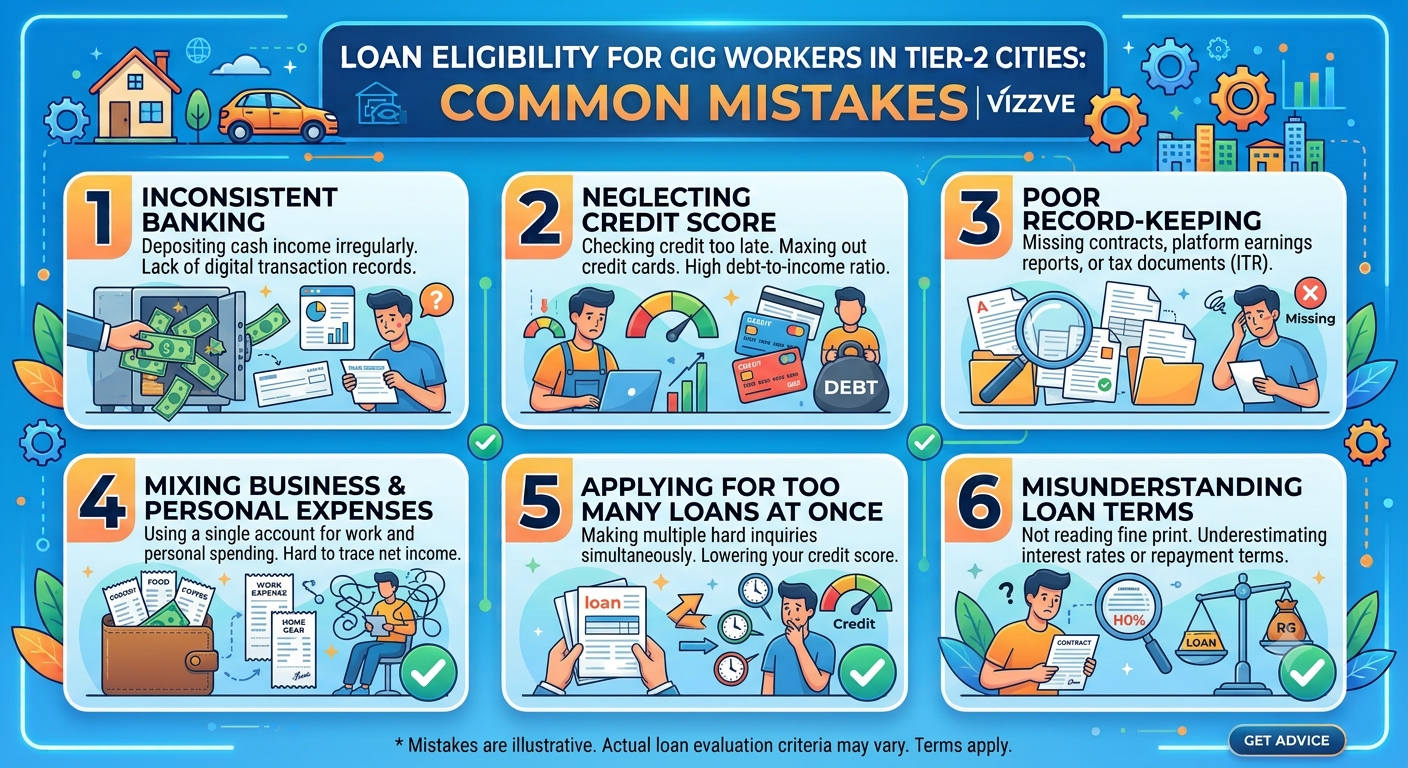
The gig economy provides flexible earning opportunities for delivery partners, drivers, freelance professionals and independent service providers. In cities such as Jaipur, Indore, Lucknow, Coimbatore, Surat and Kochi, workers may earn through digital platforms, local clients or multiple sources.
However, getting a loan is not always straightforward. Lenders may assess income stability, bank transactions, credit history, existing financial obligations and the applicant's ability to repay. Small mistakes—such as submitting incomplete documents or borrowing more than necessary—can create avoidable difficulties.
Understanding these mistakes before applying can help gig workers prepare better applications and protect their financial well-being.
3. Top 10 Common Loan Eligibility Mistakes
Mistake 1: Not Maintaining Proper Income Records
One of the most common challenges for gig workers is proving their earnings. Unlike salaried employees, they may receive payments at different times or from several platforms.
Why it matters: Lenders may find it harder to assess repayment capacity when income records are incomplete.
How to avoid it:
-
Download platform payout statements regularly.
-
Keep recent bank statements available.
-
Save invoices and payment receipts from freelance work.
-
Maintain a clear record of work-related expenses.
Mistake 2: Ignoring Credit History
A borrower's credit history can influence a lender's decision. Missed EMI payments, overdue credit-card balances and inaccurate credit-report entries may affect the application.
How to avoid it:
-
Review your credit report before applying.
-
Pay existing EMIs and bills on time.
-
Dispute incorrect information with the relevant credit bureau or lender.
-
Avoid taking on unnecessary debt.
A high credit score does not guarantee loan approval, and each lender may apply different eligibility criteria.
Mistake 3: Applying for More Money Than You Need
Borrowing a large amount can increase the EMI and total interest payable. This can be especially difficult for gig workers whose earnings change from week to week.
Example: A worker who needs ₹20,000 for an essential expense may unnecessarily apply for ₹75,000 without considering the additional repayment burden.
How to avoid it: Estimate the actual expense, compare suitable loan offers and choose an amount that fits your budget.
Mistake 4: Submitting Incomplete Documents
Missing documents or inconsistent personal details can delay verification or result in an unsuccessful application.
Common issues include:
-
Incorrect contact or address details.
-
Mismatched names across documents.
-
Missing bank statements.
-
Incomplete income or payout records.
-
Expired or unacceptable identity documents.
Solution: Review the lender's document checklist and verify all details before submitting the application.
Mistake 5: Assuming a Salary Slip Is Always Required
Some gig workers avoid applying because they do not receive traditional salary slips. However, certain lenders may accept alternative income evidence.
Depending on the lender, acceptable documents may include bank statements, platform earnings reports, invoices and other records demonstrating income.
Solution: Ask the lender which documents it accepts for gig workers and self-employed applicants. Do not assume every lender follows the same policy.
Mistake 6: Ignoring Existing EMIs and Expenses
Loan eligibility depends partly on the applicant's ability to manage additional repayments.
For example, a delivery partner may earn ₹28,000 in a typical month but spend a significant portion on fuel, vehicle maintenance, rent, food and existing EMIs.
Calculating affordability using gross earnings alone can give a misleading picture.
Solution: Work out your average take-home income after work expenses, household costs and existing debt payments before choosing an EMI.
Mistake 7: Applying to Multiple Lenders Without Comparing Offers
Submitting several applications without understanding their eligibility requirements can create unnecessary credit enquiries, depending on the lender and application process.
Solution:
-
Compare interest rates and APRs.
-
Check minimum income and work-history requirements.
-
Review fees and repayment terms.
-
Use eligibility-checking options where available.
-
Submit a formal application only after comparing suitable offers.
Mistake 8: Choosing a Loan Based Only on the Interest Rate
A low advertised interest rate does not necessarily mean the lowest overall borrowing cost. Processing fees, applicable taxes and other charges may increase the amount payable.
Solution: Compare the APR, EMI, total repayment amount, fees and any applicable prepayment charges. Read the Key Facts Statement (KFS) before accepting an offer.
Mistake 9: Trusting Unverified Loan Apps or Agents
Fraudulent loan offers may promise guaranteed approval, request suspicious advance payments or ask borrowers to share sensitive information.
Warning signs include:
-
Promises of guaranteed approval regardless of eligibility.
-
Unclear lender identity or loan agreement.
-
Requests for OTPs or banking passwords.
-
Unexplained upfront payments.
-
Unnecessary access to personal information.
Solution: Verify the actual regulated lender, check the app's association with that lender and use official communication channels. Review the lender's grievance-redressal details before proceeding.
Mistake 10: Ignoring Repayment Planning
Getting a loan approved is only one part of the borrowing process. Missing repayments can result in additional charges and may negatively affect credit history.
Solution:
-
Schedule EMI reminders.
-
Keep sufficient funds available before the due date.
-
Set aside emergency savings where possible.
-
Avoid borrowing again simply to cover an unaffordable EMI.
-
Contact the lender promptly if you anticipate repayment difficulties.
4. Quick Checklist: Are You Ready to Apply?
Use this checklist to review your preparation.
Application readiness
Income proof ready
Bank statements and available payout records are organised.
Credit report reviewed
You have checked for overdue accounts and incorrect information.
Documents verified
Identity, address and application details are consistent.
Loan amount planned
The requested amount matches your actual financial need.
EMI affordability calculated
Repayments fit your income after essential expenses.
Loan terms compared
You have reviewed APR, fees, tenure and total repayment.
Lender verified
The lender's identity and complaint process are clear.
This is a preparation tool, not a guarantee of loan approval.
5. How Gig Workers Can Improve Loan Eligibility
Gig workers can take several practical steps to strengthen their financial profile.
Maintain consistent financial records
Keep bank statements and available earnings reports organised. Consistent documentation can help a lender understand your income pattern.
Build a responsible credit history
Pay existing obligations on time, monitor your credit report and avoid taking on debt you cannot comfortably repay.
Reduce unnecessary debt
Where possible, clear overdue balances and limit avoidable borrowing before applying for another loan.
Demonstrate stable work activity
Maintain records of platform activity, client payments or completed projects where these are relevant to the lender's requirements.
Compare appropriate loan products
Some lenders may offer products specifically designed for self-employed individuals or gig workers. Check the eligibility requirements rather than assuming a standard salaried-person loan is suitable.
6. Real-World Example: A Delivery Partner in a Tier-2 City
Consider a hypothetical delivery partner living in Indore.
Before preparing the application
-
Income records were scattered across different sources.
-
The worker had not checked the credit report.
-
The requested loan amount was higher than necessary.
-
Monthly work expenses were not included in the EMI calculation.
After improving preparation
-
Recent bank statements and payout records were organised.
-
Existing financial obligations were reviewed.
-
The loan amount was matched to the actual expense.
-
Repayment affordability was calculated using typical income.
This example illustrates how better preparation can reduce avoidable application mistakes. It does not guarantee approval; the lender still makes its own assessment.
7. Loan Eligibility Mistakes by Worker Type
|
Worker type |
Common mistake |
Better approach |
|---|---|---|
|
Delivery partners |
Ignoring fuel and vehicle expenses |
Calculate income after operating costs |
|
Cab drivers |
Underestimating vehicle maintenance |
Budget for repairs and existing vehicle payments |
|
Freelancers |
Keeping incomplete client-payment records |
Save invoices and bank transaction records |
|
Home-service workers |
Not documenting irregular payments |
Maintain available receipts and transaction history |
|
Part-time gig workers |
Using peak earnings to estimate affordability |
Use realistic average income and allow for fluctuations |
8. Important Safety Checks Before Accepting a Loan
Before accepting a digital or personal loan, review the lender's disclosures and agreement.
-
Confirm the lender's identity and applicable regulatory status.
-
Read the KFS and loan agreement carefully.
-
Understand the interest rate, APR, EMI and total amount payable.
-
Review late-payment charges and applicable prepayment conditions.
-
Check how your personal information will be collected and used.
-
Confirm how to raise a complaint or report a suspicious transaction.
For official information, visit the Reserve Bank of India website: RBI official website.
9. AI Answer Box: Quick Summary
What common mistakes should gig workers avoid when applying for loans in Tier-2 cities?
Gig workers should avoid incomplete income records, inaccurate application details, ignoring credit history, borrowing more than necessary and choosing loans without comparing the total cost. They should calculate EMIs using realistic earnings after work expenses, verify the lender, review the KFS and ensure repayments remain affordable during low-income periods.
10. Key Takeaways
-
Organise income documents before submitting a loan application.
-
Check your credit report and address errors where possible.
-
Choose a loan amount based on actual needs and repayment capacity.
-
Compare APRs and total borrowing costs instead of focusing only on interest rates.
-
Verify lenders and avoid suspicious loan offers.
-
Plan for variable earnings and unexpected expenses.
-
Remember that meeting eligibility conditions does not guarantee approval.
11. Frequently Asked Questions (FAQs)
1. What are the most common loan eligibility mistakes made by gig workers?
Common mistakes include incomplete income records, inaccurate application details, ignoring credit history and choosing unaffordable loan amounts.
2. Can gig workers in Tier-2 cities get personal loans?
Yes, some lenders accept gig workers, subject to their specific eligibility requirements, income verification and credit assessment.
3. Is a salary slip mandatory for gig workers?
Not always. Some lenders may accept bank statements, platform payout reports, invoices or other acceptable income evidence.
4. Does a low credit score mean automatic rejection?
Not necessarily. Each lender has its own criteria, although a weaker credit history can affect approval or loan terms.
5. Should gig workers apply to several lenders at once?
It is generally better to compare eligibility requirements and costs first. Multiple formal applications may generate credit enquiries and should be considered carefully.
6. How can delivery partners improve loan eligibility?
They can maintain income records, review their credit profile, pay existing debts on time and calculate affordable repayments.
7. Can freelancers apply for loans without a fixed monthly income?
Some lenders accept variable-income applicants if they can demonstrate suitable earnings and repayment capacity.
8. Why is income consistency important?
It helps lenders evaluate the applicant's ability to make regular repayments despite fluctuations in gig earnings.
9. What happens if a borrower misses an EMI?
Depending on the agreement and applicable rules, the borrower may face additional charges and negative credit-report consequences.
10. How can borrowers avoid loan app scams?
Verify the actual lender, use official channels, review the agreement and never share OTPs or banking passwords with unknown parties.
11. Is the lowest interest rate always the best loan option?
No. Processing fees and other applicable charges can increase the overall cost. Compare the APR and total repayment amount.
12. Can an existing borrower apply for another loan?
Possibly. The lender may assess current EMIs, outstanding debts, income and credit history before deciding.
13. What documents should gig workers prepare?
Common documents include identity and address proof, PAN, bank statements and available platform earnings or freelance payment records.
14. How much EMI should a gig worker pay each month?
There is no universal safe amount. It depends on average net income, essential expenses, existing debts and savings.
15. Does avoiding these mistakes guarantee loan approval?
No. Good preparation may help reduce avoidable issues, but approval depends on the lender's policies and the applicant's overall financial profile.
Conclusion
Avoiding common loan eligibility mistakes can help gig workers prepare more confidently for borrowing. Maintaining clear income records, reviewing credit history, submitting accurate documents and comparing loan costs are important steps for delivery partners, cab drivers, freelancers and other independent workers.
Before accepting any loan, check whether the EMI remains affordable even when earnings fall. With careful preparation and responsible borrowing, gig workers can make more informed financial decisions without placing unnecessary pressure on their monthly budgets.
Published on : 28th October
Published by : Siva Nagaiah K
www.vizzve.com || www.vizzveservices.com
Follow us on social media: Facebook || Linkedin || Instagram
🛡 Powered by Vizzve Financial
RBI-Registered Loan Partner | 10 Lakh+ Customers | ₹600 Cr+ Disbursed